
- Release Year: 2011
- Platforms: iPhone, Nintendo Switch, PlayStation 3, PlayStation 4, PlayStation 5, PS Vita, Windows Apps, Windows, Xbox One, Xbox Series
- Publisher: Paradox Interactive AB
- Genre: Compilation
- Game Mode: Single-player
- Average Score: 72/100
Description
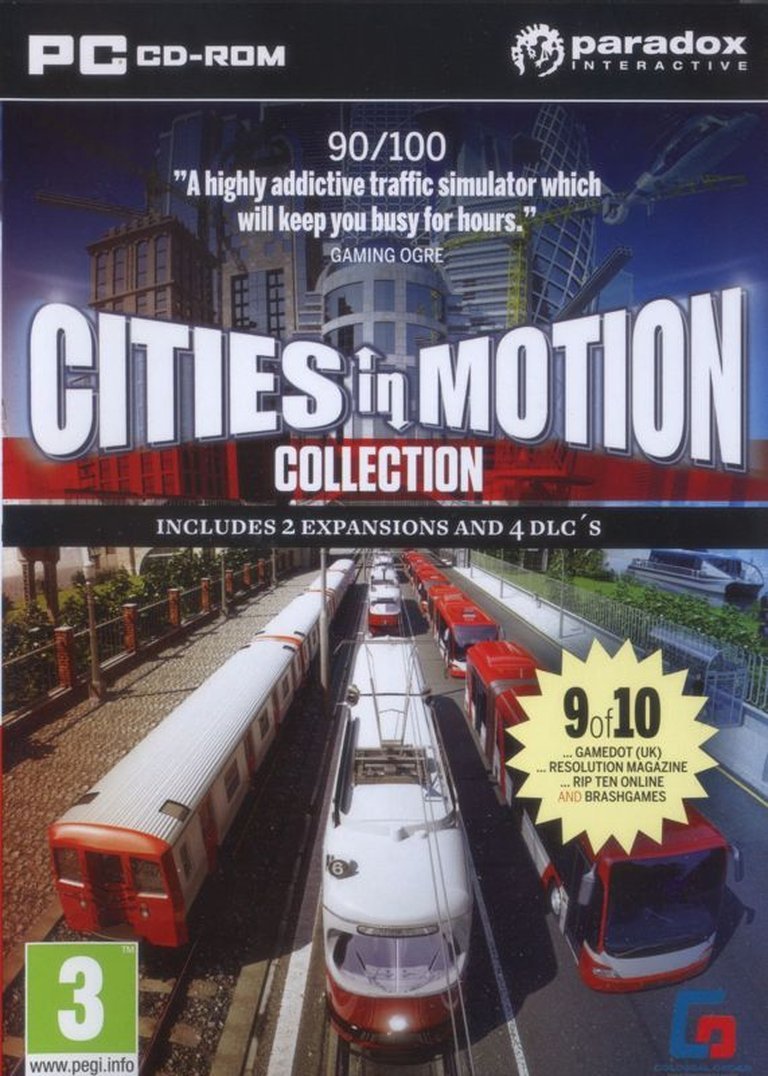
Cities in Motion Collection is a business simulation game where players manage and expand public transportation networks across diverse urban environments. As the head of a transit company, you design routes using buses, trams, metros, waterbuses, and helicopters across European cities like Amsterdam, Berlin, Helsinki, and Vienna. The collection includes the base game and multiple DLCs offering expanded content such as Tokyo, German Cities, design-themed expansions, and metro station enhancements. Players balance finances, optimize routes, and fulfill civic demands in both campaign scenarios and sandbox mode.
Gameplay Videos
Where to Buy Cities in Motion Collection
PC
Cities in Motion Collection Patches & Updates
Cities in Motion Collection Guides & Walkthroughs
Cities in Motion Collection Reviews & Reception
metacritic.com (70/100): A positive surprise, a remarkable “public transport tycoon” game from a brand new dev team that clears all the basic hurdles of the genre and manages to be entertaining.
gamewatcher.com : Combining a strong economic base-game with a wonderfully realised graphics engine, you’re tasked with solving a gigantic transport puzzle.
choicestgames.com : This mechanic of building a bigger, better and more profitable public transport network means the game has some of the same addictive qualities as Transport Tycoon.
gamespot.com (75/100): Cities in Motion finds fun and challenge in the hustle and bustle of modern urban transit.
Cities in Motion Collection Cheats & Codes
PC
Edit the “config.script” file in the “My Documents/Cities in Motion/” directory: change `$debug = false;` to `$debug = true;` and add `$disableDebug = false;` at the end. Then press the following keys during gameplay to activate cheats:
| Code | Effect |
|---|---|
| F1 | Skip day |
| F2 | Force objectives completion |
| F3 | +10,000 money |
| F4 | Skip passengers in objectives |
| F12 | Open console |
Cities in Motion Collection: A Definitive Examination of Urban Transit Mastery
Introduction
Cities in Motion Collection is not merely a game—it’s an ode to the unsung architects of urban mobility. Bundling the 2011 base game Cities in Motion with seven DLCs, this compilation invites players to orchestrate intricate transit networks across Europe and beyond. While modern city-builders like Cities: Skylines dominate the genre, this collection remains a cult classic for its laser focus on public transport logistics. This review argues that Cities in Motion Collection is a mechanically rich but occasionally unwieldy simulator that rewards patience with unparalleled depth, cementing its place as a foundational text for transport enthusiasts.
Development History & Context
Origins of a Vision
Developed by Finnish studio Colossal Order (later renowned for Cities: Skylines) and published by Paradox Interactive, Cities in Motion emerged in 2011 during a transitional period for simulation games. While SimCity and Transport Tycoon had long dominated the urban-planning niche, Colossal Order sought to narrow the scope to public transit management, merging economic strategy with civic planning.
Technological Constraints
Built on the Unity engine, the game’s 3D graphics were ambitious for the era, though limited by hardware constraints. Lead designer Karoliina Korppoo emphasized a citizen-centric approach, with AI simulating 7 distinct social classes—each with unique transit preferences. Yet, the lack of dynamic weather or day-night cycles (noted by critics like GameSpot’s Brett Todd) reflected the era’s technical limitations.
Industry Landscape
At launch, the market lacked dedicated transit simulators. Paradox’s strategy of frequent DLC releases (13 packs total) expanded the game’s lifespan, though fragmented its content—a double-edged sword that predated modern live-service models.
Narrative & Thematic Deep Dive
Scenarios as Historical Vignettes
While not narrative-driven, Cities in Motion’s campaign mode frames transit development as a historical endeavor. Players tackle 12 scenarios, such as post-war Berlin’s reconstruction or Tokyo’s 1970s monorail boom, each reflecting real-world urban evolution. These vignettes underscore themes of progress vs. sustainability, as players balance profit motives with civic needs.
Citizens as Characters
The game’s “social cliques” system—ranging from budget-conscious students to luxury-seeking businesspeople—functions as a thematic core. Each group critiques your network, demanding tailored solutions. A PC Gamer UK reviewer noted, “The challenge isn’t laying tracks; it’s appeasing a city’s fractious identity.”
Gameplay Mechanics & Systems
Core Loop: Logistics as Puzzle
The gameplay revolves around five transit types: buses, trams, metros, water buses, and helicopters. Each requires distinct infrastructure—metros demand subterranean tunnels, while trams rely on street-level rails. The DLCs introduce new vehicles (e.g., monorails in Tokyo) and cities, adding variety but necessitating micromanagement.
Economic Balancing Act
Players juggle fare pricing, employee wages, and loan repayments—a system IGN called “Excel-spreadsheet-meets-SimCity.” The absence of direct competition (a cited weakness by GameWatcher) shifts focus to solitaire efficiency.
UI & Accessibility
The interface, though information-dense, overwhelms newcomers. Brett Todd critiqued its lack of clarity: “When passengers riot at a bus stop, you’re left guessing: more buses or new routes?” Sandbox mode offers respite, letting players experiment freely across eras (1920–2020).
World-Building, Art & Sound
Aesthetic Functionalism
Cities like Vienna and Helsinki are rendered in crisp 3D, though GameSpot noted their “utilitarian” feel—buildings serve as backdrops for transit networks rather than lived-in spaces. The DLCs expand locales (e.g., Cologne, San Francisco), each with unique architectural flair.
Sound Design: Rhythms of Transit
The soundtrack shifts across eras—jazz for the 1920s, synth for the 2000s—echoing Transport Tycoon’s time-sensitive scoring. Yet, repetitive vehicle noises (e.g., screeching trams) grate over time, a flaw highlighted by ChoiceGames.
Reception & Legacy
Critical Divide
Launch reviews were mixed (Metacritic: 72/100). Praise centered on depth and realism, while criticism targeted repetitive gameplay and opaque systems. PC PowerPlay dubbed it “difficult, nerdy, tedious but satisfying.”
Player Reception
User scores trend higher (Steam: 75% positive), with fans lauding its modding community and strategic challenge. The Cities in Motion Collection’s bundling of DLCs resolved early content gaps, earning a 4.0/5 average from players on MobyGames.
Industry Influence
The game’s DNA is visible in Cities: Skylines, which expanded urban planning while simplifying transit mechanics. Its focus on citizen AI also inspired later management games like Workers & Resources: Soviet Republic.
Conclusion
Cities in Motion Collection is a time capsule of ambition—flawed yet foundational. Its unparalleled focus on transit logistics offers a niche thrill, though opaque systems and dated UX may alienate casual players. For urbanists and simulation devotees, however, it remains essential: a testament to the beauty of infrastructure, and a reminder that every crowded bus stop hides a story. In the pantheon of city-builders, it’s not the most accessible, but for those willing to master its labyrinthine networks, few games deliver such granular satisfaction.
Final Verdict: A flawed masterpiece for transport enthusiasts; a daunting curio for others.