
- Release Year: 1999
- Platforms: Windows
- Publisher: Hasbro Interactive, Inc.
- Developer: MicroProse Software, Inc.
- Genre: Strategy, Tactics
- Perspective: Diagonal-down
- Game Mode: Hotseat, LAN, Online PVP, Single-player
- Gameplay: 4X, Business simulation, Fog of war, Managerial, Randomly Generated Environments, Turn-based strategy (TBS)
- Setting: Fantasy, Science fiction, Totality of history
- Average Score: 75/100
Description
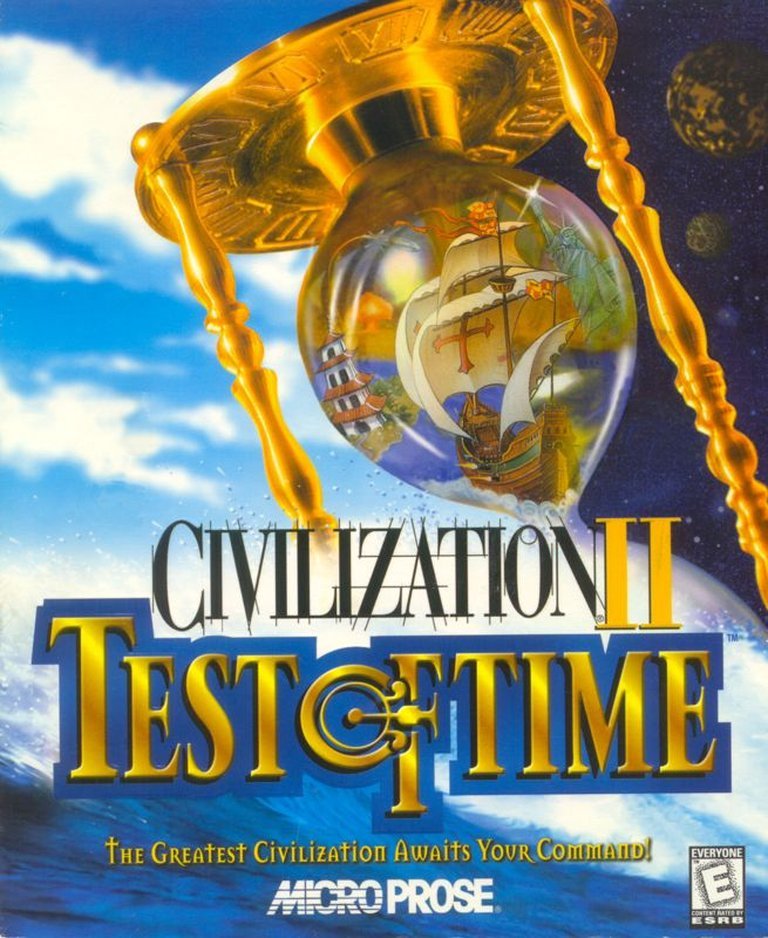
Civilization II: Test of Time is a strategic turn-based game that expands on the classic Civilization II formula, offering a redesigned interface, enhanced graphics, and three new sci-fi and fantasy scenarios set across 10 unique worlds, including the Centaurus Star System, Lalande 21185, and Midgard. As a 32-bit Windows application, it supports multiplayer for up to 7 players via LAN or Internet, blending deep 4X gameplay with managerial and tactical elements.
Gameplay Videos
Civilization II: Test of Time Free Download
Civilization II: Test of Time Patches & Updates
Civilization II: Test of Time Mods
Civilization II: Test of Time Guides & Walkthroughs
Civilization II: Test of Time Reviews & Reception
nodicenoglory.com (66/100): Despite how enamored some players were by Test of Time, most critics and most Civilization fans were less than impressed by it.
gamepressure.com (85/100): Civilization II: Test of Time offers new worlds and a number of enhancements.
mobygames.com (74/100): A wonderful game, if you like chess.
Civilization II: Test of Time Cheats & Codes
PC
Enter codes during gameplay.
| Code | Effect |
|---|---|
| Q | Update throne room |
| [Ctrl] + [Shift] + T | New council attitude and time |
| [Ctrl] + [Shift] + U | Edit unit, except for type |
| [Shift] + 123456 + [Release Shift] + T | Control opponent city |
| V | Control opponent city (press V, move diagonally into city, then press Enter) |
PlayStation
Enter codes during gameplay.
| Code | Effect |
|---|---|
| _CasH | Extra money (enter as town name while holding R1 when entering the capital H) |
| Circle, Triangle, R1, R2, L1, L2, L2, L1, R1, R1, R1 | All advances (when choosing tribe, select Romans and enter button sequence) |
Civilization II: Test of Time – A Bold Experiment in a Legendary Franchise
Introduction
In the pantheon of turn-based strategy games, few titles command as much reverence as Civilization II. Its 1999 follow-up, Civilization II: Test of Time (ToT), remains one of the most divisive entries in the franchise—a game that dared to expand the series’ scope into science fiction and fantasy while refining its core mechanics. Released during a turbulent period for the Civilization brand, ToT was both a response to market pressures and an ambitious attempt to redefine what a Civilization game could be. This review explores its development, gameplay innovations, thematic depth, and enduring legacy, arguing that while Test of Time may not have achieved universal acclaim, it stands as a fascinating artifact of its era—a bridge between the classical Civilization experience and the bold experimentation of Alpha Centauri.
Development History & Context
A Franchise in Flux
By 1999, the Civilization series was at a crossroads. Sid Meier, the franchise’s creator, had departed MicroProse in 1996 to form Firaxis Games, leaving the future of Civilization in the hands of a studio now owned by Hasbro Interactive. Meanwhile, Activision’s Civilization: Call to Power (1999) had emerged as a direct competitor, expanding the formula into futuristic and underwater colonization. A legal dispute ensued, resulting in Activision being barred from using the Civilization name in future titles. MicroProse’s response was Test of Time—a game that sought to reclaim the franchise’s dominance by blending the familiar with the fantastical.
The Vision Behind Test of Time
Developed by MicroProse’s Hunt Valley studio under producers Alex De Lucia and Chris Bowling, Test of Time was conceived as more than a simple expansion. Lead designers John Possidente and Mick Uhl aimed to create a “definitive” version of Civilization II while introducing radical new campaigns. The game’s most striking innovation was its multi-layered maps, allowing players to traverse different planes of existence—surface, underground, cloud, and undersea worlds in the fantasy campaign, and multiple planets in the science fiction scenario.
Technologically, ToT was a 32-bit Windows application, a significant upgrade from Civilization II’s 16-bit origins. It supported multiplayer via LAN, modem, and internet, accommodating up to seven players—a feature that aligned with the growing popularity of online gaming. However, the game’s development was constrained by the hardware of the late ’90s, limiting its graphical fidelity and AI complexity.
The Gaming Landscape of 1999
Test of Time arrived in a year crowded with strategy titans. Sid Meier’s Alpha Centauri, released just months earlier, had already pushed the Civilization formula into sci-fi territory with greater narrative depth and mechanical sophistication. Age of Empires II dominated real-time strategy, while Homeworld redefined 3D RTS gameplay. In this context, ToT faced an uphill battle: it was neither a true sequel nor a radical departure, but a hybrid that struggled to carve out its own identity.
Narrative & Thematic Deep Dive
The Original and Extended Campaigns: A Familiar Foundation
At its core, Test of Time retained the historical grandeur of Civilization II. Players could still guide a civilization from the Stone Age to the Space Age, researching technologies, building wonders, and engaging in diplomacy or warfare. The “Extended Original” campaign, however, introduced a twist: upon launching the Alpha Centauri spaceship, players were transported to a new map where they battled the alien Centaurians, unlocking a secondary tech tree. This narrative expansion, while modest, hinted at the larger-scale interstellar conflicts that Alpha Centauri would later explore in greater depth.
The Science Fiction Campaign: A Cosmic Odyssey
The science fiction campaign, set in the Lalande 21185 star system, was ToT’s most ambitious narrative experiment. Players chose between humans and an alien species (the “non-humans”), both marooned on the planet Funestis after a catastrophic crash. The campaign unfolded across four distinct maps:
– Funestis: An Earth-like planet where the two species first make contact.
– Orbital Platforms: Ancient Lalandian structures orbiting Funestis, holding lost technologies.
– Naumachia: A barren, resource-rich rocky planet.
– Nona: A gas giant serving as the cultural heart of the extinct Lalandian civilization.
The campaign’s narrative was sparse but evocative, with victory achievable through technological ascension (building a quantum gate), conquest, or constructing a starship to return to Earth. The fusion of human and alien cultures into the “Proteans” added a layer of evolutionary intrigue, though the lack of deep storytelling left much of the lore implied rather than explicit.
The Fantasy Campaign and Midgard: Mythology as Gameplay
The fantasy campaign drew heavily from Norse, Celtic, and Slavic mythology, offering a stark contrast to the historical and sci-fi settings. Players could lead one of seven factions:
– Elves: Agile and magical, thriving in the Surface World.
– Merfolk: Aquatic beings dominant in the Undersea World.
– Goblins: Cunning and industrious, excelling underground.
– Stygians (Undead): Necromantic horrors lurking in the depths.
– Buteo (Bird People): Aerial masters of the Cloud World.
– Humans: Medieval Europeans with balanced capabilities.
– Infidels: Nomadic warriors inspired by steppe cultures.
The campaign’s four layered maps—Surface, Underground, Cloud, and Undersea—created a verticality rarely seen in strategy games. Each realm had unique resources, terrain, and strategic advantages, forcing players to adapt their tactics. The Midgard scenario, a scripted variant of the fantasy campaign, introduced a linear narrative centered on the escape of the dark sorcerer Volsang. Scripted events, such as the awakening of mythical figures like Baba Yaga and the Dagda, added a sense of urgency and lore-rich depth. However, the scenario’s rigid structure and repetitive quests (plagued by bugs that prevented the intended “10 quests” victory condition) left some players frustrated.
Themes: Exploration, Adaptation, and the Burden of Legacy
Test of Time’s overarching themes revolved around adaptation and exploration. Whether colonizing alien worlds, navigating mythical realms, or surviving the rise of an ancient evil, players were constantly challenged to expand beyond their comfort zones. The game also grappled with the burden of legacy—both in its narrative (e.g., the forgotten threat of Volsang) and its meta-context as a Civilization title trying to escape the shadow of its predecessors.
The fantasy and sci-fi campaigns, while mechanically innovative, often felt like thematic experiments rather than fully realized narratives. The lack of voice acting, cinematic sequences, or deep character development (a stark contrast to Alpha Centauri’s philosophical leaders) left the worlds feeling more like strategic sandboxes than immersive stories. Yet, for players willing to engage with the lore through gameplay, ToT offered a rich tapestry of possibilities.
Gameplay Mechanics & Systems
Core Gameplay: Refining a Classic
Test of Time retained the turn-based, 4X (eXplore, eXpand, eXploit, eXterminate) structure of Civilization II, but with several key refinements:
– Redesigned Interface: The UI was overhauled for clarity, with improved unit animations and a more intuitive tech tree.
– Multi-Layered Maps: The ability to traverse different planes (e.g., surface to underground) added strategic depth, requiring players to manage resources and defenses across multiple fronts.
– Expanded Tech Trees: Each campaign featured unique research paths, from the magical advancements of Midgard to the alien technologies of Lalande 21185.
– Enhanced Diplomacy: While still rudimentary by modern standards, ToT’s AI opponents were slightly more aggressive and unpredictable than in Civilization II.
Combat and Unit Design
Combat in ToT remained turn-based and grid-oriented, but the introduction of fantasy and sci-fi units spiced up engagements:
– Fantasy Units: Dragons, griffins, and undead legions clashed in Midgard, while sci-fi battles featured laser rifles and alien bio-weapons.
– Terrain Advantages: The multi-layered maps forced players to consider verticality—e.g., Buteo units dominating from the Cloud World or Stygians ambushing from underground tunnels.
– Balancing Issues: Some units, particularly in the fantasy campaign, were overpowered (e.g., dragons), while others felt underwhelming. The lack of a dedicated map editor (a regression from Civilization II) limited community balancing efforts.
Character Progression and Civilization Management
ToT’s progression systems were largely unchanged from Civilization II, with players advancing through technological eras. However, the fantasy and sci-fi campaigns introduced asymmetrical civilization traits:
– Fantasy Races: Elves excelled in magic and culture, while Goblins thrived in industry and espionage.
– Sci-Fi Factions: Humans and aliens had distinct tech trees, with some technologies inaccessible to the other species until late-game hybridization.
UI and Accessibility
The redesigned interface was a double-edged sword:
– Pros: Cleaner visuals, better unit animations, and streamlined menus made the game more accessible to newcomers.
– Cons: Some veterans criticized the loss of Civilization II’s charm, particularly the removal of animated diplomatic scenes and the throne room upgrades.
Multiplayer: A Step Forward
ToT’s multiplayer support was a significant improvement, allowing up to seven players to compete via LAN or internet. The hotseat mode also enabled local multiplayer, a rarity in modern strategy games. However, the lack of synchronous turns and persistent connection issues (common in late ’90s online gaming) limited its longevity.
World-Building, Art & Sound
Visual Design: A Mixed Bag
Test of Time’s art direction was a departure from Civilization II’s pixel-art aesthetic, opting for a more polished but somewhat generic look:
– Isometric Maps: The diagonal-down perspective and isometric tiles were functional but lacked the personality of Civilization II’s sprites.
– Unit Animations: While improved, the animations were simplistic by 1999 standards, especially compared to Alpha Centauri’s fluid visuals.
– Fantasy and Sci-Fi Aesthetics: The Midgard campaign’s mythological creatures and the Lalande system’s alien landscapes were visually distinct, but the low resolution and limited color palettes muted their impact.
Sound and Music: Atmospheric but Repetitive
The audio design in ToT was functional but unremarkable:
– Music: The soundtrack, composed by Roland J. Rizzo, featured orchestral and ambient tracks that suited the game’s grand scale. However, the limited number of tracks led to repetition.
– Sound Effects: Battle cries, spell effects, and ambient noises were serviceable but lacked the immersive quality of later strategy games.
– Voice Acting: Absent entirely, a missed opportunity given the game’s mythological and sci-fi themes.
Atmosphere: The Strength of Imagination
Despite its technical limitations, Test of Time’s greatest strength lay in its world-building. The multi-layered maps and asymmetrical factions encouraged players to imagine their own stories. The Midgard scenario, with its scripted events and mythological figures, created a sense of a living world—even if the execution was rough around the edges.
Reception & Legacy
Critical Reception: A Divisive Release
Test of Time’s reception was polarized, with critics and fans split over its innovations:
– Praise:
– Computer Gaming World (80%) lauded the game’s variety and improved AI, calling it a “sophisticated” evolution of Civilization II.
– IGN (7.8/10) appreciated the sci-fi and fantasy campaigns, describing them as “a lot of fun once you get past the weird names.”
– PC Gamer UK (79%) highlighted the long-term motivation provided by the new scenarios.
– Criticism:
– GameSpot (4.2/10) was scathing, calling it a “carbon copy” of Civilization II with “new names for the units and technology advances.”
– PC Accelerator (5/10) dismissed it as an “almost pointless exercise” with “woeful” graphics.
– Spel för Alla (5/10) argued that the game offered little new, feeling like a “half-decent diversion” rather than a true evolution.
The aggregate score of 66% on GameRankings reflected this divide, far below Civilization II’s 94% Metacritic rating.
Commercial Performance and Fan Response
Commercially, Test of Time underperformed expectations. Many Civilization fans saw it as an unnecessary cash grab, especially given the proximity of Alpha Centauri’s release. However, a dedicated niche of players embraced its experimental campaigns, particularly the fantasy and sci-fi settings. Modding communities kept the game alive, creating custom scenarios ranging from Star Trek to historical what-if scenarios.
Influence and Legacy
Test of Time’s legacy is complex:
– Innovations: Its multi-layered maps and asymmetrical factions presaged later 4X games like Master of Orion III and Endless Legend.
– Missed Opportunities: The lack of deep narrative or voice acting highlighted the limitations of Civilization’s traditional design, pushing future entries toward more immersive storytelling.
– Cultural Impact: While overshadowed by Alpha Centauri, ToT remains a cult favorite, celebrated for its boldness if not its polish.
Conclusion: A Flawed but Fascinating Experiment
Civilization II: Test of Time is a game of contradictions—a title that dared to expand the Civilization formula into uncharted territory while remaining tethered to its predecessor’s mechanics. Its multi-layered maps, asymmetrical factions, and genre-blending campaigns were ahead of their time, yet its execution was hampered by technical limitations and a lack of narrative depth.
Final Verdict: 7.5/10 – A Bold but Imperfect Evolution
Test of Time is not the best Civilization game, nor is it the most polished. But it is one of the most interesting—a testament to the creativity of its developers and the enduring appeal of the 4X genre. For fans of strategy games willing to overlook its rough edges, ToT offers a unique experience that bridges the gap between classical Civilization and the sci-fi grandeur of Alpha Centauri. It may not have stood the test of time as well as its predecessors, but its ambition ensures it will always have a place in the annals of strategy gaming.
Recommended For:
– Civilization veterans seeking a fresh challenge.
– Fans of fantasy and sci-fi strategy games.
– Modders and scenario designers looking for a flexible sandbox.
Not Recommended For:
– Players expecting a narrative-driven experience.
– Those who prefer modern 4X games with deeper diplomacy and graphics.
– Purists who believe Civilization II should never have been tampered with.
In the end, Civilization II: Test of Time is a game that asks more questions than it answers—much like the civilizations it tasks players with building. And in that uncertainty lies its enduring intrigue.