
- Release Year: 2007
- Platforms: Macintosh, Windows
- Publisher: Coladia Games, JoWooD Productions Software AG, Nobilis Group, Noviy Disk
- Developer: Kheops Studio
- Genre: Adventure
- Perspective: 1st-person
- Game Mode: Single-player
- Gameplay: Graphic adventure, Puzzle elements
- Setting: Alexandria, Ancient Egypt, Historical, Mystical
- Average Score: 67/100
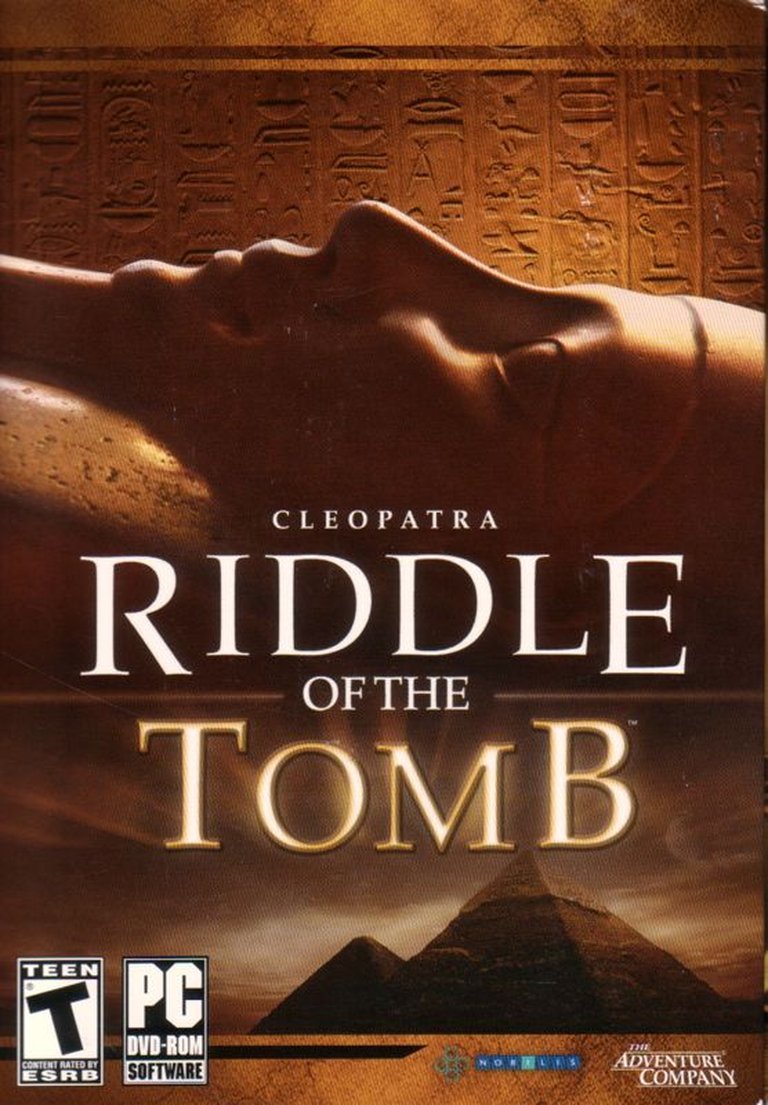
Description
Cleopatra: Riddle of the Tomb is a historical adventure game set in ancient Alexandria during Cleopatra’s rise to power. Players guide the young ruler through puzzles, occult mysteries, and strategic decisions to secure her fate as Egypt’s queen. Featuring a Myst-like atmosphere, the game blends exploration of Alexandria’s streets with astrology-themed challenges and interactive storytelling, immersing players in a pivotal era of Egyptian history.
Gameplay Videos
Cleopatra: Riddle of the Tomb Free Download
Cleopatra: Riddle of the Tomb Guides & Walkthroughs
Cleopatra: Riddle of the Tomb Reviews & Reception
metacritic.com (67/100): Mixed or average reviews overall.
uhs-hints.com : Excellent graphics; enticing (and historically-accurate) story; great user interface features; well-integrated puzzles; smooth game play
gamefaqs.gamespot.com (70/100): What Riddle of the Tomb lacks in innovation, it makes up for in charm.
Cleopatra: Riddle of the Tomb: Review
Introduction
In the pantheon of historical adventure games, few figures loom as large as Cleopatra VII, a queen whose legend intertwines myth, politics, and sensuality. Released in 2007 by French developer Kheops Studio, Cleopatra: Riddle of the Tomb (also known as Cleopatra: A Queen’s Destiny) seeks to weave her rise to power into a Myst-inspired puzzle odyssey. Positioned at the twilight of the mid-2000s adventure resurgence, the game delivers a visually sumptuous but mechanically conservative dive into Ptolemaic intrigue. This review argues that while Riddle of the Tomb succeeds as an accessible, historically evocative experience, its reluctance to innovate beyond genre tropes ultimately renders it a charming footnote rather than a landmark entry in gaming history.
Development History & Context
Kheops Studio emerged in the early 2000s as a specialist in narrative-driven adventures, carving a niche with titles like Return to Mysterious Island (2004) and Destination: Treasure Island (2006). Their formula fused pre-rendered 3D environments, inventory-based puzzles, and historical settings—a response both to the declining popularity of pure point-and-click adventures and the rising demand for casual-friendly gameplay.
Developed in an era of shifting industry priorities—marked by the ascendancy of console action games like BioShock and Assassin’s Creed—Riddle of the Tomb faced constraints typical of mid-budget European studios. Limited resources necessitated static, node-based navigation and minimal character animation, while a focus on educational appeal (via publisher collaborations like Nobilis) required careful adherence to historical authenticity, particularly in recreating Alexandria’s landmarks.
Narrative & Thematic Deep Dive
Set in 48 BCE during Cleopatra’s civil war against her brother Ptolemy XIII, the game casts players as Thomas of Chaldea, an astrology apprentice whose mentor Akkad vanishes under mysterious circumstances. The plot unfolds as a political-religious thriller: Cleopatra enlists Thomas to complete Akkad’s divination, foreseeing her alliance with Julius Caesar and ascent to godhood.
While Cleopatra’s presence is more symbolic than central—she appears fleetingly as a co-protagonist—the narrative explores themes of fate versus agency and theocracy versus pragmatism. Ptolemy’s forces weaponize religious dogma (e.g., manipulating Sobek’s priesthood), while Cleopatra’s alliance with Chaldean astrologers frames her as a proto-humanist ruler. However, character development is shallow: supporting figures like Akkad’s daughter Iris feel undercooked, and dialogue oscillates between wooden exposition (“The stars foretell a great alliance!”) and melodramatic flair (“Ptolemy’s cruelty knows no bounds!”).
The game’s adherence to history is more aesthetic than substantive: while Alexandria’s Library and Pharos Lighthouse are meticulously recreated, Mesopotamian motifs (e.g., Ishtar Gate-inspired tiles) clash with Egyptian authenticity. This dissonance reflects Kheops’ tendency to prioritize romanticized spectacle over strict accuracy.
Gameplay Mechanics & Systems
As a first-person point-and-click adventure, Riddle of the Tomb inherits Kheops’ signature systems:
-
Dynamic Combinatorial Inventory:
Items can be disassembled and reassembled (e.g., breaking a vase to use its shards as tools). This encourages holistic puzzle-solving, though solutions often hinge on trial-and-error due to vague feedback. -
Astrological Zodiac System:
At the game’s start, players choose a zodiac sign influencing puzzle variants. Scorpio might simplify a lock mechanism, while Gemini introduces a multi-step repair sequence—a clever but underutilized mechanic. -
Puzzle Design:
Puzzles blend logical deduction (decoding hieroglyphics, aligning celestial spheres) with rote busywork (mixing potions via trial-and-error). Standouts include a catapult sequence requiring creative weight distribution, yet others fall flat (e.g., tedious alchemy formulas). -
User Interface:
The 360° panoramic view allows meticulous exploration, while a dynamic journal logs clues, dialogues, and quests—a lifeline for unwieldy puzzles. Fast-travel via an in-game map mitigates backtracking, a welcome QoL feature.
Flaws emerge in pacing and difficulty balancing: with just 6–10 hours of playtime, the game feels rushed, while the absence of fail-states (e.g., death, irreversible mistakes) sterilizes tension.
World-Building, Art & Sound
Riddle of the Tomb shines brightest in its audiovisual craftsmanship:
-
Visual Design:
Pre-rendered environments capture Alexandria’s grandeur—sun-drenched courtyards, labyrinthine libraries, and the towering Pharos Lighthouse—with cinematic flair. However, static NPCs and stiff animations (e.g., lip-syncing akin to “animatronics at a theme park” [Adventure Gamers]) undercut immersion. -
Soundscape:
Oud-heavy orchestrations and ambient desert winds evoke antiquity, while voice acting ranges from serviceable (Cleopatra’s regal lilt) to cartoonish (Kordax the hunchback). Sound design falters during puzzles, where inconsistent feedback (e.g., silent item interactions) frustrates.
Historically, the game juggles reverence and Hollywood excess: Cleopatra is sexualized (form-fitting attire, hushed dialogue), yet her strategic intellect is foregrounded—a tension reflecting pop culture’s enduring fascination with her mythos.
Reception & Legacy
Upon release, Riddle of the Tomb garnered mixed-average reviews (67/100 Metascore). Critics praised its lush visuals (Game Chronicles: “high quality visuals set the mood”) and puzzle variety (IGN: “satisfying to unravel”), while panning its short runtime (Adventure Classic Gaming: “bit on the short side”) and derivative design (Just Adventure: “homogenized, by-the-numbers pabulum”).
Commercially, it performed modestly, buoyed by retail bundles like Adventure Games Bundle (2009) and ports to iOS/Mac. Its legacy lies in preserving Kheops’ template—later iterated in Nostradamus (2007) and Dracula 3 (2008)—but it failed to catalyze genre evolution. Modern analysis (e.g., Egypopcult Database) frames it as a time capsule of 2000s Euro-adventures: earnest, educational, yet aesthetically conservative.
Conclusion
Cleopatra: Riddle of the Tomb is a paradox: a game that meticulously reconstructs an ancient world yet feels mechanically fossilized. Its strengths—evocative art, thoughtful historical theming, and accessible puzzles—make it a worthwhile curiosity for adventure aficionados and Egyptology enthusiasts. However, formulaic design, rushed storytelling, and missed opportunities (e.g., the zodiac system’s untapped potential) relegate it to the genre’s middle tier.
For Kheops completists or gamers seeking a short, picturesque diversion, Riddle of the Tomb delivers—but as a chapter in video game history, it remains a shadow of its muse: captivating yet ephemeral, a queen without a crown.
Final Verdict:
★ ★ ★ ☆ ☆
A historically rich but innovation-starved adventure that fades beside its peers.