
- Release Year: 2004
- Platforms: Macintosh, Windows
- Publisher: Crown & Andrews Pty Ltd
- Developer: Ken Duncan Panographs
- Genre: Puzzle
- Perspective: Top-down
- Game Mode: Single-player
- Gameplay: Optional piece rotation, Point and select, Puzzle, Save progress, Variable piece count
Description
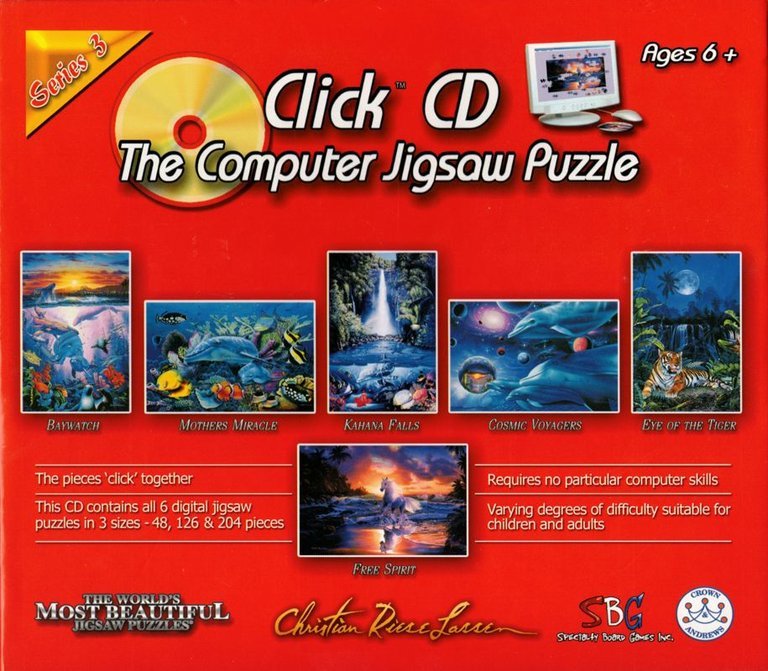
Click CD: The Computer Jigsaw Puzzle – Series 3, Christian Riese Lassen presents six magnificent puzzles based on the artwork of Christian Riese Lassen. Each puzzle can be configured with 48, 126, or 204 pieces, with the option for piece rotation and the ability to save or hide non-edge pieces. Powered by the Smoke & Mirrors engine and requiring no installation, it’s a versatile puzzle collection for all skill levels.
Click CD: The Computer Jigsaw Puzzle – Series 3, Christian Riese Lassen: A Nostalgic Oasis in the Digital Puzzle Desert
The early 2000s witnessed a peculiar moment in gaming history: the triumphant yet melancholic zenith of the CD-ROM puzzle collection. Amidst this era, Click CD: The Computer Jigsaw Puzzle – Series 3, Christian Riese Lassen emerges not as a revolutionary force, but as a meticulously crafted time capsule. Developed by Ken Duncan Panographs and published by Crown & Andrews Pty Ltd in 2004, this title represents a fascinating intersection of analog nostalgia, digital preservation, and the commercialization of artistic appreciation. While devoid of conventional narrative or complex mechanics, its enduring value lies in its faithful digital translation of Christian Riese Lassen’s vibrant marine artistry and its role within a specific cultural context. This review argues that Series 3 is less a game in the traditional sense and more a culturally significant artifact—a curated gallery of digital jigsaw puzzles that captures a fleeting moment when physical hobbies migrated into the nascent CD-ROM marketplace.
Development History & Context
Ken Duncan Panographs, the developer, operated at the tail end of a genre popularized by “click CD” compilations distributed through specialty retailers like The Entertainer and electronic superstores. These collections, often bearing titles like “Click CD: The Computer Jigsaw Puzzle” or “Click CD: The Computer Matching Game,” leveraged the ubiquitous CD-ROM format to offer bundled activities targeting family audiences. Series 3, Christian Riese Lassen is part of this lineage, specifically focusing on jigsaw puzzles using digital renditions of Lassen’s artwork.
Released in 2004, Series 3 arrived during a transitional phase for CD-ROM gaming. The market had largely shifted towards online downloads and mobile platforms, yet physical CD distributions persisted in niche retail spaces. The game’s technical specifications—requiring Windows 95/NT4 or later, 32MB RAM, and a 166MHz Pentium processor—reflect the era’s accessibility goals: it was designed to run on relatively modest systems, ensuring its appeal to families and educational institutions. The use of the Smoke & Mirrors Jigsaw Puzzle engine signifies reliance on established, stable, and easily customizable software rather than proprietary innovation. This approach prioritized artistic fidelity over technical experimentation, a hallmark of the genre.
The commercial landscape for such compilations was increasingly competitive. While titles like Puzzle Series Vol. 1: Jigsaw Puzzle (2006, Nintendo DS) would later dominate portable gaming, Series 3 existed in a pre-smartphone world where physical discs were still a tangible medium for entertainment. Its distribution channels—retail outlets like HobbyWonder.ca and eBay listings—highlight its positioning as a standalone product rather than part of a broader franchise. The collaboration with Crown & Andrews Pty Ltd, an Australian publisher, suggests a niche market strategy targeting English-speaking regions like Australia, Canada, and North America.
Narrative & Thematic Deep Dive
Unlike adventure or role-playing games, Click CD: The Computer Jigsaw Puzzle – Series 3, Christian Riese Lassen functions as a curated art experience rather than a narrative-driven product. Its “story” unfolds not through plot or character arcs, but through the evocative power of Christian Riese Lassen’s illustrations. Lassen, a marine artist based in Hawaii, specializes in vibrant depictions of oceanic life, tropical paradises, and spiritual motifs. The six puzzles included—”Mother’s Miracle,” “Free Spirit,” “Cosmic Voyagers,” “Eye of the Tiger,” “Baywatch,” and “Kahuna Falls”—evoke themes of natural grandeur, human connection to the environment, and transcendent adventure.
- “Mother’s Miracle”: Likely references maternal love and oceanic serenity, possibly depicting a mother and child in a marine setting.
- “Free Spirit”: Suggests themes of liberation and boundless energy, potentially featuring dynamic wave patterns or wildlife.
- “Cosmic Voyagers”: Merges marine and celestial motifs, hinting at spiritual exploration beyond physical boundaries.
- “Eye of the Tiger”: Alludes to resilience and vigilance, possibly inspired by tiger sharks or metaphorical challenges.
- “Baywatch”: A nod to lifeguard culture, blending coastal safety with recreational joy.
- “Kahuna Falls”: Evokes Polynesian mysticism and waterfall power, rooted in Hawaiian heritage.
These titles serve as thematic signposts, inviting players to engage with Lassen’s art through puzzle-solving. The absence of explicit dialogue or plotlines transforms the experience into a contemplative exercise, where the act of assembling pieces mirrors the artist’s own process of capturing ephemeral moments. The thematic cohesion enhances immersion, allowing players to project emotional narratives onto the visuals—a strategy that compensates for the lack of traditional game storytelling.
GamePlay Mechanics & Systems
At its core, Series 3 is a straightforward jigsaw puzzle simulator built around the Smoke & Mirrors Jigsaw Puzzle engine. The gameplay loop is minimalist: players select a puzzle (from the six Lassen artworks) and choose a difficulty level—48, 126, or 204 pieces. The interface is point-and-click, with options to rotate pieces and save progress. Two utility features stand out: the ability to hide non-edge pieces (streamlining the assembly process) and piece rotation (enhancing flexibility for uniquely shaped jigsaw pieces).
Key mechanics include:
– Piece Customization: Players can adjust the number of pieces, catering to varying skill levels from casual solvers to puzzle enthusiasts.
– Save Functionality: Progress can be saved, allowing for prolonged engagement without loss of advancement.
– Edge Piece Visibility: Hiding non-edge pieces reduces visual clutter, making the puzzle approachable for children—a demographic emphasized in retail descriptions.
Innovations in Series 3 are modest but notable. The integration of artwork from a single artist ensures visual consistency, while the optional piece rotation addresses a common pain point in digital jigsaw puzzles: awkward angles that hinder assembly. However, the game’s limitations are evident. There are no time trials, leaderboards, or achievements, reflecting its target audience of family-oriented, non-competitive players. The engine’s stability—prioritized over graphical enhancements or interactive elements—underscores the product’s utility over entertainment innovation. Critically, the absence of sound design or dynamic feedback further cements its status as a tool rather than a game.
World-Building, Art & Sound
The game’s world-building is entirely dependent on Christian Riese Lassen’s illustrations. Each puzzle unfolds as a self-contained environment, rendered in rich colors and intricate detail. The settings range from serene coastal scenes (“Baywatch,” “Kahuna Falls”) to dynamic adventures (“Cosmic Voyagers,” “Eye of the Tiger”). The art’s spiritual undertones—evident in titles like “Mother’s Miracle” and “Free Spirit”—create an immersive atmosphere where puzzle-solving becomes a meditative act. The fixed, flip-screen perspective ensures that each puzzle occupies the full screen, maximizing visual impact without distracting UI elements.
Sound design is non-existent in the available records, though its absence is consistent with the era’s budget constraints and the genre’s focus. Any audio elements would likely have been ambient background sounds, now lost to time. The visual presentation prioritizes fidelity to Lassen’s work, with no alterations or filters—allowing players to appreciate the artwork as intended. This approach resonates with the game’s underlying theme: preservation. By digitizing Lassen’s artwork, Series 3 democratizes access to his art, transforming it from a physical collectible into an interactive experience.
Reception & Legacy
At launch, Series 3 received no critical reviews, as documented in MobyGames’ archives. Its commercial reception was likely muted; physical CD-ROM puzzle compilations rarely garnered mainstream attention. However, its niche appeal endures through collector communities. On platforms like eBay, listings for Series 3 appear as “like-new” items, often bundled with other Ken Duncan Panographs titles, indicating its status as a sought-after artifact of early-2000s digital culture.
The game’s legacy is multifaceted:
– Cultural Preservation: As one of the few digital archives of Christian Riese Lassen’s work, Series 3 serves as a historical record of his art’s accessibility before the rise of digital galleries.
– Genre Influence: It represents a final chapter in the CD-ROM puzzle boom, predating the dominance of mobile apps like Jigsaw Puzzles (2010s). While lacking mechanical innovation, its emphasis on artistic authenticity influenced later collections that featured high-resolution artwork.
– Collector’s Item: For retro gaming enthusiasts, Series 3 symbolizes the era when gaming and hobby culture intersected in tangible formats. Its scarcity and association with Lassen’s art elevate it to a collector’s item.
Conclusion
Click CD: The Computer Jigsaw Puzzle – Series 3, Christian Riese Lassen is not a landmark game. Its lack of narrative, simplified mechanics, and absence of critical acclaim prevent it from achieving canonical status. Yet, within the context of early-2000s gaming, it occupies a unique niche: a digital sanctuary for puzzle enthusiasts and art admirers. Ken Duncan Panographs succeeded not through innovation, but through curation—transforming Lassen’s marine masterpieces into accessible puzzles that honor both the artist and the enduring appeal of analog play.
For historians and collectors, Series 3 is a valuable artifact that encapsulates a fleeting moment when physical hobbies migrated into the digital realm. Its legacy lies not in gameplay mechanics, but in its ability to democratize art and preserve a bygone era of gaming. As such, Click CD: The Computer Jigsaw Puzzle – Series 3, Christian Riese Lassen earns a place in gaming history as a quiet curiosity—a testament to the enduring power of puzzles and the artists who inspire them.