
- Release Year: 2004
- Platforms: Macintosh, Windows
- Publisher: Crown & Andrews Pty Ltd
- Developer: Ken Duncan Panographs
- Genre: Puzzle
- Perspective: Top-down
- Game Mode: Single-player
- Gameplay: Jigsaw puzzle
Description
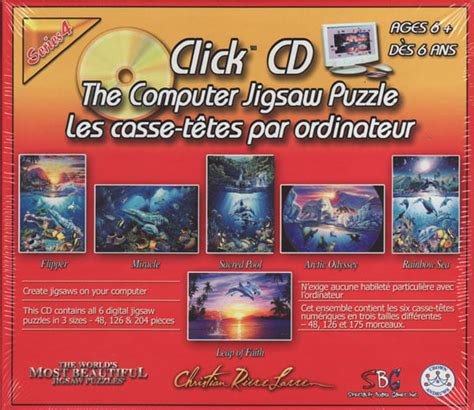
Click CD: The Computer Jigsaw Puzzle – Series 4, Christian Riese Lassen is a digital puzzle game featuring six jigsaws based on the artwork of Christian Riese Lassen, including Flipper, Miracle, Sacred Pool, Arctic Odyssey, Rainbow Sea, and Leap of Faith. Players can customize each puzzle with 48, 126, or 204 pieces, with optional piece rotation, and features like saving progress or hiding non-edge pieces. The game uses the Smoke & Mirrors engine and requires no installation.
Click CD: The Computer Jigsaw Puzzle – Series 4, Christian Riese Lassen: Review
Introduction
In an era dominated by sprawling open worlds and hyper-realistic combat, Click CD: The Computer Jigsaw Puzzle – Series 4, Christian Riese Lassen stands as a quiet, meditative artifact—a digital ode to the analog art of puzzle-solving. Released in 2004 for Windows and Macintosh by Crown & Andrews Pty Ltd and developed by Ken Duncan Panographs, this title is the fourth installment in a series leveraging the “Smoke & Mirrors Jigsaw Puzzle engine.” It eschews narrative grandeur for the simple, profound satisfaction of assembling fragmented art into cohesive wholes. This review posits that Click CD represents a niche intersection of digital preservation and artistic appreciation, offering a timeless, low-stress experience defined by Christian Riese Lassen’s ethereal marine artwork. Though technologically modest by modern standards, its enduring charm lies in its ability to transform a centuries-old pastime into a serene digital ritual.
Development History & Context
The Studio and Creators
Developed by Ken Duncan Panographs, an Australian studio specializing in puzzle software and digital art adaptations, Click CD emerged from a lineage of niche CD-ROM titles. The studio’s focus on accessible, non-violent gaming aligns with the game’s tranquil ethos. The series was published by Crown & Andrews Pty Ltd, a company known for distributing hobbyist-centric products, reinforcing the game’s positioning as a digital “hobby kit.” The partnership with Christian Riese Lassen—a globally renowned marine artist—was central to its identity. Lassen, celebrated for his vibrant, spiritually-infused depictions of ocean life, lent his signature style to six exclusive puzzles, elevating the game beyond mere software into a curated art experience.
Technological Constraints
Running on Windows 95/NT4 or later (or Mac OS 8.1 via Classic environment), the game demanded minimal hardware: a 166MHz Intel Pentium processor, 32MB of RAM, and a standard CD-ROM drive. Its lightweight engine required no installation, a deliberate choice reflecting CD-ROM-era limitations of storage and user convenience. This “run-and-play” simplicity underscores a pragmatic approach to design: focus on the puzzle mechanics without bloating the experience with unnecessary features. The fixed/flip-screen top-down perspective and point-and-click interface further emphasize accessibility over technical prowess, ensuring compatibility with mid-2000s consumer hardware.
Gaming Landscape at Release
In 2004, the gaming landscape was bifurcated between blockbuster AAA titles and burgeoning casual gaming markets. Nintendo’s DS had just launched, popularizing handheld puzzle games like Puzzle Series: Jigsaw Puzzle, but PC/Mac audiences still lacked dedicated digital puzzle software beyond browser-based Flash games. Click CD occupied a unique space: it targeted older demographics, art collectors, and puzzle enthusiasts underserved by mainstream gaming. Its release alongside other Lassen-themed games—such as DeJig: Lassen Art Collection (1997) for Sega Saturn—highlighted a niche but dedicated market for digital adaptations of fine art. Competitors like Puzzle Series Vol. 1: Jigsaw Puzzle (2006) would later refine the genre, but Click CD’s early focus on artist collaborations set a precedent for blending gaming with cultural preservation.
Narrative & Thematic Deep Dive
Plot and Characters
As a jigsaw puzzle game, Click CD deliberately eschews traditional narrative arcs or character development. Instead, its “story” unfolds through the contemplative act of assembly. Each puzzle—“Flipper,” “Miracle,” “Sacred Pool,” “Arctic Odyssey,” “Rainbow Sea,” and “Leap of Faith”—functions as a standalone tableau, inviting players to reconstruct Lassen’s vision piece by piece. The absence of dialogue or cutscenes shifts the narrative burden entirely to the artwork. For instance, “Sacred Pool” depicts a mystical underwater scene with glowing fish and coral, evoking a sense of wonder, while “Arctic Odyssey” contrasts icy blues with vibrant wildlife, emphasizing harmony in nature. This non-linear, player-driven narrative mirrors the meditative process of puzzle-solving itself.
Underlying Themes
Lassen’s artwork imbues the game with transcendent themes of spirituality, environmental reverence, and interconnectedness. His signature style—characterized by luminescent colors, fluid water effects, and anthropomorphized marine life—frames the ocean as a sacred, living entity. “Miracle,” for example, shows a breaching dolphin encircled by rainbows, symbolizing divine intervention and nature’s beauty. Similarly, “Leap of Faith” depicts a diver suspended between light and shadow, suggesting courage in the face of the unknown. These themes are amplified by the puzzle mechanic: assembling fragmented images mirrors the human quest for wholeness and meaning in chaos. The game’s core philosophy—that order emerges from fragmentation—resonates as a quiet metaphor for life, making it more than a mere puzzle; it becomes a digital meditation on beauty and perseverance.
Gameplay Mechanics & Systems
Core Gameplay Loop
The gameplay loop is elegantly simple: select a puzzle from Lassen’s six artworks, choose a difficulty (48, 126, or 204 pieces), and reassemble the image via drag-and-drop. Players rotate pieces (optional), save progress, or activate a helper that hides non-edge pieces, streamlining the process without eliminating challenge. The Smoke & Mirrors engine ensures smooth piece snapping, with a subtle “click” confirming correct placements—a tactile reward that reinforces completion. Time pressure is absent, allowing players to engage at their own pace. This design prioritizes relaxation over competition, appealing to those seeking a mindful escape from high-stress gaming.
User Interface and Controls
The interface is a model of minimalist functionality. A top-down menu system offers puzzle selection, difficulty toggles, and utility options (e.g., hiding pieces, saving). Point-and-click controls are responsive, with no complex button combinations or hidden menus. The lack of tutorial or instructions assumes player familiarity with jigsaw puzzles, reinforcing its appeal to traditionalists. However, this minimalism can be a double-edged sword; players unfamiliar with digital puzzles might crave guidance on features like piece rotation or the “edge-highlight” tool, which is buried in sub-menus.
Innovative Features
Despite its simplicity, Click CD introduces practical innovations. The “hide non-edge pieces” function—later adopted by modern puzzle games—reduces visual clutter, aiding players overwhelmed by smaller pieces. The save system is robust, allowing multiple in-progress puzzles to persist. Most notably, the Smoke & Mirrors engine dynamically generates puzzles, ensuring no two sessions are identical even with the same art. This replayability extends longevity beyond a one-time playthrough. However, the absence of features like leaderboards or timers limits competitive appeal, cementing its status as a purely contemplative experience.
World-Building, Art & Sound
Setting and Atmosphere
The “world” of Click CD is defined by Lassen’s aquatic environments. Each puzzle creates a microcosm of oceanic life: “Rainbow Sea” immerses players in a kaleidoscope of tropical fish, while “Arctic Odyssey” juxtaposes icy landscapes with playful orcas. These settings evoke a sense of immersion through Lassen’s masterful use of light and perspective. The top-down view mimics the disorienting yet awe-inspiring vantage point of peering into the ocean’s depths, transforming puzzle-solving into an act of underwater exploration.
Visual Direction
Lassen’s artwork is the undisputed star. His hyper-saturated, luminous style—reminiscent of Thomas Kinkade but with a marine focus—creates a dreamlike aesthetic. Details like the iridescent scales of fish in “Flipper” or the ethereal glow of “Sacred Pool” transform puzzles into galleries. The digital rendering preserves the vibrancy of Lassen’s originals, though low-resolution scans in some copies (noted in eBay listings) can lead to pixelated edges on larger puzzles. Still, the art remains the game’s defining strength, with each piece serving as a window into Lassen’s romanticized vision of nature.
Sound Design
Sound design is conspicuously absent. No background music, sound effects, or voice-overs accompany gameplay. This silence is both a limitation and a strength: it eliminates distractions, allowing players to focus entirely on the visual and tactile aspects of puzzle-solving. For some, this lack of auditory feedback may feel sterile, but it aligns with the game’s minimalist ethos, prioritizing art over spectacle.
Reception & Legacy
Launch Reception
Contemporary reception is poorly documented, with no mainstream critic reviews in the sources. However, anecdotal evidence from seller listings and forums suggests a warm reception among niche audiences. A 2017 player review on WonderClub praises its addictive quality: “Good Puzzle. This puzzle kept me up all night. How cool is that?” This sentiment highlights the game’s ability to captivate through simplicity. Commercial success is hard to gauge, but its inclusion in the CD-ROM Software Library at the Internet Archive indicates cultural preservation value.
Evolution of Reputation
Over time, Click CD has faded from mainstream memory but retains cult status among puzzle and art enthusiasts. On platforms like eBay, copies command premium prices (up to $99.99), reflecting its rarity. Retrospectives from puzzle communities celebrate it as a bridge between analog and digital jigsaw experiences. However, its reputation is constrained by technical limitations; modern players accustomed to 3D graphics and dynamic puzzles may find it outdated. Yet, its legacy as a vessel for Lassen’s art endures, with related physical puzzles (e.g., Ravensburger’s Daybreak) still sought after by collectors.
Influence on the Industry
Click CD’s influence is subtle but notable. It pioneered the artist-centric puzzle game model, paving the way for titles like Puzzle Series Vol. 1: Jigsaw Puzzle (2006) and mobile apps focusing on licensed art. Its emphasis on accessibility—no installation, low system requirements—foreshadowed the casual gaming boom. More broadly, it underscores the potential of CD-ROMs as vehicles for cultural preservation, predating digital archives like the Internet Archive. However, its lack of innovation in core mechanics limits its direct impact on puzzle game evolution. Instead, it remains a poignant relic of a pre-streaming era when digital distribution prioritized substance over spectacle.
Conclusion
Click CD: The Computer Jigsaw Puzzle – Series 4, Christian Riese Lassen is a paradox: technologically unremarkable yet artistically transcendent. As a product of its time, it embodies the CD-ROM era’s promise of accessible, multimedia experiences. While its gameplay mechanics are simple, its true strength lies in its role as a digital canvas for Christian Riese Lassen’s marine art. The puzzles serve as both leisure activity and meditation, transforming fragmented images into moments of clarity. Though it lacks the narrative depth or technical prowess of modern games, its legacy endures in its quiet celebration of beauty and patience. For historians of digital culture, it represents a niche but vital artifact—a testament to how games can preserve art and foster mindfulness. In an age of sensory overload, Click CD remains a digital sanctuary, inviting players to slow down and assemble wonder, one piece at a time.