
- Release Year: 1988
- Platforms: Arcade, MSX, NES, Nintendo Switch, PlayStation 4, SEGA Master System, Sharp X68000, TurboGrafx-16, Windows
- Publisher: Apros, Hot-B Co., Ltd., Joyful table, Ninja Games Japan Co., Ltd., SEGA Enterprises Ltd., Sharp Corporation, Taito Corporation, Tommo Inc., UFO Interactive Games, Inc.
- Developer: Taito Corporation
- Genre: Action
- Perspective: Side view
- Game Mode: Hot Seat, Single-player
- Gameplay: Shooter
- Setting: Fantasy
- Average Score: 55/100
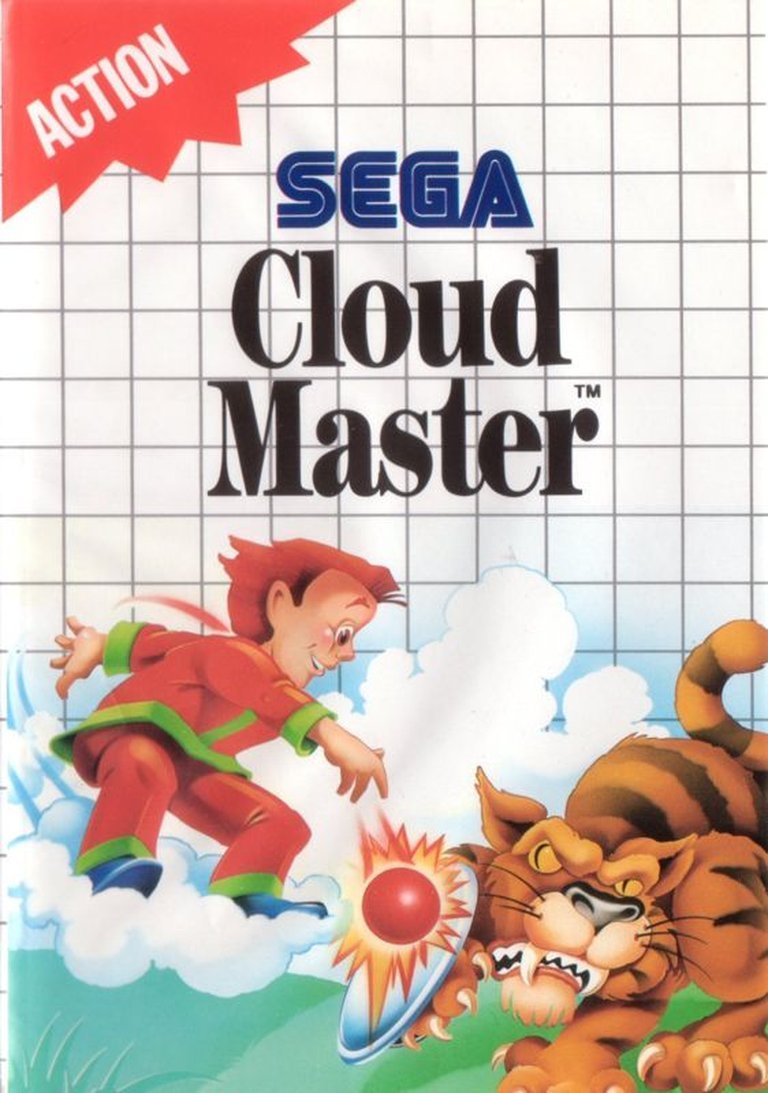
Description
Cloud Master is a side-scrolling shooter set in a fantasy world inspired by Chinese mythology. Players control a small character riding a cloud, shooting energy balls at enemies while collecting power-ups and upgrading abilities in shops. The game features various stages with mid-bosses and large end bosses, and is known for its unique enemies like flying noodle bowls and bears with guns.
Gameplay Videos
Cloud Master Guides & Walkthroughs
Cloud Master Reviews & Reception
mobygames.com (55/100): Cute, but not worth the pain.
Cloud Master Cheats & Codes
Sega Master System
At the title screen, press Left, Right, Left, Left, Right, Left, Right, Right to enable Cheat Mode. Then pause the game and use the following codes.
| Code | Effect |
|---|---|
| Right | Gain a life |
| 2 + Right | Increase fire power |
| Left | Lose a life |
| 1 + Left | Restart level |
| 1 + Right | Skip level |
| 1 + Down | Skip to boss |
| 2 + Left | Toggle secondary fire |
| Up | Toggles invincibility off |
| Down | Toggles invincibility on |
MSX2
Press ESC to pause the game, then press F2+SHIFT and one of the following keys:
| Code | Effect |
|---|---|
| A | Increase the primary weapon power (repeat to increase more) |
| B | Increase the secondary weapon power (repeat to increase more) |
| C | Invulnerability |
| E | Disable invulnerability |
| F | Increase the number of lives |
| M | Restart the stage |
| Backspace | Advance a stage |
Sega Master System (Pro Action Replay)
Use the following Action Replay codes with the Pro Action Replay cheat device.
| Code | Effect |
|---|---|
| 00c4 c903 | Infinite Lives |
| 00C38301 | Enable cheat mode |
| 00C4C703 | Invincibility |
| 00C4C905 | Infinite lives (keeps showing 5) |
| 00C4C307 | Maximum firepower |
| 00C4C405 | Maximum speed |
| 00C4C50x | Select special magic (button ) – values 1..C |
Cloud Master: Review
In the late 1980s, the shoot ’em up genre was reaching a saturation point. With so many space-faring shooters flooding arcades and home consoles, developers needed a hook—something to make their game stand out. Taito’s Cloud Master (known in Japan as Chūka Taisen) attempted to do just that, trading starships for a cloud-riding monk and space aliens for mythological Chinese creatures. The result is a game that’s as bizarre as it is difficult, a title that has earned a cult following for its sheer audacity, even if its gameplay leaves something to be desired.
Development History & Context
Cloud Master emerged from Taito’s prolific arcade division in 1988, a time when the company was riding high on hits like Arkanoid and Rainbow Islands. The decision to base the game on Journey to the West—a classic Chinese novel featuring the Monkey King—was a bold one, especially for a Western audience unfamiliar with the source material. The protagonist, Mike Chen (originally Sun Wukong), floats on a cloud and fires energy balls at enemies that range from flying noodle bowls to bears with guns.
The game’s development was handled by Hot-B for the arcade version, with home ports following shortly after. The Sega Master System version, released in 1989, was the only one to see a Western release, which is perhaps why it’s the most remembered today. The NES, PC Engine, and MSX2 versions remained Japan-exclusive, with the PC Engine port even getting a title change to Gokuraku! Chuuka Taisen (“Paradise! Chinese Taisen”).
Technically, Cloud Master was a product of its time. The arcade version ran on Taito’s standard hardware, which was capable but not cutting-edge. The home ports had to contend with the limitations of 8-bit systems, resulting in some graphical compromises and, in the case of the NES version, an extra stage that wasn’t in the original.
Narrative & Thematic Deep Dive
The plot of Cloud Master is as thin as the cloud Mike Chen rides on. You’re a monk on a divine mission, but the specifics are lost in translation—literally. The game’s dialogue is notoriously poor, with instructions and story beats that make little sense in English. This only adds to the game’s surreal charm, as you’re left to piece together the narrative from context clues and the sheer absurdity of the enemies you face.
Thematically, Cloud Master is a love letter to Chinese mythology, albeit one filtered through a Japanese arcade sensibility. The enemies are a mix of traditional mythological creatures and bizarre anachronisms. You’ll fight dragons, phoenixes, and kappa, but also flying bowls of ramen and modern-day soldiers. It’s a hodgepodge that somehow works, creating a world that feels both familiar and alien.
The game’s setting is equally eclectic. Each stage takes you through a different part of ancient China, from misty mountains to bustling villages. The backgrounds are colorful but repetitive, with little to distinguish one level from the next beyond the palette swap. This lack of variety extends to the gameplay, which follows a predictable pattern: shoot waves of enemies, defeat a mini-boss, then face off against a larger boss.
Gameplay Mechanics & Systems
At its core, Cloud Master is a straightforward shoot ’em up. You control Mike Chen as he floats across the screen, firing energy balls at enemies that approach from both directions. Power-ups are scattered throughout the levels, granting you stronger shots, faster movement, or special abilities like fireballs and shields. The game also features shops where you can spend credits to buy additional power-ups, a mechanic that adds a layer of strategy but is underutilized.
The controls are responsive, but the game’s difficulty is punishing. Enemies swarm the screen, projectiles are hard to see against the busy backgrounds, and the bosses require precise timing to defeat. The checkpoint system doesn’t help matters, as dying sends you back to the beginning or midpoint of a stage, stripping you of all your power-ups. This can make progress feel like a grind, especially in the later levels.
One of the game’s more unique features is its variety of enemies. Each stage introduces new foes with different attack patterns, keeping the gameplay from becoming too monotonous. However, this variety is undermined by the fact that many enemies are just reskins of earlier ones, with the same basic behaviors. The bosses, while visually impressive, also suffer from this lack of variety, with each one following a similar attack pattern.
World-Building, Art & Sound
Cloud Master‘s greatest strength lies in its art and sound design. The game’s visuals are bright and colorful, with a distinct Chinese aesthetic that sets it apart from other shooters of the era. The character sprites are well-animated, particularly Mike Chen, whose movements are fluid and expressive. The backgrounds, while repetitive, are detailed and evocative, capturing the essence of ancient China.
The sound design is equally strong. The music is catchy and fitting, with a traditional Chinese flavor that complements the game’s theme. The sound effects, while simple, are effective, adding weight to the action on screen. The NES version, in particular, is notable for its music, which was composed by Planet2 and Soul Duke. The soundtrack has since been released on CD by the Japanese label Clarice Disc, a testament to its enduring appeal.
However, the game’s world-building is hampered by its lack of narrative depth. The story is barely there, and what little there is is lost in translation. This makes it difficult to invest in the game’s world, as there’s little context for the action on screen. The enemies, while visually interesting, are also underdeveloped, with no backstory or motivation beyond “they’re in your way.”
Reception & Legacy
Upon its release, Cloud Master received mixed reviews. Critics praised its unique theme and visuals but were divided on its gameplay. The Sega Master System version, in particular, was noted for its difficulty, with many reviewers finding it frustrating rather than challenging. The NES version fared even worse, with critics lambasting its repetitive gameplay and lack of innovation.
Over time, Cloud Master has gained a cult following, thanks in part to its bizarre premise and challenging gameplay. The game’s legacy is perhaps best summed up by its influence on later titles. In 2008, Starfish SD, a company founded by former Hot-B employees, developed a remake for the Nintendo Wii titled The Monkey King: The Legend Begins. This was followed by a Nintendo Switch port in 2018, titled Chuuka Taisen, and a version of the arcade game with HD HUD and menu elements released for Switch, Steam, and PlayStation 4 by UFO Interactive as Monkey King: Master of the Clouds.
Despite these efforts, Cloud Master remains a niche title, remembered more for its eccentricity than its gameplay. It’s a game that’s easy to admire but hard to love, a relic of a bygone era that’s as frustrating as it is fascinating.
Conclusion
Cloud Master is a game that defies easy categorization. It’s a shoot ’em up with a unique theme, a challenging difficulty curve, and a distinct visual style. But it’s also a game that’s held back by its repetitive gameplay, punishing difficulty, and lack of narrative depth.
For fans of the genre, Cloud Master is worth a look for its historical significance and its sheer audacity. It’s a game that takes risks, even if those risks don’t always pay off. For everyone else, it’s a curiosity—a relic of a time when arcade games were as much about style as substance.
In the end, Cloud Master is a game that’s easy to respect but hard to recommend. It’s a title that’s as frustrating as it is fascinating, a game that’s as much a product of its time as it is a product of its creators’ imaginations. Whether you love it or hate it, there’s no denying that Cloud Master is a game that leaves a lasting impression.