
- Release Year: 1997
- Platforms: Macintosh, Windows 16-bit, Windows
- Publisher: Mattel Media
- Developer: team smartyPants!, Inc.
- Genre: Educational
- Game Mode: Single-player
- Gameplay: Fashion, Hair Styles, Makeovers, Mini-games, Quizzes
- Average Score: 70/100
Description
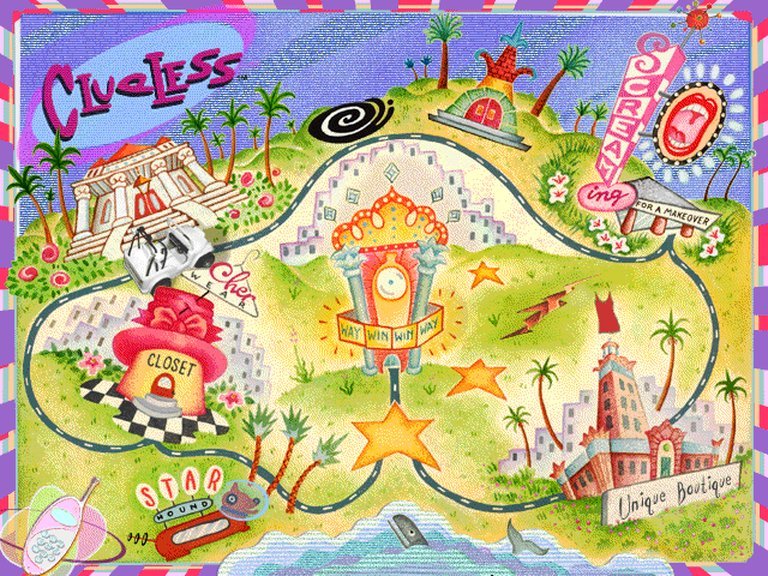
Clueless: CD-ROM immerses players in the world of Cher Horowitz with interactive activity centers focused on makeovers, fashion styling, and hair design. The game also features positive ‘win-win’ quizzes and mini-games inspired by women’s magazines, making learning about style and self-expression both fun and educational.
Gameplay Videos
Clueless: CD-ROM Free Download
Clueless: CD-ROM Reviews & Reception
mobygames.com (70/100): Clueless: The CD-Rom is based on the hit film and TV show.
handwiki.org : Clueless: CD-ROM is an educational video game based on the Clueless franchise.
Clueless: CD-ROM: Review
Introduction
In the sun-drenched, hyper-stylized world of 1990s youth culture, few franchises captured the zeitgeist with the effervescent charm of Clueless. The 1995 film and its subsequent television series were masterpieces of modern Jane Austen adaptations, translating Regency-era social maneuvering into the glittering, slang-drenched halls of Beverly Hills High. Against this backdrop, the 1997 Clueless: CD-ROM emerged as a multimedia curiosity—a licensed title promising to extend the franchise’s influence into the burgeoning realm of educational software. Marketed to girls aged 8 and up by Mattel Media and developed by the prolific team smartyPants!, Inc., the game ambitiously promised “creative activity centers” centered on makeovers, fashion, and “win-win” mini-games. Yet, despite the untapped potential of Cher Horowitz’s world, this CD-ROM ultimately stands as a cautionary tale of licensing overreach, where cultural cachet could not salvage deeply flawed execution. This review will dissect Clueless: CD-ROM‘s legacy, arguing that while it captures the superficial gloss of its source material, it fails as both entertainment and education, cementing its place as a nostalgic yet forgotten artifact of a specific technological and cultural moment.
Development History & Context
Clueless: CD-ROM arrived at a pivotal juncture in interactive media. Released in 1997 for Windows and Macintosh, it rode the wave of CD-ROM adoption, which enabled richer multimedia experiences than earlier floppy disk-based formats. However, the era was defined by technological constraints: limited storage capacity (around 650MB), primitive 3D rendering, and reliance on pre-rendered assets or simple animations. This context shaped the game’s design, which defaulted to static menus and basic sprite-based activities rather than dynamic exploration.
The developer, team smartyPants!, Inc., was a specialized studio with a portfolio heavily skewed toward licensed, girl-oriented titles like Barbie Cool Looks Fashion Designer and Detective Barbie in the Mystery of the Carnival Caper!. Their approach was formulaic: prioritize colorful visuals, intuitive point-and-click interfaces, and “safe” content aligned with Mattel’s educational mandate. The game’s 102-person credits (including illustrators, sound designers, and vocal talent) underscore its production scale, yet its vision remained narrow. Targeted squarely at a young female demographic, Clueless: CD-ROM was conceived as a digital “activity center,” a genre popularized by CD-ROMs like Barbie Fashion Designer. However, it entered a market saturated with licensed games—many of which prioritized brand synergy over innovation. This competitive landscape, combined with the nascent nature of educational software, meant Clueless: CD-ROM had to balance entertainment value with pedagogical rigor, a balance it would catastrophically fail to achieve.
Narrative & Thematic Deep Dive
The game’s narrative framework is skeletal, serving as a loose scaffold for its activities rather than a cohesive story. Players are ostensibly guided by Cher Horowitz, voiced by Joy Gohring, who acts as a sarcastic, fourth-wall-breaking narrator echoing her film persona. However, Cher’s presence is purely ornamental; her quippy interjections (“As if!”) lack the depth or character development of the source material. The game’s “plot” revolves around completing a series of self-contained tasks—designing outfits, styling hair, and participating in quizzes—all framed as part of Cher’s “mission” to enhance social status and express individuality. This superficially aligns with the film’s themes of transformation and self-discovery, but the game reduces these complex ideas to rote, mechanical actions. For instance, Tai Frasier’s makeover from “clueless” newcomer to style icon is presented as a simple drag-and-dress exercise, devoid of the film’s emotional arc or social commentary.
The “win-win” activities, which include trivia quizzes and magazine-style mini-games, attempt to emulate the show’s positive, empowering ethos but fall flat. Questions focus on trivial fashion knowledge or pop-culture references (e.g., “What is Cher’s favorite designer?”), reinforcing materialism over genuine empowerment. The dialogue, while peppered with franchise-accurate slang (“irksome,” “Baldwin”), feels recycled and uninspired. Ultimately, Clueless: CD-ROM trades the film’s sharp satire of teenage privilege for a sanitized, hollow version of its world, where the only “mystery” is why a game so rich in source material feels so narratively vacant.
Gameplay Mechanics & Systems
At its core, Clueless: CD-ROM is a collection of disconnected mini-games and activities, offering no meaningful progression or player agency. The main menu presents a “mall” interface where players select between six primary activities:
1. Makeover Studio: Players drag-and-drop clothing, makeup, and hairstyles onto character templates.
2. Fashion Designer: A simplified dress-up mode allowing customization of outfits.
3. Hair Styler: Focuses on creating various hairstyles using virtual tools.
4. Trivia Challenge: Pop quizzes with questions about the film and teen culture.
5. Memory Match: A basic card-flipping game featuring Clueless characters.
6. “Win-Win” Games: Generic minigames like “Suck and Blow” (a simplified card game) or “Duck Duck Goose.”
Each activity operates in isolation, with no overarching goal or reward system. The mechanics are rudimentary: clicking, dragging, and answering multiple-choice questions. While intuitive for young players, they lack depth or challenge. For example, the Fashion Designer mode offers limited clothing options and no way to save creations, reducing creativity to disposable, ephemeral acts. The UI, while colorful, is cluttered with redundant buttons and inefficient navigation—a common flaw of 1990s CD-ROM interfaces.
Character progression is nonexistent, and there is no narrative incentive to revisit activities. The “win-win” philosophy—ensuring players never “lose”—dumbs down gameplay to the point of tedium. Even the trivia, which could have capitalized on the film’s witty dialogue, is reduced to rote memorization. This design philosophy, while “positive,” sacrifices engagement for safety, making the game feel like a chore rather than a delight.
World-Building, Art & Sound
Clueless: CD-ROM’s world-building is static and underdeveloped. The game recreates the film’s aesthetic—Beverly Hills mansions, high school hallways, and shopping malls—but as static backdrops rather than explorable spaces. Characters are represented as low-resolution sprites or pre-rendered stills, lacking the charisma of their live-action counterparts. Cher’s mansion, for instance, is a single screen with clickable objects (e.g., a computer to access trivia), but no sense of place or interactivity beyond its designated activity.
The art direction, handled by team smartyPants! illustrators like Aletha Reppel and Brian Maloney, captures the film’s signature pastel palette and plaid-heavy fashion but lacks polish. Character designs are inconsistent, with facial expressions frozen in perpetual smiles. Environments are visually flat, relying on scanned textures and simple parallax scrolling to simulate depth. The game’s few animations—like Cher’s head nodding or a hairdo swaying—are rudimentary and repetitive.
Sound design is equally mixed. Joy Gohring’s voice performance as Cher is the highlight, nailing the character’s cadence and Valley Girl inflections, but her lines are sparse and recycled. The soundtrack, composed by Jan Bozarth and Shane Madden, features generic pop instrumentals and a few licensed songs from the film (e.g., “Supermodel”), but their integration feels jarring and disconnected from gameplay. Sound effects are minimal, limited to clicks and chirps, failing to enhance the atmosphere. In essence, the game’s audiovisual presentation is a facsimile of Clueless—visually recognizable but emotionally sterile.
Reception & Legacy
At launch, Clueless: CD-ROM received muted, often critical reception. SuperKids, one of the few outlets to review it, awarded a tepid 70% (3.5/5), damning it with faint praise: “Despite its totally awesome potential, this program falls way short in the entertainment category, and as for education, well, it’s a big zero.” Critics universally lamented its shallow gameplay and lack of educational merit, noting that its “positive slant” felt like a veneer for a poorly designed product. Commercially, it was a footnote—overshadowed by Mattel’s more successful Barbie titles and the mainstream gaming boom of the late 1990s.
Its legacy is one of obscurity and cautionary example. Today, it persists only as a niche curiosity on abandonware sites like MyAbandonware, where it is downloaded for nostalgia rather than enjoyment. The game’s influence on subsequent titles is negligible; licensed educational games of this ilk largely faded with the CD-ROM era, supplanted by more sophisticated interactive media. Historically, Clueless: CD-ROM serves as a symbol of the era’s limitations: the inability of licensed games to transcend their source material, and the struggle to merge education with entertainment in a pre-broadband world. It is occasionally referenced in discussions of gendered gaming or 1990s pop culture artifacts, but never celebrated.
Conclusion
Clueless: CD-ROM is a time capsule of unrealized potential. In its attempt to bottle the magic of Amy Heckerling’s teen satire, it instead delivers a hollow, fragmented experience that fails both as a game and as a piece of media. Its activities are repetitive, its world-building inert, and its educational value nonexistent—a stark contrast to the wit and social commentary of the film it emulates. For historians, it offers a fascinating window into the licensed game market of the 1990s, where brand recognition often trumped quality. For players, it remains a curio, playable only through emulation and appreciated for its place in the Clueless ecosystem. Ultimately, Clueless: CD-ROM is less a game and more a digital footnote: a reminder that even the most culturally resonant franchises can falter when translated into the wrong medium. As if, indeed.