
- Release Year: 2015
- Platforms: Macintosh, Windows
- Publisher: astragon Sales & Services GmbH
- Developer: Reality Twist GmbH
- Genre: Simulation
- Perspective: 1st-person, 3rd-person, Behind view
- Game Mode: Single-player
- Average Score: 47/100
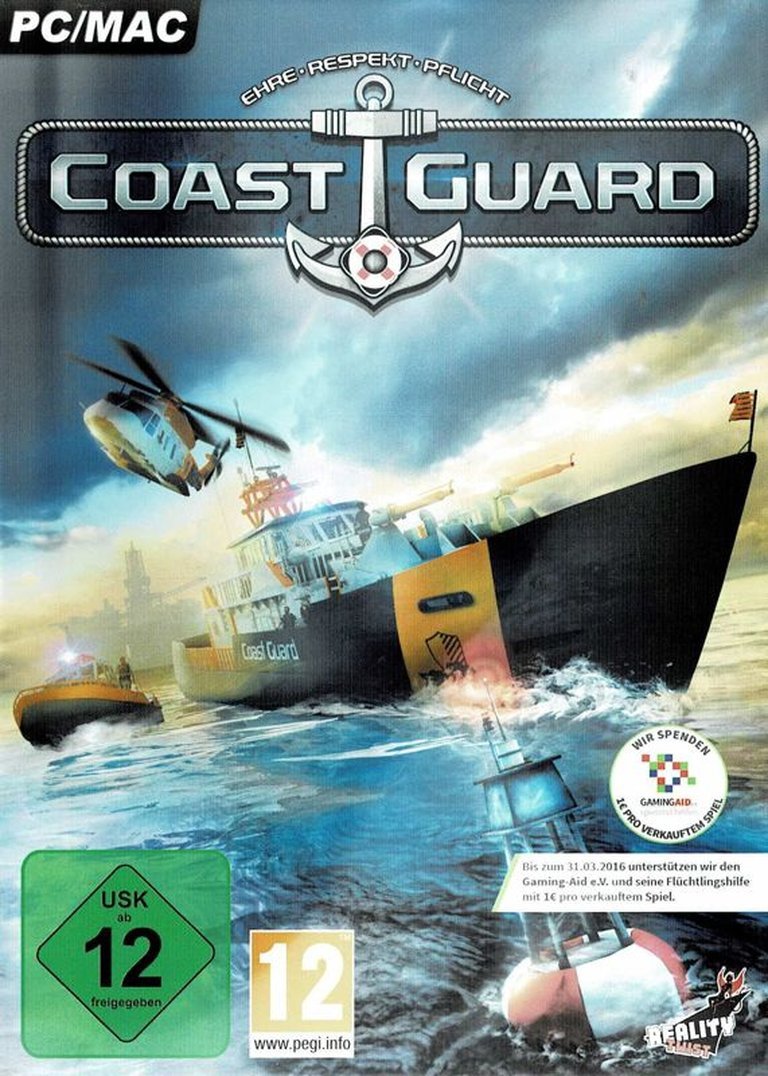
Description
Coast Guard is a 2015 simulation game that immerses players in the high-stakes world of coast guard operations. Taking on the role of officer Finn Asdair and his crew, players blend naval ship handling with police procedural tasks to pursue dangerous criminals across the open ocean, all while adhering to the motto ‘Honor – Respect – Duty’ and experiencing the life-saving challenges of maritime law enforcement.
Gameplay Videos
Where to Buy Coast Guard
PC
Coast Guard Cracks & Fixes
Coast Guard Guides & Walkthroughs
Coast Guard Reviews & Reception
metacritic.com (47/100): This looks, sounds, and plays like a student project attached to a Unity water physics tech demo.
gamewatcher.com : This Nautical Puzzler excites, but is bogged down with bugs.
bigredbarrel.com : the game is tedious experience and it’s a struggle to get through.
thesixthaxis.com : sadly the game doesn’t quite manage to pull it off.
Coast Guard: A Deep Dive into a Sunken Simulation-Adventure Hybrid
1. Introduction: The Tempestuous Allure of the High Seas
In the vast ocean of video game history, certain vessels set sail with bold ambitions, promising uncharted experiences, only to founder on the reefs of poor execution. Coast Guard, released in October 2015 by German studio Reality Twist GmbH and publisher astragon Sales & Services GmbH, is one such vessel. It arrived with the provocative proposition: a serious, narrative-driven simulation of the United States Coast Guard, blending perilous maritime operations with a grisly murder mystery. At a time when military shooters dominated the action genre, Coast Guard sought to honor a real-world service often overlooked in digital entertainment, aiming for the gravitas of a procedural drama fused with the tactile engagement of a vehicle simulator. This review argues that Coast Guard is a fascinating case study in conceptual promise tragically undermined by fundamental flaws in narrative delivery, mechanical design, and technical polish. It is not merely a “bad” game; it is a deeply conflicted one, perpetually at war with itself—a ship trying to sail two different, incompatible courses at once, resulting in a sluggish, frustrating, and ultimately forgettable voyage.
2. Development History & Context: From Maritime Rescue to Murky Waters
Coast Guard emerged from Reality Twist GmbH, a small German developer with a specific pedigree. Their previous work was primarily in the niche but respectable Ship Simulator series, most notably Ship Simulator: Maritime Search and Rescue (2009). This lineage is crucial to understanding Coast Guard‘s DNA. The studio was clearly conversant in thelanguage of maritime simulation—water physics, vessel modeling, and seafaring environments. According to a developer statement on the Steam community hub, the inspiration for Coast Guard “mainly arises from real life events,” with the overarching story “inspired loosely by several events that took place during the last years.” The developers explicitly stated they aimed to “simulate real life issues rather then just real mechanics,” and the ships were inspired by U.S. Coast Guard cutters, while characters were “loosely based on several movie actors the developer team liked.”
This was a deliberate pivot from pure simulation toward a structured, story-led adventure. The gaming landscape of 2015 was seeing a resurgence of narrative-focused, “walking simulator”-adjacent titles, but Coast Guard attempted a unique fusion: the environmental interactivity and clue-gathering of an point-and-click adventure grafted onto a maritime sim framework. The technological constraints were those of a mid-to-low budget PC title of its era—relying on a presumably modified version of the Ship Simulator engine or a similar middleware. The ambition to create a “freely roamable mother ship” and detailed offshore environments (oil rigs, islands, ghost ships) while maintaining a coherent narrative was significant for a team of 16 credited individuals, as listed on MobyGames. However, this scope appears to have outstripped their resources for refinement, leading to the jarring disconnect between the often-beautiful seascapes and the踉跄ing, stiffly animated human elements that define the game’s reception.
3. Narrative & Thematic Deep Dive: A Mystery Lost in the Fog
The narrative framework of Coast Guard is its most conceptually intriguing element and, paradoxically, one of its most criticized components. The game employs a non-linear, memory-loss structure. The protagonist, Coast Guard officer Finn Asdair, begins the game stranded on a derelict ghost ship, having suffered a head injury that has caused amnesia. As players explore this eerie vessel, they discover clues—notes, objects—that trigger flashback missions. These missions, played in chronological order, depict the events leading up to the present crisis: a complex case involving a murder on an oil rig, human trafficking, and corporate malfeasance. The intention is to create a “disjointed feeling” that fuels player curiosity, as described by GameWatcher’s Matthew Moyer.
Plot Structure and Pacing: The story jumps between the tense, atmospheric exploration of the ghost ship in the “present” and the varied missions of the past. This structure has potential, but execution is flawed. Reviews consistently note that the pacing is “inconsistent” (Big Red Barrel) and that the frequent switches back to the ghost ship act as “momentum killers.” The narrative attempts to blend a “whodunnit” with a politically charged thriller about refugees and trafficking, but the tonal shifts are jarring. The mystery itself, while containing “a few good twists” (GameWatcher), is marred by a script described as “cringe-inducing” and sounding “like something a 14-year-old who’s watched too much G.I. Joe might write” (Big Red Barrel). The dialogue is overly insistent, with crew members repeatedly using the protagonist’s name (“Finn, look over there,” “Good job, Finn”) in a way that feels like unsubtle, lazy characterization rather than organic camaraderie.
Characters and Voice Acting: The crew—engineer Fatima Morgane, chief investigator Colman Bauers, and forensic specialist Larry La Bouche—are presented as a core unit but remain “generic with no motivation or personality” (Big Red Barrel). They exist primarily as functional archetypes to deliver exposition or next-step instructions. The voice acting is almost universally panned. It is characterized as “very poor,” “emotionally void,” and “hokey” (Hooked Gamers). Lines are delivered without appropriate inflection, making solemn scenes feel comically flat. This is compounded by notoriously bad lip-syncing, where “mouths moving when nothing is being said” (GameWatcher) is a frequent distraction, completely breaking immersion during interrogations and conversations—a critical failure for a game so reliant on dialogue and mystery-solving.
Themes and Tone: The game explicitly states its motto: “Honor – Respect – Duty,” and the Steam description touts the “extraordinary lives of coast guard officers.” Thematically, it gestures toward the real Coast Guard’s multi-faceted role: search and rescue, law enforcement, environmental protection, and migrant interdiction. The missions involve rescuing refugees, chasing human traffickers, and collecting water samples. However, the “serious, fairly realistic presentation” (Hooked Gamers) clashes with an “over the top” campaign narrative that feels more like a B-movie. The attempted gravitas is undercut by the poor acting and writing, preventing any meaningful engagement with its potentially weighty themes. The game cannot decide if it is a tribute to real-world heroism or a pulpy conspiracy thriller, and in doing so, fails at both.
4. Gameplay Mechanics & Systems: Adrift Between Sim and Adventure
Coast Guard‘s gameplay is a hybrid beast, and its mechanical identity crisis is its most damaging flaw. It oscillates between two distinct modes: Vessel Operation and On-Foot Investigation/Adventure, with neither feeling fully realized.
Vessel Operation (The Sim-Lite Aspect): Players control two ships: the Daniel Defoe (the “mothership”) and a smaller, nimbler “daughter boat” (likely the Luke Fox). Control is deliberately simplified. As Big Red Barrel succinctly stated, “There’s no controls apart from forward, reverse and turn.” There is no complex engine management, anchoring, or detailed navigation. This simplifies the experience into a slow-paced, arcade-like steering challenge. The one area where this system shines is in water physics. Multiple reviews praise the impressive, real-time water effects: waves create wakes, spray flies during acceleration, and choppy seas (5-foot waves) “definitely take some getting used to” (GameWatcher), making rescuing bobbing survivors a genuinely tricky skill-based activity. The boats themselves are “nicely modelled” with details like waving flags and rotating lights (TheSixthAxis). However, this praise is heavily qualified. The physics are inconsistent; water frequently “clips through the boat” (Big Red Barrel), and the vessel can feel “floaty” or unresponsive. Critically, the AI for persons in the water is broken: they “sat in the water, not moving closer to the boat,” forcing players to accidentally run them over (Big Red Barrel), turning rescue into a frustrating task.
On-Foot Investigation & Adventure Elements: This is where the game leans into point-and-click and adventure game conventions. Players disembark to explore environments—an oil rig, a ghost ship, an island—in first-person. The core loop involves searching for clues (hidden in “random places” with poor hints, per Big Red Barrel), using items on objects/characters, and engaging in multi-choice dialogue trees. The intention is sound: process evidence in a lab aboard the Daniel Defoe, interrogate suspects, and build a case. In practice, this system is plagued by “trial and error” (Big Red Barrel) andopaqueprogression. The dialogue requires asking questions in a specific, often non-intuitive order. A player might have evidence and verification from one character but be unable to use it with another, forcing them to repetitively cycle through all dialogue options with all NPCs until the arbitrary trigger is found. The hint system (via the logbook or radioing crew) is frequently useless, telling players to “figure something out when I’d already figured it out” (Big Red Barrel). This transforms investigation into a tedious chore.
Systems Integration and Flaws: The two modes are stitched together by a mission structure framed by the memory-flashback plot. However, the transition between sailing and walking is clunky. The game suffers from a “practically non-existent” checkpoint system (TheSixthAxis). Checkpoints only trigger after major mission completions, but the game doesn’t clearly indicate when a mission is truly over. Quitting after a cutscene could mean losing significant progress, leading to “replay[ing] quite a few sections” (TheSixthAxis). Compounding this are numerous technical bugs: graphical glitches (objects clipping through walls, fog effects following Indoors), mission-breaking errors like a target boat failing to spawn (GameWatcher), and the aforementioned AI and physics issues. The overall design philosophy is unclear. It is “not action packed or fast paced enough to be entertainly arcade-y, and it’s not nearly complex enough to be a sim. It exists somewhere in the middle” (Hooked Gamers)—a purgatory that satisfies neither audience.
5. World-Building, Art & Sound: A Sea of Contrasts
The audiovisual presentation of Coast Guard is a study in stark contrasts, where a technically impressive and atmospheric element is often immediately followed by a cheap or broken one, shattering immersion.
World-Building and Atmosphere: The game’s greatest environmental triumph is its water. The dynamic ocean, with its wave patterns, wakes, and weather effects (storms, fog), is repeatedly highlighted as “breathtaking” (Steam description), “impressive,” and “always impressive” (GameWatcher). Sailing during a storm, with the ship heaving violently and spray drenching the screen, successfully conveys the danger and power of the sea. The ship models are also a high point. The Daniel Defoe is “freely roamable,” allowing players to visit the bridge, lab, and interrogation room, and is populated with “high levels of attention to detail” (TheSixthAxis)—flags, lights, equipment. The daughter boat is a “nice variation.” These environments sell the fantasy of being aboard a working Coast Guard cutter. Conversely, the land-based environments (oil rig interiors, ghost ship corridors, island locales) are described as “lifeless” and “poorly textured” (Big Red Barrel). They feel like cheap, empty sets, populated by “stiff and static” character models (GameWatcher) and plagued by invisible walls that disrupt exploration. The ghost ship, a key narrative location, is the sole exception, where its “creaking hull and other spooky sounds” (TheSixthAxis) create a genuinely atmospheric and tense experience, proving the team could create mood when focused on audio-visual environment over human interaction.
Art Direction and Technical Fidelity: The graphical quality is deeply inconsistent. While the water and ship exteriors can look “really good” (GameWatcher), a “closer look” reveals “shortcomings such as poor quality textures” (Gamepressure). Character animations are “hilariously bad” (TheSixthAxis), and lip-syncing is “off” (GameWatcher). This technical dissonance is a constant irritant. The user interface is functional but basic, with a logbook for mission tracking and clues. The game supports multiple perspectives (first-person for investigations, third-person/behind-view for piloting), which is a sensible design choice.
Sound Design: The soundtrack receives mixed but generally positive notes. It has “several songs which fit their setting and are simply nice to listen to,” with a clever dynamic where “the volume of the music changes based on your proximity to its source on the ship” (GameWatcher). Sound effects are a similar mixed bag: environmental sounds like seabirds and engines are “well done,” but the complete absence of collision sounds (“any clang or even a thudding sound when you run your boats into other objects,” GameWatcher) is a glaring omission that breaks physical realism. Unsurprisingly, the voice acting is the major sore point, undermining every narrative moment it accompanies.
6. Reception & Legacy: Sinking Without a Trace
Upon its release on October 21, 2015, Coast Guard was met with near-universal mediocrity or outright disdain from critics and players, a fate sealed by its fundamental design contradictions and technical shortcomings.
Critical Reception: Aggregate scores tell the story. On Metacritic, it holds a “Generally Unfavorable” Metascore of 47 based on 10 critic reviews. On OpenCritic, its score is 4.8/10, with only 4% of critics recommending it. Individual critic scores ranged from a low of 20/100 (DarkStation, which called it “a student project attached to a Unity water physics tech demo”) to a high of 65/100 (GameWatcher). The consensus, however, clustered around the 5-6/10 range (Hooked Gamers 5.5/10, TheSixthAxis 6/10, GameWatcher 6.5/10). The pattern is clear: praise for its water graphics, ship models, and occasionally engaging story is invariably followed by condemnation of its “poor voice acting,” “repetitive missions,” “frustrating” trial-and-error investigations, “graphical glitches,” and “rushed” feel (GameWatcher). The game was perceived as an idea that “gets a lot of things right, but at the end of the day, feels rushed” (GameWatcher) and a title that “doesn’t really know what it wants to be” (TheSixthAxis).
User Reception: The community response was even more brutal. On Steam, it holds a “Mostly Negative” overall rating (57 reviews, with only 33% positive at the time of data collection), and its User Score on Metacritic is a dismal 3.9/10. The “Mostly Negative” Steam tag and reviews decrying it as a waste of time or a broken product cemented its reputation. One of the few positive user reviews noted its story about refugees as “well told,” but even this was an exception that proved the rule of widespread disappointment.
Legacy and Influence: Coast Guard has virtually no discernible legacy or influence on the industry. It did not spawn a series (a mobile spinoff, Coast Guard: Beach Rescue Team, arrived in 2017 but appears to be a different, simpler game). It is not cited as an inspiration by other developers. It exists as a cautionary tale—a specific example of the dangers of genre hybridization without a clear, cohesive vision and sufficient polish. Its primary value today is as a preserved artifact of a niche ambition on MobyGames, remembered primarily for its spectacular failure to capitalize on a unique premise. It shares a thematic niche with earlier titles like Ship Simulator: Maritime Search and Rescue (which it is a spiritual successor to in some ways) and later, very different games like Maneater (which features USCG as antagonists), but it occupies a lonely, discredited space in the “sim-lite” genre. Its story of a flawed but earnest attempt to simulate a first responder service is overshadowed by its technical and narrative failings, ensuring it is discussed, if at all, as a footnote—a ship that launched, hit the rocks, and was quickly forgotten.
7. Conclusion: A Well-Intentioned Voyage Doomed by Execution
Coast Guard is a game perpetually caught between two worlds. Its heart seems to be in the right place: a sincere, if awkward, attempt to celebrate the multifaceted work of a real-world service through a serious, story-driven experience. Its environmental art, particularly the dynamic oceans and detailed cutters, demonstrates a genuine technical skill in simulating the look and feel of being at sea. Its narrative framework, with its amnesiac detective plot and conspiracy thriller overtones, shows ambition to be more than a simple vehicle sim.
However, these strengths are consistently sabotaged by catastrophic weaknesses. The voice acting and script are arguably its Achilles’ heel, destroying any narrative credibility. The gameplay hybrid is neither a satisfying sim nor a compelling adventure, instead inheriting the repetitive chores of the former and the frustrating, opaque puzzles of the latter. The technical state—clipping, bugs, poor animations, broken AI—screams of a project launched before it was ready. The direction and pacing are uncertain, with tonal whiplash and momentum-killing structural choices.
In the grand tapestry of video game history, Coast Guard is not a masterpiece, nor is it so abysmal as to be fascinating in its awfulness. It is, as Hooked Gamers termed it, merely “okay.” But in a crowded marketplace, “okay” is a death sentence. Its legacy is that of a missed opportunity of staggering proportions. It proves that a unique concept, even one grounded in real-world heroism, is not enough. It requires competent writing, polished mechanics, and a unified design vision to stay afloat. Coast Guard had the map to an interesting destination but was captained by a crew that couldn’t steer clear of the icebergs. It remains, for historians and journalists, a precise and detailed lesson in how not to blend genres, a ghost ship of development whose salvageable parts—the beautiful water, the neat ship models—are sadly not enough to rescue the whole from the depths.