
- Release Year: 2005
- Platforms: GameCube, Nintendo DS, PlayStation 2, Wii, Windows
- Publisher: Bigben Interactive UK Ltd., Conspiracy Entertainment Corp., Midas Interactive Entertainment Ltd., Neko Entertainment SARL, Noviy Disk
- Developer: Neko Entertainment SARL
- Genre: Driving, Racing
- Perspective: Behind view
- Game Mode: Hotseat, Single-player
- Gameplay: Arcade, Automobile, Track racing, Vehicle simulator, Vehicular
- Setting: Fantasy
- Average Score: 51/100
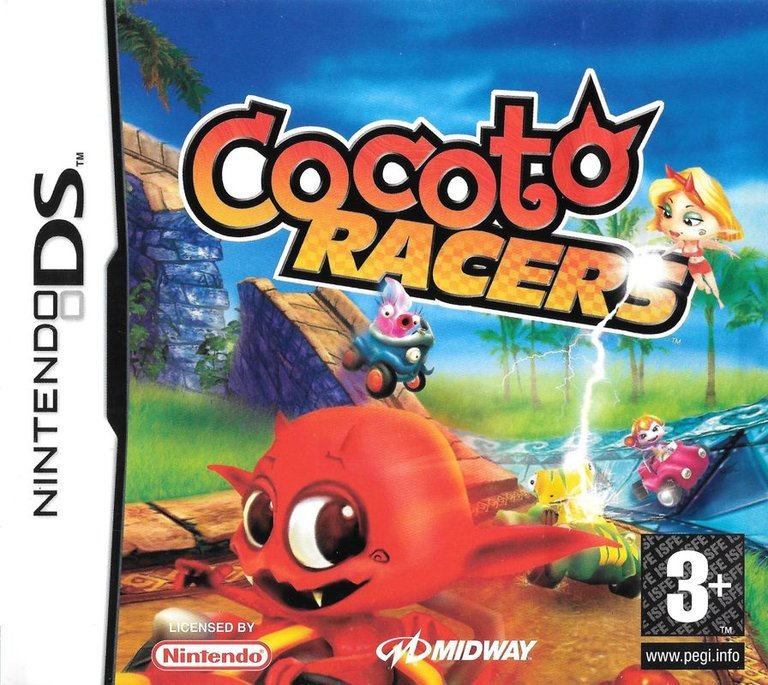
Description
Cocoto: Kart Racer is a fantasy-themed kart racing game where players compete as one of twelve unique creatures in a high-stakes tournament to win a mysterious cauldron and retain their magical powers. The game features five vibrant worlds—Abyss, Volcano, Atlantis, Jungle, and Paradise—each with distinct tracks filled with speed strips, ramps, and power-ups to outmaneuver opponents. With multiple modes including championship, time challenge, and local multiplayer for up to four players, it offers a mix of arcade-style racing and strategic item-based gameplay, drawing comparisons to classics like Mario Kart but with its own whimsical twist.
Gameplay Videos
Cocoto: Kart Racer Free Download
Cocoto: Kart Racer Reviews & Reception
metacritic.com (45/100): Cocoto Kart Racer isn’t an awful game. It’s a simple, fast-paced racing game that should be easy for younger gamers to play. On the other hand, there’s no reason for anyone to buy it because everything it does, Mario Kart DS does better.
ign.com : Cocoto Kart Racer isn’t an awful game. It’s a simple, fast-paced racing game that should be easy for younger gamers to play. On the other hand, there’s no reason for anyone to buy it because everything it does, Mario Kart DS does better.
mobygames.com (57/100): Cocoto Kart Racer is a kart racing game where you can choose to race as one of twelve strange available creatures, each with their own features.
Cocoto: Kart Racer Cheats & Codes
Game Boy Advance
Enter these codes at the ‘Codes’ screen to unlock new racers.
| Code | Effect |
|---|---|
| 95871 | Unlocks racer Bobong |
| 51653 | Unlocks racer Glabooh |
| 32812 | Unlocks racer Shiny |
| 28946 | Unlocks racer Zaron |
Cocoto: Kart Racer: A Forgotten Relic of the Mid-2000s Kart Racing Boom
Introduction: The Shadow of Mario Kart
In the annals of kart racing history, Cocoto: Kart Racer (2005) occupies a peculiar niche—a game that is simultaneously derivative and ambitious, yet ultimately overshadowed by the titan it so blatantly emulates. Developed by French studio Neko Entertainment and published by a rotating cast of companies including Bigben Interactive, Conspiracy Entertainment, and Midway Games, Cocoto arrived during the height of the kart racing craze, a genre dominated by Nintendo’s Mario Kart series. Its existence is a testament to the era’s appetite for accessible, multiplayer-friendly racing games, but its legacy is one of mediocrity, a cautionary tale of how imitation without innovation can render a game forgettable.
This review seeks to dissect Cocoto: Kart Racer with surgical precision, examining its development context, narrative (or lack thereof), gameplay mechanics, artistic direction, and critical reception. By doing so, we aim to answer a fundamental question: Does Cocoto deserve its obscurity, or is there hidden depth beneath its derivative surface?
Development History & Context: The Rise of Budget Kart Racers
The Studio Behind the Wheel
Neko Entertainment, the French developer behind Cocoto: Kart Racer, was no stranger to licensed or derivative games. Founded in 2000, the studio had already cut its teeth on titles like Cocoto: Platform Jumper (2004), a Donkey Kong Country-inspired platformer, and WWF Panda Junior, a wrestling game for younger audiences. Their portfolio suggests a studio comfortable with creating games that borrow heavily from established franchises, often targeting younger or budget-conscious audiences.
The Cocoto series itself was an attempt to carve out a niche in the early 2000s, a time when mascot-driven platformers and kart racers were still viable. The character Cocoto, a small, round creature with a mischievous grin, was designed to be marketable, if not particularly memorable. The decision to pivot from platforming to kart racing was a calculated one—Mario Kart: Double Dash!! had reinvigorated the genre in 2003, and the DS and Wii eras were on the horizon, promising new audiences hungry for multiplayer experiences.
Technological Constraints and Multiplatform Chaos
Cocoto: Kart Racer was developed during a transitional period in gaming hardware. The PlayStation 2 and GameCube versions (both released in 2005) were the game’s initial outings, followed by a Windows port in 2006, a Nintendo DS version in 2007, and a Wii release in 2008. This multiplatform approach was ambitious but ultimately diluted the game’s identity. Each version had its own quirks:
– The PS2 and GameCube versions were the most visually robust, though still hampered by the hardware’s limitations.
– The DS version suffered from the system’s weaker processing power, resulting in muddy visuals and simplified tracks.
– The Wii version introduced motion controls (via the Wii Wheel in the 2011 “sequel,” which was merely a rebranding of the original game with added tilt controls).
The game’s development was further complicated by its publishing history. Different regions saw different publishers—Bigben in Europe, Conspiracy in the US, and Kemco in Japan—leading to inconsistent marketing and distribution. This fragmented approach likely contributed to the game’s lack of cohesive identity.
The Gaming Landscape of 2005-2008
The mid-2000s were a golden age for kart racers. Mario Kart DS (2005) had just revolutionized the genre with its online multiplayer, while Crash Tag Team Racing (2005) and Nicktoons Unleashed (2007) proved that licensed kart racers could still find an audience. Cocoto entered this crowded field with little to differentiate itself beyond its lower price point (often marketed as a budget title) and its bizarre cast of characters.
The game’s release on the Wii in 2008 was particularly ill-timed. By then, Mario Kart Wii had already set a new standard for the genre, complete with motion controls and a robust online mode. Cocoto’s Wii version, lacking online play and featuring only local multiplayer, felt like a relic of the past.
Narrative & Thematic Deep Dive: A Cauldron of Confusion
The Plot: A Race for Power
Cocoto: Kart Racer’s narrative, such as it is, revolves around a tournament where twelve creatures compete to win a mysterious cauldron that grants them power. The premise is paper-thin, serving as little more than a justification for the racing mechanics. Unlike Mario Kart, which leans into its characters’ established personalities, Cocoto offers no backstory, no cutscenes, and no dialogue. The characters are introduced in the instruction manual but remain ciphers in the game itself.
The lack of narrative context is a missed opportunity. The game’s fantasy setting—with tracks set in the Abyss, Volcano, Atlantis, Jungle, and Paradise—could have been a rich backdrop for world-building. Instead, the tracks feel disconnected, with no overarching theme or progression.
The Characters: A Rogues’ Gallery of Forgettable Misfits
The game’s roster consists of twelve racers, though only eight are available initially:
1. Cocoto – The titular character, a small, round creature with a mischievous grin.
2. Baggy – A portly, slow-moving character with “sturdy” handling.
3. Turtini – A turtle-like racer, presumably the slow but steady option.
4. Geckill – A gecko-inspired character, likely agile but weak.
5. Scritch – A rodent-like racer.
6. Duggil – A mole or digging creature.
7. Shiny – A shiny, metallic character, possibly the speedster.
8. Neuro – A brain-like creature with “great acceleration.”
The remaining four are unlockable, but their designs are equally uninspired. The characters’ attributes are buried in the manual, a baffling design choice that forces players to either memorize their stats or play blindly.
Themes: Power, Competition, and the Illusion of Choice
The game’s central theme—competing for power—is underdeveloped. The cauldron, the supposed prize, is never explained. Why do these creatures need power? What happens if they lose? The game offers no answers, reducing the tournament to a hollow excuse for racing.
The lack of character development or world-building makes Cocoto feel like a soulless imitation. Even Crash Team Racing, another mascot racer, had a clear narrative and character motivations. Cocoto’s failure to invest in its own lore is a critical flaw, leaving players with no reason to care about the outcome of the races.
Gameplay Mechanics & Systems: A Mario Kart Clone with Training Wheels
Core Gameplay Loop: Familiar but Shallow
Cocoto: Kart Racer follows the standard kart racing formula:
– Championship Mode: A series of cups (or “pots”) where players race across multiple tracks to earn points.
– Time Trial: A solo mode for setting lap records.
– Multiplayer: Local split-screen for up to four players (though the DS version is limited to two).
The controls are simplistic:
– Accelerate/Brake: Standard fare.
– Jump: Used to avoid obstacles or take shortcuts.
– Power-Ups: Collected via item boxes scattered across the tracks.
The game’s physics are forgiving, with collisions rarely resulting in significant slowdowns. This makes the game accessible but also removes much of the skill-based challenge found in Mario Kart.
Power-Ups: Blatant Plagiarism
The power-ups in Cocoto are near-identical to those in Mario Kart:
– Orbs: Circle the kart for protection (like green shells).
– Fairy: Homes in on the race leader (blue shell).
– Piranha: Chases the nearest opponent (red shell).
– Fireball: Drops behind the kart (banana peel).
– Storm Angel: Strikes all racers with lightning (lightning bolt).
The lack of originality is staggering. Even the names are uninspired—”Storm Angel” instead of “Lightning Bolt” does little to distinguish the game.
Track Design: Generic and Confusing
The game’s five worlds—Abyss, Volcano, Atlantis, Jungle, and Paradise—are thematically distinct but visually bland. The tracks lack the personality of Mario Kart’s courses, which often tell a story through their design (e.g., racing through a mansion, a beach, or a haunted forest). In Cocoto, the tracks are a series of generic turns and jumps, with little to memorize or master.
The DS version suffers the most, with tracks that are cramped and difficult to navigate due to the system’s smaller screen. The Wii version’s motion controls are clunky, making precise steering a challenge.
Multiplayer: A Missed Opportunity
Multiplayer is where kart racers shine, but Cocoto stumbles. The split-screen mode on consoles is functional but unremarkable, and the DS version’s lack of online play is a glaring omission. The game’s budget nature is evident in its lack of polish—no online leaderboards, no customizable races, and no additional modes beyond the basics.
World-Building, Art & Sound: A Fantasy World Without Charm
Visual Design: Mushy and Uninspired
Cocoto: Kart Racer’s art direction is its weakest aspect. The characters are bland, the tracks are repetitive, and the overall aesthetic is a muddy, dark palette that lacks vibrancy. The PS2 and GameCube versions fare slightly better, but even they suffer from low-resolution textures and simplistic models.
The fantasy setting is underutilized. The Abyss tracks could have been eerie and atmospheric, the Volcano tracks fiery and dynamic, but instead, they blend together into a forgettable mush. The lack of visual landmarks makes the tracks difficult to navigate, especially in later laps.
Sound Design: Forgettable and Repetitive
The game’s soundtrack, composed by Raphaël Gesqua, is serviceable but unremarkable. The tracks are generic racing tunes, lacking the catchy melodies of Mario Kart or the atmospheric depth of Crash Team Racing. The sound effects—engine revs, power-up noises, and collision sounds—are functional but forgettable.
Reception & Legacy: The Critic’s Verdict
Critical Reception: A Budget Title with Budget Reviews
Cocoto: Kart Racer received lukewarm reviews, with critics universally comparing it unfavorably to Mario Kart. IGN’s review of the Wii version (6.4/10) called it “the cream of the crop” among budget kart racers but criticized its split-screen implementation. The DS version fared worse, with IGN scoring it 4.5/10 and calling it “mediocre and lacking creativity.”
French gaming site Jeuxvideo.com gave the DS version a 50% score, describing it as “a game you play without really playing,” a damning indictment of its forgettable nature.
Commercial Performance: A Niche Audience
The game’s commercial performance is difficult to gauge, but its presence on multiple platforms suggests it found some success in the budget market. However, its lack of lasting impact is evident in its obscurity today. The Cocoto series continued with Cocoto: Funfair (2006) and Cocoto Magic Circus (2007), but none achieved mainstream recognition.
Legacy: A Footnote in Kart Racing History
Cocoto: Kart Racer’s legacy is one of obscurity. It is remembered, if at all, as a Mario Kart clone that failed to innovate. Its lack of originality, shallow gameplay, and forgettable presentation ensure it remains a footnote in the genre’s history.
Conclusion: A Game That Never Found Its Identity
Cocoto: Kart Racer is a game that exists in the shadow of Mario Kart, and it never escapes that shadow. Its derivative mechanics, bland presentation, and lack of originality make it a forgettable entry in the kart racing genre. While it may have found a niche audience among younger players or budget-conscious gamers, it offers little to justify its existence beyond being a cheaper alternative to Nintendo’s masterpiece.
Final Verdict: 4/10 – A mediocre imitation that fails to carve its own path.
Cocoto: Kart Racer is a relic of an era when kart racers were a dime a dozen. In a genre defined by innovation and charm, Cocoto is a cautionary tale of what happens when a game fails to bring anything new to the table. It is not a bad game, but it is not a good one either—it is simply there, a ghost of a better game that never was.