
- Release Year: 2008
- Platforms: Windows
- Publisher: City Interactive S.A., Noviy Disk
- Developer: City Interactive S.A.
- Genre: Action
- Perspective: 1st-person
- Game Mode: Online PVP, Single-player
- Gameplay: Shooter
- Setting: South America
- Average Score: 36/100
Description
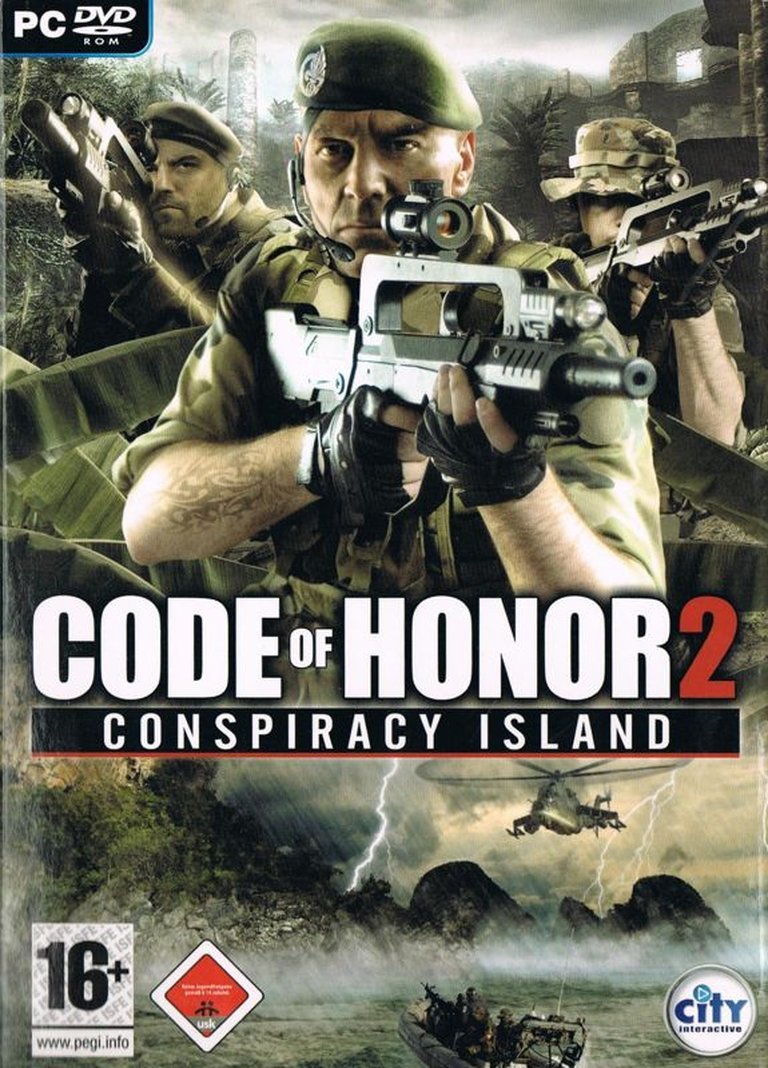
Code of Honor 2: Conspiracy Island is a first-person shooter set in French Guiana, where players take on the role of Claude Boulet, a soldier of the French Foreign Legion. The game follows Boulet as he battles rebels from the Global Liberation Front who have seized a secret science base on Ile Royale, a former prison island. The rebels threaten to detonate the base’s nuclear reactor, and it’s up to the player to stop them. The game features a continuous, mission-driven narrative that takes players through caves, an old prison, and the research laboratory itself, culminating in intense combat scenarios, including battles against helicopters.
Gameplay Videos
Code of Honor 2: Conspiracy Island Free Download
Code of Honor 2: Conspiracy Island Cracks & Fixes
Code of Honor 2: Conspiracy Island Reviews & Reception
metacritic.com (32/100): A triumphant return to form for the series.
gamesradar.com (36/100): It’s short, it’s bland, and it’s got all the ingredients to be PC Gamer’s most generic shooter of ’08.
mobygames.com (40/100): Budget titles have some rules too. Unfortunately the makers of Conspiracy Island know all the bad ones – clichéd plot and characters, wooden animation, prefabricated levels – and just one good: lots of action!
Code of Honor 2: Conspiracy Island Cheats & Codes
PC
While playing, press the Talk button (default key is T), then type any of the following codes and press [Enter].
| Code | Effect |
|---|---|
| god | God Mode |
| ammo | Full Ammo |
| kfa | All Weapons and Ammo |
| guns | All Weapons |
| tears | Unlimited Ammo |
| poltergeist | Ghost Mode |
| maphole | Skip Level |
| health | Full health |
| gimmegun [name] | Spawn weapon |
Code of Honor 2: Conspiracy Island: A Forgotten Relic of Budget FPS History
Introduction
In the annals of first-person shooter history, Code of Honor 2: Conspiracy Island (2008) stands as a curious artifact—a game that, despite its ambitions, became a footnote in the genre’s evolution. Developed by City Interactive and published under the same banner, this sequel to Code of Honor: The French Foreign Legion (2007) attempted to carve out a niche in the crowded military shooter market of the late 2000s. Yet, its legacy is one of missed potential, technical limitations, and a cautionary tale about the challenges of competing in an era dominated by titans like Call of Duty and Half-Life 2.
This review aims to dissect Code of Honor 2 with the precision of a historian’s scalpel, examining its development, narrative, gameplay, and reception to understand why it remains a largely overlooked title. Was it a victim of its budget constraints, or did it fail to innovate in a genre that was rapidly evolving? Let’s embark on this journey through the jungles of French Guiana and the corridors of Ile Royale to find out.
Development History & Context
The Studio Behind the Game
City Interactive, a Polish developer and publisher, was no stranger to the budget shooter market by 2008. Founded in 2002, the studio had built a reputation for churning out military-themed first-person shooters, often leveraging licensed engines to keep costs low. Code of Honor 2 was no exception, utilizing the LithTech Jupiter EX engine—a modified version of the engine that powered F.E.A.R. (2005) and Condemned: Criminal Origins (2005). While the Jupiter EX engine was capable of delivering impressive physics and lighting effects, City Interactive’s implementation in Code of Honor 2 was decidedly lackluster, a testament to the studio’s budgetary constraints and perhaps a lack of technical prowess.
The game’s development was helmed by a team of 103 individuals, with key figures including CEO Marek Tymiński, Director of Development Leszek Kobyliński, and Lead Game Designer Michał Sadowski. The team’s experience was primarily rooted in budget titles, and Code of Honor 2 was part of a broader strategy to capitalize on the popularity of military shooters without the resources of larger studios like Infinity Ward or Valve.
The Gaming Landscape of 2008
The late 2000s were a golden age for first-person shooters. Call of Duty 4: Modern Warfare (2007) had revolutionized the genre with its cinematic presentation and tight gameplay, while Half-Life 2: Episode Two (2007) and BioShock (2007) pushed narrative and atmospheric boundaries. Even Crysis (2007) had set a new benchmark for graphical fidelity and open-ended gameplay.
Into this fray stepped Code of Honor 2, a game that, on paper, had the trappings of a modern military shooter: a tropical setting, a nuclear threat, and a protagonist from the French Foreign Legion. Yet, it lacked the polish, innovation, and sheer production value of its contemporaries. The game’s budget pricing—often retailing for around $20—reflected its position as a “B-tier” title, aimed at gamers who couldn’t afford or didn’t want to invest in the latest AAA blockbusters.
Technological Constraints
The LithTech Jupiter EX engine, while powerful, was not without its limitations. City Interactive’s use of the engine in Code of Honor 2 was hampered by several factors:
- Graphical Fidelity: Despite the engine’s capabilities, Code of Honor 2 suffered from muddy textures, blocky character models, and inconsistent lighting. The game’s tropical environments, which should have been lush and vibrant, often felt sterile and repetitive.
- Physics and AI: While the engine supported advanced physics, the AI in Code of Honor 2 was rudimentary. Enemies often stood still or moved predictably, making combat feel more like a shooting gallery than a tactical engagement.
- Optimization Issues: The game was plagued by technical problems, including long load times, frequent crashes, and compatibility issues with newer hardware. These issues were exacerbated by the game’s reliance on the GameSpy multiplayer service, which has since been shuttered.
In many ways, Code of Honor 2 was a victim of its era—a game caught between the technological advancements of the late 2000s and the budget constraints of a mid-tier studio.
Narrative & Thematic Deep Dive
Plot Overview
Code of Honor 2: Conspiracy Island follows Claude Boulet, a soldier of the French Foreign Legion, as he is deployed to Ile Royale, a former prison island off the coast of French Guiana. The island is home to a secret research facility housing an experimental nuclear reactor. When the Global Liberation Front (GLF), a terrorist organization, seizes control of the facility and threatens to detonate the reactor, Boulet is sent in to neutralize the threat.
The game’s narrative is straightforward, lacking the depth and complexity of contemporaries like BioShock or Half-Life 2. There are no real missions in the traditional sense; instead, the game unfolds as a single, continuous operation, with Boulet progressing through caves, prisons, and laboratories in pursuit of the GLF. The story is delivered through a series of in-game cutscenes and radio chatter, but the dialogue is often ham-fisted, and the voice acting ranges from serviceable to downright wooden.
Characters and Dialogue
Claude Boulet is a generic protagonist, lacking the charisma or depth of characters like Half-Life’s Gordon Freeman or Call of Duty’s Captain Price. His interactions with other characters are minimal, and the game’s supporting cast—comprising fellow Legionnaires and GLF terrorists—are equally forgettable.
The dialogue in Code of Honor 2 is particularly noteworthy for its lack of polish. Lines are often delivered with little emotional inflection, and the subtitles frequently fail to sync with the spoken words. The GLF terrorists, who speak in heavily accented English and Spanish, come across as caricatures rather than credible threats. The game’s attempt to inject tension through radio chatter and in-game banter falls flat, leaving the narrative feeling hollow and unengaging.
Themes and Setting
At its core, Code of Honor 2 is a game about military intervention and the fight against terrorism—a theme that was prevalent in post-9/11 media. However, the game does little to explore these themes in any meaningful way. The GLF is portrayed as a faceless, one-dimensional enemy, and the French Foreign Legion is depicted as a heroic force with little moral ambiguity.
The setting of French Guiana and Ile Royale is underutilized. While the tropical environment and the island’s history as a penal colony could have provided rich opportunities for world-building, the game’s levels are largely linear and devoid of atmosphere. The caves, prisons, and laboratories that Boulet traverses feel more like generic shooter set pieces than lived-in spaces.
The “Conspiracy” That Wasn’t
One of the most glaring issues with Code of Honor 2 is its title. The game’s subtitle, Conspiracy Island, suggests a narrative filled with intrigue and hidden agendas. However, the game’s plot is remarkably straightforward, with no real conspiracy to uncover. The GLF’s motives are clear from the outset, and there are no twists or revelations to speak of. This disconnect between the game’s title and its actual content is emblematic of its broader identity crisis—a game that promises more than it delivers.
Gameplay Mechanics & Systems
Core Gameplay Loop
Code of Honor 2 is, at its heart, a linear first-person shooter. The gameplay revolves around moving from one objective to the next, engaging in firefights with GLF terrorists, and occasionally solving simple environmental puzzles (e.g., flipping switches, opening doors). The game’s structure is reminiscent of early 2000s shooters like Medal of Honor or Call of Duty, but it lacks the polish and variety of those titles.
The game’s combat is functional but uninspired. Boulet has access to a range of weapons, including the FAMAS assault rifle, the H&K MP5 submachine gun, and the Mossberg shotgun. Each weapon has a distinct feel, but the lack of enemy variety and the rudimentary AI make combat feel repetitive. Enemies often stand in the open or move predictably, making it easy to dispatch them with little strategy.
Combat and AI
The AI in Code of Honor 2 is one of its weakest aspects. Enemies exhibit basic behaviors—taking cover, flanking the player, and occasionally retreating—but these actions are often telegraphed and easy to counter. The game’s difficulty is further undermined by the regenerating health system, which allows Boulet to recover from damage simply by avoiding fire for a few seconds. This mechanic, while common in modern shooters, feels out of place in a game that otherwise adheres to a more traditional FPS design.
The game’s “Covert Fire System,” touted as a key feature, is little more than a basic lean mechanic. Players can take cover behind objects and peek out to fire, but the system lacks the depth and tactical options of games like Gears of War or Rainbow Six. The result is a combat experience that feels shallow and unengaging.
Character Progression and Customization
Code of Honor 2 features no meaningful character progression or customization. Boulet’s abilities remain static throughout the game, and there are no upgrades or skill trees to explore. The only form of progression comes from acquiring new weapons, but even this is limited by the game’s small arsenal.
User Interface and Controls
The game’s UI is functional but unremarkable. The HUD provides basic information—health, ammo, and objectives—but lacks the polish of contemporary titles. The controls are standard for an FPS, with WASD movement and mouse-based aiming, but the lack of customization options (e.g., key rebinding, sensitivity adjustments) is a notable oversight.
Multiplayer
Code of Honor 2 includes a multiplayer mode, featuring standard modes like Deathmatch, Team Deathmatch, and Capture the Flag. However, the multiplayer experience is hampered by several issues:
- Server Population: Even at launch, the game struggled to maintain a healthy player base. Finding a match was often difficult, and the few servers that were active were sparsely populated.
- Technical Issues: The multiplayer mode suffered from the same technical problems as the single-player campaign, including crashes, lag, and compatibility issues.
- Lack of Innovation: The multiplayer modes are bare-bones, offering little to distinguish Code of Honor 2 from other shooters of the era. The maps are lifted directly from the single-player campaign, and there are no unique multiplayer-specific features.
The multiplayer component of Code of Honor 2 feels like an afterthought—a checkbox feature included to meet genre expectations rather than a fully realized experience.
World-Building, Art & Sound
Setting and Atmosphere
Code of Honor 2’s setting—French Guiana and the island of Ile Royale—is rich with potential. The tropical environment, the history of the penal colony, and the secret research facility could have provided a compelling backdrop for a military thriller. However, the game fails to capitalize on this potential.
The levels in Code of Honor 2 are largely linear and devoid of atmosphere. The caves, prisons, and laboratories that Boulet traverses feel more like generic shooter set pieces than lived-in spaces. The tropical environment is underutilized, with little in the way of environmental storytelling or immersive details. The result is a world that feels sterile and forgettable.
Visual Direction
The game’s visual direction is a mixed bag. On one hand, the LithTech Jupiter EX engine is capable of delivering impressive lighting and physics effects. The game’s use of dynamic shadows and destructible cover is notable, but these features are undercut by the game’s muddy textures and blocky character models.
The character models in Code of Honor 2 are particularly lackluster. Enemies are often indistinguishable from one another, and the animations are stiff and unnatural. The game’s tropical environments, while occasionally visually striking, are marred by repetitive textures and a lack of detail.
Sound Design
The sound design in Code of Honor 2 is one of its few bright spots. The weapon sounds are particularly well-done, with the FAMAS assault rifle and Mossberg shotgun delivering satisfying audio feedback. The game’s ambient sounds—jungle noises, distant gunfire, and the hum of machinery—are also effective, if underutilized.
However, the voice acting and dialogue are a significant weak point. The lines are often delivered with little emotional inflection, and the subtitles frequently fail to sync with the spoken words. The GLF terrorists, who speak in heavily accented English and Spanish, come across as caricatures rather than credible threats.
Reception & Legacy
Critical Reception
Code of Honor 2: Conspiracy Island was met with overwhelmingly negative reviews from critics. The game holds a Metacritic score of 32/100, based on six critic reviews, and a user score of 3.7/10. Critics universally panned the game for its lack of innovation, technical issues, and forgettable narrative.
- Worth Playing (4.3/10): “Not every shooter has to be a triple-A title of the first order, but there really isn’t much to Code of Honor 2: Conspiracy Island’s shooting-gallery action that hasn’t been done better by today’s discounted specials or even by the venerable classics.”
- IGN (3/10): “But since this is a PC game, and since there are about three billion better shooters out there, there’s not much, if anything, to redeem Code of Honor 2.”
- GameZone (3.1/10): “Easily one of the worst FPS I have ever played, and the fact that the game is so short is a second slap in the face.”
The few positive reviews came from players who appreciated the game’s budget pricing and straightforward gameplay. However, even these reviews acknowledged the game’s numerous flaws.
Commercial Performance
Code of Honor 2 was a commercial failure, struggling to find an audience in a market dominated by AAA shooters. The game’s budget pricing and lack of marketing support further hindered its commercial prospects. While exact sales figures are unavailable, the game’s lack of cultural impact and its rapid disappearance from retail shelves suggest that it failed to recoup its development costs.
Legacy and Influence
Code of Honor 2 has had little to no influence on the first-person shooter genre. The game’s lack of innovation, technical issues, and forgettable narrative ensured that it would be quickly forgotten by both players and developers. The Code of Honor series itself was short-lived, with Code of Honor 3: Desperate Measures (2009) serving as the final entry in the trilogy.
In the years since its release, Code of Honor 2 has become a cautionary tale about the challenges of competing in a genre dominated by AAA titles. The game’s failures highlight the importance of innovation, polish, and narrative depth in creating a successful first-person shooter.
Conclusion
Code of Honor 2: Conspiracy Island is a game that promised much but delivered little. Its straightforward narrative, uninspired gameplay, and technical issues ensured that it would be quickly forgotten in the annals of first-person shooter history. While the game’s budget pricing and straightforward gameplay may have appealed to a niche audience, its lack of innovation and polish ultimately doomed it to obscurity.
In the final analysis, Code of Honor 2 is a relic of its era—a game caught between the technological advancements of the late 2000s and the budget constraints of a mid-tier studio. It serves as a reminder of the importance of innovation, polish, and narrative depth in creating a successful first-person shooter. For historians and enthusiasts of the genre, Code of Honor 2 is a fascinating case study in what happens when ambition outstrips execution.
Final Verdict: 4/10 – A forgettable footnote in FPS history.