
- Release Year: 2005
- Platforms: PlayStation 2, Windows, Xbox
- Publisher: Akella, Ubisoft Entertainment SA
- Developer: Darkworks S.A.
- Genre: Action, Survival horror
- Perspective: Third-person
- Game Mode: Single-player
- Gameplay: Puzzle elements, Survival horror
- Setting: Arctic, Boat, North Pole, Ship
- Average Score: 71/100
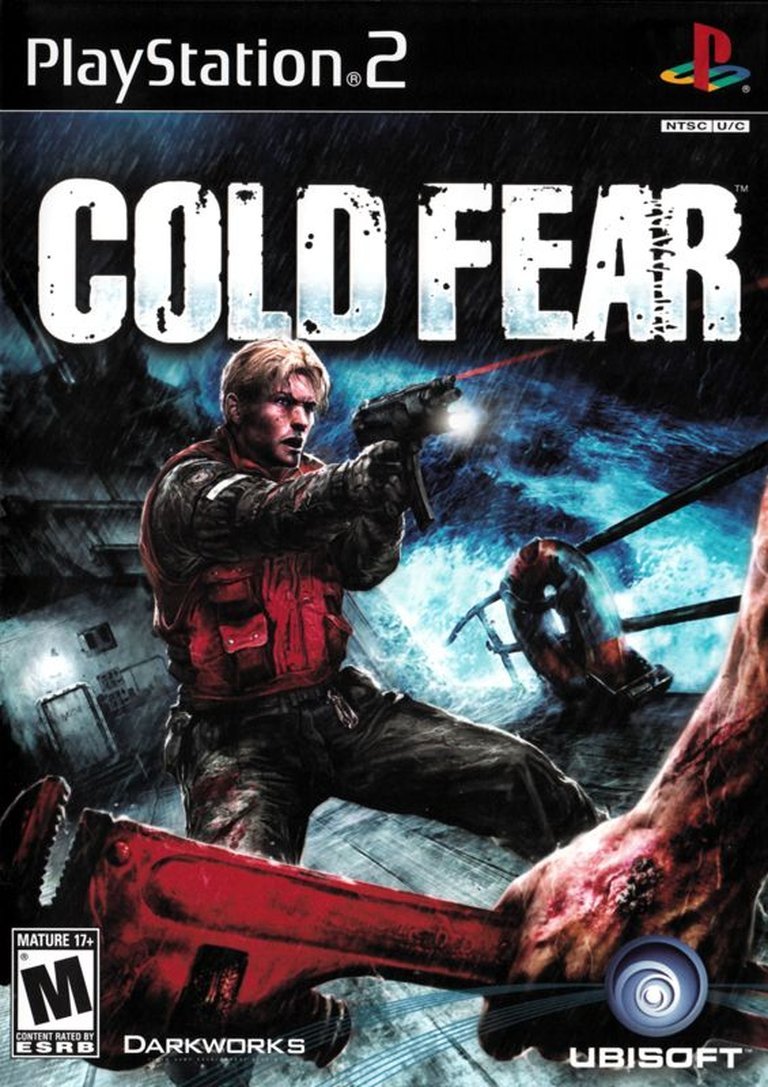
Description
Veteran USCG Tom Hansen boards a storm-ravaged Russian whaler where his Coast Guard team is slaughtered by mysterious creatures, forcing him to uncover the truth behind the slaughter while investigating the ship’s connection to the abandoned Russian scientific drilling platform ‘Star of Sakhalin’ in this third-person survival horror adventure featuring combat, puzzles, and a narrative-driven experience.
Gameplay Videos
Where to Buy Cold Fear
PC
Cold Fear Free Download
Cold Fear Cracks & Fixes
Cold Fear Patches & Updates
Cold Fear Mods
Cold Fear Guides & Walkthroughs
Cold Fear Reviews & Reception
metacritic.com (71/100): It’s good quality and fans of the genre will definitely gain some enjoyment. While not quite as classic or exciting as Resident Evil, it measures up well and is worth a look for horror nuts.
imdb.com (70/100): This is effectively scary and exciting, and the music isn’t bad. You get into it quickly, and I can’t deny that it’s quite addictive.
ign.com (76/100): COLD FEAR renews the horror genre by combining the popular elements of both action and horror releases, delivering an action-packed, fear-filled gaming experience.
mobygames.com (70/100): A fun, addicting game that’s certainly worth the try.
Cold Fear Cheats & Codes
PlayStation 2 (Button Sequence)
At the ‘Press Start’ screen, press the following buttons: Circle, Up, Square, Triangle, Right, Down.
| Code | Effect |
|---|---|
| Circle, Up, Square, Triangle, Right, Down | Enables Cheat Mode (indicated by a gun sound). |
PlayStation 2 (CodeBreaker)
Requires CodeBreaker V7 or higher. The ‘Enable Code’ must be active for the other codes to work.
| Code | Effect |
|---|---|
| B4336FA9 4DFEFB79 00E81797 99DE57A5 2DBA4D99 1693FBAE C4F5071C 32DA32C2 |
Enable Code (Master Code – Must Be On) |
| 8E26339C C51E6DE4 32F253FC 2D227C61 |
Infinite Health |
| 2C4D9475 D755EF85 | Infinite Ammo (All Weapons) |
| DC4D314E DC4B4041 | Max Infinite Ammo (All Weapons) |
| 7A8DBBA7 45E3F436 | Extra Ammo (All Weapons) |
| 5C669FE6 F506698B | Never Reload (All Weapons) |
| D07BFF74 E4FE18DA | Infinite Resistance |
| 0BB38382 A13100B8 | Unlock Extreme Difficulty |
PlayStation 2 (Action Replay MAX)
Requires Action Replay MAX device. Master codes must be enabled.
| Code | Effect |
|---|---|
| 6720-Q00K-ECR4N 84CZ-C9HK-E189P |
Master Code (Must Be On) |
| M46U-R37E-WTFWN HVMV-PYUN-N6TFN J0E1-QQ3J-5V7BX |
Master Code (Must Be On) |
| N022-R3AJ-YYBNE NPC8-FC4T-26BBA |
Never Reload |
| M38M-3THY-AQVV9 WH06-QC7Q-TTJ05 |
Infinite Ammo |
| WN56-H437-83N7N 3PHQ-PCEC-GYJA9 NK9Z-33MN-D65GV GQHX-RT1W-BY4YJ KW6T-DMPF-Z8VZQ 180F-0C0F-3VV3Y EMWT-90NR-E8K4V |
Infinite Health |
| BW9Q-YCCR-DNMMR VU44-DRT2-35MKT GYNB-PTQX-WMQR3 5K18-D4PM-N4QX6 |
Infinite Ammo/No Reload |
| Z0QX-BXB4-K2KHU H95K-E2MU-PX3WQ |
Infinite Resistance |
| Z95X-MRFN-U2ZWJ 9NGV-TA7U-R5X1H |
All Bonus Material Open |
PlayStation 2 (GameShark)
Requires GameShark device. Master code must be entered first.
| Code | Effect |
|---|---|
| 9802CDE6 – 78A38D99 | Master Code (Must Be On) |
| 282248ED – DBA513E5 | Infinite Resistance |
| 280568AF – 6F8A7A65 280568F1 – 6F.. |
Infinite Ammo |
Cold Fear: Review
Introduction
In the shadow of Capcom’s genre-redefining Resident Evil 4, Ubisoft’s Cold Fear arrived in March 2005 as a survival horror vessel adrift in turbulent seas. Developed by Darkworks—the studio behind the cult classic Alone in the Dark: The New Nightmare—it promised a novel premise: a Coast Guard investigation of a parasite-infested Russian whaler amidst a brutal Arctic storm. While its technical ambition and atmospheric intensity earned fleeting praise, Cold Fear ultimately sank into mediocrity, overshadowed by its celebrated contemporary and hampered by derivative design. This review dissects its development history, narrative ambitions, mechanical innovations, artistic execution, and legacy to argue that Cold Fear represents a tragic case of unrealized potential—a game brilliant in moments yet crippled by rushed production and thematic stagnation.
Development History & Context
Cold Fear emerged from Darkworks’ Parisian studios as the studio’s second major project following Alone in the Dark: The New Nightmare (2001). Initially conceived as the fifth entry in the Alone in the Dark series, it pivoted to a standalone IP to explore new creative territory. Announced at E3 2004 under publisher Namco, the project was swiftly acquired by Ubisoft, marking the French giant’s inaugural foray into survival horror. This shift injected resources but also intensified market pressures, as the game launched just two months after Resident Evil 4‘s genre-redefining debut.
Technically, Cold Fear was a marvel of mid-2000s engineering. To simulate the Eastern Spirit‘s violent pitching and rolling, Darkworks developed a proprietary “Darkwave editor,” enabling unprecedented control over vertical and horizontal ship movement. As programmer Claude Levastre detailed, this system required creating nine times the usual character animations to compensate for sliding and staggering, resulting in over 900 distinct animations for protagonist Tom Hansen alone. Physics-based environmental hazards—swinging wires, crashing waves, and sliding crates—reacted dynamically to the storm, turning the deck into a lethal obstacle course. RenderWare engine facilitated a multi-platform release for PlayStation 2, Xbox, and PC, though the latter suffered from infamously flawed copy protection that Ubisoft later patched.
Yet the development timeline was perilously short. Announced in mid-2004 and released within 14 months, Cold Fear lacked the polish of peers. Its 5–6 hour runtime and narrative rush in the second act reflected this crunch, as the team grappled with replicating RE4‘s success while carving its own identity. This tension between ambition and execution defines the game’s legacy.
Narrative & Thematic Deep Dive
The narrative follows Coast Guard veteran Tom Hansen, a former Army Special Forces member, as he investigates the Eastern Spirit, a Russian whaler broadcasting a distress signal in the Bering Strait. Upon boarding, Hansen discovers a crew transformed into grotesque “Exos” by parasitic Exocels that burrow into hosts and reanimate them. The plot unfolds through geopolitical intrigue: Russian mafia colonel Dmitriy Yusupov exploited Exocels as bioweapons, while Dr. Viktor Kamsky, a rogue scientist, experiments with human mutation. CIA agent Jason Bennett’s involvement adds layers of conspiracy, framing the outbreak as a potential arms race.
Thematic threads explore scientific hubris and the corruption of power. Kamsky’s journals reveal a descent into madness as he prioritizes parasitic “evolution” over ethics, while Yusupov’s greed catalyzes disaster. Body horror permeates the Exocels’ transformations—hosts become multi-limbed abominations, embodying the parasites’ invasive nature. Yet the narrative falters in execution. The CIA subplot feels underdeveloped, Kamsky’s motivations are paper-thin, and dialogue is wooden, with Hansen’s stoicism undercutting emotional resonance. Key moments—like Anna Kamsky’s infection or Kamsky’s final mutation—lack the gravitation to elevate the story beyond B-movie tropes. The rushed finale leaves loose ends, and the “damsel in distress” trope for Anna feels antiquated, diminishing the game’s potential for deeper existential horror.
Gameplay Mechanics & Systems
Cold Fear‘s gameplay splits between survival horror tension and third-person shooter action, epitomized by its dual-camera system: a fixed, Resident Evil-style perspective or an over-the-shoulder view. This duality creates a schizoid experience—fixed cameras evoke classic dread, while shoulder-view aiming facilitates combat, presaging RE4‘s innovations but feeling disjointed.
Core gameplay revolves around resource scarcity. With no inventory, health kits and ammo are used immediately, streamlining management but sacrificing strategic depth. Combat emphasizes precision: Exos can be knocked down but revive unless decapitated via headshots or stomping. This mechanic adds weight to encounters but highlights enemy variety—Exoshades blind but sound-sensitive, Exospectres phase invisibly, and Exomasses are hulking brutes with single weak points. Human mercenaries introduce gunplay, though their AI is rudimentary.
The Eastern Spirit‘s storm is the game’s masterstroke. Constant heaving makes aiming an ordeal, and Hansen must grab railings to steady himself. Falling overboard triggers a stamina-based minigame, while environmental hazards—swinging crates, electrified water—add chaos. This dynamism diminishes in the oil rig’s static interiors, however. The Resistance gauge, depleting during running or grappling, adds tension but feels punitive, especially when paired with the inability to run while aiming. Checkpoint saves are sparse, and the lack of a map frustrates navigation in repetitive industrial corridors. Boss fights, like the mutated Kamsky, devolve into repetitive patterns, undermining earlier intensity.
World-Building, Art & Sound
Cold Fear‘s greatest triumph is its atmosphere. The storm-tossed whaler is a tour de force of environmental design, rendered with gritty realism. Waves crash against the hull, rain obscures the camera, and metal groans under stress. Textures—from rusted pipes to flickering lights—immerse players in decay. The oil rig’s sterile labs offer thematic contrast but lack the outdoor set pieces’ dynamism.
Sound design elevates tension: Tom Salta’s score blends industrial percussion with strings, while ambient skittering, wind howls, and distant gunfire create unease. Marilyn Manson’s “Use Your Fist and Not Your Mouth” underscores aggression, though its placement feels anachronistic. Voice acting is mixed—Hansen’s stoicism and Russian accents lend authenticity, but dialogue is stilted.
World-building thrives on scattered documents. Kamsky’s journals detail Exocel experiments on dogs, orcas, and humans, while Yusupov’s logs expose mafia ties and paranoia. This supplementary storytelling enriches lore but is undermined by linear design, limiting environmental storytelling beyond the ship.
Reception & Legacy
Cold Fear received mixed-to-negative reviews, with scores reflecting its flawed execution: 68 on Metacritic (PS2), 71 (Xbox), and 66 (PC). Critics praised the ship’s physics and opening atmosphere but criticized generic interiors, brevity, and lack of innovation. IGN noted its “solid little thriller” mechanics but lamented its derivative nature, while GameSpot derided it as “atmospherically derivative.” The Xbox version fared best due to smoother controls, but the PC port’s copy protection woes damaged its reputation.
Commercially, the game sank, selling only 70,000 units in the U.S. by 2006. Its failure was compounded by Resident Evil 4‘s dominance, cementing Cold Fear as an “also-ran.” Legacy-wise, it’s remembered for technical ambition—its environmental dynamics and camera system presaged trends in Resident Evil: Revelations—but rarely cited as an influence. Atari’s 2025 acquisition of the IP led to a GOG.com re-release, a belated nod to its cult appeal.
Conclusion
Cold Fear is a survival horror paradox: a technically ambitious masterpiece in its opening act yet a perfunctory slog thereafter. Darkworks’ ship physics and atmosphere remain chillingly effective, but rushed development and thematic inertia prevent greatness. It stands as a cautionary tale about releasing in the shadow of a genre titan—a game that dared to innovate mechanically but faltered narratively. For historians, it’s a vital study in ambition’s limits; for players, it’s a flawed gem worth revisiting for its Arctic dread. Ultimately, Cold Fear is less a classic and more a chilling reminder that even the most polished ship can founder if its narrative compass breaks.