
- Release Year: 1999
- Platforms: Macintosh, Windows
- Publisher: Encore Software, Inc.
- Developer: Contraband Entertainment, Inc
- Genre: Action
- Perspective: 1st-person
- Game Mode: Single-player
- Gameplay: Arcade, Rail shooter, Shooter
- Setting: Old West, Western
- Average Score: 49/100
Description
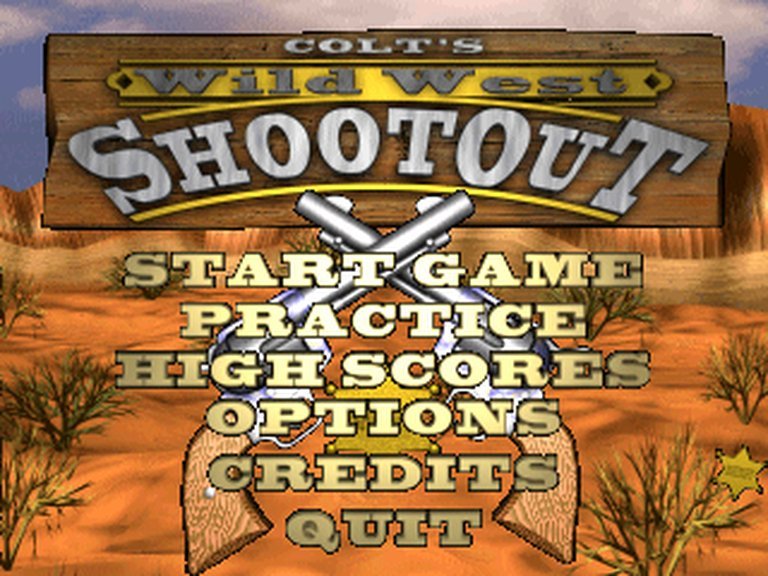
Colt’s Wild West Shootout is a first-person rail shooter set in the Wild West, where players control a sheriff tasked with stopping desperadoes robbing the Red River Bank. The character automatically advances through four levels—a town, church, train, and mine—shooting enemies that emerge from cover with a revolver (manual reload, unlimited ammo) or limited special weapons like shotguns, while avoiding civilians, collecting health-restoring potions represented by sheriff’s stars, and facing boss battles against historical outlaws like Billy the Kid and Jesse James who throw projectiles and require multiple hits.
Gameplay Videos
Colt’s Wild West Shootout Free Download
Colt’s Wild West Shootout Reviews & Reception
myabandonware.com (87/100): A Great railshooter
Colt’s Wild West Shootout: Review
Introduction
Imagine stepping into the dusty streets of Red River, revolver in hand, as a lone sheriff facing down a ruthless gang of outlaws—echoes of Sergio Leone films and arcade cabinets promising quick-draw glory. Released in 1999, Colt’s Wild West Shootout aimed to deliver that fantasy through a licensed rail shooter branded by the iconic Colt Firearms company. Developed by the modest Contraband Entertainment and published by Encore Software, this PC (and Macintosh) title promised “fast arcade action so real you’ll swear you’re in the old wild west.” Yet, as a game historian, I see it less as a timeless classic and more as a curious artifact of late-’90s budget gaming: a fleeting nod to rail-shooter heyday that buckles under its own brevity and simplicity. My thesis? While it captures a sliver of Western shootout thrill in an era craving light-gun alternatives for PC, its lack of depth, replayability, and polish renders it a forgettable footnote—playable nostalgia for abandonware enthusiasts, but a cautionary tale of licensed ambition gone awry.
Development History & Context
Contraband Entertainment, Inc., a small California-based studio, crafted Colt’s Wild West Shootout amid the late 1990s PC gaming boom, where arcade ports and light-gun shooters like The House of the Dead (1996) and Point Blank dominated arcades but struggled on home PCs without dedicated hardware. Led by CEO Michael Bell, with project management from Lynette Latta and production by Josh Hackney, the team included 17 developers and testers like Rebecca Ann Heineman (a veteran with credits on 66+ games, including Redneck Rampage), Richard J. Lowenthal (52 credits), and Nate Trost (41 credits). Special thanks went to Colt historian Kathy Hoyt, underscoring the licensed tie-in with Colt’s .45 Single Action Revolver, Long-Barreled Peacemaker, and Fast Action Rifle—real-world firearms marketed through gameplay.
Technological constraints were stark: built for Windows 95/98 (Pentium II 300 MHz recommended, 64 MB RAM), it shipped on CD-ROM with mouse or joystick input, eschewing light guns for accessibility. The gaming landscape was shifting—3D FPS giants like Quake III Arena (1999) and Half-Life (1998) ruled, while rail shooters filled budget bins as Lethal Enforcers sequels and Time Crisis inspired quick-play alternatives. Encore Software, known for edutainment, positioned this as a $15 impulse buy, leveraging Western nostalgia post-Red Dead Revolver‘s eventual rise. Development emphasized arcade simplicity over innovation, with quality assurance by Kalan Kier’s team (testers like Amy Kong and Josh Hartwell). Cross-platform Mac support hinted at broader appeal, but low production values—evident in pixelated 2D sprites and looping MIDI tunes—betrayed its shoestring budget. Released around September-October 1999, it arrived as abandonware-ready obscurity, preserved today via sites like MyAbandonware and Archive.org, runnable on modern Windows only with hacks like DgVoodoo or resolution tweaks.
Narrative & Thematic Deep Dive
Colt’s Wild West Shootout boasts a narrative as sparse as a frontier ghost town: you’re an unnamed sheriff thwarting desperadoes robbing the Red River Bank. No cutscenes, voiceovers, or branching paths—just inter-level text screens framing four non-linear stages (town, church, train, mine) culminating in boss duels against historical outlaws like Jesse James, Billy the Kid, Clay Allison, and Black Bart. The plot unfolds via on-rails progression: your character auto-advances, halting at shootouts where “arrests” (euphemism for graphic screams) unfold. Themes draw from mythic Western tropes—law vs. chaos, quick justice amid moral ambiguity—but ring hollow without depth.
Characters are archetypes: faceless bandits pop from cover, civilians cower (shoot them, lose health), and bosses hurl projectiles while tanking hits, evoking showdowns with larger-than-life legends. Dialogue? Nonexistent beyond pain yelps and twangy exclamations. The Colt license infuses authenticity—Peacemaker revolver as default weapon—but VPC critiques highlight promotional undertones, framing violence as heroic amid gun glorification (“Be quick or be dead”). Subtextually, it romanticizes vigilantism, sidestepping historical nuance (e.g., Billy the Kid’s youth or Jesse James’ folk-hero status) for arcade pulp. No progression arc or emotional stakes; it’s a power fantasy stripped bare, mirroring budget shooters’ disregard for story. As historian, I note its “licensed” tag as cynical tie-in marketing, prioritizing brand over substance in an era when games like Gunfighter: The Legend of Jesse James (2001) attempted deeper Western yarns.
Gameplay Mechanics & Systems
At its core, Colt’s Wild West Shootout is a pure rail shooter: first-person view auto-scrolls through levels, pausing at arenas for pop-up combat. Primary loop—aim, shoot, reload, survive—relies on mouse/joystick crosshair precision. Default Colt revolver offers unlimited ammo but demands manual cylinder reloads (six-shot bursts), adding tension amid swarms. Pickups like shotguns (wide spread) or rifles (powerful but scarce) spice variety, while potions restore sheriff-star health (start with three; hits from bullets or innocents deduct one).
Core Systems Breakdown:
– Combat Loop: Enemies emerge predictably from barrels/corners; quick target ID is key. Bosses innovate slightly—dodge/shoot thrown dynamite/objects, multi-hit health bars demand sustained fire.
– Progression: Four levels (non-linear order) + saloon practice (bottle-breaking tutorial). Difficulty scales enemy speed/aggression, but no unlocks, secrets, or scores persist.
– UI/Controls: Clean HUD (ammo counter, stars, crosshair) shines; mouse feels floaty sans aim-assist, joystick better for authenticity. No multiplayer/offline co-op (1-player only).
– Innovations/Flaws: Practice mode builds muscle memory; civilian avoidance adds risk-reward. But patterns repeat—IGN likened it to “Whack-a-Mole”—yielding mastery in minutes. Total playtime: 10-20 easy, 30 max difficulty. No secrets/bonuses exhausts replayability; reload clunkiness frustrates without auto-fire.
Flawed by brevity, it nails arcade reflexes but fumbles longevity, a relic of pre-Time Crisis design ignoring procedural variety.
World-Building, Art & Sound
The Old West setting—Red River town, haunted church, rattling train, shadowy mine—evokes B-movie grit via static 2D backdrops. Pixelated sprites (grainy humans, wooden props) and limited palette scream low-budget 1999 tech, with smooth animations belying archaic resolution (320×240/640×480 native; modern runs windowed/tiny sans tweaks). Atmosphere builds via dim lighting, dust motes, and era-appropriate clutter (wagons, pews, rails), immersing briefly despite pixelation.
Art direction prioritizes functionality: enemies cartoonishly pop, explosions sprite-based, Colt guns crisply detailed for licensing. No dynamic weather/cycles; repetition dulls wonder.
Sound design fares mixed: Sharp gunshots/reloads satisfy, villain screams visceral (VPC-noted “kills” as arrests). Voice acting is sparse but fitting—grunts, taunts. Music? Looping banjo/piano (“She’ll Be Coming ‘Round the Mountain,” “Red River Valley”) grates, per IGN’s “bad piano” rage, undermining tension. Overall, elements coalesce for guilty-pleasure nostalgia, but cheapness permeates—functional Western diorama, not immersive frontier.
Reception & Legacy
Launch reception was dismal: MobyGames aggregates 30% critics (IGN’s Trent C. Ward: 3.9/10, blasting 20-30 minute runtime, “no long-term gameplay,” Whack-a-Mole tedium; Hacker: 20/100, equating it to preferring rat-infested basements). One player score: 1.7/5. No Metacritic aggregate; budget status ($15 CD-ROM) excused graphics/music but not emptiness. Commercial flop—collected by 3 MobyGames users, now abandonware (MyAbandonware 4.33/5 from niche fans praising rail fun).
Legacy? Minimal. No direct sequels/influence; overshadowed by Red Dead Redemption (2010) era-defining Westerns or Call of Juarez (2006). Staff scattered—Heineman to broader ports. As Colt licensee, it exemplifies firearms marketing (VPC study), prefiguring debates on games/guns. Preserved via emulation (Win2000/VMware/DgVoodoo), it’s retro curiosity for rail-shooter completists, akin Wild West Shootout (2010 Wii). No industry ripple; a blip amid 1999’s Unreal Tournament dominance.
Conclusion
Colt’s Wild West Shootout distills rail-shooter essence—reflexive shootouts, Western flair—into a 30-minute curiosity, bolstered by Colt licensing and solid core loop yet crippled by repetition, brevity, and budget visuals/audio. Contraband’s effort captures arcade spirit sans evolution, earning panning as disposable. In video game history, it occupies “forgotten budget bin” tier: playable relic for abandonware divers, warning against licensed shortcuts. Verdict: 2/10—skip unless craving pixelated Peacemaker nostalgia; true Wild West awaits Red Dead. A sheriff’s badge tarnished by time.