
- Release Year: 2003
- Platforms: Macintosh, Windows
- Publisher: 1C Company, Akella, Battlefront.com, Inc., CDV Software Entertainment AG, SNEG Ltd., Snowball Studios, Strategy First, Inc.
- Developer: Battlefront.com, Inc.
- Genre: Simulation, Strategy, Tactics
- Perspective: 3rd-person
- Game Mode: Hotseat, LAN, Online PVP, Single-player
- Gameplay: Real-time, Tactical, Turn-based, Wargame
- Setting: Africa, Historical events, World War II
- Average Score: 81/100
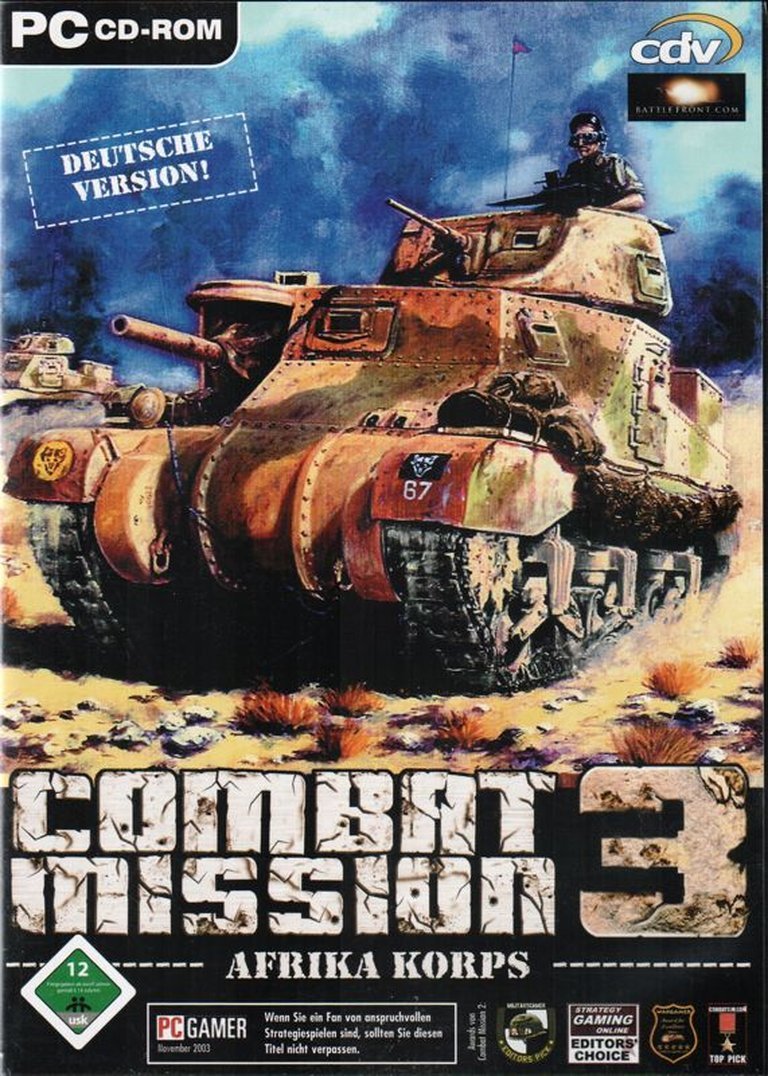
Description
Combat Mission 3: Afrika Korps is the third and final installment in the WWII Combat Mission series, shifting the focus to the North African campaign. It blends turn-based strategic planning with real-time tactical execution, where players issue timed orders during the planning phase that are resolved non-interactively, with combat realism enhanced by factors like field of view, armor plating, and precise hit point calculations.
Where to Buy Combat Mission 3: Afrika Korps
Combat Mission 3: Afrika Korps Free Download
Combat Mission 3: Afrika Korps Cracks & Fixes
Combat Mission 3: Afrika Korps Reviews & Reception
metacritic.com (81/100): While it’s a bit disappointing that Afrika Korps doesn’t address any of the weaknesses of Barbarossa to Berlin, it’s still a great wargame, and its tank-friendly and diverse environments make it the best installment in the series.
Combat Mission 3: Afrika Korps Cheats & Codes
PC
Enter the following cheats during the game.
| Code | Effect |
|---|---|
| kaboom | alle Panzer 5 mal |
| klatsch | alle Soldaten 30 mal |
| ertoios | alle Flugzeuge 2 mal |
| ihavethepower | Mission abschliessen |
| cool | Mission verlorieren |
| hello | Feindliche Einheiten laufen über |
| oooh | Strichmännchen |
| my movie | Replay speichern |
| teleport | markierte Einheit teleportieren |
Combat Mission 3: Afrika Korps: A Flawed Masterpiece of Tactical Realism
Introduction
In the pantheon of computer wargames, few titles have left as indelible a mark on the design philosophy of tactical simulation as Combat Mission 3: Afrika Korps. Released in late 2003 by the venerable boutique studio Battlefront.com, this game represents both the zenith and the stagnation of a pioneering series. It is the final installment in the original Combat Mission trilogy that redefined tactical WWII gaming, transporting the franchise’s signature hybrid turn-based/real-time system from the frozen steppes of the Eastern Front and the bocage of Normandy to the scorching sands of the North African desert, the mountains of Italy, and the cliffs of Crete. Yet, for all its historical authenticity and mechanical depth, Afrika Korps arrived to a critical chorus that largely decried it as a glorified scenario pack—a brilliant engine in desperate need of an overhaul. This review will argue that Combat Mission 3 is a profound paradox: a game that achieves unprecedented levels of battlefield verisimilitude and narrative immersion through its systems, yet one hamstrung by technological inertia, a notoriously poor AI, and an interface that remains wilfully inaccessible. Its legacy is that of a cult classic, a game loved fiercely by a dedicated niche but whose failure to evolve ultimately ceded the tactical wargame throne to more accessible, modern competitors.
Development History & Context
Studio & Vision: Combat Mission 3: Afrika Korps was developed by Battlefront.com, Inc., a studio founded by Charles Moylan and Stephen Grammont. The team was tiny by modern standards, with the core programming credited to Moylan alone and art handled by a handful of individuals including Dan Olding and Fernando J. Carrera Buil. Their vision, as articulated in the series’ foundational design document, was to create a “pseudo-realistic” tactical simulation that balanced the deliberate planning of turn-based strategy with the dynamic, unpredictable flow of real-time combat. The “Simultaneous Action Selection” (SAS) system—where players issue timed orders to all units in a “planning phase,” which are then resolved non-interactively in a “execution phase”—was their revolutionary answer to the “fog of war” and the chaos of battle.
Technological Constraints & The Era: By 2003, the Combat Mission engine, first seen in Beyond Overlord (2000), was showing its age. It was a DirectX 8/9-era product built for the era of 32-bit graphics and single-core processors. The game’s system requirements (Pentium II 233 MHz, 64MB RAM) were modest even then, but the visual fidelity—while detailed in unit modeling—was plainly dated compared to contemporaries like Blitzkrieg (2003) or the impending Call of Duty (2003). The choice to not overhaul the engine for Afrika Korps was a conscious, if controversial, one. The developers prioritized expanding the order-of-battle database and refining the simulation’s mathematical core over graphical innovation. This decision reflected both the studio’s limited resources and its unwavering commitment to the niche, hardcore wargamer who valued data over dazzle.
The Gaming Landscape: The early 2000s were a transitional period for strategy games. The real-time strategy (RTS) genre was dominated by accessible, resource-gathering epics like Warcraft 3 and Age of Mythology. The tactical wargame space was more fragmented. SSG’s Panzer General series was beloved but aging. Shrapnel’s Close Combat series was gritty and squad-focused but lacked the 3D battlefield view. Combat Mission had carved out a unique space: the “thinking man’s” tactical simulator. Its direct predecessor, Combat Mission II: Barbarossa to Berlin (2002), had been critically lauded for its depth but noted for its same-engine limitations. Afrika Korps entered this landscape not as a sequel with new features, but as a thematic expansion—a fact that would define its critical reception.
Narrative & Theematic Deep Dive
Combat Mission 3 possesses no traditional narrative. There is no overarching campaign with named protagonists, cutscenes, or scripted dialogue. Instead, its “story” is emergent, historical, and purely systemic. The game offers seven historical campaigns and over 140 individual scenarios, each framed by a concise, text-based briefing. These briefings are miniature history lessons, outlining the strategic situation, objectives, and force compositions for engagements ranging from Operation Crusader (1941) to the battles for the Gothic Line in Italy (1944).
Thematic Depth Through System: The narrative power of Afrika Korps derives not from plot but from its unflinching simulation of the tactical realities of the Mediterranean Theatre. The themes are those of logistics, attrition, and the tyranny of terrain.
* The Desert as a Character: The open, arid landscapes of North Africa are not merely a backdrop but an active, punishing combatant. The simulation of dust clouds kicked up by moving vehicles—a feature highlighted in the demo and reviews—does more than add visual flair; it dynamically obscures vision, revealing or concealing movements and forcing commanders to constantly reassess their situational awareness. The scarcity of cover turns every wadi, rocky outcrop, or cluster of palm trees into a vital tactical asset.
* Logistical Desperation: While not explicitly modeled as a resource-management mechanic, the scenario design and unit availability constantly evoke the supply crises that defined the Afrika Korps’ fate. Players often command understrength units with limited ammunition, mirroring the historical experience of Rommel’s forces. Victory feels less like a triumphant parade and more like a hard-scrabble survival.
* Multinational Coalition & Axis Cooperation: The ability to command British, American, Canadian, Australian, New Zealand, South African, Free French, and Polish forces on the Allied side, and German and Italian units on the Axis, is more than a roster list. It subtly reinforces the historical narrative of a global conflict. Each nation’s equipment—the specific variants of Sherman tanks, the different Italian infantry equipment—is meticulously modeled, encouraging players to learn and adapt to the doctrinal strengths and weaknesses of each army.
* Absence of Heroism: The game’s austerity strips away the cinematic heroism common in other WWII titles. There are no super-soldiers. A squad of infantry is a fragile bundle of hit points vulnerable to a single machine gun burst. A tank’s frontal armor is a godsend; its side armor is a death sentence. The “story” told is one of cold, brutal mechanics: angles of impact, penetration values, morale checks. It is a narrative of inevitability and entropy, where a single lucky shot can unravel hours of meticulous planning.
Gameplay Mechanics & Systems
The core of Combat Mission 3 is its unaltered, meticulously detailed SAS system, which remains its greatest strength and most divisive feature.
The Turn Structure:
1. Planning Phase (Turn-Based): The player has unlimited time to study the 3D battlefield (with a free, fully rotatable camera), review unit stats, and issue orders. Orders are not simple “move here” commands. They are complex, timed scripts. An infantry squad can be given a series of waypoints with specific speeds (walk, run, rush), behaviors (tight, loose, infiltration), and actions (hunt, move, fire). An armor unit can be directed to move, face a specific direction, and begin firing at a designated target or area. Artillery and air support calls are also plotted. All these orders are given a relative start time, creating a complex, interwoven choreography.
2. Execution Phase (Real-Time): Once both sides’ planning periods expire (or a time limit is reached), the game engine resolves all orders in real-time, for a duration of 60 simulated seconds. Players watch as their carefully laid plans unfold (or catastrophically fail). There is no player input during this phase. This is the game’s defining, love-it-or-hate-it mechanic. It transforms the game from a traditional turn-based strategy into a spectator sport for one’s own intricate clockwork.
Combat & Simulation Depth: The game’s “pseudo-realistic” claim is not mere hyperbole. The engine calculates:
* Ballistics: Individual shell trajectories, with penetration determined by angle of impact, range, and armor thickness. Different ammunition types (AP, HE, HVAP) have distinct effects.
* Damage & Penetration: A hit on a vehicle is not a generic “damage” event. It models the specific location (turret, hull front, side, track), the armor thickness at that point, and the shell’s penetration power. A non-penetrating hit may still cause “spalling” (internal fragments) or disable a track.
* Line of Sight (LOS) & Spotting: Units have a 3D cone of vision obscured by terrain, trees, and buildings. Spotted enemies are represented by a unit icon with a “spotted” status that fades if they move out of LOS. This creates immense tension as enemies can disappear from view, forcing players to predict movements.
* Morale & Suppression: Infantry squads have a morale rating. Heavy fire, casualties, and tank proximity cause suppression, which degrades accuracy and can trigger a “break” where the squad flees. Tanks have a “shaken” status if hit.
* Environment: Weather (dust storms, rain) and day/night cycles significantly affect visibility and combat effectiveness. The desert terrain of Afrika Korps accentuates this, with vast fields of fire and limited cover.
Flawed Systems:
* Artificial Intelligence: This is the game’s most notorious and persistent failing. As repeatedly hammered by critics (GameSpy: “bad that it’s hard to recommend… as anything other than a multiplayer game”; CGW: “remains unchanged”), the AI is exceptionally rudimentary. It typically exhibits two behaviors: static defense (sitting in place until spotted) or simple, headlong rushes. It does not employ sophisticated flanking maneuvers, set up effective layered defenses, or use terrain intelligently beyond basic cover-seeking. Scenario briefings often include developer notes advising players to give the AI a bonus or to play the scenario as a puzzle rather than a dynamic simulation. This cripples the single-player experience, reducing it to a repetitive exercise in exploiting predictable AI patterns.
* User Interface (UI): The UI is a relic. While logically organized, it is cluttered and unintuitive. The camera controls are particularly criticized (Out of Eight: “same graphics, same sounds, same AI, same gameplay… New missions”). The learning curve is Astronomical, with the 213-page manual (per GameStar) being a necessity rather than a luxury. The color scheme changed from green to red for the desert, but the fundamental layout and information density remain daunting.
* Lack of Innovation: As the core engine is identical to Barbarossa to Berlin, veterans found little new. The “new features” are primarily content-based (the desert environments, Italian towns, new unit types like multi-turreted tanks) and simulation tweaks (dust clouds). The fundamental gameplay loop is unchanged, leading to the common critic verdict that it is an expensive scenario pack.
World-Building, Art & Sound
Visuals & Atmosphere: The game’s graphics, while updated from its predecessor, are firmly rooted in the aesthetics of 2002-2003. Unit models are low-polygon but surprisingly detailed—the silhouette of a Panzer III is distinct from a M4 Sherman, and an Italian Bersagliere looks different from a British Tommy. The environments, however, are where the game’s setting truly shines. The desert maps are vast, with rolling dunes, rocky wadis, and sparse vegetation rendered with a stark, beautiful minimalism. Italian maps feature terraced hillsides, village compounds with stone walls, and vineyards. The day/night cycle is not just aesthetic; night battles are genuinely dark, requiring flares or infantry with flashlights, creating an atmosphere of tense, claustrophobic uncertainty. The “dust cloud” mechanic is a masterpiece of environmental storytelling: a tank column moving across the plain becomes a mobile smokescreen, betraying its position from miles away while hiding its composition. It is a brilliant, double-edged sword that perfectly captures the unique nature of desert warfare.
Sound Design: The soundscape is functional and immersive within its limitations. Tank engines have distinct rumbles, gunfire has weight and echo, and explosions are satisfyingly concussive. The audio cues—the squeal of tracks, the chatter of machine guns—are critical for identifying threats when visual LOS is blocked. The ambient sounds of wind in the desert or birds in an Italian valley add a layer of life. However, the sound library is reused from previous titles, and the number of unique voice lines for unit responses is extremely limited, breaking immersion during long firefights.
Contribution to Experience: Together, the art and sound build a world that feels tactically authentic, even if not photorealistic. The clarity of unit icons against the terrain, the visual feedback of dust and smoke, and the auditory cues create a complete sensory loop for command decision-making. The world-building is not in a scripted story but in the sand between your digital tank’s tracks and the crack of a distant rifle that you must locate.
Reception & Legacy
Contemporary Reception (2003-2004):
Critical reception was mixed-to-positive but deeply conflicted. Aggregate scores vary: Metacritic (based on a broader set of reviews) lists 81/100, while MobyGames’ aggregation of 7 specific critic reviews gives 67%. This gap highlights the divide between mainstream and niche press.
* Praise focused on the unparalleled tactical depth, the authenticity of the simulation, and the richness of the historical setting. PC Gamer (US) awarded it 92%, calling it a must for serious wargamers. IGN gave 8.7/10, praising its “unmatched realism down to the smallest detail.”
* Criticism was almost uniformly centered on the lack of evolution. Reviews repeatedly called it a “stand-alone expansion pack” (Out of Eight), a “scenario pack” (CGW), and criticized the “vorsintflutliche [antediluvian] engine” that needed “einzustampfen [to be scrapped]” (PC Games Germany). The AI was a universally acknowledged deal-breaker for single-player. The UI and manual were cited as player-hostile (GameStar docking 5 points for the separate manual).
Commercial & Cult Legacy:
Commercially, it was a success within its niche, sold through Battlefront’s direct-to-consumer model and publishers like CDV. Its true legacy is cultic. It developed a fiercely loyal community that modded scenarios, created new units, and kept the multiplayer scene alive via Play-by-Email (PBeM) and LAN. For these dedicated players, the game’s flaws were acceptable trade-offs for its supreme depth and historical authenticity. It cemented the Combat Mission name as synonymous with “hardcore tactical WWII.”
Influence on the Industry:
Its direct influence on larger AAA titles was minimal, as its engine and philosophy were too specialized. However, its DNA is evident in later tactical games that adopted hybrid time systems, like Radio Commander (2019) or the Command: Modern Operations series. More broadly, it represented the last gasp of the deep, data-heavy, single-theater wargame as a commercially viable (if niche) product before the market shifted towards more accessible, multi-theater titles like Men of War (2009) or the Company of Heroes series, which combined spectacle with tactical depth. The Combat Mission engine itself would be iterated upon for the modern Combat Mission: Shock Force (2007) and beyond, but Afrika Korps marked the end of an era—the final product of an engine conceived in 1999.
The 2025 Re-release: The game’s appearance on Steam in September 2025, published by SNEG, is a testament to its enduring cult status. As noted in the Steam store data, it currently holds a 100% “Positive” rating from 10 user reviews, likely from nostalgic veterans and new discoverers attracted by the low price point and the promise of “unmatched historical accuracy.” This re-release, bundled in the Combat Mission Classic Collection, has effectively reversed its commercial lifecycle, transforming it from a discontinued 2003 title into a preserved piece of wargaming history.
Conclusion: Verdict & Place in History
Combat Mission 3: Afrika Korps is not a game for the faint of heart, the impatient, or the casual strategist. It is a demanding, often frustrating, and visually dated simulation that requires the patience of a scholar and the tactical mind of a general. Its infamous AI is a fatal flaw for solo players, and its unchanged engine represents a significant missed opportunity to broaden its appeal.
Yet, to dismiss it is to overlook a monumental achievement. In its meticulous modeling of ballistics, its breathtaking use of terrain and atmosphere to create tactical puzzles, and its unwavering commitment to historical authenticity, it offers an experience unmatched in the annals of WWII gaming. The thrill of a perfectly timed ambush, the relief of a tank surviving a direct hit due to a well-angled hull, the tension of advancing through a dust cloud not knowing what lies ahead—these are moments of pure, systemic storytelling that no scripted cutscene can replicate.
Its place in video game history is therefore specific and seminal: it is the high-water mark of the “hardcore” tactical wargame as a commercially viable niche product. It perfected the formula its predecessors invented and, by refusing to change it, also signaled the end of that formula’s mainstream viability. It is the essential, flawed cornerstone of the Combat Mission series—a game you must play to understand the depths of tactical simulation, and one you will simultaneously curse for its obstinate refusal to meet modern standards of accessibility and AI competency. For the historian, it is a pristine artifact of 2003 wargame design philosophy. For the player, it is a demanding but deeply rewarding experience for those willing to conquer its formidable learning curve and forgive its numerous sins. It is, ultimately, a masterpiece of its specific kind, and a poignant reminder that technological progress is not the only measure of a game’s worth.