
- Release Year: 2008
- Platforms: Windows
- Publisher: Electronic Arts, Inc.
- Genre: Compilation
- Setting: Tiberium universe
Description
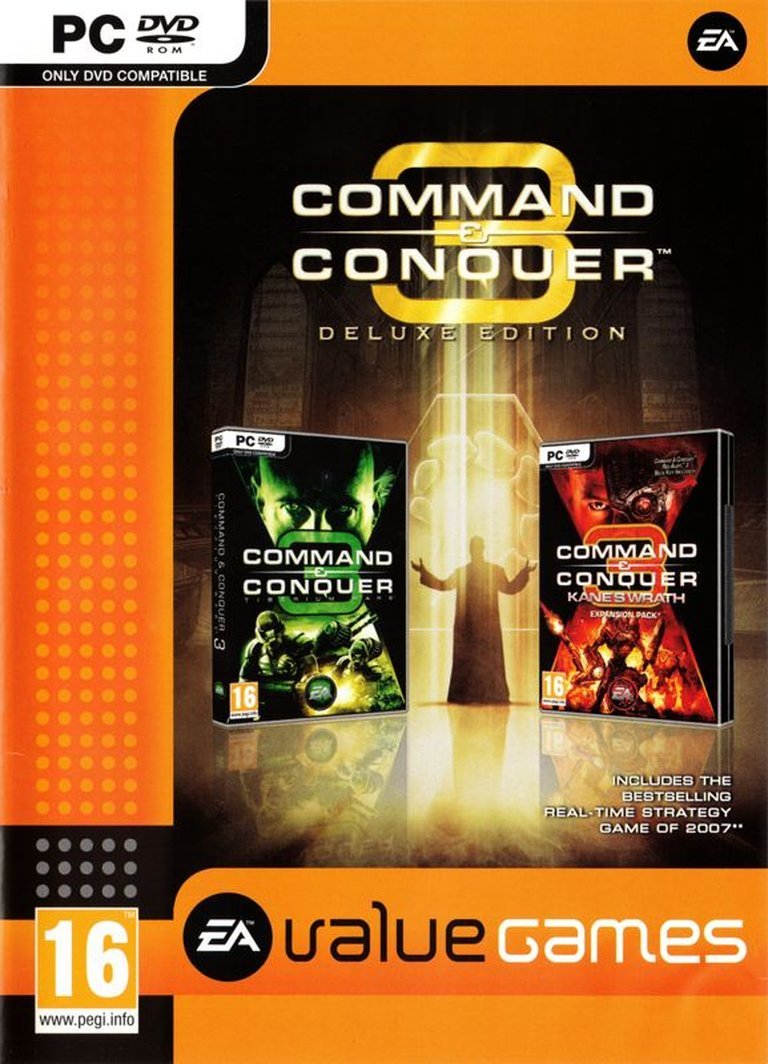
Command & Conquer 3: Limited Collection, also known as the Deluxe Edition, is a compilation that bundles the base game ‘Command & Conquer 3: Tiberium Wars’ (2007) and its expansion ‘Command & Conquer 3: Kane’s Wrath’ (2008). Set in the Tiberium universe, these real-time strategy games feature a conflict between the Global Defense Initiative (GDI), the Brotherhood of Nod, and the alien Scrin over control of a Tiberium-infested Earth, with Kane’s Wrath expanding the narrative through a new Nod campaign and additional sub-factions for all sides.
Command & Conquer 3: Limited Collection Reviews & Reception
retro-replay.com : it’s the perfect entry point or nostalgic trip for RTS enthusiasts.
Command & Conquer 3: Limited Collection: The Definitive Tiberium War
Introduction: A Complete Package for a Pivotal Conflict
In the long and storied history of real-time strategy, few franchises carry the gravitational pull of Command & Conquer. By 2008, the series had already weathered studio transitions, universe splits, and iterative evolution. The release of the Command & Conquer 3: Limited Collection that year was more than a simple repackaging; it was a vital consolidation. This compilation united the 2007 base game, Command & Conquer 3: Tiberium Wars, with its 2008 expansion, Kane’s Wrath, presenting the entire “Third Tiberium War” saga as a single, cohesive experience. At a time when digital distribution was rising but physical “complete edition” collections still held significant market power, this release served as both a victory lap for EA Los Angeles’s revitalization of the Tiberium universe and the most accessible entry point for a new generation of commanders. This review argues that the Limited Collection represents the pinnacle of the classic C&C formula—a masterclass in tight mechanics, cinematic presentation, and faction asymmetry—wrapped in a package that, despite some era-specific blemishes, remains an essential monument to the RTS genre.
Development History & Context: From Westwood Ghosts to EA Los Angeles
The journey to Tiberium Wars and its Limited Collection was fraught with the typical turbulence of a franchise in transition. The original Command & Conquer and Red Alert series were born at Westwood Studios, a company synonymous with the RTS boom of the 1990s. Following EA’s acquisition of Westwood in 1998 and its subsequent closure in 2003, the C&C legacy was inherited by EA Los Angeles (EALA), a studio initially focused on console titles like The Lord of the Rings: The Battle for Middle-earth series.
The Vision and Constraints: EALA’s mandate was clear: resurrect the core C&C experience with modern 3D graphics and deeper mechanics, but within a tight development window. Tiberium Wars reportedly had only 11 months of core production, while Kane’s Wrath was built in approximately 18 months with a team half the size of its predecessor. This “rushed but focused” development led to a game that felt polished and content-rich but sometimes showed signs of its compressed timeline, particularly in AI pathfinding and certain balance quirks. The technical foundation was the SAGE (Strategy Action Game Engine) 2.0, a powerful but demanding tool that enabled the game’s detailed 3D models, dynamic lighting, and destruction—features that were breathtaking for 2007 but also contributed to its reputation for high system requirements.
The 2007-2008 Landscape: The RTS genre was in a state of flux. Blizzard’s Warcraft III (2002) and StarCraft (1998) dominated the competitive scene with deep macro/micro gameplay. Company of Heroes (2006) redefined tactical WWII combat. Supreme Commander (2007) pushed the scale of warfare to apocalyptic levels. Tiberium Wars and Kane’s Wrath didn’t try to out-scale or out-twitch these contemporaries. Instead, they leaned into the C&C identity: fast-paced, resource-driven combat with a heavy emphasis on iconic, rock-paper-scissors unit archetypes, superweapons, and the signature full-motion video (FMV) cutscenes. The Limited Collection’s release in March 2008 was a strategic move to capitalize on the holiday success of Tiberium Wars and Kane’s Wrath, offering a “complete” product before the impending arrival of another C&C title, Red Alert 3, later that year.
Narrative & Thematic Deep Dive: A Sci-Fi Saga of Faith, Faction, and First Contact
The Limited Collection presents a two-act narrative. Tiberium Wars is the broad, galactic-scale conflict, while Kane’s Wrath is a character-driven prequel exploring the machinations of the series’ eternal antagonist.
Act I: Tiberium Wars (2007) – The Third War
The story is set in a post-Tiberian Sun world where the alien crystalline substance Tiberium has catastrophically reshaped Earth. Three factions clash:
* Global Defense Initiative (GDI): The UN-backed military powerhouse, representing order, technological superiority, and a desperate attempt to save the planet from Tiberium poisoning. Their narrative is one of grim duty and sacrifice.
* Brotherhood of Nod: A decentralized, fanatical techno-terrorist movement led by the messianic Kane. They view Tiberium not as a plague but as a “gift” of evolution, and their struggle is framed as a holy war against the oppressive “old world” order of GDI.
* The Scrin: A mysterious, insectoid alien race revealed to be the original “gardener” of Tiberium. Their arrival is the catalyst for the “Third” Tiberium War. Their motives are initially inscrutable, driven by a directive to harvest mature Tiberium fields, making them a terrifying, biological-force-of-nature antagonist.
The plot is delivered through the series’ trademark live-action FMVs, featuring a solid cast including Joseph D. Kucan as a perpetually charismatic Kane, Billy Dee Williams as the disillusioned GDI Director Redmond Boyle, and Tricia Helfer as the icy Nod general Kilian Qatar. The narrative serves its purpose effectively: it provides motivation for each faction’s campaign, features clear betrayals and twists (most notably the Scrin’s true purpose and the inner turmoil within Nod), and culminates in a three-way race to a Scrin “Threshold Tower” in Washington D.C. Thematically, it explores classic C&C motifs: the clash of ideology vs. pragmatism (Nod vs. GDI), the danger of playing god with technology (Tiberium itself), and the awe/fear of first contact (the Scrin).
Act II: Kane’s Wrath (2008) – The Wrath of a Prophet
The expansion shifts focus almost entirely to Nod, functioning as a prequel/parallel narrative to Tiberium Wars. Players assume the role of a Nod commander directly under Kane’s command, years before the Scrin arrival. The campaign is a globetrotting campaign of sabotage, infiltration, and shocking violence.
* Narrative Structure: It’s a more personal, spy-thriller-esque story compared to the grand war of the base game. Missions involve assassinating rival Nod generals, stealing experimental technology from GDI, and manipulating world governments. The plot reveals Kane’s long-term plan to infiltrate and corrupt GDI from within through the “Mark of Kane” mind-control parasite, culminating in the stunning betrayal of GDI Director Boyle—a key event that sets the stage for the fractured state of GDI in Tiberium Wars.
* Character Deep Dive: Kane is no longer a distant, enigmatic figure but a hands-on strategist, frequently appearing in cutscenes to deliver chillingly calm monologues about destiny and sacrifice. The expansion’s story elevates him from a simple villain to a profoundly disturbing ideological force. The theme shifts from “war for survival” to “the corrosive nature of fanaticism and the price of faith,” as Nod commanders are shown committing increasingly brutal acts for Kane’s vision.
Together, the two campaigns create a complete arc: Kane’s Wrath shows the rotting foundation being laid, and Tiberium Wars depicts the catastrophic, world-shattering building that collapses upon it.
Gameplay Mechanics & Systems: Refinement, Asymmetry, and Dominion
The Limited Collection‘s lasting power rests on its exceptionally tight and differentiated gameplay.
Core Gameplay Loop (Tiberium Wars):
The classic C&C loop is preserved and polished: harvest Tiberium (a hazardous resource requiring Refineries and specialized Harvesters), build a base with a functional production tree (Barracks/War Factory/Advanced Factory/Node), amass an army, and destroy the enemy. Key innovations include:
1. Faction Asymmetry is King: This is the game’s greatest strength.
* GDI: Defensive, powerful, and expensive. Units like the Mammoth Tank and Juggernaut artillery are slow but devastating. Their superweapon is the Ion Cannon, a precision orbital strike.
* Nod: Aggressive, mobile, and cloaked. Units are cheaper and faster, with an emphasis on stealth (Stealth Tanks, Saboteurs) and hit-and-run tactics. Their superweapon is the Nuclear Missile, a slower but area-denying terror weapon.
* Scrin: Bio-mechanical, adapted to Tiberium. Their units regenerate in tiberium fields, and they field unique units like the Desintigrator (anti-structure) and the terrifyingly efficient Devourer Walker. Their superweapon is the Rift, a localized dimensional tear that annihilates everything in its wake.
2. The “Rock-Paper-Scissors” 2.0: The system is deeper than simple unit counters. Every unit has a primary and often a secondary weapon, and tactical abilities (e.g., GDI’s “Guard Mode,” Nod’s “Cloak,” Scrin’s “Tiberium Spike” healing). This forces constant micro-management and combined-arms thinking.
3. Dynamic Base Building: Structures can be built anywhere with sufficient space, allowing for incredible base design creativity and defensive layouts. The MCV (Mobile Construction Vehicle) is a core strategic unit for both expanding and relocating.
Kane’s Wrath – The Dominion Mode & Hero Focus:
The expansion introduces two major systems:
1. Global Conquest (Dominion): A brilliant turn-based strategic layer that sits outside skirmish/mission play. Players manage a world map, capturing territories, managing income, and deploying hero units (like the Black Hand commando or GDI’s General Granger) into tactical battles. Success in these battles carries over, providing persistent bonuses. This added a “campaign map” metagame that greatly increased long-term engagement.
2. Enhanced Heroics: Named characters (Kane, Alexa, Prince Alexis, etc.) are now fully playable in skirmish with unique, powerful abilities that can single-handedly turn battles. This creates a “hero-focused” sub-style of play, especially for Nod.
Innovations and Flaws:
* Innovations: The expansion of naval combat (making water a viable front), the introduction of truly transformative units (Empire of the Rising Sun in Red Alert 3, but in the Tiberium universe, the Scrin’s adaptability was a step in this direction), and the Dominion mode were all significant.
* Flaws: Pathfinding for large armies, especially through choke points or against Scrin structures, was notoriously problematic. The AI, while improved in Kane’s Wrath, still exhibited routine “suicide rushes” on higher difficulties. The infamous “no-entry zone” around large units (like the GDI Juggernaut) could cause armies to spread unnaturally, a frustration noted in player reviews. Some superweapon timers were also seen as overly punitive.
World-Building, Art & Sound: A Gritty, Cinematic Dystopia
The artistic and sonic identity of Tiberium Wars is a deliberate departure from the campy, alt-history vibe of the Red Alert series. This is a serious, grimy, post-apocalyptic science fiction.
* Visual Direction: The SAGE 2.0 engine renders a world choked with glowing green Tiberium crystals. Environments are masterpieces of decay: cracked urban streets, radiation-scorched deserts, and tainted forests. Unit design is functional and industrial for GDI, sleek and terrorist-tech for Nod, and utterly alien and organic for the Scrin. The FMV cutscenes, shot with a serious tone and practical effects (for the time), look comparably less cheesy than Red Alert 3‘s broad comedy, though they are very much of their late-2000s era.
* Sound Design: The soundscape is a cacophony of rumbling tank engines, shattering crystal, and alien screeches. Each faction has a distinct audio identity: GDI’s sharp, military reports; Nod’s whispered stealth cloaks and explosive sabotage; the Scrin’s wet, biological impacts and eerie, melodic pings. The interface sounds are punchy and satisfying, providing crucial audio feedback for every command.
* Music: Frank Klepacki, the legendary composer of the original C&C games, returned to compose the iconic “Hell March 3” for the GDI campaign—a brilliant fusion of electric guitar, industrial beats, and orchestral swells that perfectly captures GDI’s mighty, beleaguered resolve. James Hannigan and Timothy Michael Wynn handled the bulk of the remaining score, providing distinct, moody tracks for each faction’s menus and missions that reinforce their thematic cores (Nod’s tribal, driving rhythms; Scrin’s alien, ambient dread).
Reception & Legacy: Critical Darling, Cult Classic, and a Franchise Crossroads
- Critical Reception: The compilation itself, as noted in the source material (MobyGames/GameStar), holds an 87% critic score. Tiberium Wars was widely praised for its return to form after the mixed reception of C&C: Generals. Critics highlighted the excellent faction asymmetry, engaging campaigns, and high-production-value FMVs. Common criticisms mirrored the gameplay flaws noted above: pathfinding issues, a sometimes-oppressive superweapon meta, and a story some felt was less compelling than the Red Alert series’ alt-history charm.
- Commercial & Player Reception: The Limited Collection was a commercial success as a value proposition. Player scores are more polarized; MobyGames shows a perfect 5.0 from its limited sample, but broader community discourse (as seen in the provided player review excerpts) reveals a split. Some hail it as a near-perfect return to classic C&C, while others, especially those coming from Red Alert 2, found the tone too grim, the Scrin faction unbalanced or uninteresting, and mechanics like the “no-entry zone” frustrating.
- Legacy and Industry Influence: The Tiberium Wars era is a critical inflection point.
- The Last “Classic” C&C: For many, this represents the last pure, uncompromised embrace of the original Dune 2/C&C formula before the series experimented with more action-oriented or hero-focused designs (Red Alert 3‘s unit abilities, C&C 4‘s mobile base).
- Precursor to Red Alert 3: The same EALA team, using the refined SAGE 2.0 engine, developed Red Alert 3 immediately after Kane’s Wrath. Many gameplay innovations—expanded naval combat, unit abilities, the shift toward a more campy tone—were stress-tested here. The Limited Collection is, in effect, the “serious” sibling to Red Alert 3‘s “satirical” one.
- Modding and Longevity: The game’s robust modding tools (FinalBlue, etc.) spawned a vibrant community. Famous mods like Tiberium Essence and The Forgotten significantly extended the game’s lifespan by adding new factions, units, and balance overhauls, a testament to the solid underlying systems.
- DRM Controversy: It was released during the peak of the SecuROM DRM backlash sparked by Spore. While Tiberium Wars itself had a less severe implementation (five activations), the controversy surrounding its sister game Red Alert 3 (which had tighter limits) colored the perception of EA’s C&C titles from this era.
Conclusion: The Quintessential “Classic” C&C Experience, Preserved
The Command & Conquer 3: Limited Collection is not a flawless artifact. Its AI stumbles, its pathfinding can infuriate, and its grim sci-fi tone lacks the infectious absurdity of the Red Alert series. However, it is arguably the most pure and focused expression of the core Command & Conquer fantasy since the Westwood days. The triad of GDI, Nod, and Scrin provides unparalleled faction asymmetry, where choosing a side isn’t just an aesthetic preference but a fundamental commitment to a unique strategic philosophy. The marriage of the base game’s global, apocalyptic war with Kane’s Wrath‘s intimate, conspiratorial prequel creates a narrative depth rarely matched in the genre.
In video game history, this collection stands as the capstone of the “classic” RTS era. It refined a 15-year-old formula to a razor’s edge, delivered it with cinematic bombast, and packaged it with unprecedented completeness. While Red Alert 3 would experiment with tone and mechanics, and later entries would stray further, the Limited Collection remains the definitive document of what many consider the “true” legacy of Command & Conquer: a game of base-building, resource harassment, army composition, and satisfying, explosive combat, all framed by cheesy (but effective) live-action drama. For the historian, it is the essential artifact of EALA’s stewardship. For the player, it is a timeless, generously content-packed strategy experience that, with a thriving mod community still active, has not yet finished its war.
Final Verdict: 9/10 – A Masterpiece of Its Kind, Slightly Marred by Its Era.