
- Release Year: 1997
- Platforms: DOS, Windows
- Publisher: Virgin Interactive Entertainment, Inc.
- Genre: Special edition
- Game Mode: Single-player
Description
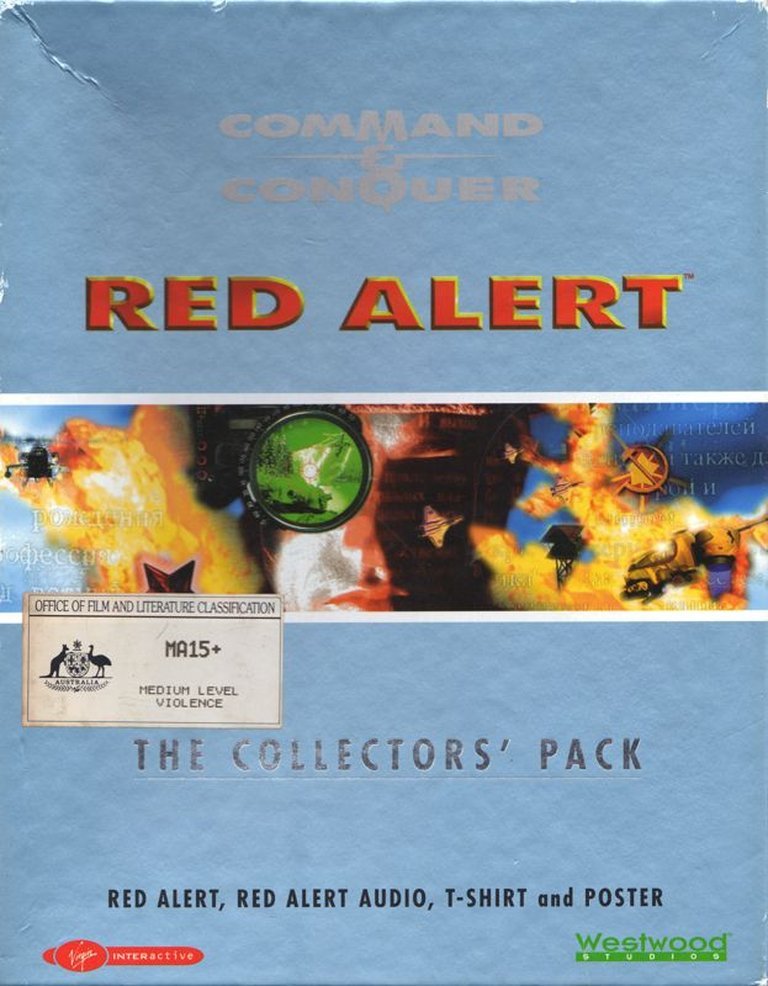
Command & Conquer: Red Alert (The Collectors’ Pack) is a special edition of the iconic real-time strategy game, set in an alternate history where Allied Forces clash with an aggressive Soviet Union for control of Europe. As a prequel to the original Command & Conquer, it features fast-paced tactical gameplay, a gripping Cold War-inspired narrative, and competitive multiplayer. This collector’s edition includes the base game, a 67x44cm poster, a soundtrack CD, a T-shirt, and a manual, making it a must-have for fans of the series.
Gameplay Videos
Command & Conquer: Red Alert (The Collectors’ Pack) Cracks & Fixes
Command & Conquer: Red Alert (The Collectors’ Pack) Patches & Updates
Command & Conquer: Red Alert (The Collectors’ Pack) Mods
Command & Conquer: Red Alert (The Collectors’ Pack) Guides & Walkthroughs
Command & Conquer: Red Alert (The Collectors’ Pack) Reviews & Reception
retro-replay.com : The Collector’s Pack enhances this core gameplay by including a detailed printed manual. This manual serves as both a nostalgic artifact and a strategic guide.
Command & Conquer: Red Alert (The Collectors’ Pack) Cheats & Codes
PC
Type in the code when the game is loading.
| Code | Effect |
|---|---|
| XPEINA518 | Starts you off with 20 medium tanks. |
PlayStation
Enable the cheat codes, then enter the following code while you have the Toolbar open:
| Code | Effect |
|---|---|
| X, Circle, Triangle, Triangle, Circle, X | Change Ore to Civilians |
| Square, Circle, Square, X, Circle, Circle | Change Ore to Gold |
| Triangle, Circle, Circle, Square, Square, X | Chronoshift |
| Square, Triangle, Circle, X, Triangle, Square | Full Map |
| X, Square, Square, Circle, Triangle, Circle | Instant Victory |
| Square, Square, Circle, X, Triangle, Circle | More Money |
| Circle, X, Circle, Triangle, Square, Triangle | Nuclear Attack |
| Square, X, Circle, Circle, X, Triangle | Instant Parabomb |
Command & Conquer: Red Alert (The Collectors’ Pack): Review
Introduction
In the pantheon of real-time strategy (RTS) titans, Command & Conquer: Red Alert occupies a throne forged from Tesla coils and chronospheres. Released in 1996 by Westwood Studios, the game redefined the genre with its audacious blend of alternate-history storytelling, razor-sharp gameplay, and campy live-action theatrics. The Collectors’ Pack (1997) elevates this classic into a tangible monument, bundling the base game with physical treasures that amplify its legacy. This review argues that the Pack isn’t merely a nostalgia trip—it’s the definitive artifact of a game that reshaped multiplayer strategy and narrative ambition in the 90s, bridging the gap between digital innovation and collector’s passion.
Development History & Context
Westwood Studios, fresh off the success of Command & Conquer (1995), sought to expand their RTS empire with a prequel set not in the Tiberium-scarred future but in a Twilight Zone-esque Cold War. Originally conceived as an expansion, Red Alert evolved into a standalone title when its scope outgrew the constraints of the Tiberian Dawn universe. Developed by a team of nearly 30 under veterans like Brett Sperry and Adam Isgreen, the game emerged in an era dominated by Warcraft II and Total Annihilation. Yet Westwood’s vision was distinct: a faster, more cinematic RTS that leveraged the nascent CD-ROM format to deliver full-motion video (FMV) cutscenes, a divisive gamble that paid off spectacularly.
Technologically, Red Alert pushed the limits of 90s hardware. Its isometric sprite-based engine prioritized clarity over graphical flourish, ensuring smooth performance on modest PCs. The studio’s embrace of online multiplayer via Westwood Online (later XWIS) was revolutionary, enabling LAN and modem battles years before broadband ubiquity. Released on November 22, 1996, Red Alert sold 1.5 million copies in its first month alone, capitalizing on a holiday season crowded with RTS clones but devoid of its irreverent charm.
Narrative & Thematic Deep Dive
Red Alert’s narrative is a delirious cocktail of pseudo-science and geopolitical fan fiction. Albert Einstein’s time machine erases Hitler in 1924, creating a fractured timeline where Stalin’s USSR engulfs Europe. Players choose between the Allied Nations (a technocratic coalition) and the Soviet war machine, each campaign unraveling through gloriously hammy FMV sequences. The Allies’ story—canonically linked to the Tiberium saga—culminates in Stalin’s suffocation under rubble (and a handkerchief), while the Soviet ending reveals the Brotherhood of Nod’s shadowy machinations via Kane (Joseph D. Kucan), whose smirk became franchise legend.
Themes of hubris and manipulation pervade both storylines. Stalin’s expansionism mirrors real-world Cold War paranoia, while the Allies’ reliance on espionage and sabotage critiques Western interventionism. Characters like Tanya (Lynne Litteer), a quippy commando who shrieks “CHA-CHING!” while demolishing buildings, and the Soviet General Gradenko, who meets his end via poisoned tea, embody a tonal tightrope between satire and sincerity. The FMV briefings—shot on shoestring budgets with B-movie bravado—elevate the story into interactive pulp fiction, a precursor to Stranger Things-era nostalgia.
Gameplay Mechanics & Systems
Red Alert’s gameplay is a masterclass in asymmetric design. The Allies favor agility and subterfuge: Light Tanks outmaneuver Soviet behemoths, spies drain enemy coffers, and the Chronosphere relocates units in tactical flashes. The Soviets, meanwhile, embrace brute force: Heavy Tanks crush defenses, Tesla Coils vaporize infantry, and the Iron Curtain grants temporary invincibility. Resource management hinges on harvesting ore fields (with rare gems accelerating economies), while power grids punish overexpansion—a brittle war of attrition where a single sabotage can collapse empires.
Innovations abound: naval combat (Cruisers vs. Submarines), air support (Allied Longbows vs. Soviet MiGs), and faction-specific superweapons redefined RTS scale. The mission design alternates between base-building onslaughts and tense commando raids, with branching paths adding replayability. Skirmish and multiplayer modes supported up to eight players, fostering a competitive scene that birthed strategies like “tank rushing” and “ore denial.” Yet flaws linger: pathfinding glitches, imbalanced AI difficulty (merely adjusting unit HP), and the occasional mission-breaking bug. The Collectors’ Pack’s manual mitigates these with tactical primers, transformin cardboard into a survival guide.
World-Building, Art & Sound
Westwood crafted a universe as vibrant as its cadmium-red loading screens. The art direction embraces cartoonish exaggeration—Soviet War Factories loom like dystopian cathedrals, while Allied Pillbox turrets resemble tin toys—yet retains tactical clarity. Weather effects (rain-slicked fields, snow-blanketed tundras) and destructible environments sell the illusion of a war-torn Europe. The FMV sets, though cheesy, ooze retro-futurism, blending WWII aesthetics with Tesla-powered sci-fi.
Sound design is equally iconic. Frank Klepacki’s soundtrack—a fusion of industrial metal, Soviet marches, and electronic beats—pulverizes eardrums with tracks like “Hell March,” a anthem so enduring it scored gym workouts and military parades. Unit barks (“Kirov reporting!”) and voice acting (Tanya’s gleeful sadism) inject personality into every pixel. The Collectors’ Pack’s soundtrack CD isn’t a bonus—it’s the game’s beating heart, preserved in audio amber.
Reception & Legacy
Upon release, Red Alert garnered universal acclaim. Critics lauded its “perfect balance” (PC Gamer), awarding it Strategy Game of the Year honors. Commercially, it dominated charts, moving 347,844 units in the U.S. by 1996’s end and 1.5 million globally in a month. Its expansions—Counterstrike and Aftermath—solidified its legend, introducing mutant-ant missions (a Starship Troopers parody) and units like the Chrono Tank.
The game’s legacy is seismic. It popularized faction asymmetry, inspiring StarCraft’s Terrans vs. Zerg. Its modding community birthed tools like Red Alert: The Lost Files and OpenRA, extending its lifespan into the 2020s. In 2008, EA declared it freeware, while the 2020 Remastered Collection reintroduced it to new audiences. The Collectors’ Pack encapsulates this journey—a time capsule of posters and T-shirts that predates “special editions” as we know them.
Conclusion
Command & Conquer: Red Alert (The Collectors’ Pack) is more than a game; it’s a cultural artifact. The base game remains a paradigm of RTS design—fast, witty, and unapologetically bold—while the physical extras (manual, soundtrack, poster) deepen the connection between player and pixel. For historians, it exemplifies 90s ambition; for strategists, it’s a textbook of timeless mechanics. Amidst remasters and reboots, this Pack stands as the ultimate tribute to a title that didn’t just command armies—it conquered imaginations. In the annals of gaming history, Red Alert isn’t just a relic—it’s a revolution preserved in amber.