
- Release Year: 1999
- Platforms: Windows
- Publisher: ak tronic Software & Services GmbH, Electronic Arts, Inc., Sold Out Sales & Marketing Ltd.
- Developer: Westwood Studios, Inc.
- Genre: Strategy, Tactics
- Perspective: Diagonal-down
- Game Mode: LAN, Online PVP, Single-player
- Gameplay: Base building, Fog of war, Freely destructible terrain, Real-time strategy, Resource Management
- Setting: Europe, Futuristic, Middle East, North America, Sci-fi
- Average Score: 91/100
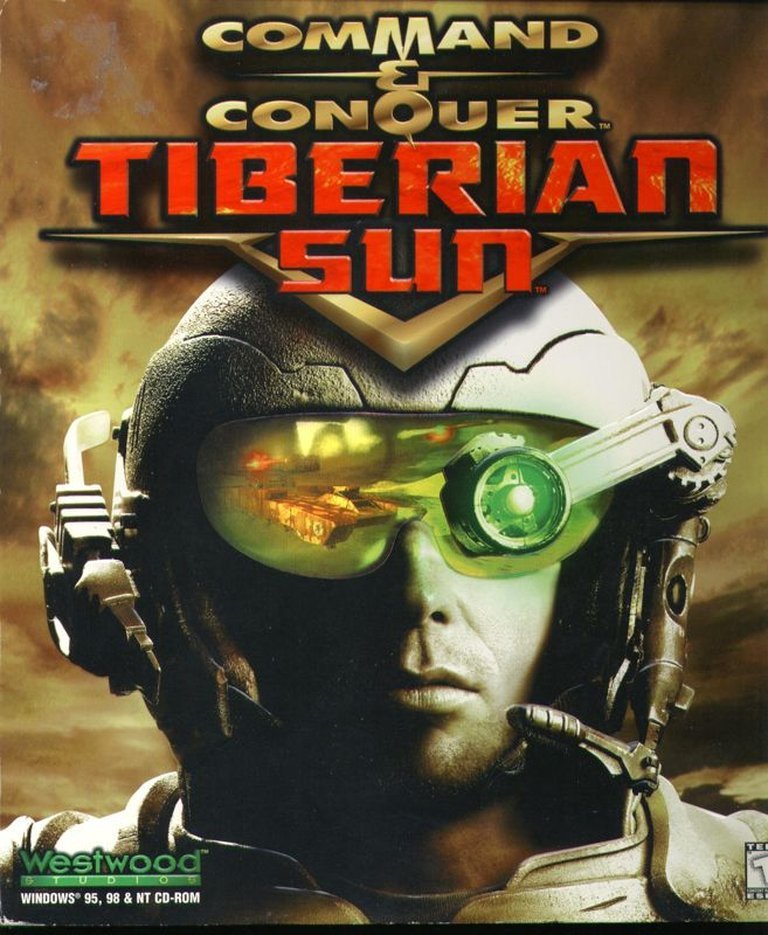
Description
Set in the year 2030 amidst a Tiberium-contaminated Earth, Command & Conquer: Tiberian Sun is a real-time strategy sequel where the Global Defense Initiative (GDI) battles the resurgent Brotherhood of Nod, led by the seemingly immortal Kane. The planet’s alien Tiberium threat has spawned mutated life forms and a marginalized faction of survivors called The Forgotten. Featuring an isometric engine combining 2D sprites and 3D voxels, the game contrasts GDI’s brute-force tactics with Nod’s hit-and-run strategies, introducing advanced units like hovercrafts, subterranean flame tanks, and mechanized walkers, alongside support powers and counter-technologies for asymmetric gameplay.
Gameplay Videos
Where to Buy Command & Conquer: Tiberian Sun
PC
Command & Conquer: Tiberian Sun Free Download
Command & Conquer: Tiberian Sun Patches & Updates
Command & Conquer: Tiberian Sun Mods
Command & Conquer: Tiberian Sun Reviews & Reception
imdb.com (90/100): Well, what can I say? The “real” Command and Conquer 2 follows on from 1.5 (Red Alert) and then some.
imdb.com (90/100): The game is enjoyable, although it gets quite hard. The special effects are good, and the plot is great.
imdb.com (80/100): Had this actually been a film it would have been one of the most nonsensical and implausible sci-fi movies ever. However, as the ‘movie’ only serves to keep the game going, I’ll judge it against gaming standards and as such this is better than anything done before.
imdb.com (100/100): If you like RTS (real time strategy) games, you will love TS. It blows all other RTS games away.
imdb.com (100/100): Tiberian Sun is a game to remember for it’s amazing potential and outstanding acting, particularly from Joseph D Kucan who plays Kane in the videos as well as the talented James Earl Jones and Michael Biehn.
honestgamers.com : It isn’t an entirely poor game at all. It isn’t the classic that the fanbase had hoped for either.
moddb.com (100/100): The best game I have ever play… It is hard, but so fun, so great, so… C&C
moddb.com (80/100): Contrary to popular belief… it doesn’t hold a candle to the game-play and experience that Red Alert 2 offered in my books, but that isn’t to say I don’t like the game, quite the contrary, it is another game that I love.
moddb.com (100/100): Brilliant game.. shame the other C&C games fail to match its standard even though it is over a decade old.
moddb.com (90/100): Pretty good, a little slow at times. A lot of units and structures, making things interesting.
moddb.com (90/100): Brilliant game, definitely best of the Tiberium series. Good campaign as well as good skirmish battles.
moddb.com (80/100): While tiberian sun is not the best c&c game, it is still better than tiberian dawn and red alert 1 by leaps and bounds. It has the best atmospheric setting of all the c&c games.
moddb.com (100/100): a good game
moddb.com (100/100): Fun game and another excelent work by Westwood studios. Superb in every way.
moddb.com (80/100): Although TS feels unfinished, the story, the campaigns, the atmosphere and the music make an excellent immersion that kept me addicted to it for years.
Command & Conquer: Tiberian Sun: Review
Introduction
In the annals of real-time strategy (RTS) history, few titles carry the weight of anticipation and cultural impact quite like Command & Conquer: Tiberian Sun. Released in August 1999 after a tumultuous, multi-year development cycle, this sequel to the landmark 1995 original arrived amidst a saturated RTS market dominated by Blizzard’s StarCraft and Ensemble Studios’ Age of Empires II. Yet, Tiberian Sun carved its own legacy not through revolution, but through a masterful refinement of the formula, wrapped in a dystopian narrative of ecological collapse and ideological warfare. This review posits that while Tiberian Sun was a flawed diamond—hobbled by launch bugs and cut features—it remains a towering achievement in world-building, atmosphere, and factional asymmetry, cementing its status as a cult classic and a pivotal entry in the Command & Conquer saga. Its enduring appeal lies not just in its gameplay, but in its prescient themes and the haunting beauty of its ruined world—a prophecy that feels eerily relevant in an era of climate anxiety and geopolitical tension.
Development History & Context
Westwood Studios began work on Tiberian Sun weeks after the 1995 release of the original Command & Conquer, driven by a vision to elevate the franchise into a darker, more futuristic sci-fi epic. The team, led by veterans like Brett Sperry and Adam Isgreen, aimed for a “semi-3D” isometric engine that blended 2D sprites with voxel-based vehicles, creating unprecedented terrain depth. However, the project’s scope ballooned into a four-year odyssey fraught with challenges. In 1998, Electronic Arts acquired Westwood amid Virgin Interactive’s financial collapse, leading to leadership shifts and intensified pressure to meet deadlines. Key features like dynamic day/night cycles, fully destructible urban environments, and a customizable “loadout screen” for mission deployments were cut due to technical constraints and feature creep. As Westwood producer Rade Stojsavljević later admitted, the game’s ambition outpaced its execution, resulting in an engine that prioritized voxel rendering at the expense of pathfinding and AI stability.
The gaming landscape in 1999 was fiercely competitive. While Tiberian Sun promised a darker, more mature take on the Command & Conquer universe, competitors like StarCraft had already defined multiplayer excellence, and Age of Empires II set new standards for historical RTS depth. Westwood’s decision to retain the core “build-base-destroy” loop while adding factional asymmetry—a hallmark of the series—was both a safe bet and a calculated risk. The final product, though incomplete, reflected a studio grappling with its legacy: innovating without alienating fans while pushing the boundaries of its aging engine. The result was a game that, despite its flaws, sold 1.5 million copies in its first month (a record for EA at the time) and became the fastest-selling PC game in Germany, earning Platinum awards from the VUD for over 700,000 sales across German-speaking territories.
Narrative & Thematic Deep Dive
Command & Conquer: Tiberian Sun operates on a dual-narrative structure, weaving two parallel stories through the lens of the Second Tiberium War (2030). The GDI campaign follows Commander Michael McNeil (Michael Biehn, Aliens), a maverick officer recalled from training to counter Nod’s resurgence. Tasked with retrieving the alien “Tacitus” database and preventing a global Tiberium cataclysm, McNeil’s story unfolds like a military thriller, emphasizing GDI’s moral ambiguity in its fight for a “dying” world. In contrast, Nod’s campaign centers on Anton Slavik (Frank Zagarino), a Black Hand operative who seizes control of the Brotherhood after executing the GDI puppet General Hassan. Under Kane’s enigmatic return, Slavik’s narrative is a paranoid thriller about reunifying a fractured cult, culminating in a doomsday plan that transforms Earth into a Tiberium-based utopia.
The script, penned by Westwood’s design team, leans into pulp sci-fi tropes but elevates them through character depth. Kane, played by series creator Joseph D. Kucan, emerges as a messianic anti-hero, his immortality and charisma blurring the line between fanaticism and wisdom. McNeil and Slavik are not blank slates; their dialogues reveal personal stakes, with McNeil questioning GDI’s militarism and Slavik grappling with Kane’s ruthless vision. Thematically, the game dissected the military-industrial complex, framing both factions as architects of their own downfall. GDI’s orbital station, the Philadelphia, symbolizes detached bureaucratic power, while Nod’s chemical missiles and Tiberium-based weapons mirror real-world terrorism’s capacity for self-destruction. The Forgotten—mutant survivors led by the charismatic Tratos (Christopher Winfield)—serve as a moral third voice, their existence condemning both sides’ exploitation of Tiberium. The narrative’s prescience is striking: in a pre-9/11 world, it explored terrorism, ecological collapse, and the ethics of intervention, making its live-action FMV cutscenes (featuring James Earl Jones as GDI General Solomon) feel like a dystopian news report from the future.
Gameplay Mechanics & Systems
At its core, Tiberian Sun retains the Command & Conquer formula—harvest Tiberium, build bases, and annihilate opponents—but refines it with asymmetrical faction design and tactical depth. GDI’s gameplay emphasizes brute force: Mammoth Mk. II walkers with dual railguns, Hover MLRS artillery, and the Firestorm Generator, an impenetrable energy barrier. Nod, however, thrives on subterfuge: subterranean “Devil’s Tongue” flame tanks, Stealth Tanks, and Tick Tanks that deploy into artillery. These differences extend to resource management; Nod’s Harvesters collect blue Tiberium (a volatile, high-yield variant), while GDI prioritizes green Tiberium for stable income.
The engine’s voxel technology rendered vehicles in pseudo-3D, allowing for dynamic terrain deformation—craters from explosions, destructible bridges—and environmental hazards like Tiberium Veins and Veinhole Monsters. Unit veterancy added RPG layers, promoting survivors to “elite” status with unique perks (e.g., self-healing Mammoths). Yet, the game suffered from technical hiccups: pathfinding glitches trapped units in terrain, and the AI’s passivity undermined challenge. Superweapons like the Ion Cannon and Multi-Mission Rocket were criticized for being overpowered, ending skirmishes unfairly. Still, innovations like concrete slabs (GDI’s counter to Nod’s subterranean units) and waypoint systems for patrols demonstrated Westwood’s commitment to tactical nuance. The expansion Firestorm (2000) addressed some flaws, adding the Juggernaut artillery and mobile Stealth Generator, while integrating a “World Domination” multiplayer mode that blended strategy with territory control. Despite its imperfections, Tiberian Sun’s factional asymmetry set a template for future RTS games, proving that depth could coexist with accessibility.
World-Building, Art & Sound
Command & Conquer: Tiberian Sun’s greatest triumph is its oppressive, immersive atmosphere. Set in 2030, a world ravaged by Tiberium’s spread, the game’s environments—frostbitten Canadian tundras, Tiberium-infested Egyptian deserts, and crumbling European cities—convey a palpable sense of decay. Isometric voxels rendered structures with weathered textures, while dynamic lighting simulated ion storms that crippled electronics. The visuals, though limited by the engine’s constraints, used color masterfully: GDI’s blue-and-gray palettes evoked cold efficiency, while Nod’s fiery hues and occult symbols radiated menace.
The FMV cutscenes, directed by Kucan, were a budgetary marvel. Shot in Nevada’s deserts with over 40 crew members, they featured Hollywood talent—James Earl Jones’ booming authority as Solomon and Michael Biehn’s weary intensity as McNeil—elevating the narrative to B-movie heights. Sound design, overseen by Dwight Okahara, recorded real explosives from the FBI’s detonation training, lending battles a visceral weight. Frank Klepacki and Jarrid Mendelson’s soundtrack fused industrial techno with ambient dread, tracks like “Ion Storm” and “What Lurks” becoming iconic. Together, these elements forged a world where every Tiberium crystal crackled with threat, and every mission felt like a battle for humanity’s soul. This synergy of art and sound created a benchmark for atmospheric RTS design, influencing titles like StarCraft II and XCOM 2.
Reception & Legacy
Upon release, Tiberian Sun received critical acclaim tempered by reservations. Aggregators like GameRankings scored it 79.68%, with outlets like PC Gamer praising its “fascinatingly dark” narrative and “perfectly balanced” multiplayer. IGN hailed its “phenomenal gameplay,” while GameSpot lamented its “predictable” mechanics. Commercially, it was a juggernaut, selling 2.4 million copies by 2001 and earning nominations for “Computer Game of the Year” at the DICE Awards. Yet, some critics, notably German magazine Power Unlimited, deemed it the “Biggest Disappointment in 1999” for its lack of innovation. Player reviews were equally divided; some lauded its “unmatched atmosphere,” while others bemoaned its “slow pace” and “unfair” superweapons.
The Firestorm expansion (2000) redeemed many flaws, adding a cohesive story about the AI CABAL’s betrayal and new units like the Cyborg Reaper. Over time, Tiberian Sun’s reputation evolved. Its dystopian themes and factional depth earned it a cult following, with fans citing its influence on modern narratives of eco-apocalypse. The game became freeware in 2010 and debuted on Steam in 2024, introducing it to new audiences. Modding communities, particularly Twisted Insurrection (a standalone expansion), have kept its legacy alive, overhauling graphics and adding new campaigns. Today, it’s recognized as a flawed masterpiece—a game that prioritized atmosphere over perfection and, in doing so, defined the Command & Conquer universe’s bleak, unforgettable identity.
Conclusion
Command & Conquer: Tiberian Sun is a paradox: a game born of ambition that delivered restraint, yet remains a landmark of RTS design. Its technical shortcomings—buggy AI, cut features, and a sluggish pace—undermine its potential, but its strengths are undeniable. The dual campaigns, factional asymmetry, and haunting narrative of a world drowning in Tiberium created a template for mature RTS storytelling. Westwood’s commitment to atmosphere, from Klepacki’s score to the FMV cutscenes, elevated it beyond mere strategy, turning each mission into a visceral, desperate struggle. While it never dethroned StarCraft as the genre’s king, its legacy endures in games like Homeworld and XCOM, which prioritize world-building and thematic depth.
In an era of climate crisis and ideological polarization, Tiberian Sun’s vision of a world torn between environmental ruin and human folly feels less like science fiction and more like prophecy. It is, in the end, a testament to the power of games as narrative mediums—a flawed, unforgettable masterpiece that asks not just how to win a war, but what we sacrifice to fight it. For all its imperfections, Tiberian Sun stands as a towering achievement: a diamond in the rough that, after two decades, still gleams with the dark light of genius.