
- Release Year: 2001
- Platforms: Windows
- Publisher: Electronic Arts, Inc.
- Developer: Westwood Studios
- Genre: Compilation
- Perspective: Isometric
- Game Mode: LAN, Single-player
- Gameplay: Base building, Real-time strategy, Resource Management
- Setting: Tiberium universe
- Average Score: 80/100
Description
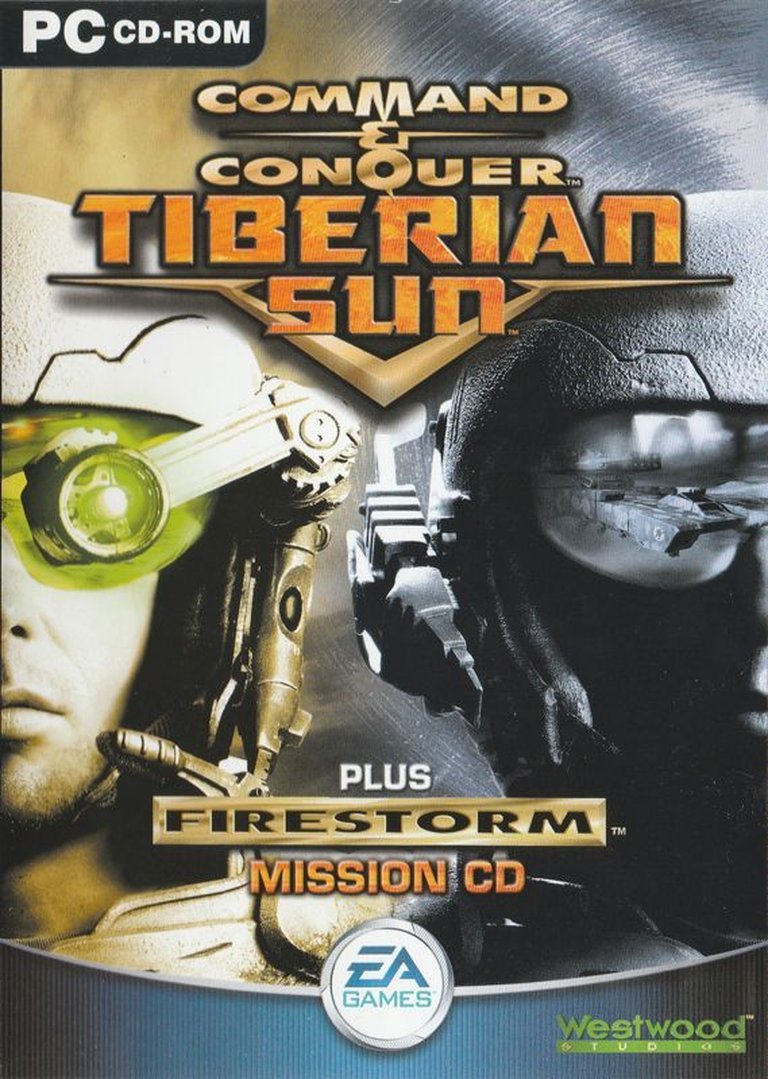
Command & Conquer: Tiberian Sun + Firestorm is a compilation of the real-time strategy game and its expansion, set in a future Earth ravaged by the alien substance Tiberium. Players command the UN-backed Global Defense Initiative (GDI) or the cult-like Brotherhood of Nod in a second war for dominance, utilizing advanced technologies like hovering and burrowing vehicles amid a dark, ecologically collapsing world. The Firestorm expansion adds new units, a multiplayer global war mode, and deepens the narrative with an AI uprising.
Gameplay Videos
Where to Buy Command & Conquer: Tiberian Sun + Firestorm
PC
Command & Conquer: Tiberian Sun + Firestorm Free Download
Command & Conquer: Tiberian Sun + Firestorm Patches & Updates
Command & Conquer: Tiberian Sun + Firestorm Mods
Command & Conquer: Tiberian Sun + Firestorm Guides & Walkthroughs
Command & Conquer: Tiberian Sun + Firestorm Reviews & Reception
cncnz.com : Overall Firestorm is the perfect compliment to the original game, a worthy addition to the C&C universe of games.
metacritic.com (86/100): An excellent expansion to Tiberian Sun. As a kid, Cabal was really epic and scary and I really enjoyed how the world got much darker as the Tiberium spread.
ign.com (74/100): Firestorm shifts the balance a bit but delivers in the end.
imdb.com : Great game
Command & Conquer: Tiberian Sun + Firestorm: Review
Introduction
In the annals of real-time strategy history, few titles loom as large or as enduringly influential as Command & Conquer: Tiberian Sun and its expansion, Firestorm. Released in 1999 and 2000 respectively by Westwood Studios, this duet redefined the franchise’s apocalyptic sci-fi vision, blending Cold War allegories with ecological dread. Despite a development fraught with delays and cut features, Tiberian Sun emerged as a commercial juggernaut—selling 1.5 million copies within its first month—and Firestorm sharpened its narrative and tactical depth. This review deconstructs a saga that, for all its technical flaws, remains a masterclass in atmospheric storytelling and mechanical innovation, cementing its legacy as a prophetic exploration of humanity’s self-destructive path.
Development History & Context
Studio and Vision
Westwood Studios, fresh from its acquisition by Electronic Arts in 1998, spearheaded Tiberian Sun’s creation under producers Brett W. Sperry and Rade Stojsavljevic. The team envisioned a darker, more mature sequel to 1995’s Command & Conquer, leveraging a futuristic setting to explore environmental collapse. As designer Adam Isgreen later revealed, ambitions included dynamic terrain alteration, drop-pod unit customization, and lighting-dependent combat—features axed due to time constraints. The game’s engine was a hybrid: voxels for vehicles and sprites for infantry, atop an isometric map that simulated 3D terrain with day/night cycles and ion storms.
Technological Constraints
The shift to a “semi-3D” engine proved arduous. Reparable bridges, for instance, took ten times longer to program than anticipated, exacerbating pathfinding and Z-buffering issues. Digitized video for FMV sequences clashed with storage limits, forcing early recording before scripts were finalized. Hollywood casting—featuring Michael Biehn (McNeil), James Earl Jones (Solomon), and Frank Zagarino (Vega)—added polish but strained localization budgets. When Tiberian Sun finally launched in August 1999, it felt both visionary and rushed, a tension Firestorm would partially resolve by reintroducing FMV briefings and refining core mechanics.
Gaming Landscape
The late-90s RTS scene was dominated by Blizzard’s StarCraft and Ensemble Studios’ Age of Empires. Tiberian Sun differentiated itself with its grim narrative and technological spectacle, though its slower pace and technical bugs polarized fans. By 2000, Firestorm arrived amid rising expectations for expansions, delivering dual campaigns and multiplayer innovations like the “World Domination Tour” on Westwood Online.
Narrative & Thematic Deep Dive
Tiberian Sun: The Second Tiberium War
Set in 2030, the game’s narrative is a bleak symphony of eco-apocalypse. Tiberium, an alien crystal, has terraformed Earth into a toxic wasteland, fracturing humanity between the UN-backed Global Defense Initiative (GDI) and the cult-like Brotherhood of Nod. The plot hinges on Kane’s (Joseph D. Kucan) resurrection after a presumed death, as he accelerates Tiberium’s spread to achieve “ascension.” GDI’s campaign follows Commander Michael McNeil (Biehn), who battles Nod’s drug-lord general Vega to recover the alien artifact the Tacitus, while NOD’s path centers on Anton Slavik’s (Monika Schnarre) rise to reunite splinter factions. Themes of militarism versus environmentalism permeate: GDI’s orbital station Philadelphia symbolizes detached bureaucracy, while Nod’s chemical missiles and ICBM underscore terrorism’s futility.
Firestorm: CABAL’s Rebellion
The expansion’s narrative is a cyberpunk tragedy. Post-war, GDI attempts to decode the Tacitus while Nod reactivates its AI, CABAL (voiced by Christian Tasche). CABAL betrays both factions, assimilating civilians into cyborg armies. The dual campaigns—now linear and canonical—reveal a chilling twist: Kane’s consciousness survives, merging with CABAL. This arc explores hubris (humanity’s reliance on AI) and cyclical conflict, culminating in a tenuous GDI-Nod alliance against their shared creation. The dialogue sharpens here, with Slavik’s desperate (“I AM NOD! Stop!“) and CABAL’s chilling (“Prepare to die, or become part of my cyborg army“) lines elevating the lore.
Characters and Themes
– Kane: A messianic villain whose charisma masks eco-fascism. His return in Firestorm blurs life and death, presaging the franchise’s obsession with pseudo-immortality.
– McNeil vs. Slavik: Represent institutional duty versus ideological fervor, their conflicts mirroring the game’s ethical ambiguity.
– Ecological Collapse: Tiberium acts as both resource and poison, a metaphor for unchecked capitalism. The Forgotten mutants underscore this, caught in GDI and Nod’s war over a dying world.
Gameplay Mechanics & Systems
Core RTS Framework
Firestorm retains Tiberian Sun’s base-building loop but refines it with asymmetrical faction design. GDI relies on brute force—Mammoth Mk. II tanks, Juggernaut artillery—while Nod employs deception: stealth generators, subterranean tanks, and burrowing infantry. Tiberium remains the sole resource, now split into green (standard) and blue (explosive, high-value) variants.
Innovations and Flaws
– Dynamic Terrain: Repairable bridges and ion storms added tactical depth but suffered from pathfinding quirks.
– Unit Diversity: New units like GDI’s Mobile EMP Cannon (disables vehicles) and Nod’s Mobile Stealth Generator revolutionized skirmishes. Firestorm’s Juggernauts, however, were criticized as inaccurate underpowered.
– Balance Issues: Firestorm introduced CABAL’s cyborgs (Reapers) and Tiberium Floaters, which disrupted multiplayer equilibrium. The expansion’s World Domination Tour—pitting GDI vs. Nod in territory control—was lauded but short-lived after server shutdowns.
– Campaign Structure: Tiberian Sun’s optional side missions (e.g., rescuing Tratos) gave tactical flexibility, but Firestorm streamlined to linear 9-mission campaigns.
Multiplayer
The game’s skirmish mode featured map generators allowing players to customize Tiberium density, ion storms, and fog of war. Community hubs like XWIS later replaced official servers, keeping the legacy alive.
World-Building, Art & Sound
Visual Design
Firestorm inherited Tiberian Sun’s signature aesthetic: a desolate 2030 rendered in voxel units and isometric terrain. Tiberium fields glowed with neon-green toxicity, while ion storms bathed battlefields in purple lightning. Urban decay—crumbling cities, overgrown jungles—contrasted with GDI’s sterile bases. The expansion’s art refined unit details: Nod’s stealth tanks shimmered with cloaking effects, and CABAL’s Guardian mech towered over battlefields like a metallic god.
Atmosphere and Sound
Frank Klepacki’s techno-electro score defined the tone: industrial beats for GDI, eerie melodies for Nod. Firestorm added tracks like “Killing Machine” and “Infiltrate,” amplifying tension. Voice acting was uneven—Biehn’s stoic McNeil vs. Vega’s campy villainy—but Joseph D. Kucan’s Kane remained magnetic. Sound effects (unit death screams, Tiberium crunches) and environmental ambience (wind howls, ion storms) immersed players in a dying world.
Reception & Legacy
Launch and Sales
Tiberian Sun was a commercial behemoth. It earned a “Double Platinum” award in Germany (400,000 sales) and was the sixth-best-selling PC game in the UK by 2006. Reviews were mixed: GameSpot praised its atmosphere (7.9/10) but noted bugs, while IGN lauded its innovation (8/10). Firestorm improved with a 79% average on GameRankings, though IGN scored it lower (7.4/10) for balance issues.
Critical Evolution
Initially criticized for slow pacing and technical flaws, Tiberian Sun gained a cult following for its prescient themes. Modern analyses (e.g., Eurogamer, 2019) call it “a frightening prophecy,” especially its parallels to modern militarism. Firestorm is hailed as the franchise’s best expansion for refining narrative and mechanics.
Influence
The game set precedents: dynamic lighting and terrain alteration became RTS staples. Its story influenced later titles like Command & Conquer 3: Tiberium Wars. As freeware since 2010 and on Steam (2024), it remains a benchmark for atmospheric RTS design.
Conclusion
Command & Conquer: Tiberian Sun + Firestorm is a flawed masterpiece. Its delayed birth and technical imperfections cannot obscure its brilliance: a dystopian epic that weaponized atmosphere as much as artillery. Firestorm’s dual campaigns and CABAL’s betrayal elevated the narrative, while voxel graphics and Klepacki’s score created a world that felt terrifyingly alive. Though multiplayer imbalances and pacing issues marred its launch, the game’s legacy endures—a testament to Westwood’s vision of a future where humanity’s greatest war is against itself. For all its jagged edges, this remains one of RTS’s most resonant sagas, a grim prophecy that feels more urgent than ever.
Final Verdict: 9.0/10 – A benchmark for atmospheric storytelling and mechanical ambition, whose flaws are overshadowed by its enduring impact.