
- Release Year: 2006
- Platforms: Windows
- Publisher: Eidos Interactive Limited
- Genre: Special edition
- Game Mode: LAN, Single-player
- Average Score: 70/100
Description
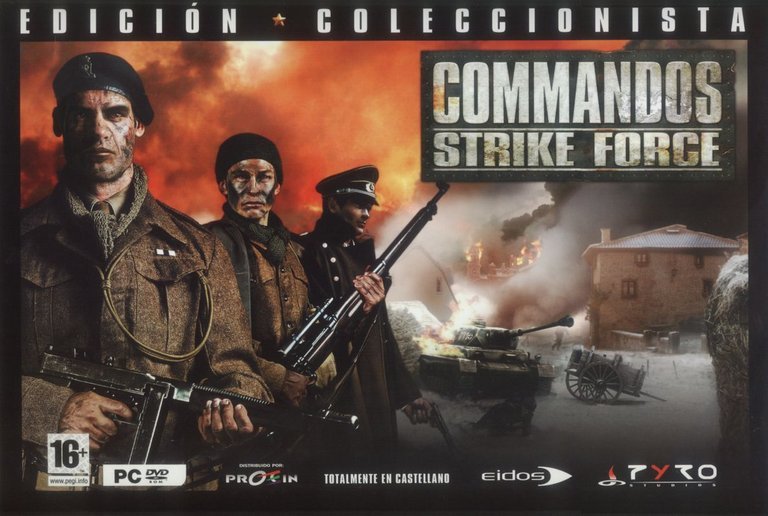
Commandos: Strike Force (Collector’s Edition) is a first-person tactical shooter and the fourth installment in the Commandos series, set during World War II. Players lead a squad of three specialized commandos—Green Beret, Sniper, and Spy—through distinct campaigns in occupied France, Norway, and the Soviet Union, utilizing unique weapons and abilities to complete stealth-based objectives and combat missions. The Collector’s Edition includes the game, original soundtrack, and a 64 MB USB stick.
Commandos: Strike Force (Collector’s Edition) Cracks & Fixes
Commandos: Strike Force (Collector’s Edition) Patches & Updates
Commandos: Strike Force (Collector’s Edition) Mods
Commandos: Strike Force (Collector’s Edition) Reviews & Reception
imdb.com (70/100): I hate to be the one to say this, but… stick to what you know
worthplaying.com : Strike Force moves into the stealth action and first-person shooter territory, but doesn’t manage to do either of them extraordinarily well.
gamesreviews2010.com : Commandos: Strike Force received mixed reactions from critics and fans alike.
Commandos: Strike Force (Collector’s Edition) Cheats & Codes
PC
Press `~` and enter the codes
| Code | Effect |
|---|---|
| allammo | 999 ammo |
| fly | fly |
| god | god mode |
| unloaded | no reload |
| ghost | they can’t see you |
| TRUCO | Enter TRUCO as a profile name to unlock all missions |
Xbox
Pause game play, then hold L + R and press A, Y, A, B, X, Y.
| Code | Effect |
|---|---|
| A, Y, A, B, X, Y | Unlimited Ammo |
| TRUCO | Enter TRUCO as a profile name to unlock all missions |
PlayStation 2
Enter TRUCO as a profile name.
| Code | Effect |
|---|---|
| TRUCO | Enter TRUCO as a profile name to unlock all missions |
PC (demo version file edits)
Edit ‘juegover.cfg’ in the config folder. Change the value in the ‘.bMenusExtrasActivo’ line to ‘1’.
| Code | Effect |
|---|---|
| Change .bMenusExtrasActivo to 1 | Extra menus (demo version) |
Commandos: Strike Force (Collector’s Edition): Review
Introduction
In the pantheon of World War II video games, few series have achieved the cult status of Commandos. Known for its meticulous real-time tactics and overhead perspective, the series carved a niche for itself among strategy enthusiasts. However, Commandos: Strike Force (Collector’s Edition), released in 2006, marked a radical departure from the series’ roots. Developed by Pyro Studios and published by Eidos Interactive, this installment shifted to a first-person shooter (FPS) format, a move that polarized fans and critics alike. This review will dissect the game’s development, narrative, gameplay mechanics, and legacy, ultimately assessing whether this bold experiment succeeded or faltered in its ambition.
Development History & Context
Pyro Studios, the Spanish developer behind the Commandos series, faced a dilemma by the mid-2000s. The series’ traditional real-time tactics gameplay, while beloved, was showing signs of aging in an industry increasingly dominated by immersive first-person experiences. The decision to pivot to an FPS was not made lightly. The studio aimed to modernize the franchise while retaining the tactical depth that defined its predecessors. However, the shift came with significant challenges, including adapting the series’ signature stealth and strategy elements to a first-person perspective.
The technological constraints of the era played a crucial role in shaping Strike Force. The game was built using the RenderWare engine, which, while capable, struggled to deliver the polished visuals and fluid gameplay of contemporaries like Call of Duty 2 or Brothers in Arms: Road to Hill 30. Additionally, the gaming landscape in 2006 was saturated with WWII shooters, making it difficult for Strike Force to stand out. Despite these hurdles, Pyro Studios pressed forward, hoping to capture a new audience while retaining the series’ core fanbase.
Narrative & Thematic Deep Dive
Commandos: Strike Force tells the story of a specialized Strike Force unit operating during World War II. The game is divided into three campaigns set in France, Norway, and the Soviet Union, each featuring a distinct set of missions. The narrative follows Lieutenant William Hawkins (a British sniper), Captain Francis O’Brien (an Irish Green Beret), and Colonel George Brown (a German spy working for the Allies). The plot is relatively straightforward, focusing on sabotage, espionage, and combat missions, but it is the characters’ interactions and the game’s themes that add depth.
The game explores themes of loyalty, betrayal, and the moral complexities of war. The revelation of a double agent within the Strike Force unit adds a layer of intrigue, though the execution of this twist is somewhat underwhelming. The dialogue is serviceable but lacks the depth and charm of the series’ earlier entries. The game’s attempts to humanize its characters through in-engine cutscenes and voice acting fall short, leaving the narrative feeling shallow compared to the rich storytelling of the original Commandos games.
Gameplay Mechanics & Systems
At its core, Commandos: Strike Force is a tactical FPS that allows players to switch between three distinct characters, each with unique abilities. The Green Beret excels in close-quarters combat and heavy weaponry, the Sniper specializes in long-range precision and stealth, and the Spy focuses on infiltration and sabotage. This character-switching mechanic is one of the game’s standout features, allowing for dynamic gameplay and strategic planning.
However, the execution of these mechanics is marred by several flaws. The game’s AI is notably weak, with enemy soldiers often failing to react realistically to threats. Stealth mechanics, a hallmark of the series, feel clunky and unintuitive. The ability to disguise as enemy soldiers is a welcome addition, but the implementation is flawed, with enemies often failing to recognize the player even when in plain sight. The combat is serviceable but lacks the depth and satisfaction of contemporary shooters.
The user interface (UI) is another area where Strike Force stumbles. The HUD is cluttered and uninformative, making it difficult to track objectives and health. The game’s controls are also somewhat cumbersome, with awkward keybindings and a lack of customization options. These issues detract from the overall experience, making the game feel dated even by 2006 standards.
World-Building, Art & Sound
Commandos: Strike Force attempts to recreate the atmosphere of World War II through its art direction and sound design. The game’s environments are detailed and evocative, with well-realized locations ranging from French villages to Norwegian ports and Soviet ruins. However, the graphics are hampered by the limitations of the RenderWare engine, resulting in muddy textures and lackluster lighting.
The sound design is one of the game’s strongest aspects. The orchestral score, performed by the Bratislava Symphony Orchestra, is epic and immersive, enhancing the game’s cinematic moments. The voice acting is competent, with each character having a distinct accent and personality. Sound effects, including gunfire and ambient noise, are well-implemented, adding to the game’s sense of immersion.
Reception & Legacy
Upon its release, Commandos: Strike Force received mixed reviews from critics and fans. Aggregator sites like Metacritic gave the game scores in the low 60s, indicating a lukewarm reception. Critics praised the game’s ambitious shift to a first-person perspective and the inclusion of character-switching mechanics, but they were quick to point out its numerous flaws. The game was criticized for its weak AI, clunky controls, and lack of innovation in a crowded genre.
Commercially, Strike Force underperformed, selling poorly despite its Collector’s Edition packaging, which included the original soundtrack and a 64 MB USB stick. The game’s failure to capture a wider audience can be attributed to its lack of polish and the oversaturation of WWII shooters in the mid-2000s. However, it did receive an award for sales of at least 40,000 units in Spain, a testament to the series’ enduring popularity in its home country.
The game’s legacy is somewhat mixed. While it failed to revitalize the Commandos franchise, it laid the groundwork for future experiments in the series. The character-switching mechanic, in particular, would be refined in later entries like Commandos: Origins (2025). However, Strike Force remains a cautionary tale about the risks of deviating too far from a series’ core identity.
Conclusion
Commandos: Strike Force (Collector’s Edition) is a bold but flawed experiment. Its attempt to modernize the Commandos series by shifting to a first-person perspective was ambitious, but the execution fell short. The game’s weak AI, clunky controls, and lack of innovation in a crowded genre ultimately doomed it to obscurity. However, it is not without its merits. The character-switching mechanic, epic soundtrack, and evocative environments offer glimpses of what could have been.
In the grand tapestry of video game history, Commandos: Strike Force is a footnote rather than a landmark. It serves as a reminder of the challenges of reinventing a beloved franchise and the importance of staying true to its core strengths. While it may not be remembered as a classic, it remains a fascinating artifact of a pivotal moment in the evolution of the Commandos series. For fans of the original games, it is a curious but ultimately disappointing detour; for newcomers, it offers a unique, if flawed, take on the WWII shooter genre.