
- Release Year: 2005
- Platforms: Windows
- Developer: Jeff Silvers Software
- Genre: Action, Fixed-screen shoot ’em up
- Perspective: Top-down
- Game Mode: Co-op, Single-player
- Gameplay: Arcade, Shooter
- Setting: Futuristic, Sci-fi
Description
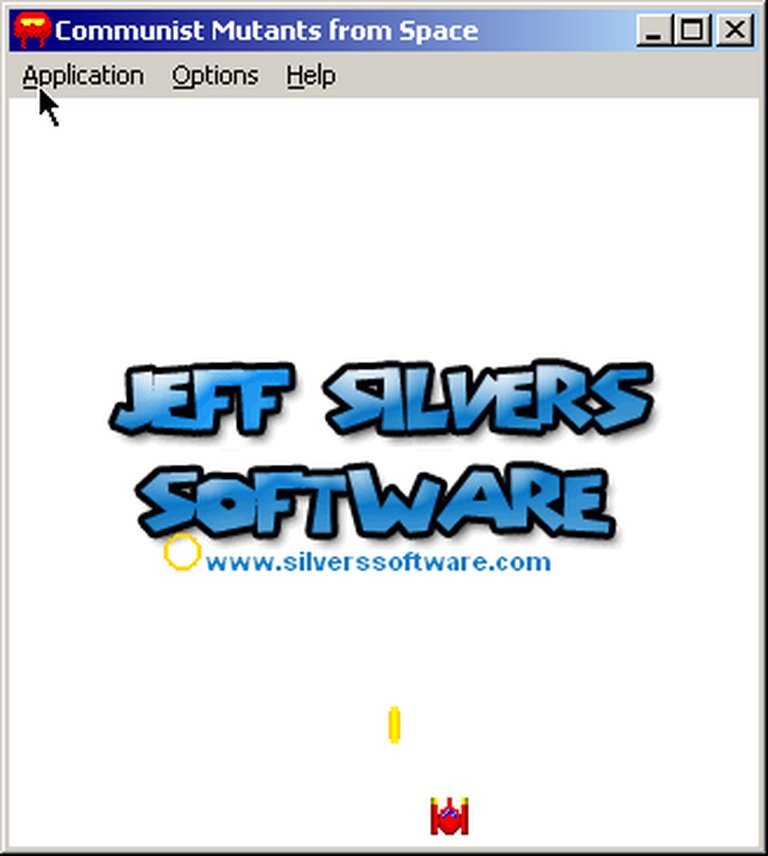
Communist Mutants From Space is a fan-made remake of the 1982 Atari 2600 game, set in a satirical Cold War sci-fi universe where players defend Earth as a space pilot battling communist alien invaders. Gameplay involves shooting eggs that hatch mutants from a top-down view, with the goal of destroying the Mother Creature who shields herself with her offspring. The remake enhances graphics and adds two-player co-op, blending arcade shooter action with anti-communist propaganda humor.
Communist Mutants From Space Reviews & Reception
mobygames.com : Excellent shooter. Don’t miss it.
Communist Mutants From Space: A Critical Retrospective
Introduction: The Red Scare, a Cassette, and a Cultural artifact
In the vast pantheon of video game history, few titles possess a moniker as simultaneously ridiculous, audacious, and perfectly of-its-moment as Communist Mutants from Space. This is not merely a game; it is a time capsule, a literal and figurative artifact dropped from the tailpipe of the Cold War into the burgeoning medium of home video games. At first glance, it appears to be little more than a pulp-infused Space Invaders or Galaxian clone, wrapped in a garish, jingoistic wrapper. But to dismiss it as such would be to ignore its profound technical innovation, its fascinating development story, and its unflinching, if clumsy, embodiment of early 1980s American geopolitical anxiety. This review will argue that Communist Mutants from Space is a significant, if deeply flawed, milestone. It represents a crucial, failed experiment in expanding the Atari 2600’s capabilities through the Starpath Supercharger, a brilliant design iteration on the fixed shooter formula, and a stark, un-PC cultural document whose thematic brazenness has, in hindsight, transformed it from forgotten commodity into a celebrated cult curio. Its legacy is not in birthing a franchise, but in encapsulating a specific collision of technology, marketing, and ideology that defined an era of gaming.
1. Development History & Context: Cassettes, Superchargers, and a Starpath Gamble
The Studio and the Vision
The game was developed by Starpath (formerly Arcadia Corporation), a company born not from passion for play but from a pragmatic hardware problem. Starpath’s core innovation was the Supercharger, a peripheral for the Atari 2600 that used a standard cassette deck to load game data as audio signals into an additional 6,144 bytes of RAM (compared to the console’s paltry 128 bytes). This allowed for games with vastly larger ROM sizes, more complex graphics, and richer sound than standard cartridges could accommodate. Communist Mutants from Space was one of the flagship titles for this system, a showcase for what the Supercharger could do.
The game was programmed by Stephen H. Landrum, for whom this was a first commercial release. In a 1993 interview, Landrum revealed a crucial detail: the incendiary title was not his creation. It was coined by Starpath’s advertising agency. Landrum initially thought it was a joke but soon realized its marketing genius: “the outrageousness of the name would actually help the program.” This separation is key. The game’s core mechanics are competent, even innovative for the hardware, but its identity—its very soul—was a calculated commercial ploy. Originally codenamed Galactic Egg, the game’s re-branding tethered a fairly generic space shooter directly to the hottest political topic of the day.
Technological Constraints and Innovations
The Atari 2600 was famously limited, a console where programmers had to wrestle with every single clock cycle. The Supercharger changed the equation. By loading data from cassette, it offloaded storage and allowed for dynamic memory management. For Communist Mutants, this meant:
* Enhanced Graphics: Smoother multi-sprite animations, more detailed enemy and egg formations, and a scrolling score that could display six digits—a technical feat for the 2600 at the time.
* Complex Enemy Logic: The Mother Creature and her managing of the egg rows required more CPU overhead than a standard cartridge could have supported. Her ability to “repair” gaps in her egg-shield by moving to fill them was a sophisticated AI behavior for 1982.
* The Loading Ritual: The game’s 2-4 minute load time from cassette was a major hurdle. Players had to physically manage a tape player, a barrier to instant gratification that ultimately contributed to the Supercharger’s commercial failure. This process, using frequency-shift keying to encode data as audio tones, is a fascinating footnote in the history of software distribution.
The 1982 Gaming Landscape
Released in 1982, the game entered a saturated shooter market. Space Invaders (1978) had defined the genre, and Galaxian (1979) had added diving enemies. The Atari 2600 itself had dozens of shooters. Starpath’s strategy was twofold: technical superiority (via the Supercharger) and thematic provocation. While Atari’s official Galaxian port wouldn’t arrive until 1983, Communist Mutants offered a similar core loop but wrapped in a uniquely American, anti-communist package that resonated with the Reagan-era zeitgeist. The Soviet invasion of Afghanistan (1979), the “Evil Empire” speech (1983), and pervasive pop-culture fear of nuclear annihilation and ideological subversion made its theme not just acceptable, but commercially savvy.
2. Narrative & Thematic Deep Dive: Dialectical Materialism and Irradiated Vodka
Plot and Characters: A Manual-Only Saga
The game’s narrative is almost entirely external to the gameplay, residing in the manual and box art. There is no in-game story sequence, no character portraits, no text. You are an unnamed cannon operator. The antagonists are:
* The Planet Rooskee: A thinly veiled phonetic pun on “Russia.”
* The Mother Creature: A “cunning” alien queen, explicitly stated to be “filled with irradiated vodka” and driven mad by it. She is the source of the invasion, a bizarre fusion of communist leadership (the “Mother” of the proletariat) and stereotypical Russian alcoholism.
* The Communist Mutants: Formerly “peaceful, democratic” beings from conquered planets, transformed into “bloodthirsty COMMUNIST MUTANTS.” They are not individual villains; they are a collective horde, the “proletarian enemy masses.”
Your role is as a defender for the “Anti-Communist Force of Earth.” In the 2005 fan remake, this is given a name: Harry McCarthy, a clear nod to McCarthyism, further tying the action to the historical paranoia of the 1950s.
Thematic Analysis: Propaganda as Gameplay Aesthetic
This is where the game becomes a fascinating historical document. Its themes are not subtext—they are the text, plastered across the title screen with a red “C” incorporating a hammer and sickle.
* Communism as Contagion/Infection: The core metaphor is literal mutation. Communism is not a political ideology but a biological virus, transmitted via “irradiated vodka.” It turns ordinary beings into mindless, aggressive drones. This reflects Cold War propaganda about communist “brainwashing” and the “domino theory” of ideological spread.
* The Horde vs. The Individual: The player’s lone cannon (or two in the remake) stands against endless, regenerating waves. The Mother Creature’s eggs act as a protective shield barrier, a literal wall of communists that must be dismantled. The thematic message is clear: you must strike at the heart of the system (the Mother Creature) to break its regenerative capacity. Until then, you are merely fighting a rearguard action against an endless supply of fanatics.
* Capitalist Bourgeoisie Knowhow: The MobyGames description for the remake hilariously notes you defeat them with “your good ole one-two anti-Communist bourgeois knowhow.” This tongue-in-cheek acknowledgment frames the player’s action as the weaponization of Western individualism and technological prowess against a collectivist, brainwashed foe.
* Superficial Integration: Crucially, this propaganda does not integrate with the mechanics. There is no “ideology meter.” The mutants’ behavior is identical to Galaxian‘s aliens. The theme is a skin, a narrative justification for what is otherwise a pure, abstract arcade challenge. This makes it a potent example of “ludonarrative dissonance” decades before the term was coined, but also underscores that the theme was primarily a marketing hook, not a design pillar.
The 2005 Remake’s “Fortification”
Jeff Silvers’ 2005 fan remake doubles down on the satire with a knowing, postmodern smirk. It gives the player a name (Harry McCarthy) and explicitly mentions the “Anti-Communist Force of Earth.” The description’s mention of “dialectical materialism” and “proletarian enemy masses” is a graduate-level ironic deployment of Marxist terminology to describe a mindless shooter. It also frames the addition of two-player co-op as “an ideological compromise given Kropotkin’s writings on federating for mutual aid”—a brilliant, academic joke that treats the game’s own fiction as a serious political philosophy to be debated. The remake doesn’t just update the graphics; it updates the discourse around the game, inviting a more self-aware engagement with its dated politics.
3. Gameplay Mechanics & Systems: A Polished Galaxian with Options
Core Loop: The Egg Shield Meta
At its heart, Communist Mutants from Space is a fixed shooter where the player’s ship is confined to the bottom of the screen. The enemy formation is not a static grid like Space Invaders, but a dynamically managed system:
1. The Eggs: Four rows of eggs (6, 7, 8, 7 eggs per row) slide horizontally at the top.
2. Hatching: Periodically, an egg hatches into a Communist Mutant. This mutant executes a diving run at the player’s cannon, firing a bomb, before attempting to return to the top and re-enter an egg.
3. The Mother Creature: She sits above the egg rows. Her critical function is regeneration. Whenever an egg is destroyed (by the player) or hatches, the Mother Creature will move to that column and lay a new egg, maintaining her protective barrier.
4. Primary Objective: To clear the wave, you must shoot the Mother Creature. As long as she lives, the egg barrier will perpetuate. Destroying her stops the regeneration, allowing you to clear the remaining eggs and mutants.
5. Loss Condition: You start with 3 reserve cannons. A cannon is destroyed if hit by a mutant or its bomb. You earn an extra cannon every other wave. Game over when the last cannon is lost.
This “shield-holding boss” mechanic is the game’s primary innovation over Galaxian. The Mother Creature is not just a high-value target; she is the system administrator of the enemy hive. The strategic imperative shifts from “clear the screen” to “create a path to the admin.” It adds a layer of tactical targeting absent in many contemporary shooters.
The Revolutionary Options Menu
Where the game truly shines is its pre-game options menu, accessed via the Select switch. This was highly unusual for the era, where game variations were typically cycled through with the Select button, with no clear indication of what you’d get. Communist Mutants presents a clear list:
* Number of Players (1-4): Supports hot-seat multiplayer. Players 1 & 3 share Joystick 1; Players 2 & 4 share Joystick 2. This allows for a four-player rotation on two ports.
* Difficulty Level (1-9): A granular scale for enemy speed and potentially aggression, far more precise than the standard A/B difficulty switches.
* Shields: When ON, pulling back on the joystick activates a temporary (5-second) invincibility shield, usable once per level/cannon. A crucial survival tool.
* Time Warp: When ON, pushing up on the joystick slows all enemy movement for about 10 seconds. This allows for careful aiming during dense mutant dives.
* Penetrating Fire: When ON, your standard shot passes through one enemy, hitting a second behind it.
* Guided Fire: When ON, your shot becomes a missile you can steer with the joystick after firing, for a short distance.
These options create a profound depth of customization. You could play a pure, classic experience with all options off, or engage in a highly tactical, power-up-laden run with all options on. The “Guided Fire” option, in particular, is a game-changer, allowing precision strikes on the Mother Creature or specific egg clusters. The system’s elegance is that all these power-ups are selected before the game starts, not randomly dropped. This makes the player’s strategic choice part of the setup, not a reward, emphasizing planning over reflex.
Controls and UI
Controls are standard Atari 2600 joystick: left/right to move, button to fire. The special options (Shield, Time Warp) are tied to directional inputs (down, up), meaning the player must manage movement, firing, and special abilities on a single stick—a classic challenge of 2600 design. The UI is minimalist but effective: a score display at the top, remaining cannons in reserve, and a clear visual indication of the active player (P1-P4). The Mother Creature’s position and the egg rows are always visible, providing perfect information.
Flaws and Limitations
- Repetitive Waves: While difficulty escalates (faster enemies, smarter diving patterns), the fundamental pattern of “clear eggs -> shoot Mother” does not substantially change over 32+ waves.
- Audio-Based Loading: For the original, the multi-minute cassette load is a fatal flaw for repeated play. The 2005 download eliminates this.
- Derivative Foundation: Despite its additions, the core enemy behavior—eggs hatching into diversifying attackers—is directly lifted from Galaxian. It refines but does not reinvent the genre’s core loop.
4. World-Building, Art & Sound: Cassette Aesthetics and Propaganda Imagery
Visuals and Atmosphere
The Supercharger’s extra RAM enabled a cleaner, more detailed look than most 2600 games. Screenshots show:
* The Mother Creature: A large, multi-colored sprite that moves with a distinctive, scurrying animation along the top row. Her design is a grotesque, vaguely insectoid queen, fitting for a “Mother” of mutants.
* The Eggs: Clearly defined, wobbly ovals that slide in their rows.
* The Mutants: Swooping, spiky aliens that differentiate slightly in color.
* The Cannon: A simple, blocky turret at the bottom.
The 2005 remake, by Jeff Silvers, enhances this significantly with smoother animations, more vibrant colors, and detailed backgrounds, while maintaining the top-down perspective. It captures the original’s aesthetic but with the polish of a 21st-century fangame.
The propaganda art on the box and title screen is integral. The use of red, the hammer-and-sickle integrated into the logo, and the imagery of hordes descending on a single defender sells the Cold War fantasy more powerfully than any in-game element.
Sound Design
For the 2600, the sound is serviceable. The TIA chip produces the expected beeps and boops for shooting, explosions, and mutant sounds. The Supercharger may have allowed for slightly more varied audio samples, but it’s still within the 2600’s famous limitations—more rhythm than melody. The 2005 remake, with music credited to “MidwayNirvanaWorld Wrestling Entertainment” (a likely inside joke or placeholder), can presumably offer a richer audio experience, though specific details are sparse.
The sound’s role is purely functional: to provide audio cues for hatching, shooting, and hits. The theme is communicated visually and textually, not aurally.
5. Reception & Legacy: From Obscurity to Cult Artifact
Contemporary Reception (1982-1984)
Communist Mutants from Space was a launch title for the Supercharger and received generally positive, if niche, reviews.
* Arcade Express (Oct 1982) featured it in “Hotseat,” praising its arcade-quality action.
* Computer + Video Games (July 1983) listed it among notable 2600 titles.
* Electronic Fun with Computer Games (Jan 1983) famously lauded its title as an “all-time great video game moniker.”
Critics and players appreciated its speed, smoothness, and the unprecedented options menu. It was seen as a technically impressive title that maximized the Supercharger’s potential. However, its distribution was limited to mail-order via Starpath, and the Supercharger itself was a commercial flop due to its clunky cassette system and the impending video game crash of 1983. Thus, its reach was always constrained.
Modern Retrospective Assessment
In retro gaming circles, the game’s reputation has evolved from forgotten tech demo to beloved cult classic.
* Technical Praise: It is consistently cited as one of the best games for the Supercharger, and one of the most technically impressive 2600 games period, for its smooth multi-sprite action and menu system.
* Cult Status via Thematic Audacity: Its unapologetic, almost cartoonish anti-communist propaganda is now viewed with a mix of awe and amusement. Modern reviewers often highlight its “ridiculous” premise as its most memorable feature, a peak of un-PC 80s jingoism that feels like a parody, despite being earnest. This gives it a unique identity among hundreds of generic space shooters.
* Gameplay Respect: The depth offered by the options menu is still praised. The strategic layer of targeting the Mother Creature and managing limited-use power-ups (Shield, Time Warp) gives it replay value beyond a pure twitch shooter.
* Collectibility: As a Supercharger title, it is rare and valuable. Sealed copies command $60-$150. Its notoriety from its title and theme boosts demand among Atari completists.
* The 2005 Remake’s Role: Jeff Silvers’ fangame, released as freeware, has kept the title alive in modern retro communities. It serves as an accessible, playable version that preserves the original’s spirit while updating its presentation. Its 3.1/10 average on MobyGames (from only 2 ratings) suggests it remains a deeply niche taste, known more by reputation than by broad play.
Influence and Industry Place
Communist Mutants did not spawn a genre or a franchise. Its direct influence is minimal. Its legacy is more symbolic and technological:
1. Proof of Concept for Peripherals: It demonstrated that the Atari 2600 could host more complex games via RAM-expansion hardware, a lesson that would be applied later (in a more successful, cartridge-based way) by companies like Codemasters with their Game Genie/Game Wizard RAM trickery.
2. The Power of Thematic Branding: It is a case study in how a provocative, memorable title can define a game’s cultural afterlife, even if the gameplay is derivative. Its name is its primary asset.
3. Cult of the Derivative: It shows that a game doesn’t need to be wholly original to be interesting. Its refinements to the Galaxian formula (the Mother Creature shield, the options menu) are meaningful enough to warrant preservation and study.
4. Document of Its Time: It stands as a primary source artifact for historians studying the cultural penetration of Cold War rhetoric into everyday entertainment. It is a video game equivalent of a Red Scare comic book or a Rambo film—reflecting, amplifying, and simplifying geopolitical tensions into a clear “us vs. them” conflict.
6. Conclusion: Verdict – A Flawed, Fascinating Time Capsule
Communist Mutants from Space is not a “great” game by conventional metrics. Its gameplay, while solid and tactically interesting, is fundamentally a refined iteration of a 1979 arcade design. Its presentation on the original Atari 2600 is severely hampered by the impractical Supercharger peripheral. Its narrative is a blunt, politically tone-deaf instrument.
However, to judge it only on these grounds is to miss its historical significance. It is exceptionally important as:
* A technical triumph for the at-limit Atari 2600 hardware.
* A bold, if grotesque, crystallization of early 1980s American cultural politics.
* A precursor to the fangame/remake culture, as evidenced by Jeff Silvers’ 2005 effort.
* A testament to the power of marketing, where a title conceived by an ad agency gave a competent shooter an immortal, if infamous, identity.
Its place in video game history is secure not as a classic, but as a profoundly telling artifact. It is a game that could only have been made in 1982, for the Atari 2600, by a company trying to break hardware barriers, and in a country caught in the grip of Cold War obsession. It is a bizarre, awkward, and oddly brilliant monument to an era where the enemy was a communist mutant from the planet Rooskee, and the only way to win was to shoot through his irradiated-vodka-fueled hordes until you hit the Mother. For that audacious, specific, and utterly unadulterated vision, it earns its spot in the archives. Recommended for historians, collectors, and those with a taste for ironic cult classics; avoid for those seeking timeless, apolitical gameplay.