
- Release Year: 2004
- Platforms: GameCube, PlayStation 2, Windows, Xbox
- Publisher: 1C Company, TDK Recording Media Europe S.A.
- Developer: Cauldron Ltd.
- Genre: Action
- Perspective: Behind view
- Game Mode: Single-player
- Gameplay: Hack and Slash
- Setting: Fantasy
- Average Score: 61/100
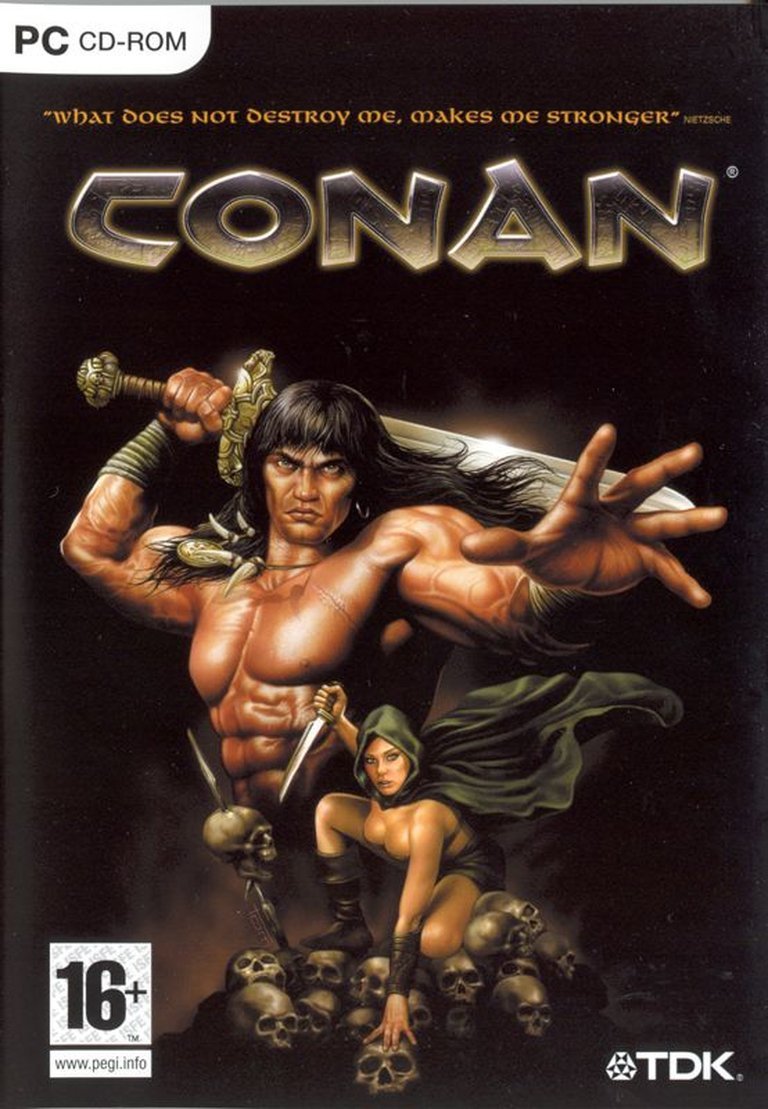
Description
Conan is a 3D hack-and-slash action game with RPG elements, set in the brutal Hyborian Age. After returning from an adventure to find his village destroyed and his uncle murdered by the Vulture Cult, Conan embarks on a vengeful quest, battling hordes of enemies—both human and supernatural—across diverse landscapes like Cimmeria, Stygia, and Darfar. Players earn experience points to unlock powerful combat skills, wield weapons like swords, hammers, and axes, and can even resurrect Conan through arena battles in Crom’s domain if defeated. The game also features a multiplayer Arena mode and a licensed soundtrack from the Conan films.
Gameplay Videos
Where to Buy Conan
PC
Conan Cracks & Fixes
Conan Guides & Walkthroughs
Conan Reviews & Reception
en.wikipedia.org (61/100): Conan received average reviews. It holds an average of 61% for Xbox and 51% for PC on aggregate website GameRankings.
imdb.com (60/100): Fun, but ends too quick. It’s like they never even bothered to complete production of the game.
mobygames.com (62/100): Not even Arnold could save this one. Strictly a melee-oriented game, Conan nonetheless packs a shitload of moves that not only do different amounts of damage, but have different strategic advantages.
Conan Cheats & Codes
PC
Go to the ‘UNLOCKABLES’ menu and enter the following button sequences.
| Code | Effect |
|---|---|
| Triangle(2), L3, Square(2), R3, Up, Down | Unlocks Conan Helmet Study Art #1 |
| Right(2), Left(2), Up, Down, Up, Down, Square(2) | Unlocks Spirit Warrior Variation #1 Art |
| Up, Down, Left(2), Square(3) | Unlocks Graven Variation #2 Art |
| Up, Down, Up, Down, Left, Right, Left, Right, Square, Triangle | Unlocks Graven Variation #1 Art |
| Left, Square, Left, Triangle, Down, R3(2) | Unlocks Cutting Room Floor: Giant Sea Serpent #2 Art |
| L3(2), Triangle(2), Square, R3 | Unlocks Cutting Room Floor: Giant Sea Serpent #1 Art |
| Up, L1, Down, R1, Square(2), Triangle(2), R3 | Unlocks Conan Helmet Study #2 Art |
| Down, L1, Down, R1, Square, L2 | Unlocks Cave Ape Variation Art |
| L3, Square, R3, Triangle, L1(2), Down(2) | Unlocks Bone Cleaver Variation Art |
Xbox (2004)
Enter the following button combinations at the title screen.
| Code | Effect |
|---|---|
| Left, Right(2), Up, Down, Left | Alternative Costumes |
| Left, Right, Up, Down(2), Right | Run Faster |
| Left(3), Up, Down, Right, Left | Super Charged Attacks |
| Up(2), Left, Down, Left, Right | Unlimited energy |
GameCube (2004)
Enter the following button combinations at the title screen.
| Code | Effect |
|---|---|
| Left, right, right, up, down, left | Alternate costumes |
| Left, right, up, down, down, right | Run faster |
| Left, left, left, up, down, right, left | Super charged attacks |
| Up, up, left, down, left, right | Unlimited energy |
PlayStation 2 (2004)
Enter the following button combinations at the title screen.
| Code | Effect |
|---|---|
| Left, right, right, up, down, left | Alternate costumes |
| Left, right, up, down, down, right | Run faster |
| Left, left, left, up, down, right, left | Super charged attacks |
| Up, up, left, down, left, right | Unlimited energy |
PlayStation 2 (PS2)
Enter the following button combinations at the title screen.
| Code | Effect |
|---|---|
| Up(2), Left, Down, Left, Right | Infinite energy |
| Left(3), Up, Down, Right, Left | Power-up attacks |
| Left, Right, Up, Down(2), Right | Faster running |
| Left, Right(2), Up, Down, Left | Alternate costumes |
Xbox
Enter the following button combinations at the title screen.
| Code | Effect |
|---|---|
| Left, Right(2), Up, Down, Left | Alternate costumes |
| Left(3), Up, Down, Right, Left | Power-up attacks |
| Left, Right, Up, Down(2), Right | Faster running |
| Up(2), Left, Down, Left, Right | Unlimited energy |
Conan: A Flawed but Fierce Hack-and-Slash Odyssey
Introduction
In the pantheon of licensed video games, Conan (2004) stands as a curious artifact—a game that swings its sword with both ambition and clumsiness. Developed by Slovak studio Cauldron and published by TDK Mediactive, this third-person action-adventure game attempts to channel the brutal spirit of Robert E. Howard’s iconic barbarian into a hack-and-slash experience. While it stumbles in execution, its raw combat, atmospheric world, and homage to the source material make it a fascinating case study in early 2000s action games.
Development History & Context
Conan emerged during a time when licensed games were often rushed, underfunded, or overly reliant on brand recognition. Cauldron, a studio known for titles like Knights of the Temple, took on the challenge of adapting Howard’s Hyborian Age, a task complicated by the need to balance fidelity to the lore with accessible gameplay. The game’s development was shaped by several key factors:
- Licensing and Inspiration: TDK secured rights to Howard’s works, allowing the team to draw from the original stories, comics, and the 1982 film. The plot was penned by Jan Kanturek, a Czech translator of Howard’s work, ensuring a degree of authenticity. The combat and soundtrack, however, leaned heavily on the films, particularly Basil Poledouris’s iconic score.
- Technological Constraints: Released in 2004, Conan was built on the Conan 3D Engine, which, while capable, struggled to keep pace with contemporaries like Prince of Persia: Warrior Within or God of War. The game’s visuals were serviceable but lacked the polish of its peers, with character models and textures that felt dated even at launch.
- Market Positioning: The early 2000s saw a surge in action-adventure games, with titles like Devil May Cry and Ninja Gaiden setting high bars for combat depth. Conan aimed to carve its niche by blending hack-and-slash mechanics with light RPG elements, a formula that had worked for games like Baldur’s Gate: Dark Alliance.
Narrative & Thematic Deep Dive
Conan’s story is a straightforward revenge tale: the barbarian returns to his village in Cimmeria to find it razed by the Vulture Cult, a group seeking a magical artifact. This premise, while simple, is steeped in Howard’s lore, taking Conan across the Hyborian Age’s diverse landscapes—from the jungles of Darfar to the deserts of Stygia.
- Plot and Pacing: The narrative is linear, with Conan pursuing his enemies through a series of environments. The game’s strength lies in its atmospheric storytelling, using environmental details and brief cutscenes to evoke the brutality of Howard’s world. However, the plot suffers from a lack of depth, often feeling like a greatest-hits tour of Conan tropes rather than a fresh adventure.
- Characters and Dialogue: Conan himself is a silent protagonist, with voice acting limited to grunts and battle cries. Supporting characters are sparse, and dialogue is minimal, relying on text and occasional voiceovers. The game’s reliance on the film’s score (a licensed inclusion) further ties it to the cinematic Conan, sometimes at the expense of its own identity.
- Themes: The game explores themes of vengeance, survival, and the indifference of the gods—particularly Crom, Conan’s deity. The save system, which requires finding rune stones, reinforces the idea of divine caprice, as Crom offers Conan a chance at resurrection in an otherworldly arena if he falls in battle.
Gameplay Mechanics & Systems
Conan’s core gameplay loop revolves around combat, with light RPG elements adding progression. The mechanics are a mix of innovation and frustration:
- Combat and Combos: The game’s combat system is its highlight, offering a wide array of moves and combos that can be unlocked using experience points. Players can wield swords, hammers, and axes, each with distinct attack patterns. The combo system is intuitive, allowing for fluid transitions between strikes, though executing advanced moves with a keyboard and mouse is cumbersome.
- Progression and Customization: Experience points earned from slaying enemies can be spent on upgrading Conan’s abilities, such as stronger attacks or increased stamina. This RPG-lite system adds a layer of strategy, encouraging players to tailor Conan’s skills to their playstyle.
- Exploration and Puzzles: The game features large, linear levels with occasional puzzles, such as lever-based challenges or environmental hazards. However, the linearity and lack of meaningful exploration make these segments feel like obligatory detours rather than organic parts of the adventure.
- Camera and Controls: The game’s most glaring flaw is its camera, which frequently obstructs the player’s view or fails to track Conan properly. Combined with imprecise controls, this makes platforming sections and combat against ranged enemies unnecessarily frustrating.
World-Building, Art & Sound
Conan’s world is a visual and auditory homage to Howard’s Hyborian Age, though its execution is uneven:
- Setting and Atmosphere: The game’s environments are diverse, ranging from icy caves to volcanic temples. Each location is richly detailed, with textures and lighting that evoke the grim beauty of Howard’s world. The jungles of Darfar feel oppressive, while the ruins of forgotten civilizations exude a sense of ancient dread.
- Visual Design: Character models, particularly Conan’s, are a weak point. Conan’s face lacks detail, and his animations, while fluid in combat, can feel stiff in cutscenes. Enemy designs, however, are varied and often grotesque, from skeletal warriors to monstrous beasts.
- Sound and Music: The game’s soundtrack is a standout feature, featuring Basil Poledouris’s iconic themes from the films. The music swells during combat, enhancing the game’s epic tone. Sound effects, such as the clash of steel and the screams of enemies, are similarly well-implemented, though voice acting is sparse and uneven.
Reception & Legacy
Conan received mixed reviews upon release, with critics praising its combat and atmosphere while criticizing its technical issues. The game’s reception varied by platform, with the Xbox version faring slightly better due to its more intuitive controls.
- Critical Reception: Aggregated scores on MobyGames and GameRankings placed Conan in the mid-60s, with critics highlighting its enjoyable combat but lamenting its repetitive gameplay and technical flaws. German publications like GameStar and PC Action praised its atmosphere, while French outlets like Jeuxvideo.com dismissed it as a forgettable hack-and-slash.
- Commercial Performance: The game’s sales were modest, failing to make a significant impact in a crowded market. Its legacy is that of a cult title, remembered fondly by fans of the genre but overshadowed by more polished contemporaries.
- Influence and Follow-Ups: Conan’s blend of hack-and-slash and RPG elements foreshadowed later titles like God of War and Dark Souls, though it lacked their refinement. The game’s multiplayer mode, which included arena battles, was a precursor to the competitive modes seen in later action games.
Conclusion
Conan (2004) is a game of contradictions—a title that captures the spirit of Howard’s barbarian in its combat and world-building but stumbles in its execution. Its flawed camera, repetitive gameplay, and technical issues prevent it from reaching greatness, but its atmospheric storytelling and satisfying combat make it a worthy experience for fans of the genre. In the annals of licensed games, Conan stands as a reminder of the challenges of adapting beloved properties, offering a glimpse of what could have been with more time and resources.
Final Verdict: A flawed but fierce hack-and-slash adventure that Conan fans and action enthusiasts may enjoy, despite its rough edges. 6.5/10