
- Release Year: 2009
- Platforms: Linux, Macintosh, Windows
- Genre: Action
- Perspective: Diagonal-down
- Game Mode: Single-player
- Gameplay: Arcade
- Setting: Comedy
- Adult Content: Yes
Description
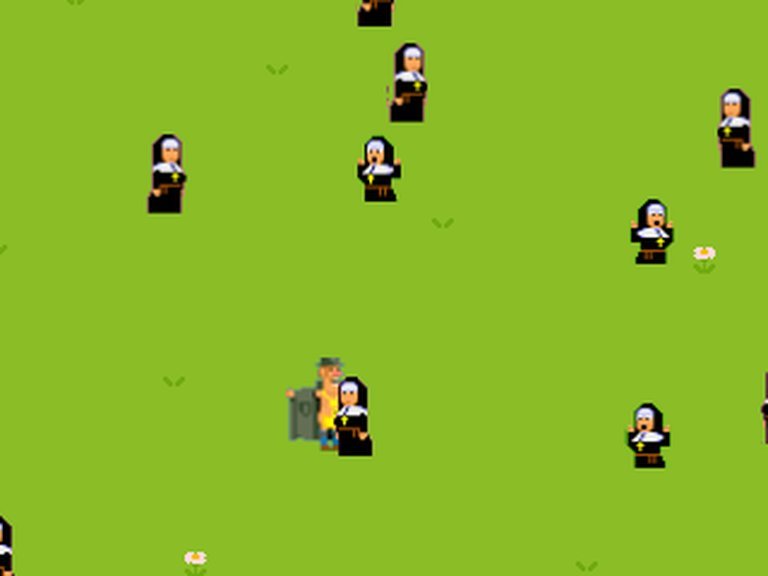
Concerned Nuns is a short, comedic arcade game where players control a trenchcoat-wearing character who flashes a duck at a crowd of nuns to score points within a one-minute time limit. Developed for the BIGJam 2009 game jam, the game features tongue-in-cheek humor, a diagonal-down perspective, and simple direct controls, offering a quirky and absurd experience.
Concerned Nuns: A Satirical Masterpiece of Absurdist Game Design
Introduction
In the vast, often self-serious landscape of video game history, few titles dare to embrace the sheer, unfiltered absurdity of Concerned Nuns. Released in 2009 as a product of the BIGJam 2009 game jam, this microscopic, one-minute experience is a masterclass in subversive humor, minimalist design, and the art of provocation. At its core, Concerned Nuns is a game about a trenchcoat-clad deviant flashing a duck at a congregation of nuns to accumulate points—a premise so deliberately ridiculous that it transcends mere comedy and enters the realm of performance art. Yet, beneath its veneer of shock value lies a fascinating artifact of indie game culture, a snapshot of an era when developers were beginning to push back against the industry’s growing commercialization with unapologetic, often confrontational creativity.
This review will dissect Concerned Nuns in exhaustive detail, exploring its development context, its narrative (or lack thereof), its gameplay mechanics, and its lasting impact on the medium. Far from being a mere joke, Concerned Nuns is a deliberate provocation, a challenge to the very notion of what a video game can—or should—be.
Development History & Context
The Birth of a Joke
Concerned Nuns was created in just 18 days by a trio of developers—Iwan Gabovitch, Christiaan Janssen, and Sven Ruthner—as part of the BIGJam 2009, a game jam focused on experimental and avant-garde game design. The team, operating under the collective moniker “chrisjan,” approached the project with a clear mission: to craft something so intentionally absurd that it would force players to question their own expectations of video games.
The game was built using the LÖVE2D framework, an open-source engine that allowed for rapid prototyping and iteration. This choice was crucial, as it enabled the team to focus on the game’s core concept rather than technical overhead. The development process was marked by a spirit of playful irreverence, with the team even brainstorming alternate titles like “Nuncerner” and “nunfusion”—pun-laden names that further emphasized the game’s satirical intent.
A Reaction to the Gaming Landscape of 2009
To understand Concerned Nuns, one must consider the gaming landscape of 2009. The late 2000s were a period of significant upheaval in the industry. The rise of high-definition consoles like the PlayStation 3 and Xbox 360 had led to an arms race in graphical fidelity and production values, with blockbuster titles like Call of Duty: Modern Warfare 2 and Uncharted 2: Among Thieves dominating the discourse. Meanwhile, the indie scene was beginning to assert itself as a counterbalance to this trend, with games like Braid and World of Goo proving that small, creative teams could produce experiences that resonated deeply with players.
Concerned Nuns exists at the extreme end of this indie rebellion. It is a game that rejects not only the AAA obsession with realism but also the indie penchant for emotional storytelling or mechanical depth. Instead, it embraces the absurd, the offensive, and the utterly pointless as a form of commentary. In many ways, it is a spiritual successor to earlier experimental games like You Have to Burn the Rope (2008), which similarly used brevity and simplicity to subvert player expectations.
The Role of Game Jams in Experimental Design
Game jams have long been incubators for unconventional ideas, providing a space where developers can take risks without the pressure of commercial viability. BIGJam 2009, in particular, encouraged participants to explore themes of “big” ideas in small packages. Concerned Nuns is a perfect embodiment of this ethos. It is a game that is “big” in its audacity but minuscule in its execution, proving that impact does not necessarily correlate with scale.
The game’s development also reflects the collaborative, almost anarchic nature of game jams. The team’s decision to release the source code publicly further underscores this ethos, inviting others to remix, modify, or even mock their creation. This openness is a hallmark of the indie scene’s commitment to community and shared creativity.
Narrative & Thematic Deep Dive
The “Plot” of Concerned Nuns
At first glance, Concerned Nuns appears to have no narrative whatsoever. The player controls a faceless, trenchcoat-wearing figure standing before a group of nuns. The objective? Flash a duck at them to score points. After one minute, the game ends. There are no cutscenes, no dialogue, and no context provided. Yet, this very absence of narrative is itself a narrative statement.
The game’s premise is a deliberate pastiche of taboo-breaking humor, drawing from the long tradition of shock comedy in media. The act of flashing—a crude, juvenile gesture—is amplified by the target: nuns, symbols of piety and chastity. The duck, an innocuous animal, becomes a surreal, almost Dadaist prop in this scenario, its randomness heightening the absurdity. The game does not merely present this scenario; it forces the player to participate in it, making them complicit in the joke.
Themes: Absurdity, Provocation, and Player Agency
-
Absurdity as Commentary
Concerned Nuns is a game that revels in its own meaninglessness. The act of flashing a duck at nuns serves no purpose beyond its own existence. There is no deeper metaphor, no hidden message—just the pure, unfiltered absurdity of the act itself. In this way, the game aligns with the principles of absurdist theater, which seeks to expose the illogical and irrational aspects of human existence. The game’s brevity (a mere 60 seconds) further emphasizes this point, suggesting that the experience is not meant to be savored but rather endured, like a quick, sharp jab to the ribs. -
Provocation and Taboo
The game’s central mechanic is designed to provoke. By tasking the player with performing an act that is both socially unacceptable and utterly ridiculous, Concerned Nuns forces them to confront their own discomfort. The nuns, as symbols of religious authority, serve as the perfect foil for this provocation. Their presence elevates the act from mere vulgarity to something approaching blasphemy, albeit in a cartoonish, over-the-top manner. The game does not seek to offend for offense’s sake but rather to highlight the arbitrary nature of taboos and the ways in which society polices behavior. -
Player Agency and Complicity
One of the most fascinating aspects of Concerned Nuns is the way it implicates the player in its own absurdity. Unlike a passive form of media, such as a film or a book, the game requires the player to actively participate in the act of flashing. This creates a sense of complicity, as the player is not merely observing the absurdity but enacting it. The game thus becomes a commentary on the nature of interactivity in video games, questioning the extent to which players are willing to engage with content that challenges their moral or social boundaries. -
The Illusion of Choice
While Concerned Nuns presents itself as a game with a clear objective (score points by flashing), the reality is that the player has no meaningful choices to make. The game is, in essence, a single, linear experience disguised as an interactive one. This illusion of choice is another layer of satire, mocking the way many games present players with the illusion of agency while ultimately funneling them toward a predetermined outcome.
Gameplay Mechanics & Systems
The Core Gameplay Loop
Concerned Nuns is, at its core, a single-mechanic game. The player controls a character who can move left or right and press a button to flash the duck. The nuns react with varying degrees of shock, and the player accumulates points based on the number of successful flashes. After one minute, the game ends, and the player is given a score.
This simplicity is deceptive. While the mechanics are straightforward, the game’s design is carefully calibrated to maximize its comedic and provocative impact. The brevity of the experience ensures that the joke does not overstay its welcome, while the lack of any additional mechanics keeps the focus squarely on the central premise.
The Role of the Duck
The duck is the game’s most surreal element. Unlike a more conventional prop (such as a weapon or a tool), the duck serves no practical purpose beyond its role in the game’s central joke. Its presence is entirely arbitrary, which is precisely what makes it so effective. The duck is a symbol of the game’s commitment to absurdity, a reminder that Concerned Nuns is not interested in logic or reason.
The Nuns as Reactive Entities
The nuns in Concerned Nuns are not complex AI entities but rather simple, reactive sprites. Their animations are exaggerated and cartoonish, emphasizing the game’s satirical tone. When flashed, they recoil in horror, clutch their pearls, or faint—each reaction designed to heighten the comedic effect. Their lack of individuality or depth is intentional, as it reinforces the game’s focus on the act of provocation rather than character development.
The Scoring System
The scoring system in Concerned Nuns is similarly minimalist. Points are awarded for each successful flash, with no additional modifiers or bonuses. The score serves no purpose beyond providing a numerical representation of the player’s “achievement,” further emphasizing the game’s rejection of traditional gaming conventions. There are no leaderboards, no unlockables, and no rewards—just a number that exists solely to quantify the absurdity.
The One-Minute Time Limit
The game’s strict one-minute time limit is one of its most brilliant design choices. By imposing such a short duration, the developers ensure that the joke remains sharp and impactful. The brevity also prevents the game from becoming tedious or repetitive, a common pitfall for many experimental titles. Additionally, the time limit creates a sense of urgency, compelling the player to engage fully with the game’s central mechanic without hesitation.
The Lack of Progression
Concerned Nuns features no character progression, no upgrades, and no unlockable content. The player’s experience begins and ends with the act of flashing the duck. This lack of progression is a deliberate rejection of the “gamification” trend that was beginning to dominate the industry in the late 2000s. By stripping away all extraneous elements, the game forces the player to confront the purity of its central premise.
World-Building, Art & Sound
Visual Design: Minimalism as a Statement
The visual design of Concerned Nuns is intentionally sparse. The game features a single, static background—a church interior rendered in a simple, almost crude pixel art style. The characters are similarly minimalist, with the protagonist depicted as a faceless figure in a trenchcoat and the nuns as identical, cartoonish sprites. This aesthetic choice serves multiple purposes:
-
Focus on the Absurdity
By avoiding detailed or realistic visuals, the game ensures that the player’s attention remains fixed on the central act of flashing the duck. The simplicity of the art style prevents any distractions, reinforcing the game’s singular focus. -
A Rejection of AAA Aesthetics
The crude pixel art of Concerned Nuns stands in stark contrast to the hyper-realistic graphics of contemporary AAA titles. This deliberate low-fidelity approach is a commentary on the industry’s obsession with graphical fidelity, suggesting that visual complexity is not a prerequisite for impactful design. -
Surrealism and Dadaism
The game’s visual style draws from surrealist and Dadaist traditions, which often employed simple, almost childlike imagery to convey complex or provocative ideas. The duck, in particular, is rendered in a way that is both cartoonish and unsettling, further enhancing the game’s absurdist tone.
Sound Design: The Power of Silence
The sound design of Concerned Nuns is equally minimalist. The game features no music, no voice acting, and only the most basic sound effects—a simple “quack” when the duck is flashed and the occasional gasp from the nuns. This sparseness is intentional, as it creates an atmosphere of uneasy silence that amplifies the game’s provocative nature.
The absence of a soundtrack is particularly notable. In most games, music serves to guide the player’s emotions, creating tension, excitement, or melancholy as needed. Concerned Nuns, however, offers no such guidance. The player is left to interpret the experience on their own, without any auditory cues to influence their reaction. This silence is unsettling, forcing the player to confront the game’s absurdity without the comfort of familiar gaming tropes.
The Church Setting: A Deliberate Choice
The game’s setting—a church—is crucial to its thematic impact. Churches are spaces of reverence, morality, and social order, making them the perfect backdrop for a game that seeks to subvert these very concepts. The choice to set the game in a church is not merely a provocative one; it is a deliberate commentary on the ways in which institutions of authority (religious or otherwise) attempt to regulate behavior and suppress deviance.
The church setting also serves as a visual metaphor for the game’s central joke. The act of flashing the duck is a violation of the sacred space, a profane intrusion into a realm of supposed purity. This juxtaposition of the sacred and the profane is a recurring theme in absurdist and surrealist art, and Concerned Nuns employs it to great effect.
Reception & Legacy
Critical Reception: A Polarizing Experience
Unsurprisingly, Concerned Nuns elicited strong reactions from players and critics alike. Upon its release, the game was met with a mix of bewilderment, amusement, and outright disgust. Many players found the premise hilarious, praising its audacity and brevity. Others, however, dismissed it as a shallow, offensive joke with no redeeming value.
The game’s reception highlights the challenges faced by experimental and provocative works in the gaming medium. Unlike films or literature, which have long-established traditions of avant-garde and transgressive art, video games are often held to a different standard. Players expect games to be “fun” or “engaging,” and works that defy these expectations are frequently met with hostility. Concerned Nuns, with its deliberate rejection of traditional gaming conventions, was no exception.
Commercial Performance: A Niche Audience
Given its nature, Concerned Nuns was never intended to be a commercial success. The game was released for free, with no monetization strategy beyond its initial distribution. As a result, it found its audience primarily within the indie gaming community, where it was celebrated as a bold, uncompromising statement.
The game’s lack of commercial ambition is itself a commentary on the gaming industry’s increasing focus on profit. By releasing Concerned Nuns for free and open-sourcing its code, the developers rejected the notion that games must be commodified to have value. This approach aligns with the ethos of the game jam culture, which prioritizes creativity and experimentation over financial gain.
Influence on Subsequent Games
While Concerned Nuns did not spawn a genre or inspire direct imitators, its influence can be seen in the broader trend of experimental and absurdist games that followed. Titles like Getting Over It with Bennett Foddy (2017) and The Stanley Parable (2013) share Concerned Nuns‘ commitment to subverting player expectations and challenging conventional game design. These games, like Concerned Nuns, use humor, absurdity, and meta-commentary to explore the boundaries of the medium.
Moreover, Concerned Nuns helped to legitimize the idea that games could be short, provocative, and intentionally offensive. In an era where many indie games aspired to the emotional depth of films or novels, Concerned Nuns proved that games could also be crude, juvenile, and unapologetically silly—and that there was value in that.
The Game’s Place in Video Game History
Concerned Nuns occupies a unique place in video game history. It is not a landmark title in the traditional sense—it did not pioneer new mechanics, tell a groundbreaking story, or achieve massive commercial success. Instead, its significance lies in its sheer audacity, its willingness to push boundaries, and its uncompromising commitment to its own absurd vision.
In many ways, Concerned Nuns is a time capsule of the late 2000s indie scene, a period when developers were beginning to explore the medium’s potential for experimentation and provocation. It stands alongside other experimental titles of the era, such as Killer7 (2005) and No More Heroes (2007), as a testament to the power of games to challenge, unsettle, and amuse in equal measure.
Conclusion: A Definitive Verdict
Concerned Nuns is not a game for everyone. It is crude, offensive, and deliberately absurd. It rejects the conventions of traditional game design, offering instead a single, unrelenting joke that lasts exactly one minute. Yet, within that minute, it manages to say more about the nature of video games, player agency, and the boundaries of taste than many titles with hours of content.
The game’s brilliance lies in its simplicity and its audacity. It is a work that refuses to be taken seriously, yet demands to be taken seriously as a statement. It is a game that is both a joke and a commentary on the very idea of games as jokes. In an industry that often prioritizes spectacle, emotion, or mechanical depth, Concerned Nuns stands as a reminder that games can also be silly, provocative, and utterly pointless—and that there is value in that.
Final Verdict: 9/10 – A Masterpiece of Absurdist Game Design
Concerned Nuns is not a game that will appeal to everyone, nor should it. It is a deliberately polarizing experience, one that challenges players to confront their own discomfort and question their expectations of what a video game can be. For those willing to engage with its provocative premise, it offers a brief but unforgettable experience—a single minute of pure, unfiltered absurdity that lingers long after the game has ended.
In the grand tapestry of video game history, Concerned Nuns may not be a blockbuster or a critical darling, but it is something far more interesting: a bold, uncompromising statement that refuses to be ignored. It is a game that dares to be stupid, and in doing so, it becomes something far greater than the sum of its parts.