
- Release Year: 2015
- Platforms: Macintosh, Windows
- Publisher: Excalibur Publishing Limited
- Genre: Compilation
- Gameplay: construction, Simulation
- Average Score: 72/100
Description
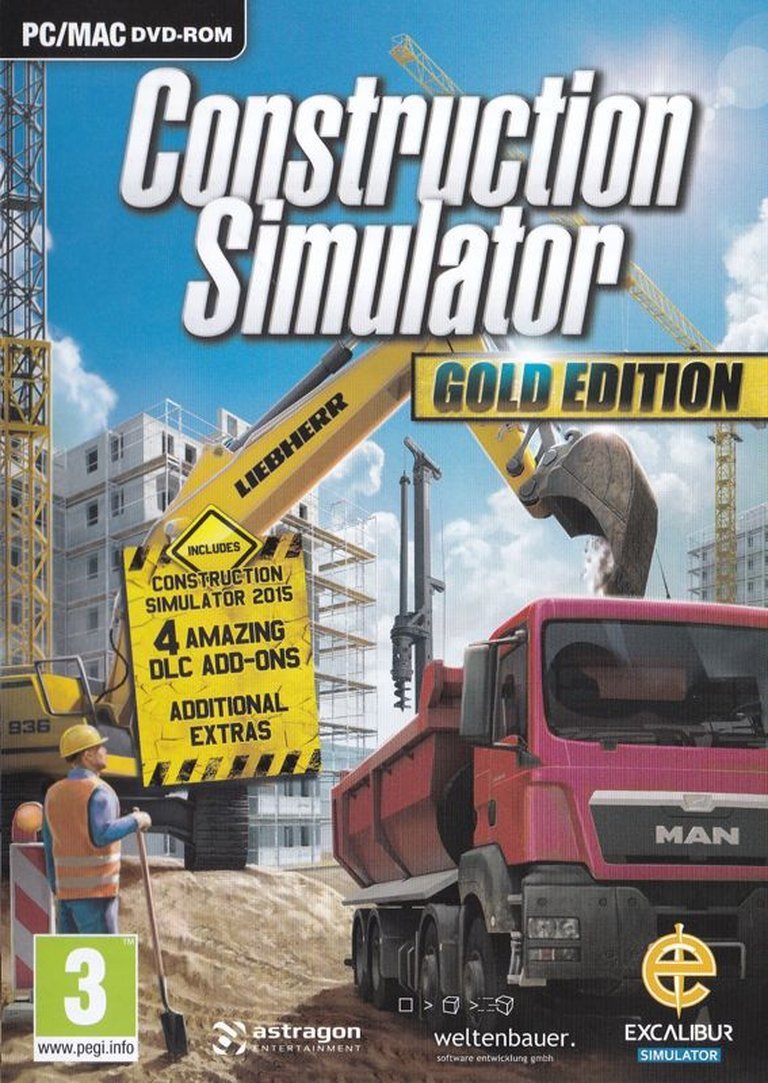
Construction Simulator: Gold Edition is a compilation package that includes the core game Construction Simulator 2015 along with multiple expansions like Liebherr equipment packs and Vertical Skyline. Players take on the role of a construction contractor, managing their business by operating realistic heavy machinery from brands such as Liebherr and Caterpillar, completing building contracts, and exploring an open-world environment while expanding their vehicle fleet and workforce.
Gameplay Videos
Construction Simulator: Gold Edition Cracks & Fixes
Construction Simulator: Gold Edition Reviews & Reception
metacritic.com (70/100): Including additional equipment — like the Liebherr RL1300, for all you tall crane enthusiasts! — and several new DLC missions/jobs, the Gold Edition provides many hours of content for the patient player to invest some serious time in learning the systems.
gamewatcher.com : Simulating hard work is surprisingly fun.
opencritic.com (75/100): Construction Simulator makes the hard work of the construction world fun.
Construction Simulator: Gold Edition: The Pinnacle of a Niche Dynasty or a Flawed Foundation?
Introduction: Appreciating the Grit
To the uninitiated, the idea of a video game about operating cranes, pouring concrete, and managing a construction company’s finances sounds less like entertainment and more like a chore. Yet, within the vast and eclectic ecosystem of simulation games, a dedicated niche has long thrived on the meticulous, almost meditative, recreation of real-world professions. Construction Simulator stands as a titan within this niche, and the Gold Edition represents the definitive consolidation of its initial triumph. Released in 2015, this compilation is not merely a collection of software but a curated monument to a specific vision: transforming the sweat, precision, and slow-burn satisfaction of heavy machinery operation into a compelling digital loop. This review will argue that Construction Simulator: Gold Edition is a landmark compilation that successfully packaged a deep, if technically uneven, simulation for a dedicated audience. Its legacy is twofold: it perfected the formula for its own series, but its core mechanical and presentational quirks also highlight the inherent challenges of simulating such a physically complex industry within the constraints of mid-2010s PC gaming.
Development History & Context: Forging a Sim from Steel and Unity
The game emerges from a specific European simulation development tradition. It was developed by weltenbauer. Software Entwicklung GmbH, a German studio whose name translates to “world builder,” signaling an ambition to create expansive, systemic worlds. Published by Astragon Entertainment, a company synonymous with specialized, often equipment-focused, simulation titles in Europe (e.g., Farming Simulator, Bus Simulator). This partnership was crucial, providing weltenbauer with the publisher’s established渠道 and understanding of a market hungry for authentic, brand-licensed machinery.
Technologically, the game was built in the Unity engine, a choice that speaks to its 2014/2015 development window. Unity offered a relatively accessible path to 3D open-world development and multi-platform deployment (Windows, Mac, Linux), but also came with the era’s common limitations regarding complex physics and draw distances. The “Gold Edition” itself is a fascinating artifact of early digital distribution strategies. Released just a year after the base Construction Simulator 2015, it functioned as both a retail boxed product (with a DVD-ROM and Steam key) and a digital bundle. Its explicit purpose was to consolidate a fragmented release calendar—the base game followed by four separate DLC packs—into a single, definitive package for newcomers, while also offering a “Gold Add-On” for existing owners. This approach catered to both newcomers overwhelmed by choice and completionists, a model that would become standard for “Game of the Year” and “Complete” editions.
The gaming landscape of 2015 was seeing a resurgence of deep sims, moving beyond the arcade sensibilities of the 2000s. Titles like Euro Truck Simulator 2 (2012) had proven a market for slow, methodical, and atmospheric simulations. Construction Simulator entered this space with a unique selling proposition: the visceral, tactile feel of operating dozens of distinct, powerfully branded hydraulic machines, a step more granular than driving a truck.
Narrative & Thematic Deep Dive: The Unwritten Story of the Builder
Construction Simulator: Gold Edition possesses no traditional narrative. There are no cutscenes, no voice-acted protagonists, and no overarching plot. Its “story” is entirely emergent, procedural, and defined by the player’s own progression through the game’s economic and territorial systems. This is a pure systemic narrative.
The implied protagonist is the player themselves, an aspiring construction magnate starting from humble beginnings. The thematic core is transformation through labor. The player begins in a quiet European village (the tutorial zone), mastering basic tasks like moving dirt with a small excavator and delivering concrete. The narrative arc is one of expansion: graduating to a sprawling American-style city, acquiring increasingly massive and expensive licenses (the Liebherr cranes, the LB 28 drill rig), and ultimately shaping the skyline itself. Each completed contract—from a simple house foundation to a monumental skyscraper or the “Vertical Skyline” DLC’s high-rise projects—is a chapter in this silent epic of productivity.
The themes are subtle but potent:
1. The Dignity of Specialized Labor: The game forces the player to learn the unique, often counter-intuitive, control schemes for each vehicle (SAE vs. ISO controls for excavators, complex boom articulation for cranes). This creates a sense of earned competence, mirroring the real-world skill required. The satisfaction comes not from combat or scores, but from the precise, controlled application of immense simulated force.
2. Capitalism as a Construction Game: The meta-game of buying, renting, and managing a vehicle fleet (with a hard cap of ~30 vehicles due to physics engine limitations, as explained in Steam community discussions) turns the simulation into a business sim. Decisions about taking loans, which jobs to accept for the best profit-to-effort ratio, and whether to rent or buy equipment create a second, strategic layer. The theme is one of incremental growth, where capital begets capability.
3. Environmental Sculpting: Unlike many city-builders where you place abstract “zones,” here you physically move the terrain, pour foundations, and erect skeletal structures. The player’s interaction with the game world is direct and physical, making the resulting cityscape a direct map of their own labor. The “flat” world noted by critics is a blank canvas, and its eventual density is the player’s trophy.
The “narrative” is thus the journey from transactional worker (completing discrete tasks for pay) to architect of place (overseeing multi-stage projects that permanently alter the map).
Gameplay Mechanics & Systems: The Gritty Gears of Progress
The core gameplay loop is deceptively simple: Accept Contract → Prepare Equipment → Travel to Site → Execute Tasks → Complete Step → Get Paid → Repeat. Its genius and its friction lie entirely in the “Execute Tasks” phase.
Vehicle Operation: This is the undisputed heart of the game. Each of the 19+ vehicles (from the base game and DLC) is a unique control puzzle.
* Earthmovers (Excavators, Loaders): Feature dual joystick controls for precise boom and bucket movement. Digging, while criticized for “wonky” physics (GameWatcher), requires planning and finesse.
* Cranes (Liebherr 150 EC-B Flat-Top, LR 1300 Crawler): The most complex systems. Players must extend booms, counter-weight with ballast, slew the entire structure, and manipulate hooks—all while managing load stability. The “Vertical Skyline” DLC focuses explicitly on these high-rise erection challenges.
* Support Vehicles (Trucks, Trailers): Driving physics are deliberate and weighty. Transporting a massive crane on a low-loader requires careful route planning and slow, cautious driving. The need to constantly drive between the vehicle depot, material suppliers (concrete, asphalt, steel), and job sites creates a significant portion of the early-game time investment, which some players find repetitive but others see as essential atmospheric immersion.
Progression & Economy: The player’s company has a home base with limited parking spots, establishing a crucial scarcity mechanic. New vehicles must be purchased from a dealership or rented (a smart solution for expensive, infrequently-used cranes). Income flows in per contract milestone, forcing budget management for materials, equipment, and loan repayments. The unlock system is territorial and reputational: completing jobs in the village unlocks the city map, and successful high-rise work unlocks more prestigious contracts.
User Interface & Controls: A major point of contention. The default keyboard+mouse controls are notoriously sprawling, requiring a “spider’s web” of keybinds for every vehicle function. This is a double-edged sword: it aims for 1:1 authenticity (like a Flight Simulator for construction), but creates a steep, daunting barrier. The game officially supports controllers (like the Xbox 360 pad), which significantly streamlines the experience, but purists argue it sacrifices precision. The UI for navigation and mission objectives is functional but plain, prioritizing the external vehicle view over flashy menus.
Multiplayer: A standout feature. Up to 4 players can cooperate online, dividing tasks on large sites (one drives materials, another operates the crane, a third excavates). This alleviates the solo-player’s drudgery of constant driving and transforms large projects into a coordinated, social activity, as noted in both the GeekDad review and Steam discussions.
Innovations & Flaws:
* Innovation: The breadth of licensed machinery (Liebherr, MAN, Caterpillar, JCB, SANY) and their distinct, detailed operation. The seamless open-world transition between driving and operating. The integration of business management with physical simulation.
* Flaws: Performance Hogs. The game’s physics and draw distance can strain mid-range systems, leading to the “spotty optimization” noted by GameWatcher and the explicit Steam community explanation that the 30-vehicle limit is a hard cap due to performance constraints. Physics wonkiness, especially with digging and material interactions, breaks immersion. The early-game repetition of simple delivery jobs can test patience. The world, while large, lacks ambient life (no pedestrian or civilian traffic density), contributing to a “flat” feel.
World-Building, Art & Sound: A Functional, Unspectacular Canvas
The world consists of two primary maps: a European village and a US-inspired city. They are technically competent open-world environments—roads are laid out logically, zoning is clear (residential, commercial, industrial), and geography provides suitable variety for bridge-building or hillside grading. However, they are aesthetic wastelands. Textures are low-resolution, vegetation is sparse and repetitive, and there is almost no dynamic weather or day/night cycle impact on gameplay. The beauty is not baked into the world itself, but projected onto it by the player’s constructions. Seeing a half-built skyscraper dominate the skyline, or a freshly paved road cutting through bland terrain, is where the world achieves its purpose. It is a sandbox, not a sightseeing destination.
The visual direction for the vehicles is the clear winner. The licensed machinery is rendered with painstaking, sometimes exquisite, detail. The metallic sheen on a Liebherr crane, the hydraulic pistons on an excavator, the brand decals on a MAN truck—all are modeled with a reverence that tells you the developers (and the licensing partners) cared deeply about this aspect. The first-person cockpit views are simple but effective.
Sound design is functional. Engine roars, hydraulic hisses, and clanking metal provide necessary audio feedback for vehicle operation. The ambient soundtrack is generic, unobtrusive background music that can be easily forgotten. The soundscape exists to serve the simulation, not to create atmosphere—a missed opportunity given the potential for the cacophony of a busy construction site.
Reception & Legacy: A Solid Foundation for an Empire
At its 2015 launch, reception was mixed-to-positive but niche. The single critic review aggregated by MobyGames (88%) and the 7.5/10 from GameWatcher are representative. Critics and players alike praised its unrivaled depth in construction vehicle simulation and its satisfying progression loop. The criticisms were consistent: the initial learning curve, technical performance issues, and the sometimes tedious nature of transport.
Its commercial performance is harder to gauge, but its sustained presence is telling. The Gold Edition model was successful enough to justify a long-running franchise. The series has seen annual or bi-annual sequels: Construction Simulator 2 (2017), 3 (2019), and a major reboot/sequel simply titled Construction Simulator (2022) which expanded to current-gen consoles. The 2022 game’s “Gold Edition” (reviewed by GeekDad) is a different beast, with vastly improved graphics, larger maps (including a spaceport!), and over 100 vehicles—a direct evolution of the 2015 formula.
The 2015 Gold Edition’s legacy is that of a crucial, consolidating blueprint. It proved there was a market for a hyper-focused construction sim that wasn’t a jokes game (Goat Simulator) or a broad city-builder (Cities: Skylines). It established the “authentic machinery + business sim + co-op” template that its successors have refined. The Steam community around the 2015 game remains active, with modding tutorials (as announced by the developer) extending its lifespan, a testament to its dedicated player base willing to overlook its technical roughness for its core mechanical appeal.
Conclusion: A Monument to Niche Mastery
Construction Simulator: Gold Edition is not for everyone. Its deliberate pace, its intimidating control schemes, and its graphically utilitarian world will repel those seeking flashy action or aesthetic grandeur. However, for the patient player willing to climb its steep learning curve, it offers something profoundly rare: a virtual apprenticeship. The tactile feedback of settling a crane’s boom just so, the strategic satisfaction of completing a multi-stage foundation pour under budget, the quiet pride of surveying a cityscape dotted with your completed buildings—these are its rewards.
As a compilation, the Gold Edition is a resounding success. It bundles the core experience with its most significant DLC expansions (notably the cranes and the “Vertical Skyline” campaign), providing 50+ hours of dense, mechanical problem-solving for a fair price. Its flaws are inherent to its ambition and its era: trying to simulate the weight, physics, and complexity of real construction within a mid-2010s indie budget inevitably leads to compromises in performance and physics fidelity.
Its place in history is secure as the title that solidified the Construction Simulator franchise’s identity. It took a promising idea and, through iterative DLC and compilation, delivered a comprehensive, if rough-edged, package. It did not revolutionize the simulation genre with new technology, but it perfected a specific, beloved subgenre. It is the digital equivalent of a well-worn, perfectly functional hard hat and steel-toed boot: unglamorous, occasionally uncomfortable, but undeniably essential for the job at hand. For those who dream not of being a hero, but of being a builder, Construction Simulator: Gold Edition remains a towering, if imperfect, monument.