
- Release Year: 2014
- Platforms: Windows
- Publisher: DolphinBarn
- Developer: DolphinBarn
- Genre: Action
- Perspective: Diagonal-down
- Game Mode: Single-player
- Gameplay: Arcade, Shooter
- Average Score: 71/100
Description
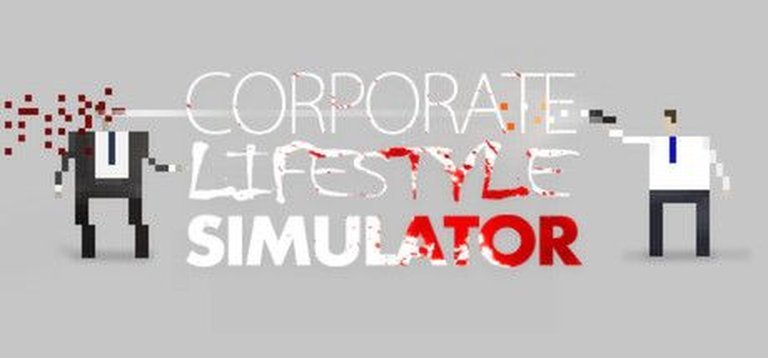
Corporate Lifestyle Simulator is an isometric action-shooter game developed by DolphinBarn, released in 2014. Set within a dystopian corporate environment, players battle through office buildings using everyday office supplies as weapons against brain dead, buzzword-spewing middle managers and zombie threats. Featuring pixel art visuals and chiptune music, the game offers a satirical take on corporate culture with arcade-style gameplay.
Gameplay Videos
Corporate Lifestyle Simulator Free Download
Corporate Lifestyle Simulator Mods
Corporate Lifestyle Simulator Guides & Walkthroughs
Corporate Lifestyle Simulator Reviews & Reception
steambase.io (82/100): Corporate Lifestyle Simulator has earned a Player Score of 82 / 100.
metacritic.com : Corporate Lifestyle Simulator is a funny little game for wage slaves who want to abreact after a boring day of work.
indiegamereviewer.com (60/100): No one is going to mistake Corporate Lifestyle Simulator for a work of genius, but it’s not meant to be.
gamecloud.net.au : After much soul searching, I believe I may have found my ultimate way to de-stress and relieve workplace dramas.
Corporate Lifestyle Simulator: Review
Introduction
In a world where the drudgery of office life often feels like a slow-motion descent into existential despair, Corporate Lifestyle Simulator emerges as a pixelated catharsis. Released on March 12, 2014, this isometric action game from DolphinBarn (developed under the pseudonym bignic) transforms the corporate nightmare into a literal zombie apocalypse. It’s a game where staplers become weapons, middle managers groan buzzwords like “synergy,” and cubicle farms transform into arenas of chaotic destruction. While not a contender for game-of-the-year glory, Corporate Lifestyle Simulator carves a niche as a cult-classic stress reliever for the 9-to-5 weary—a brutal yet hilarious satire of dehumanizing labor dressed in retro charm. Its legacy lies in its unapologetic simplicity and its ability to weaponize the mundane, proving that sometimes the most satisfying games are those that let you smash printers in the name of sanity.
Development History & Context
Corporate Lifestyle Simulator emerged from the fertile ground of Steam’s early indie boom, born from a developer identity as delightfully unhinged as its gameplay. Created by bignic under the DolphinBarn publishing banner, the game began life as a casual prototype titled Zombies, which gained traction through Steam Greenlight. The vision was refreshingly direct: to weaponize the collective resentment of office workers, turning the soul-crushing routine of corporate drudgery into a pixelated bloodbath. Technically, the game embraced constraints as stylistic choices. Its isometric diagonal-down perspective, deliberately blocky pixel art, and chiptune-dubstep soundtrack weren’t limitations but design decisions, ensuring accessibility on modest hardware while evoking 16-bit nostalgia. Released in 2014—a year defined by the indie renaissance (Papers, Please, Transistor) and the rise of Greenlight—it arrived as a counterpoint to AAA realism. Yet, its development was marred by controversy: bignic later infamously refused to provide Steam keys to Greenlight supporters, sparking backlash. This developer drama, immortalized in Steam forums and Reddit threads, ironically became part of the game’s lore, cementing its reputation as a product equal parts satire and self-sabotage.
Narrative & Thematic Deep Dive
The plot is gloriously straightforward: SuperCorp’s office workers, particularly the management, mutate into flesh-eating zombies. Players assume the role of “Dude,” an IT specialist armed with whatever lies at hand (staplers, baseball bats, stolen guns) to navigate a 27-level labyrinth of corporate decay. Beneath the zombie-slaying chaos lies a razor-sharp satire of modern work culture. The zombie managers are parodies of dehumanized corporate drones, their groans replaced by jargon like “synergy” and “paradigm shift,” reducing human interaction to hollow buzzwords. This transforms the office from a place of productivity into a hellscape of meaningless hierarchy. Rescuing coworkers—whose job titles are procedurally generated to include absurdities like “sandwich accountant” or “desk lamp operator”—underscores the game’s empathy: it’s not about erasing people, but liberating them from oppressive systems. Protagonist quips (“This one time at band camp… I cried because I was homesick”) and 90s pop culture references layer the narrative with self-aware absurdity, framing the apocalypse as a dark metaphor for the “zombification” of labor. The core theme is catharsis: by destroying printers, desks, and managers, players reclaim agency in a world designed to minimize it.
Gameplay Mechanics & Systems
Corporate Lifestyle Simulator thrives on its chaotic, destruction-focused loop. Movement uses WASD, with mouse-aimed shooting. Combat is visceral: every object—from chairs to computers—splinters into satisfying pixel debris. Weapons unlock progressively, ranging from mundane (staplers, phone cords) to over-the-top (shotguns, flamethrowers). The real joy lies in creativity: throwing objects with the fist weapon turns a presentation room into a chair-flinging massacre. Yet, mechanics reveal cracks. Health depletes rapidly, encouraging hit-and-run tactics, but weapon cycling is clunky—tiny icons force players to memorize keyboard shortcuts mid-combat, a flaw noted in reviews. Boss fights between levels offer palate-cleansing one-on-one duels but are criticized for being underwhelmingly easy. Optional objectives (destroy everything, rescue all coworkers) add replay, though the 27 levels blend into a repetitive maze of cubicles. Critically, Steamworks integration is nonexistent—no achievements, cloud saves, or leaderboards—leaving the game feeling like a self-contained relic. Despite these flaws, the core loop remains addictive: the sheer satisfaction of obliterating office supplies fuels a “just one more level” compulsion.
World-Building, Art & Sound
The SuperCorp office is a masterclass in dystopian mundanity. Levels shift between claustrophobic cubicle farms, a dimly lit parking garage, and a rooftop, but visual variety is sparse—endless desks and filing cabinets dominate, punctuated only by occasional set pieces like a server room. This repetition is intentional, mirroring the monotony of office life. The art style leans into retro charm: deliberately blocky pixel art gives characters and environments a cartoonish, exaggerated appeal. Zombie managers, rendered in stiff, tie-clad sprites, evoke a dead-eyed conformity, while protagonist Dude’s simple design emphasizes her role as everyoffice worker. Sound elevates the experience. The chiptune-dubstep soundtrack is “phenomenal” (GameCloud), blending frantic 8-bit melodies with bass drops that amplify destruction. Sound effects are equally potent: the crunch of a stapler on skull, the shatter of glass, or the groan of a zombie-manager-turned-corporate-zombie (“Leverage!”). Yet, audio can overwhelm—layers of explosions, gunfire, and dialogue sometimes drown out quips, requiring manual adjustments. The intentionally terrible voice acting in cutscenes (e.g., stilted lines like “First, I need check my Facebook”) adds to the humor, turning technical limitations into satirical tools.
Reception & Legacy
At launch, Corporate Lifestyle Simulator polarized critics and players. On Steam, it maintains a “Very Positive” rating (82/100 from 648 reviews), praised for its humor and value ($4.99). MobyGames shows a 4.0/5 average, while Metacritic scores a middling 40/100 (Cubed3 called it “repetitive” and “lacking finesse”). Positive reviews highlight its catharsis: “blowing stuff up, shooting zombies, smashing glass” (hassall, Steam). Negative critiques cite short length (2 hours) and repetitive levels. Culturally, it became a niche icon for office workers, its legacy tied to its developer’s infamy. Infamously, bignic’s refusal to honor Greenlight commitments sparked forums threads like “The Internet never forgets,” turning controversy into part of the game’s identity. Influentially, it paved the way for satirical office simulations like Corporate Salmon (2017) and The Corporate Machine (2001), proving that corporate drudgery could be mined for dark comedy. Its removal from Steam in April 2024 (“Game removed from Steam”) added a final ironic layer—fitting for a game about corporate decay. Yet, its soundtrack remains celebrated, and its meme-worthy moments (e.g., throwing Molotovs in a dark parking garage) ensure it’s remembered as a pixelated fever dream of workplace rebellion.
Conclusion
Corporate Lifestyle Simulator is a flawed gem that embraces its imperfections. It’s not a revolution in game design but a masterclass in targeted catharsis—30 minutes of chaotic destruction can exorcise a week of office frustration. Its strengths lie in unapologetic humor, satisfying destruction physics, and a soundtrack that transforms monotony into mayhem. Weaknesses—repetitive levels, clunky UI, and lack of depth—prevent it from being a timeless classic, but they’re inseparable from its charm. As a historical artifact, it documents the indie boom’s experimental spirit and the developer’s self-destructive antics. For players seeking a break from AAA spectacle, it remains a cult classic: a pixelated revolt against the soul-crushing grind, where the only buzzword that matters is “smash.” In the grand pantheon of video game satire, it’s not Shakespeare, but it’s undeniably cathartic—like stapling a zombie manager in the face and laughing.