
- Release Year: 2007
- Platforms: Macintosh, Windows
- Publisher: Power of Entertainment LLC
- Developer: Cyan Worlds, Inc.
- Genre: Action
- Perspective: 3rd-person
- Game Mode: Single-player
- Gameplay: Platform, Puzzle elements
Description
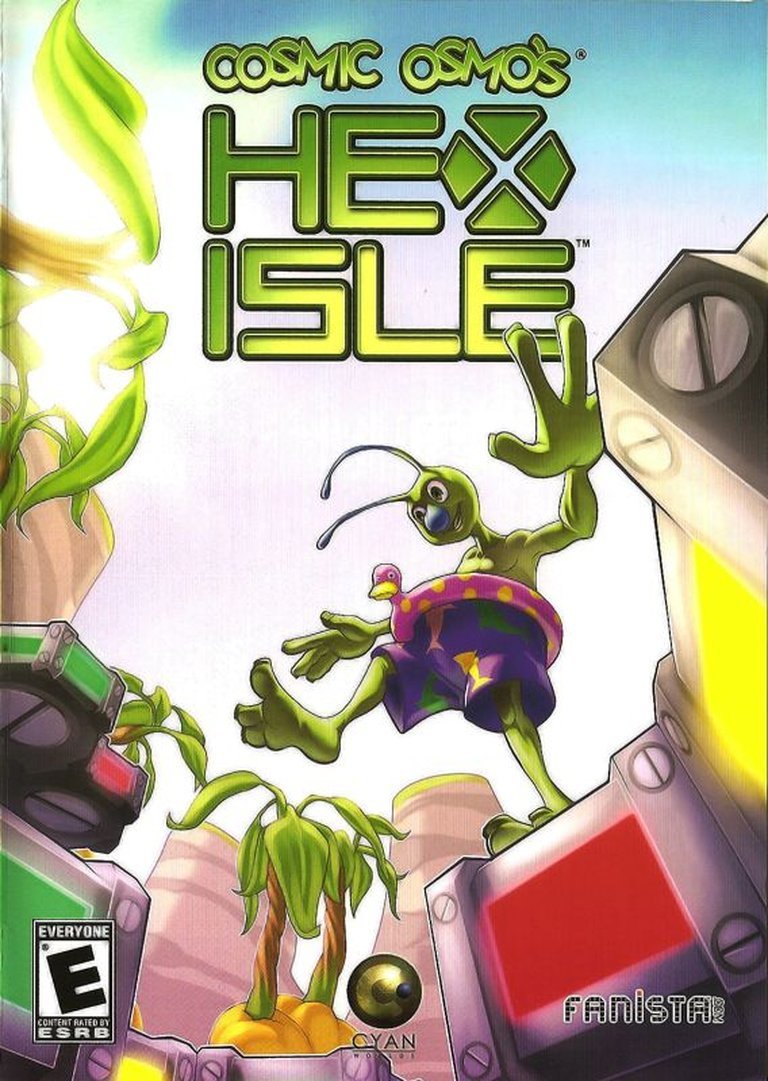
Cosmic Osmo’s Hex Isle is a 3D puzzle platformer and sequel to Cosmic Osmo and the Worlds Beyond the Mackerel. Banished to the Hex Isles for laziness, players guide Osmo across hexagonal tiles to touch six targets per level and escape. He navigates color-coded hexes with distinct behaviors—gray hexes are stable, green turn yellow when stepped on, yellow turn red, and red hexes collapse—requiring strategic pathfinding to avoid falling. With six worlds of escalating complexity and mechanics centered on timing, observation, and jumping, the game challenges players to complete levels based on strategy, speed, and score metrics.
Gameplay Videos
Where to Buy Cosmic Osmo’s Hex Isle
PC
Cosmic Osmo’s Hex Isle Free Download
Cosmic Osmo’s Hex Isle Guides & Walkthroughs
Cosmic Osmo’s Hex Isle: Review
In the pantheon of video games that have left an indelible mark on the industry, “Cosmic Osmo’s Hex Isle” stands as a testament to the creative prowess of Cyan Worlds and the enduring appeal of puzzle-adventure games. Released in 2007, this sequel to “Cosmic Osmo and the Worlds Beyond the Mackerel” is a 3D platformer that challenges players to navigate hexagonal tiles to escape from a prison. The game’s legacy is one of innovation and frustration, a dichotomy that makes it a fascinating subject of analysis. This review will delve into the development history, narrative themes, gameplay mechanics, world-building, reception, and legacy of “Cosmic Osmo’s Hex Isle,” ultimately providing a definitive verdict on its place in video game history.
Development History & Context
Studio and Creators’ Vision
“Cosmic Osmo’s Hex Isle” was developed by Cyan Worlds, a studio renowned for its groundbreaking work in the adventure genre, most notably with “Myst.” The game was published by Fanista and released on November 30, 2007. The creators’ vision was to blend the exploratory and narrative elements of their previous works with the more immediate challenges of a platformer, creating a unique hybrid that would appeal to both casual and hardcore gamers.
Technological Constraints and Gaming Landscape
The mid-2000s were a time of transition in the gaming industry. The rise of the Xbox 360 and the continued dominance of the PC as a gaming platform created a fertile ground for innovative titles. “Cosmic Osmo’s Hex Isle” was developed using the Plasma 3.0 engine, which allowed for the creation of immersive 3D environments. The game was released on Windows, Mac OS X, and Xbox 360, ensuring a broad audience.
The gaming landscape at the time was dominated by a mix of AAA titles and indie gems. The success of games like “Myst” and “Riven” had shown that there was a market for narrative-driven experiences, and “Cosmic Osmo’s Hex Isle” aimed to capitalize on this trend while adding a layer of puzzle-solving and platforming.
Narrative & Thematic Deep Dive
Plot and Characters
The narrative of “Cosmic Osmo’s Hex Isle” is relatively straightforward. Osmo, the protagonist, has been banished to the Hex Isles for his extreme laziness. The player’s goal is to help Osmo escape by navigating through a series of levels, each consisting of hexagonal tiles that react differently when stepped on. The simplicity of the plot allows the game to focus on its core mechanics, but it also means that the narrative lacks depth.
Osmo himself is a well-designed character, with a distinctive appearance and a humorous backstory. However, the lack of additional characters and a more complex narrative means that the game’s emotional resonance is limited. The dialogue is sparse and often humorous, but it does little to advance the story or develop the characters.
Themes
The primary theme of “Cosmic Osmo’s Hex Isle” is escape and perseverance. The game’s levels are designed to be challenging, requiring players to think strategically and plan their moves carefully. This theme is reinforced by the game’s scoring system, which rewards strategy, speed, and efficiency. The game also touches on the consequences of laziness, as Osmo’s banishment is a direct result of his lack of effort.
Gameplay Mechanics & Systems
Core Gameplay Loops
The core gameplay loop of “Cosmic Osmo’s Hex Isle” revolves around navigating hexagonal tiles to reach blue targets. The tiles react differently when stepped on, adding a layer of strategy to the gameplay. Blue tiles are the targets, gray tiles are stable, green tiles turn yellow, yellow tiles turn red, and red tiles collapse. Players must figure out the correct path to reach the blue tiles without falling down.
The game is divided into six worlds, each containing six levels. This structure provides a sense of progression and accomplishment, as players unlock new worlds and levels by completing the previous ones. The scoring system, based on strategy, speed, and score, adds an extra layer of challenge and replayability.
Combat and Character Progression
There is no combat in “Cosmic Osmo’s Hex Isle,” which is a departure from many platformers of the time. Instead, the game focuses on puzzle-solving and platforming. This lack of combat means that the game’s difficulty comes from its puzzles rather than its enemies, which can be both a strength and a weakness.
Character progression is minimal in “Cosmic Osmo’s Hex Isle.” Players do not gain new abilities or weapons as they progress through the game. Instead, the game’s challenge comes from the increasing complexity of its levels. This lack of progression can make the game feel repetitive, as players are essentially doing the same thing over and over again.
UI and Innovative/Flawed Systems
The user interface of “Cosmic Osmo’s Hex Isle” is straightforward and unobtrusive. The game’s controls are intuitive, with players using the keyboard and mouse to navigate Osmo through the levels. The game’s HUD provides essential information, such as the current score and the number of remaining targets, without cluttering the screen.
One of the game’s innovative systems is its use of hexagonal tiles. This mechanic adds a unique twist to the platforming genre, as players must think strategically about their movements. However, this system can also be flawed, as the game’s levels can become frustratingly difficult, requiring precise timing and a lot of trial and error.
World-Building, Art & Sound
Setting and Atmosphere
The setting of “Cosmic Osmo’s Hex Isle” is a series of hexagonal worlds, each with its own unique color scheme and design. The game’s art direction is clean and modern, with a focus on geometric shapes and bright colors. This aesthetic creates a sense of otherworldliness, fitting for a game about a character escaping from a prison in space.
The atmosphere of the game is one of isolation and challenge. The levels are often vast and empty, with players navigating through a sea of hexagonal tiles. This sense of isolation is reinforced by the game’s sound design, which features a minimalist soundtrack and sparse sound effects.
Visual Direction
The visual direction of “Cosmic Osmo’s Hex Isle” is one of its strengths. The game’s use of hexagonal tiles creates a unique and visually striking world. The levels are well-designed, with a clear sense of progression and challenge. The game’s art style is consistent throughout, with a focus on clean lines and bright colors.
Sound Design
The sound design of “Cosmic Osmo’s Hex Isle” is minimalist but effective. The game’s soundtrack features a series of ambient tracks that complement the game’s visuals and atmosphere. The sound effects are sparse but impactful, with the sound of tiles collapsing and Osmo’s footsteps providing a sense of immersion.
Reception & Legacy
Critical and Commercial Reception
“Cosmic Osmo’s Hex Isle” received mixed reviews upon its release. Critics praised the game’s unique mechanics and visuals but criticized its lack of depth and replayability. The game’s average score on MobyGames is 50%, based on one critic review. The review from “Out Of Eight” described the game as “too plain” and criticized its lack of features and monotonous gameplay.
Commercially, the game was a modest success. It was exclusively available as a boxed copy through the website of Fanista, which only shipped inside the USA. The game’s limited availability likely impacted its sales, but it still found a dedicated audience among fans of puzzle-adventure games.
Influence on Subsequent Games and the Industry
Despite its mixed reception, “Cosmic Osmo’s Hex Isle” has had a lasting influence on the gaming industry. The game’s use of hexagonal tiles and its focus on puzzle-solving and platforming have been emulated by other developers. The game’s legacy can be seen in titles like “Hex” and “Doodle Hex,” which share similar mechanics and themes.
The game’s influence can also be seen in the broader puzzle-adventure genre. Games like “Myst” and “Riven” paved the way for narrative-driven experiences, and “Cosmic Osmo’s Hex Isle” built on this foundation by adding a layer of challenge and strategy. The game’s legacy is one of innovation and experimentation, a testament to the creative prowess of Cyan Worlds.
Conclusion
“Cosmic Osmo’s Hex Isle” is a game of contrasts. Its unique mechanics and visuals are a testament to the creative vision of Cyan Worlds, but its lack of depth and replayability hold it back from greatness. The game’s legacy is one of influence and innovation, a reminder of the potential of the puzzle-adventure genre.
In the final analysis, “Cosmic Osmo’s Hex Isle” is a game that deserves to be remembered. Its strengths outweigh its weaknesses, and its influence on the industry is undeniable. For fans of puzzle-adventure games, it is a must-play title that offers a unique and challenging experience. For the broader gaming community, it is a reminder of the power of innovation and experimentation. “Cosmic Osmo’s Hex Isle” may not be a perfect game, but it is a game that matters, a testament to the enduring appeal of puzzle-adventure games.