
- Release Year: 2016
- Platforms: Linux, Windows
- Publisher: GSC Game World, Koch Media GmbH (Austria)
- Developer: GSC Game World
- Genre: Strategy, Tactics
- Perspective: Diagonal-down
- Game Mode: Online PVP, Single-player
- Gameplay: Base building, Economy Management, Large-scale Battles, Resource gathering, Tactical Formations, Technology Tree
- Setting: 17th century, 18th century, Europe, Historical, War
- Average Score: 65/100
Description
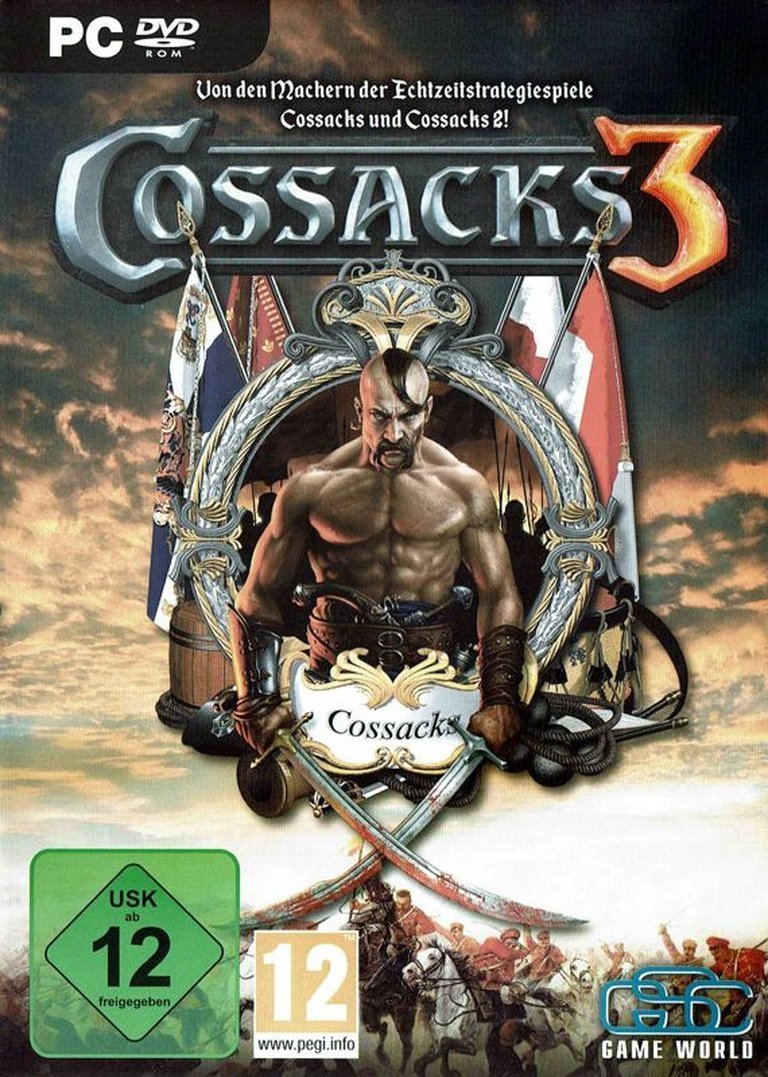
Cossacks 3 is a historical real-time strategy game set in the 17th and 18th centuries, combining base building, resource management, and large-scale battles with up to 10,000 units. Players command twelve distinct nations, each with 70 unit types, 140+ historical buildings, and 100 research opportunities, fighting tactical battles on land and sea with formations and terrain effects. The game features five single-player campaigns and multiplayer for up to eight players on randomly generated maps.
Gameplay Videos
Where to Buy Cossacks 3
Cossacks 3 Free Download
Cossacks 3 Cracks & Fixes
Cossacks 3 Patches & Updates
Cossacks 3 Mods
Cossacks 3 Guides & Walkthroughs
Cossacks 3 Reviews & Reception
realityremake.com : Cossacks 3 is a classic RTS focused on 17th and 18th century warfare.
rockpapershotgun.com : Cossacks 3, which in a sentence is a traditional build and bash RTS with higher unit counts and a little more focus on formation, is a comfort blanket, and I regret nothing.
gamewatcher.com : Majestic foundation quickly devolves into a human meat grinder, and not in a good way
Cossacks 3 Cheats & Codes
Cossacks 3 PC
Press Ctrl+Enter to open the chat/console dialog. Type ‘cheat’ and press Enter again to enable cheat mode.
| Code | Effect |
|---|---|
| showallmissions | Makes all missions available. |
| res %resource% %amount% | Generates resources. Available resource names: food, wood, stone, gold, iron, coal, all. Example: res food 100000, res all 20000000. |
| freecamera | Removes the limit on camera height. Allows changing camera angle by holding Ctrl+middlebutton (scroller) and moving the mouse. Ctrl+PageUp/Ctrl+PageDown to change camera angle of view. Home key returns camera angle to default. |
| www | Activates further commands when typed and sent in the chat box. |
| www and then P | Unlocks unit editor. |
| Ctrl + F | Disables/enables ‘Fog of War’. |
| Ctrl + W | Enables/disables peace mode. |
| Ctrl + [Arrow key] | Moves selected building. |
| Ctrl + C | Copies selected units. |
| Ctrl + V | Pastes previously copied units. |
| ^ (caret symbol) | Increases game speed. |
| ) (close parenthesis) | Reduces game speed. |
| Num Pad 1 – 8 | Switches between players. |
| Alt + 1 – 9 | Switches between players. |
Cossacks 3: Review
Introduction
In the autumnal glow of 2016, when strategy gaming was dominated by modern shooters and RPGs, Cossacks 3 emerged not as a revolutionary reinvention, but as a loving resurrection of a bygone era. Developed by the Ukrainian studio GSC Game World—the architects of the cult classic S.T.A.L.K.E.R. series and the original Cossacks: European Wars (2000)—this title promised a return to the grand, sprawling battles of 17th and 18th-century Europe. It was pitched as a “remake of the concept,” a synthesis of nostalgia and modern polish. Yet, as the smoke of its release clears, we confront a paradox: Cossacks 3 is both a triumph of historical authenticity and a relic of outdated design. This review dissects how GSC Game World’s ambitious revival captures the soul of the original while succumbing to the same tactical and technical shortcomings that defined its predecessor. Is this a fitting monument to historical RTS, or a cautionary tale of unfulfilled potential?
Development History & Context
GSC Game World’s reactivation in 2014 marked a phoenix-like rise from the ashes, with Cossacks 3 spearheading their return. The studio entrusted the project to Evgeniy Grigorovich, the visionary behind the 2001 original, ensuring a purist vision guided the remake. The goal was explicitly modern: “to replicate the essence of the original” with contemporary 3D graphics, dynamic lighting, and robust modding support. Yet, the development landscape of 2016 posed unique constraints. While engines like Unreal 4 dominated the industry, GSC opted for a proprietary solution, prioritizing unit scalability over cinematic flair. This choice reflected the game’s core identity: a faithful homage, not a reimagining.
The gaming context of the era was ripe for nostalgia. Titles like Doom (2016) and Final Fantasy XV leveraged remasters and reboots to satiate fans’ longing for the past. RTS, however, was a niche genre; StarCraft II and Age of Empires II remained benchmarks, but new entries were scarce. GSC’s gamble was to exploit this void by targeting veterans who “remembered the afternoons spent in computer rooms,” as one MobyGames review noted. The result was a game unapologetically rooted in 2000s mechanics: base-building, resource micromanagement, and army scales of up to 16,000 units—ambitious yet technically constrained by AI and physics limitations.
Narrative & Thematic Deep Dive
Cossacks 3 wears its historical heart on its sleeve, eschewing character-driven epics for a tapestry of war-torn Europe. The narrative unfolds through five campaigns—Austria, England, Ukraine, Russia, and France—each a vignette of 17th- and 18th-century conflicts. Missions like “The Battle of Khotyn” (1617) and “The Skirmish of Klushino” (1610) are lifted from history books, framed by minimalist text blurbs that contextualize each scenario without cinematic flair. The player assumes the role of a nameless commander, their identity subsumed by the nation’s struggle. For instance, the Ukrainian campaign follows Cossack raids against the Ottomans, while the Polish campaign centers on the defense of Vienna against Turkish besiegers.
This approach yields thematic authenticity but sacrifices depth. Dialogue is sparse, confined to mission briefings that read like encyclopedia entries. Themes of colonial ambition, religious strife (e.g., Protestant vs. Catholic clashes), and the decline of cavalry dominance in gunpowder warfare permeate the campaigns. DLCs like Path to Grandeur expand this with Spanish and Turkish narratives, adding nuance through naval engagements and desert sieges. Yet, the storytelling remains functional—a backdrop to gameplay rather than a compelling force. As one critic lamented, “Campaniile singleplayer sunt scurte și funcționează ca o serie de skirmish-uri scriptate fără niciun fel de context istoric” (MobyGames), emphasizing a focus on tactical purity over narrative immersion.
Gameplay Mechanics & Systems
At its core, Cossacks 3 is a symphony of logistical warfare, demanding mastery over six resources—wood, food, stone, gold, coal, and iron. Coal and iron are linchpins for firearms, while food scarcity triggers famine among troops, forcing players to balance expansion with sustainability. This granular economy is the game’s crowning achievement, rewarding meticulous planning but punishing haste. As Gamepressure noted, “Over-harvesting slows your economy, and resource scarcity cripples your war machine.”
Combat is defined by scale and counter-play. Armies swell to 16,000 units, organized into regiments of 36–108 infantry or 40 cavalry, each bolstered by officers and drummers. Formations—lines for musketeers, squares against cavalry, columns for charges—are tactical keystones. Yet, execution falters. The AI struggles to maintain cohesion, turning “majestic formations into a human meat grinder” (GameWatcher). Units scatter, prioritize distant targets, and dissolve into chaos under pressure. The UI exacerbates this; creating a regiment requires manually grouping 36 units, an officer, and a drummer—a laborious process that undermines fluidity.
Naval battles and artillery add layers, with terrain influencing tactics: hills shield infantry, while forests offer ambush opportunities. Technology research (100+ options) and nation-specific units (70 types) offer depth, yet nations feel homogenized beyond superficial unit swaps. As Rock Paper Shotgun observed, “Fail to be cognisant of [unit counters] and you’re likely to face a swift wipe-out,” highlighting a system that rewards knowledge over reflexes.
World-Building, Art & Sound
GSC crafts a world steeped in Baroque grandeur. Twelve nations (e.g., Prussia, Ottoman Empire) are rendered with architectural authenticity—from Dutch windmills to Russian Orthodox churches. Over 140 historical buildings, from fortresses to breweries, ground the experience in reality. The art direction, however, is a double-edged sword. Dynamic lighting breathes life into battlefields, but unit models and textures, while upgraded, retain a functional, almost toy-like aesthetic. The isometric perspective evokes classic RTS but lacks the vivid detail of Total War.
Sound design elevates the atmosphere. The soundtrack, a blend of folk melodies and martial marches, swells during pivotal moments. Cannonballs whistle with terrifying physics-based accuracy, while musket volleys crack like thunder. Yet, the audio loop becomes repetitive over long sessions. As Reality Remake noted, “The music captures the era’s grandeur, punctuating dramatic moments with stirring scores that lodge in your memory,” but this immersion is undercut by a lack of dynamic environmental sound.
Reception & Legacy
Upon release, Cossacks 3 polarized critics. Aggregators like Metacritic (63/100) and OpenCritic (68%) flagged its mixed reception. Praise centered on nostalgia and scale, with Rock Paper Shotgun calling it “comfort food” for RTS fans. GameStar (68/100) lauded its faithfulness to the original but criticized its “imitation of the old game” for stifling innovation. Conversely, Jeuxvideo.com (45/100) dismissed it as a “copy-paste” of the 2000 classic, while Gry OnLine (50/100) echoed this sentiment: “Niestety, trzecia odsłona to tylko odświeżona ‘jedynka’.”
Commercially, it found a niche audience, particularly in Eastern Europe. Player reviews were kinder (Steam User Score: 8.2), with veterans praising its “epic battles” and historical accuracy. Yet, technical issues—AI pathfinding, performance drops during large skirmishes—marred its reputation. Legacy-wise, Cossacks 3 revitalized the franchise, spawning eight DLCs that added nations, campaigns, and scenarios. Its modding community thrives, expanding content and balancing flaws. It remains a touchstone for historical RTS, inspiring titles like Northgard but underscoring the genre’s challenges: innovation versus authenticity, scale versus control.
Conclusion
Cossacks 3 is a time capsule—a testament to GSC Game World’s vision and a monument to the RTS genre’s golden age. It excels in its core loop: the thrill of marshaling thousands, the elegance of tactical formations, and the weight of historical consequence. Yet, it is shackled by its own nostalgia. The AI and UI, relics of a bygone design, fracture the illusion of command, reducing grand strategies to chaotic brawls. For the purist—the player who remembers the clatter of musketeers in European Wars—this is a worthy revival. For newcomers, it is a challenging, often frustrating entry point.
Ultimately, Cossacks 3 stands as a poignant paradox: a game that honors the past while failing to transcend it. It is not the Renaissance of RTS it could have been, but in its battles and economies, it captures the soul of an era. As GSC intended, it is a “remake of the concept,” and in that, it succeeds. If you seek depth over dazzle, history over hype, Cossacks 3 is a flawed yet indispensable chapter in strategy gaming’s annals. For everyone else, it is a reminder that some legacies are best left as memories.