
- Release Year: 2007
- Platforms: Windows
- Publisher: Fully Ramblomatic
- Developer: Fully Ramblomatic
- Genre: Adventure, Interactive fiction, Puzzle, Text adventure
- Perspective: Fixed
- Game Mode: Single-player
- Gameplay: Interactive fiction, Puzzle, Text parser
- Setting: Europe, Industrial Age
- Average Score: 60/100
Description
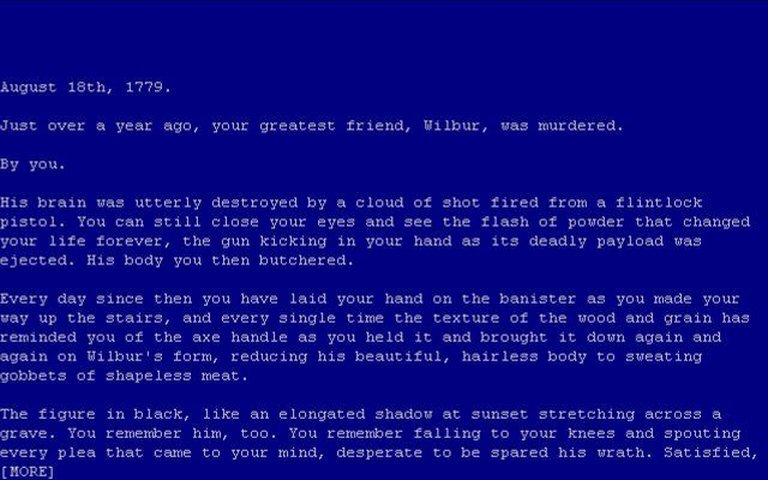
Countdown 1: The Body is a text adventure game set in Europe during 1779, where players assume the role of Jack Frehorn, a man who accidentally killed his friend Wilbur while attempting to shoot the Prince, a supernatural entity. One year after this traumatic event, Jack is now pledged to the Prince and must complete his instructions to craft the Frehorn’s Blade and write a prophecy that ties together the events of the Chzo mythos. As the first installment in a trilogy exploring Body, Soul, and Mind, the game expands on the lore established in Trilby’s Notes and serves as a prequel to 6 Days a Sacrifice, utilizing a text parser interface for gameplay that requires players to type specific commands to navigate through the story and solve puzzles.
Countdown 1: The Body Guides & Walkthroughs
Countdown 1: The Body Reviews & Reception
mobygames.com (60/100): Well, I’ll begin with the storyline. The general plot for the three games is to follow the Frehorn’s Blade destiny.
retro-replay.com : Countdown 1: The Body delivers a rich, text-driven gameplay experience that hinges on player choices and the classic text-adventure parser.
Countdown 1: The Body: An Exhaustive Review
Introduction
In the shadowed annals of interactive fiction, Ben “Yahtzee” Croshaw’s Chzo Mythos stands as a colossus—a sprawling, interconnected tapestry of cosmic horror and psychological dread. Within this opus, the Countdown trilogy (2007) occupies a unique niche: a deliberate, text-only prelude to the mythos’ culmination, 6 Days a Sacrifice. Leading this enigmatic trio is Countdown 1: The Body, a claustrophobic descent into guilt, occult obligation, and the birth of a prophecy. More than a mere game, it is a literary artifact—a minimalist text adventure that demands intellectual rigor from players while weaving threads that bind the entire Chzo saga. This review delves into the game’s intricate layers, examining its historical context, narrative weight, gameplay idiosyncrasies, atmospheric design, and enduring legacy. While its archaic mechanics and unforgiving parser may alienate contemporary players, The Body remains an indispensable, if challenging, piece of interactive storytelling for devotees of Croshaw’s singular vision.
Development History & Context
Countdown 1: The Body emerged from a uniquely fertile period in Ben Croshaw’s creative career. Conceived as a bridge between Trilby’s Notes (2007) and the anticipated 6 Days a Sacrifice, the trilogy was born from pragmatic necessity and fanatical devotion. In Croshaw’s own words, it served to “foreshadow the plot” of the finale while satiating an eager audience. Developed under his Fully Ramblomatic banner, the game was crafted using the Inform 7 system—a choice steeped in tradition. This development environment allowed Croshaw to focus on narrative and puzzle design, bypassing graphical constraints. The result was a freeware Windows release distributed as a Z-Code file, requiring players to interface with it via interpreters like WinFrotz—a technical barrier that underscored its niche appeal.
The game’s creation in 2007 placed it in stark contrast to the gaming landscape of the era. Dominated by high-definition epics like The Elder Scrolls IV: Oblivion and the rise of online multiplayer in titles like Call of Duty 4, The Body was an act of deliberate anachronism. It rejected the visual and auditory spectacle of mainstream gaming, opting instead for the cerebral purity of text. This choice was both artistic and philosophical. As Croshaw noted in interviews, the format stripped away distractions, forcing immersion through language alone. The Industrial Age European setting further distanced it from contemporary contexts, anchoring it in a period where rationalism clashed with burgeoning occultism—a theme central to the Chzo mythos. The game’s brevity (estimated playtime: 30-60 minutes) and parser-centric design signaled its intent: not to compete with AAA titles, but to serve a dedicated audience of interactive fiction enthusiasts and Chzo acolytes.
Narrative & Thematic Deep Dive
At its core, The Body is a harrowing study in psychological unraveling, set against the backdrop of Jack Frehorn’s damnation. The narrative unfolds in August 1779, one year after Jack’s catastrophic error: mistaking his beloved friend (and likely lover) Wilbur for a demon and gunning him down. This trauma is the crucible of the game. Jack’s existence is now a cycle of guilt and obligation to the Prince—a towering, inscrutable entity and Chzo’s emissary. The Prince’s return on the anniversary of Wilbur’s death (July 28th) sets the plot in motion. Jack is tasked with two seemingly simple yet cosmically significant acts: forging the “Frehorn’s Blade” and writing a prophecy that will etch the Chzo mythos into reality.
The game’s genius lies in its economical storytelling. Through terse descriptions and cryptic dialogue, Croshaw builds a world of oppressive dread. Jack’s basement—the game’s sole setting—becomes a microcosm of his fractured psyche. The crafting of the blade is not mere busywork; it is a ritualistic act of self-mutilation, a physical manifestation of his descent into darkness. The prophecy-writing sequence, which hinges on finding a pen in a desk drawer, becomes a metaphor for uncovering buried truths. As Jack scribes the text, he inadvertently documents the future tragedies of 5 Days a Stranger, including the fates of Trilby (the “Guide”) and Number Twelve. This act of writing becomes both an act of creation and complicity, blurring the line between free will and predestination.
Thematic depth permeates every interaction. The Industrial Age setting juxtaposes Jack’s occult pursuits with the era’s emerging rationalism, highlighting the tension between faith and skepticism. His relationship with Wilbur, intimate and tragic, amplifies the emotional devastation of loss. The Prince’s commands—delivered through telepathic whispers—explore themes of corrupted power and existential dread. The game’s title, The Body, is not merely descriptive; it represents the first stage in a tripartite destruction (Body, Soul, Mind) aimed at the Bridgekeeper, John Defoe. Jack’s physical and spiritual decay mirrors this ritual, positioning him as both victim and perpetrator in Chzo’s grand design. The narrative’s brevity belies its impact; it is a masterclass in compressed storytelling, where every word carries the weight of damnation.
Gameplay Mechanics & Systems
As a text adventure, The Body‘s gameplay is a double-edged sword—a blend of elegant design and maddening opacity. The core mechanic relies on a parser that interprets typed commands. Movement, for instance, requires verbs like “walk” or “go” followed by directions (“north,” “up,” etc.), a system divergent from Trilby’s Notes‘ “climb up/down” commands. This inconsistency, noted by reviewer vicrabb, forced players to relearn conventions, a hurdle compounded by the parser’s unforgiving nature. Crucially, the verb “use” is absent; players must substitute alternatives like “hit” or “put,” adding layers of abstraction. Puzzles demand linguistic precision and lateral thinking, such as the non-intuitive “open drawer” to retrieve a pen—a solution that stymied even experienced players, extending gameplay from minutes to hours.
The game’s structure emphasizes isolation and constraint. Jack’s basement is a labyrinth of locked interactions, with progress gated by environmental puzzles like placing the blade into a ritualistic pillar. While these puzzles are thematically resonant—mirroring Jack’s mental confinement—they suffer from poor signposting. The lack of inventory highlights or contextual clues creates trial-and-error frustration. Technical issues further mar the experience. The WinFrotz interpreter’s display bugs, where text would “parasite” or vanish mid-command, forced players to toggle between “play” and “scrollback” modes, breaking immersion. As vicrabb lamented, “the only thing I could do it was to press enter until I found a normal screen.”
Yet, the parser has merits. Its support for both AZERTY and QWERTY keyboards reflects thoughtful design, and solving a puzzle—however obtuse—yields genuine satisfaction. The game rewards patience and curiosity, rewarding players who engage deeply with its world. Ultimately, The Body‘s gameplay is a product of its era. It is a relic of a time when text was the primary interface, and its systems, while frustrating, are inseparable from its identity as interactive fiction.
World-Building, Art & Sound
Countdown 1: The Body achieves its atmosphere through radical minimalism, stripping away all visual and auditory artifice to emphasize narrative and psychological tension. The game’s setting—Europe’s Industrial Age—serves as a stark counterpoint to its supernatural elements. Jack’s basement, described with sparse but vivid prose (e.g., “a writing desk,” “a stone pillar”), becomes a character in itself. The Industrial Age’s cold rationalism contrasts with the occult rituals, highlighting the clash between emerging modernity and ancient, malevolent forces. This dichotomy enriches the world-building, grounding the cosmic horror in tangible historical context.
Artistically, the game is a study in abjection. WinFrotz’s default white-text-on-blue-background interface evokes the sterile, error-message aesthetic of old operating systems—a deliberate choice that reinforces the game’s oppressive tone. As vicrabb noted, this reminded them of a “Fatal Error System,” framing Jack’s reality as a corrupted system. ASCII art borders and color highlights (in scrollback mode) are sparing, adding texture without distraction. The absence of graphics is not a limitation but a strength; it forces players to internalize the setting, making the horror intimate and personal. Every description—from the “cold stone” walls to the “rough-hewn” blade—is meticulously crafted to evoke dread and decay.
Sound design is equally deliberate in its absence. With no soundtrack, sound effects, or voice acting, silence becomes a narrative tool. It amplifies Jack’s isolation, the weight of his guilt, and the unnerving presence of the Prince. This auditory minimalism creates a vacuum filled only by the player’s imagination, making the game’s psychological horror more potent. The lack of sensory input is jarring at first but ultimately immersive, aligning with the game’s text-first ethos. Together, the visual and sonic austerity create a uniquely oppressive atmosphere, where the mind is both the stage and the specter.
Reception & Legacy
Upon release, Countdown 1: The Body garnered little mainstream attention, relegated to the fringes of gaming discourse. Its text-based format and niche subject matter ensured it remained a cult curiosity. The most substantive contemporary critique came from vicrabb’s 2008 MobyGames review, which awarded it a middling 3/5. Vicrabb praised the narrative’s role in expanding the Chzo mythos, calling the storyline “something I wouldn’t have missed,” but excoriated the gameplay and technical flaws. The parser’s inconsistencies and WinFrotz bugs were deemed “very frustrating,” leading to the verdict: “Only play it if you’re interested in the Chzo Mythos or if you want to know more about the prophecy. Because if you think to find pleasure by playing it, forget it.”
Over time, The Body‘s reputation has evolved within the interactive fiction community. It is now recognized as a vital, if flawed, piece of the Chzo mythos. Fans laud it for its thematic depth and narrative economy, while acknowledging its archaic systems as a product of its time. The trilogy’s structure—Body, Soul, Mind—has been analyzed for its symbolic resonance, positioning Jack as the first step in a ritualistic destruction that echoes through the saga. Its influence is subtle but tangible; it exemplifies the potential of text-based storytelling to convey complex lore and psychological depth, inspiring a resurgence of interest in classic IF formats. For the Chzo faithful, The Body is non-negotiable—a foundational text that contextualizes Wilbur’s death, the Order of Blessed Agonies’ origins, and the prophecy’s genesis. Yet, its legacy remains confined. It is a footnote in Croshaw’s broader oeuvre, a testament to the challenges of blending niche genres with mainstream ambition.
Conclusion
Countdown 1: The Body is a paradox: a frustrating, technically dated experience that is narratively indispensable. It demands patience, rewards curiosity, and ultimately enriches the Chzo Mythos in ways few other games could. Its strengths lie in its unflinching portrayal of guilt, its masterful use of text to build atmosphere, and its role as a narrative linchpin. Jack Frehorn’s descent is a haunting microcosm of the mythos’ larger themes—sacrifice, damnation, and the inescapable weight of prophecy. Yet, its weaknesses are equally undeniable: the parser’s opacity, the puzzles’ obtuseness, and the interpreter’s bugs create barriers that will deter all but the most dedicated players.
In the final analysis, The Body is not a game for everyone. It is a relic, a love letter to a bygone era of interactive fiction, preserved in amber. For fans of the Chzo Mythos or text adventures, it is an essential, albeit imperfect, journey—a stark, atmospheric prelude that deepens the saga’s shadow. For others, it will likely be an exercise in frustration. Its place in video game history is thus secure, not as a masterpiece of gameplay, but as a bold, uncompromising act of narrative world-building. It is a reminder that some of the most profound gaming experiences are not seen or heard, but read—and in the reading, they become indelible.