
- Release Year: 2007
- Platforms: Windows
- Publisher: Fully Ramblomatic
- Developer: Fully Ramblomatic
- Genre: Adventure
- Perspective: Fixed / flip-screen
- Game Mode: Single-player
- Gameplay: Interactive fiction, Puzzle elements, Text adventure, Text parser
- Setting: Futuristic, Horror, Sci-fi
- Average Score: 70/100
Description
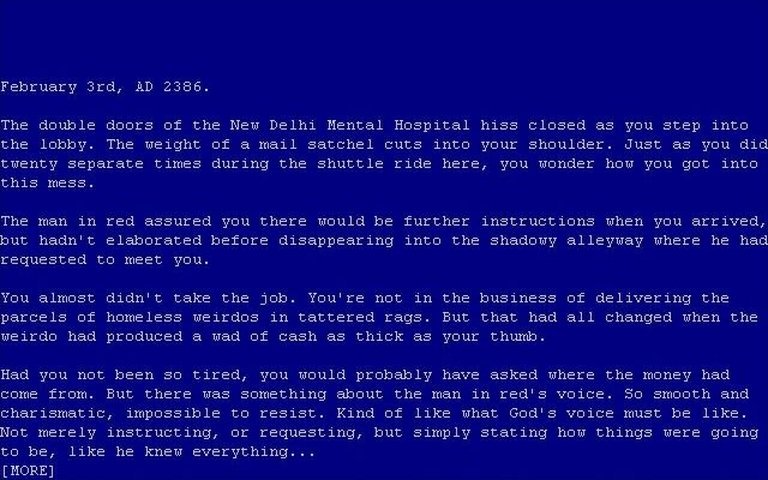
Countdown 3: The Mind is the final entry in a prequel trilogy to ‘6 Days a Sacrifice’ within the Chzo Mythos series. Set in 2386, players assume the role of an unnamed delivery man tasked with smuggling a mysterious parcel to cell 105 of the New Delhi Mental Hospital, evading guards while unraveling connections to earlier events in the franchise. This text-based interactive fiction adventure emphasizes puzzle-solving, a sci-fi horror narrative, and ties together the origins of key artifacts like Frehorn’s Blade.
Countdown 3: The Mind Mods
Countdown 3: The Mind Guides & Walkthroughs
Countdown 3: The Mind Reviews & Reception
mobygames.com (70/100): In order to satisfy players until the release of the last game in the Chzo Mythos, Ben ‘Yahtzee’ Croshaw did three games introducing this awaited sequel.
retro-replay.com : With rich narrative, mind-bending puzzles, and atmospheric storytelling, Countdown 3 – The Mind plunges you deeper into a dystopian future where every choice counts.
Countdown 3: The Mind: Review
Introduction
In 2007, as the gaming industry marched toward increasingly cinematic visuals, Countdown 3: The Mind arrived as a defiant callback to the purity of text-based storytelling. The third entry in Ben “Yahtzee” Croshaw’s Countdown trilogy—a prelude to the climactic 6 Days a Sacrifice—this minimalist horror adventure serves as both a narrative keystone in the Chzo Mythos saga and a test of player imagination. Set in a dystopian 24th century, the game tasks you with delivering a sinister package through a labyrinthine mental hospital, weaving threads from past entries into a taut, cerebral experience. While its lack of audiovisual flair may deter modern audiences, The Mind stands as a testament to the enduring power of interactive fiction—if you’re willing to meet it on its terms.
Development History & Context
Developed by Croshaw’s one-man studio Fully Ramblomatic, Countdown 3: The Mind emerged during a transitional era for indie games. Built with Inform 7 and released as freeware, the game was part of a triptych of text adventures designed to flesh out lore ahead of 6 Days a Sacrifice, the finale of Croshaw’s acclaimed Chzo Mythos series.
At the time, Croshaw was already celebrated for his narrative-driven horror titles like 5 Days a Stranger and Trilby’s Notes. The Countdown games, however, marked a deliberate shift to Z-code text parsing, eschewing the graphical interfaces of his earlier work. This choice reflected both technical constraints (Croshaw’s limited resources) and artistic intent: the trilogy served as supplementary lore for devoted fans, rewarding those willing to engage with its stark, text-only presentation.
The mid-2000s saw a resurgence of interest in parser-driven games, thanks to platforms like the Interactive Fiction Database (IFDB). The Mind leveraged this niche revival, offering a bridge between classic Infocom-style adventures and Croshaw’s signature blend of cosmic horror and dark humor.
Narrative & Thematic Deep Dive
The Mind unfolds in 2386, six months after the events of 7 Days a Skeptic. You play an unnamed courier hired by a shadowy, red-robed figure to deliver a parcel to Cell 105 of the New Delhi Mental Hospital. The parcel, revealed to be the Frehorn’s Blade—a cursed artifact from earlier games—ties into the series’ overarching prophecy about the demonic entity Chzo.
The narrative is sparse but deliberate. Early descriptions evoke a stark, bureaucratic dystopia: guards patrol sterile corridors, and the hospital’s oppressive silence underscores your vulnerability. As you navigate the facility, documents and environmental clues flesh out connections to prior games, notably the fate of Philip Harty (a pivotal figure in Trilby’s Notes) and the lingering influence of John DeFoe, the series’ malevolent spirit.
Themes of control vs. chaos permeate the story. The courier’s anonymity positions players as passive instruments in a larger cosmic game, echoing the Chzo Mythos’ fixation on predestination. Yet the ending—where Trilby himself intervenes to thwart Chzo’s resurgence—hints at defiance, suggesting that even pawns can disrupt grand designs.
Gameplay Mechanics & Systems
As a text parser adventure, The Mind demands familiarity with classic verb-noun commands (“walk north,” “take key”). While Croshaw streamlined inputs compared to obtuse predecessors, quirks remain:
- Movement: Typing “walk north” or “up/down” is mandatory; alternatives like “go to door” fail, occasionally frustrating newcomers.
- Limited Verbs: The parser rejects “use” in favor of context-specific actions (e.g., “give parcel”), requiring trial-and-error adaptation.
- Stealth Mechanics: Evading guards involves timed movements and backtracking, a mechanic praised for tension but criticized for repetitiveness.
The WinFrotz interpreter delivers the game in a stark blue-and-white interface reminiscent of vintage operating systems. While functional, technical hiccups—like text glitches and the need to toggle between “play” and “scrollback” modes—break immersion. Yet these limitations also reinforce the game’s analog charm, demanding player patience as part of its identity.
World-Building, Art & Sound
The Mind’s world-building thrives on implication. Descriptions of the hospital’s “flickering fluorescent lights” and “distant, muffled screams” evoke a Blade Runner-esque futurism, while the red-robed client’s eerie presence ties into the Chzo Mythos’ cultic undertones.
With no graphics or soundtrack, the game relies on prose to unsettle players. A standout moment involves discovering a patient’s journal, its fragmented entries hinting at Chzo’s psychic corruption. The minimalist aesthetic—white text on a blue backdrop—intentionally mirrors early PC interfaces, evoking a clinical, almost glitchy unease.
Retro Replay’s analysis rightly notes that this austerity strengthens immersion. Without visual distractions, players project their own fears onto the setting, transforming the hospital into a canvas for psychological horror.
Reception & Legacy
Upon release, The Mind garnered mixed reviews. Critics praised its narrative cohesion and atmospheric writing but critiqued its parser limitations and niche appeal. Player reviews on MobyGames (averaging 3.5/5) echoed this divide: fans lauded its lore contributions, while newcomers lamented its inaccessibility.
Yet its legacy endures. The Countdown trilogy solidified Croshaw’s reputation as a master of economical storytelling, influencing indie developers like Puppet Combo and Kitty Horrorshow. Moreover, it preserved parser-based gameplay during an era of graphical saturation, proving that text adventures could still innovate within constraints.
Today, The Mind is remembered as a curio—a bridge between Croshaw’s early experiments and his later success with Zero Punctuation. For Chzo Mythos devotees, it remains essential reading; for others, a fascinating relic of gaming’s text-first roots.
Conclusion
Countdown 3: The Mind is not for everyone. Its archaic interface, stubborn parser, and reliance on series lore render it impenetrable to casual players. Yet as a piece of interactive fiction, it excels—crafting dread through implication, rewarding patience with narrative payoffs, and serving as a love letter to gaming’s text-adventure past.
For historians, it exemplifies the DIY ethos of 2000s indie development. For players, it’s a gripping, if flawed, chapter in one of horror’s most underrated sagas. Approach it as you would an ancient tome: with caution, curiosity, and a willingness to meet it halfway. In the annals of gaming history, The Mind earns its place not through spectacle, but through sheer audacity of vision.