
- Release Year: 2020
- Platforms: Macintosh, Windows
- Publisher: Four Pixels
- Developer: Four Pixels
- Genre: Action
- Perspective: Diagonal-down
- Game Mode: Single-player
- Gameplay: Randomly Generated Environments, Shooter
Description
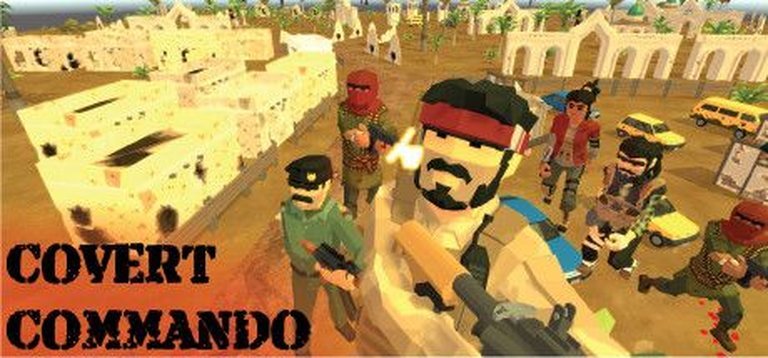
Covert Commando is an 80s-inspired arcade action game where players undertake covert missions deep behind enemy lines, assassinating bosses and rescuing hostages. Featuring procedurally generated levels that ensure unique maps each time, modern weapons, upgrades for both the player and enemies, and permadeath, it delivers a fast-paced, pick-up-and-play shooter experience with a retro aesthetic.
Where to Buy Covert Commando
PC
Covert Commando: A Retro-Roguelite Casus Belli
Introduction: Ghosts in the Machine
In the vast, overcrowded ecosystem of digital storefronts, some games whisper rather than shout. Covert Commando is one such whisper—a title that exists at the curious intersection of profound nostalgia and minimalist design philosophy. Released on Christmas Day 2020 by the virtually anonymous indie outfit Four Pixels Games, it is not a game that sought commercial dominance but rather spiritual fidelity. Its thesis is audaciously simple: to distill the frantic, pick-up-and-play essence of 1980s arcade military shooters like Commando and Cannon Fodder, and recombine it with the emergent, punishing frameworks of the modern roguelite. The result is not a masterpiece of graphic fidelity or narrative complexity, but a poignant and instructive case study in constrained, purpose-driven game design. Covert Commando asks what happens when the “one more try” ethos of the arcade is fused with the “build-a-run” mentality of the roguelike, and its answer is a brutally efficient, if ultimately limited, experiment in genre hybridisation.
Development History & Context: ThePixelated Frontline
The Studio & The Vision: Four Pixels Games is a shadowy entity. MobyGames lists it as both developer and publisher, with no individual credits provided. The most illuminating window into its ethos comes from its itch.io page and the game’s own store descriptions: “We are a few developers that grew up in ancient times (80s and 90s) that miss the no frills, pick up and play for 10 minutes, arcade action games of those decades.” This is not a corporate mission statement but a personal manifesto. The team’s vision is explicitly one of archaeological reconstruction—not just emulating the aesthetics of the 8-bit era, but recapturing its ergonomic purity: immediate action, clear stakes, and a commitment to short, intense play sessions.
Technological & Market Context (c. 2020): The game was built in Unity, a engine synonymous with indie accessibility but also with a certain homogenised aesthetic. Its release in late 2020 placed it at the tail end of the great “roguelite boom” (peaking with titles like Hades and Returnal) and amidst a renewed interest in retro-styled arcade experiences (Streets of Rage 4, River City Girls). Covert Commando’s specific niche—the top-down twin-stick military shooter—was less crowded. It entered a market saturated with Enter the Gungeon clones and Vagante descendants, aiming for a more grounded, Commando-inspired tactical carnage. Its business model as freeware on Steam and itch.io was a radical act of either confidence or humility, prioritising discovery and player feedback over revenue. The game’s journey from “very early beta” (as per itch.io in 2020) to a “live” Steam release on December 25th suggests a small, agile development cycle responsive to community input, but lacking the resources for prolonged, large-scale polish.
Narrative & Thematic Deep Dive: The Story is the Flesh
Plot & Structure (or the Lack Thereof): True to its arcade ancestry, Covert Commando possesses no traditional narrative. There is no opening cinematic, no dialogue trees, no cutscenes. The “story” is presented purely through the official ad blurb: “Deploy deep behind enemy lines, assassinate bosses and save hostages.” This is the entire narrative proposition—a Cold War-era action movie logline stripped to its atomic components. The player is an unnamed, uncharacterised “commando,” an avatar of pure function. The “enemy” is a faceless, homogenised force of “bosses” (larger, tougher units) and “hostages” (civilians to rescue, providing a binary objective beyond pure survival). This narrative vacuum is a design choice, forcing the player to project their own pulp fiction onto the proceedings.
Themes Through Mechanics: The game’s themes are emergent, born entirely from its systems:
* The Futility and Necessity of the Mission: The procedurally generated levels and permadeath create a philosophical loop. Each run is a suicide mission. You infiltrate, you fight, you die (or succeed and move on). The act of “saving hostages” feels perpetually hollow because the next run erases your last success. It mirrors the repetitive, meat-grinder nature of special operations, where victories are tactical and losses are total.
* Asymmetric Escalation: The inclusion of “upgrades for the enemies!” is a crucial, thematically resonant mechanic. The player gains permanent currency (“intelligence,” presumably) to upgrade their own arsenal and abilities between runs. But the game’s world also upgrades its threat level independently. This embodies the central tension of covert warfare: your enemy learns, adapts, and becomes more dangerous in your absence. It’s a systemic representation of an evolving threat, not a static challenge.
* The Cartoony Abyss: The “cartoony” visual style listed in user tags creates a jarring, almost Brechtian dissonance. You are mowing down hordes of comically simple soldiers with grotesque, oversized modern weaponry. The sanitised aesthetic distances the player from the violence, treating it as a puzzle of movement and resource management rather than a moral act. This reinforces the game’s arcade soul—the enemy is not human; it is an obstacle, a score multiplier, a means to a loot drop.
Gameplay Mechanics & Systems: The Calculus of Carnage
Core Loop & Control Scheme: Covert Commando is a top-down, twin-stick shooter with a diagonal-down perspective. The player moves with one stick (or WASD), aims with the other (or mouse). The “no frills” promise is immediately tested: the controls are raw and direct, with little in the way of aim-assist or smoothing. The core loop is a three-phase process:
1. Infiltrate: Enter a procedurally generated map (a network of rooms/ corridors, judging from screenshots).
2. Exfiltrate/Complete: Shoot all enemies, assassinate the boss (a single, heavily armoured unit), and rescue scattered hostages. Extracting all hostages seems to be the primary win condition.
3. Die (or Win): Permadeath is absolute. Upon death, all on-run progress is lost, but you retain “intelligence” currency for permanent upgrades.
Combat & Progression: Combat is about positioning, weapon choice, and resource economy. The “range of modern weapons” implies a tiered system (pistols, rifles, explosives), each with distinct range, fire rate, and area-of-effect. The “looter shooter” tag is key: enemies drop “intelligence” or weapon parts. The genius, and potential flaw, lies in the dual upgrade path. The player upgrades their own capabilities (health, damage, speed, new weapons). Simultaneously, the game’s “enemy upgrades” system—though poorly documented—likely increases base enemy health, damage, numbers, or AI aggression as the player progresses, creating a cruel, downward-sloping difficulty curve. This isn’t just harder levels; it’s your tools becoming relatively less effective against a superior foe.
Innovation & Flaws: The central innovation is the procedural enemy escalation. Most roguelites make you more powerful. Covert Commando makes the world more powerful in tandem, fostering a desperate, attritional mindset. The major flaw, implied by its “ultra-lite” descriptor and minimal Steam reviews, is likely content dilution. Procedural generation can create repetitive, unsatisfying maps. With only a handful of weapon types and enemy behaviours (the classic trooper, the boss, the hostage), the emergent gameplay may feel shallow after a dozen runs. The “pick up and play for 5 minutes” ethos conflicts with the typical 15-30 minute run time of a roguelite, creating a tension between accessibility and depth.
World-Building, Art & Sound: The Aesthetics of Efficiency
Visual Direction: The game presents a 2D scrolling world in a 2.5D perspective (flat sprites on a tilted plane). The art is deliberately “cartoony” and simplistic. Based on the sparse available screenshots on MobyGames, it uses a limited colour palette, likely to evoke the technical constraints of the 8-bit era it reveres. The environmental detail is minimal—bland military outpost walls, simple trees, barren terrain. This is not a world to be explored for its beauty, but a tactical space to be navigated. The clarity of visual design is paramount: hostiles, friendlies, and interactive objects must be instantly recognisable in the heat of twin-stick combat.
Sound Design: Here, the source material is silent. There are no listed audio credits, no description of the soundtrack or sound effects on Steam or MobyGames. This is a critical omission for an “arcade action” title. The whine of bullets, the thud of explosives, the frantic, looped music—these are the sensory lifeblood of the genre. Their absence from the documentation suggests either a bare-bones, possibly synthesized audio suite, or a focus so intense on mechanics that the auditory layer was deprioritised. Either way, it represents a significant sacrifice of the immersive, visceral feedback necessary for the experience to transcend a abstract puzzle.
Atmosphere: The atmosphere is one of sterile tension. The cartoony graphics prevent horror, but the permadeath and escalating enemy threat create a cold, anxious mood. There is no safety, no respite. The “hostage rescue” mechanic injects a faint, moral urgency, but it is constantly undermined by the knowledge that this same rescue must be performed again and again in a slightly different, more hostile configuration. It’s the atmosphere of a endlessly repeating, unwinnable simulation.
Reception & Legacy: The Whisper in the Crowd
Critical & Commercial Reception: Covert Commando exists in the lower strata of visibility. It has no critic reviews aggregated on MobyGames. On Steam, it boasts a “Mostly Positive” rating from a paltry 13 user reviews (as of data collection), with a Steambase Player Score of 77/100. This minuscule sample size is a testament to its obscurity. The positive reviews likely celebrate its pure, unadulterated arcane feel and the compelling “one more run” itch of the roguelite upgrade loop. The negative reviews (3) almost certainly cite repetitive gameplay, lack of content, and possibly janky controls or poor UI (a common issue in Unity-based minimalist projects).
Evolution & Influence: The game’s reputation has not evolved significantly; it remains a cult obscurity. Its influence on the industry is functionally negligible. It did not spawn clones, trend on social media, or receive significant press. However, its place in the historical landscape is as a perfect specimen of a micro-trend: the late-2010s/early-2020s passion project that merges a very specific classic genre with a very specific modern meta-system. It is a sibling to games like Cuphead (in its painstaking retro homage) and Nuclear Throne (in its brutal, minimalist roguelite shooter design), but without the budget, polish, or marketing. It demonstrates that the tools (Unity, Steam Direct, itch.io) allow for the creation of hyper-niche, designer-driven games that would have been impossible in the pre-digital distribution era. Its legacy is not one of impact, but of proof-of-concept: the arcade-roguelite fusion is mechanically viable, if commercially perilous.
Conclusion: A Commando’s Last Stand
Covert Commando is a fascinating paradox. It is a game built with immense love for a bygone era but shackled to the self-obsessed, progression-driven loop of the modern roguelite. Its genius is in its ruthless focus: a single, well-executed idea—escalating threat against a procedurally generated battlefield. Its failure is in the inevitable repetition that all minimalist, procedurally driven games face when the initial conceptual thrill wears thin.
For the historian, it is a crucial artefact of the 2020s indie scene. It represents the democratisation of game creation, where a team of “a few developers” can directly channel their childhood memories into a free, live product. For the player, its value is entirely contingent on their tolerance for repetition and their desire for unadorned, mechanical challenge. It is not a game to be “beaten” so much as a loop to be endured and slowly, incrementally mastered against a world that grows ever more hostile.
In the grand canon of video games, Covert Commando is a footnote. But it is a perfectly formed footnote, one that speaks volumes about the enduring power of arcade design, the seductive cruelty of the roguelike format, and the quiet, determined passion of developers building precisely the game they wish to play. Its final verdict is one of respectful acknowledgment: a competent, heartfelt, and ultimately narrow exercise that succeeds completely on its own deliberately limited terms. It is, in the end, a commando’s last stand—brave, isolated, and ultimately destined to be overwritten by the next procedural seed.
Final Score: 6/10 – A rigorously designed but content-thin tribute to arcade purity, saved from mediocrity by its audacious Systemic Enemy Escalation mechanic and condemned by its own minimalist restrictions. A game for specialists and historians, not for the mainstream.