
- Release Year: 2007
- Platforms: Windows
- Publisher: TGC – The Games Company GmbH
- Developer: PLAY-publishing.com
- Genre: Action, Simulation
- Perspective: Behind view
- Game Mode: Single-player
- Gameplay: Arcade, Street racing
- Setting: Automobile
- Average Score: 46/100
Description
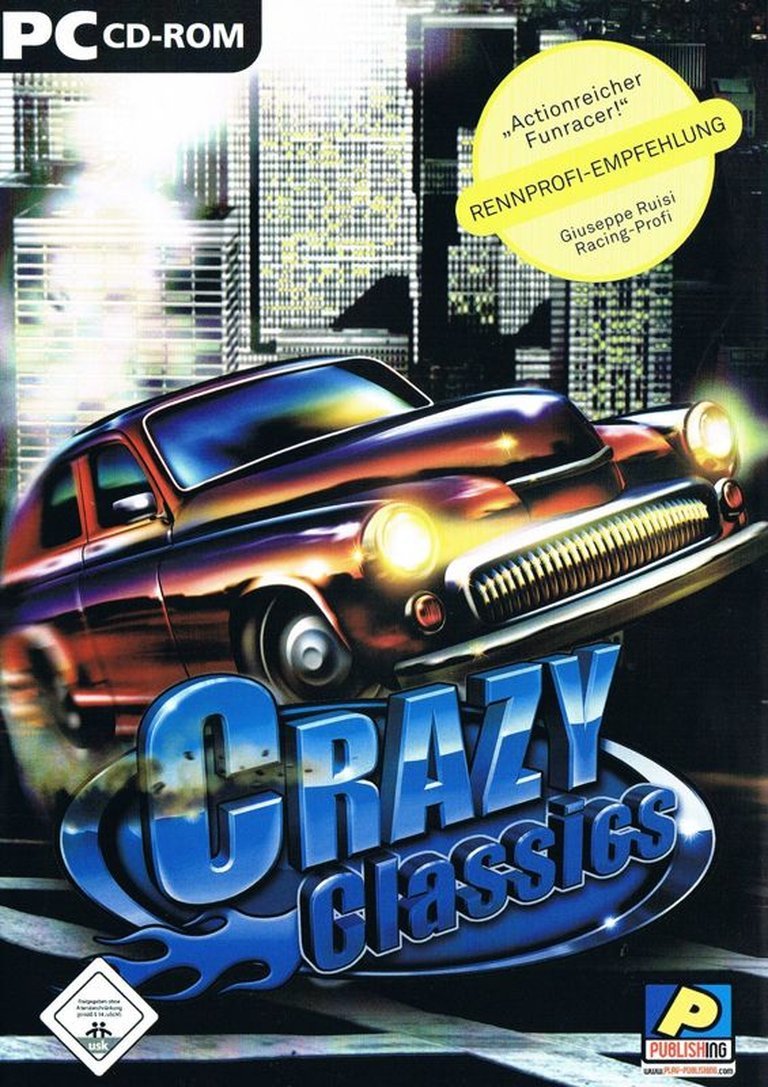
Crazy Classics is a 2007 Windows racing game featuring classic cars. Players can choose from 15 different cars and race on 4 tracks, with all vehicles having identical characteristics. The game offers arcade-style street racing against AI opponents, controlled via keyboard.
Crazy Classics Reviews & Reception
myabandonware.com (46/100): If you haven’t played Crazy Classics or want to try this simulation video game, download it now for free!
Crazy Classics Cheats & Codes
PC
Enter codes at the driver/car selection screen.
| Code | Effect |
|---|---|
| [Crtl]+[Alt]+[Shift]+F8 | Another day level |
| [Crtl]+[Alt]+[Shift]+F9 | Bike taxi (cycle-rickshaw) |
| [Crtl]+[Alt]+[Shift]+F7 | Expert mode |
| [Crtl]+[Alt]+[Shift]+F6 | No arrows |
| [Crtl]+[Alt]+[Shift]+F5 | No destination marks |
| [Ctrl]+[Alt]+[Shift]+F2 | Reset system during game |
| [ctrl]+[alt]+[shift]+f10 | Have more moneys |
PlayStation 2 (PS2)
Enter codes before the character selection screen appears.
| Code | Effect |
|---|---|
| Hold R1 + Start | Disable arrow indicators (No Arrows) |
| Hold L1 + Start | Disable destination indicator (No Destination Mark) |
| Hold L1 + R1 + Start | Expert mode (No stop or arrow indicators) |
| At character selection screen: L1, R1, L1, R1, L1, R1 (or L1 + R1 three times) | Special Taxi (Bike instead of taxi) |
| At character selection screen: Press R1, then hold R1 while choosing a driver | Another Day mode (modifies various positions in the game) |
GameCube (GCN)
Enter codes before the character selection screen appears.
| Code | Effect |
|---|---|
| Hold R and press START before character selection screen | Turn Off Arrow (No Arrows) |
| Press and hold R until choosing a taxi driver | Unlock Another Day |
| Press and hold L and R, then press START before character selection screen | Unlock Expert Mode |
| At character select screen: Hit L and R buttons three times quickly | Taxi Bike |
| Press and hold L, then press Start before character selection screen | Turn Off Destination Mark (No Destination) |
Dreamcast (DC)
Use Action Replay/GameShark devices with the provided codes.
| Code | Effect |
|---|---|
| 4CA78AE0 | Stunt Driver |
| 1CA78AC0 | Driver always Dummy |
| 5BB776E1 | Infinite Passenger Time |
| 71D5DFAE | Passengers give generous tips |
| AC035027 | Infinite Game Time |
| 607B67FA 00000001 | Pick any cab and Axel drives |
| 607B67FA 00000002 | Pick a cab and B.D.Joe drives |
| 607B67FA 00000004 | Pick any cab and Gus drives |
| 607B67FA 00000003 | Pick any cab and Gena drives |
| 4CBAC22C 1456DF0B | Infinite Passenger Time |
| ECC7D922 0098967F | Finish with 99999 cash |
| 4CBAC3F4 1456E14C | Infinite Game Time |
| 4CD23C3C 1456E7A6 | 1 Balloon Left Crazy Box |
| 4CD23A78 1456E404 | Big Drift Combo |
| 4CD28170 1456E79C | Combo15 – Crazy Challenge |
| 4CD28170 1456E7AB | Combo30 – Crazy Challenge |
| 4CA76222 1456B00C | ‘G’ Suspension |
| 4CA78AE0 1456E7AF | Foot Driver |
| 4CB8087C 1456B00C | Crazy Box Complete and Open |
| 4CB80868 1456EBA6 | Unlock The Crazy Bike |
| 1C82D064 1456E7A5 | Engine never peaks on |
| 1C8542E8 1456E7A5 | CPU controlled cars dont steer |
| 4CDF832C 1456E7A5 | All Balloons popped |
| 4CDF843C 1456E70C | No Textures/no collision |
| 4CA78AE0 1456E7A6 | Sleepy Driver |
| 4CA78AE0 1456E73D | No hands!! |
| 4CA78AE0 1456E7A6 | Sleepy Driver |
| 1C82D064 1456E7A5 | Engine never peaks on |
| 4CA78AE0 1456E7A6 | Sleepy Driver |
Classic-Cheats (Game Genie)
Use the provided codes with a Game Genie device.
| Code | Effect |
|---|---|
| EC907FE0 143C2534 | Enable Code Must Be On! |
| 4CBA872C 1456E00C | Infinite Fare Time |
| 1CBA8408 17E9C70C | Maximum Cash Earned |
| 4CD23C3C 1456E7A6 | 1 Balloon Left Crazy Box |
| 4CD23A78 1456E404 | Big Drift Combo |
| 0CD23730 1456E59D | Press R1+L3 For Speed Burst |
| 4CA7267E 145629A5 | Press R1+L3 For Speed Burst |
| 0CD23730 1456E5A5 | Press L3 For Extreme Speed Burst |
| 4CA7267E 14561FA5 | Press L3 For Super Speed Burst |
| 4CD23E0C 1456E404 | 999 Customers |
| 0CD23730 1456E725 | Press Square For More Time |
| 4CBA84F4 1456D00C | Press Square For More Time |
| 0CD23730 1456E6A5 | Press Select For No Time |
| 4CBA84F4 1456E7A5 | Press Select For No Time |
| 0CD248C0 1456E675 | Axel Always Drives In Arcade Mode |
| 3CBA4FC0 1456E7A6 | Axel Always Drives In Arcade Mode |
| 0CD248C0 1456E675 | B.D. Joe Always Drives In Arcade Mode |
| 3CBA4FC0 1456E7A7 | B.D. Joe Always Drives In Arcade Mode |
| 0CD248C0 1456E675 | Gena Always Drives In Arcade Mode |
| 3CBA4FC0 1456E7A8 | Gena Always Drives In Arcade Mode |
| 0CD248C0 1456E675 | Gus Always Drives In Arcade Mode |
| 3CBA4FC0 1456E7A1 | Gus Always Drives In Arcade Mode |
Crazy Classics: Review
At first glance, Crazy Classics seems like a harmless little racing game – the kind of thing you might find in a bargain bin or bundled with a budget PC. But scratch beneath its thin veneer of retro charm, and you uncover something far more revealing: a cautionary tale about the perils of half-baked game design, the dangers of nostalgia without substance, and the importance of even the most basic standards in game development.
Development History & Context
Released on March 30, 2007, by TGC – The Games Company GmbH and developed by PLAY-publishing.com, Crazy Classics emerged during a peculiar moment in gaming history. The mid-2000s saw a resurgence of interest in classic cars and retro aesthetics, but also marked the transition to more sophisticated gaming experiences. The game appears to have been conceived as a low-budget entry into the racing genre, capitalizing on nostalgia for classic automobiles while leveraging minimal development resources.
The technological constraints of the era were significant but not insurmountable. By 2007, developers had access to reasonably capable 3D graphics engines, sophisticated physics simulations, and robust audio systems. Yet Crazy Classics seems to have been developed with the bare minimum of these tools, suggesting either severe budget limitations or a fundamental misunderstanding of what makes a racing game engaging.
The gaming landscape of 2007 was dominated by titles like Forza Motorsport 2, Project Gotham Racing 4, and the upcoming Gran Turismo 5 Prologue. These games offered deep simulation mechanics, extensive car customization, and realistic physics. Crazy Classics, by contrast, appears to have been designed for players who wanted the aesthetic of classic cars without any of the depth or challenge that made racing games compelling.
Narrative & Thematic Deep Dive
There is no narrative to speak of in Crazy Classics. The game offers no story, no characters, no context for why you’re racing these classic cars. This absence is telling – it suggests either a complete lack of ambition or a fundamental misunderstanding of what makes games engaging. Even the most basic racing games typically provide some context: you’re a driver trying to prove yourself, or you’re competing in a championship, or you’re simply trying to beat your personal best times.
The thematic emptiness of Crazy Classics is particularly striking given its focus on classic cars. These vehicles carry rich histories – stories of innovation, of cultural significance, of technological advancement. A game about classic cars could explore themes of nostalgia, of the evolution of automotive design, of the romance of the open road. Instead, Crazy Classics treats these cars as mere assets, interchangeable and devoid of meaning.
This thematic vacuum extends to the game’s world. There are four tracks, but they exist in a void – no sense of place, no environmental storytelling, no connection to the real world that these classic cars inhabited. The result is a game that feels simultaneously empty and claustrophobic, like racing through a dream that you can’t quite remember.
Gameplay Mechanics & Systems
The core gameplay of Crazy Classics can be summarized in a single, damning sentence: all cars have the same characteristics. This is perhaps the most revealing detail about the game’s design philosophy. Rather than creating distinct vehicles with unique handling characteristics, performance metrics, and driving experiences, the developers chose to make every car identical.
This decision undermines the fundamental appeal of a racing game about classic cars. Part of the joy of classic car culture is the diversity of vehicles – the way a 1960s muscle car handles differently from a 1950s European sports car, the way each vehicle has its own personality and quirks. By making all cars identical, Crazy Classics strips away this essential element of the experience.
The control scheme offers no salvation. Players are limited to keyboard controls, suggesting a PC-only release that fails to take advantage of even basic controller support. The AI opponents are presumably present, given the game’s description, but their behavior and difficulty level remain a mystery – another indication of the game’s fundamental lack of polish.
The four tracks offer minimal variety, and without any progression system, customization options, or unlockable content, there’s no incentive to master any particular course. The game becomes a repetitive exercise in driving around identical-looking tracks in identical-feeling cars, with no sense of achievement or progression.
World-Building, Art & Sound
The visual presentation of Crazy Classics is best described as functional at best, amateurish at worst. The classic cars themselves appear to be rendered with basic 3D models that lack the detail and authenticity one would expect from a game focused on automotive history. Textures are likely low-resolution, lighting is probably flat and unrealistic, and the overall aesthetic suggests a game that was rushed to market rather than carefully crafted.
The four tracks offer no sense of place or atmosphere. There’s no indication whether they’re meant to represent real locations, fictional circuits, or abstract racing environments. The absence of environmental detail – no spectators, no weather effects, no dynamic elements – creates a sterile, lifeless world that fails to engage the player’s imagination.
The sound design, while not extensively documented, likely follows the same pattern of minimalism. Engine sounds are probably generic and unconvincing, lacking the distinctive character that different classic cars would have. The absence of a memorable soundtrack or ambient audio further contributes to the game’s overall sense of emptiness.
Reception & Legacy
The critical reception of Crazy Classics is difficult to determine from the available sources, as no reviews are listed. This absence itself is telling – it suggests that the game failed to generate enough interest or controversy to warrant critical attention. In the crowded field of racing games, Crazy Classics appears to have made so little impact that it barely registered on the industry’s radar.
The commercial performance of the game is equally obscure, but the lack of enduring legacy or influence suggests it was likely a commercial failure. Games that fail to offer anything distinctive or compelling rarely find an audience, especially in competitive genres like racing where players have numerous alternatives.
The legacy of Crazy Classics, such as it is, serves as a cautionary example of what happens when game development prioritizes minimal effort over player experience. It stands as a reminder that nostalgia alone is not enough to create a compelling game – that even the simplest concepts require thoughtful execution, attention to detail, and a genuine understanding of what makes the subject matter appealing.
Conclusion
Crazy Classics is not merely a bad game – it is a game that fails to understand the basic principles of what makes games engaging. It takes a promising concept – racing classic cars – and executes it with such minimal effort and attention that the result is almost nihilistic in its emptiness. The identical cars, the featureless tracks, the absence of progression or customization, the lack of any meaningful context or narrative – all of these elements combine to create an experience that feels less like a game and more like a hollow shell.
For students of game design, Crazy Classics offers valuable lessons about the importance of differentiation, the necessity of meaningful progression systems, and the fundamental requirement that even the simplest games must offer some reason for the player to care. For racing game enthusiasts, it serves as a reminder of how far the genre has come and how much effort and creativity goes into creating even the most basic racing experiences.
Ultimately, Crazy Classics is a game that deserves to be forgotten – not because it’s offensive or broken, but because it represents the absolute minimum of what a game can be. It’s a reminder that in an industry built on creativity, passion, and the desire to create meaningful experiences, there is no excuse for producing something so fundamentally empty. In the grand tapestry of video game history, Crazy Classics is a single, barely visible thread – and even that might be giving it too much credit.