
- Release Year: 1996
- Platforms: Windows
- Publisher: Webfoot Technologies, Inc., XLM Software
- Developer: XLM Software
- Genre: Action
- Perspective: Side view
- Game Mode: Single-player
- Gameplay: Arcade
- Setting: Cave, Underground
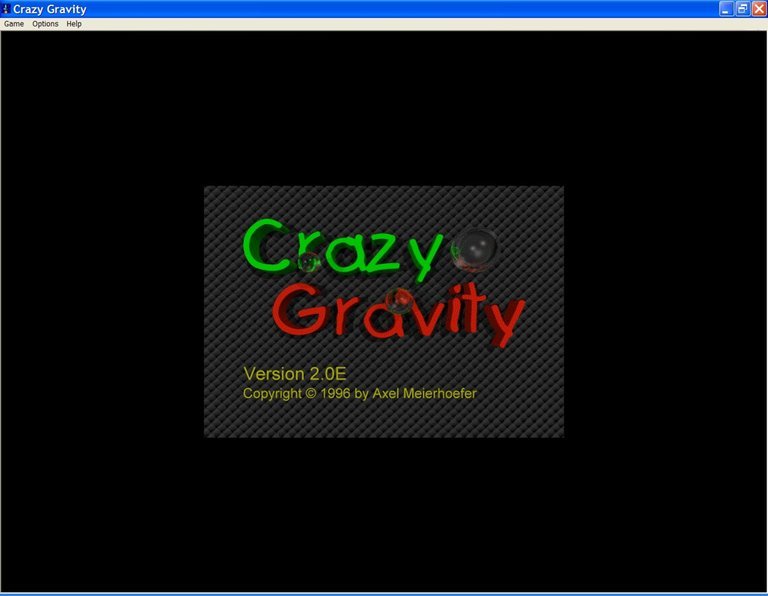
Description
Crazy Gravity is an arcade-style action game set in an underground cave system where players pilot a space shuttle to transport freight containers to a designated platform. The shuttle is controlled solely through engine acceleration, with steering achieved by directional thrust, requiring players to counteract constant gravity while navigating obstacles like sluices, locked doors, magnets, and enemy fire across 20 levels, with fuel and time limits adding to the challenge.
Gameplay Videos
Where to Buy Crazy Gravity
PC
Crazy Gravity Free Download
Crazy Gravity Reviews & Reception
myabandonware.com : Highly recommended, especially to fans of Gravity Force and similar games.
Crazy Gravity Cheats & Codes
PC
Enter codes at the password screen.
| Code | Effect |
|---|---|
| Hyacinth | Unlocks Level 2 |
| Meridian | Unlocks Level 3 |
| Kickback | Unlocks Level 4 |
| Interval | Unlocks Level 5 |
| Yearling | Unlocks Level 6 |
| Positron | Unlocks Level 7 |
| Clavicle | Unlocks Level 9 |
| Daffodil | Unlocks Level 10 |
| Dictator | Unlocks Level 11 |
| Blackout | Unlocks Level 12 |
| Laburnum | Unlocks Level 13 |
| Zucchini | Unlocks Level 14 |
| Eyeglass | Unlocks Level 15 |
| Frippery | Unlocks Level 16 |
| Guardian | Unlocks Level 17 |
| Nuisance | Unlocks Level 18 |
| Ornament | Unlocks Level 19 |
| Mishmash | Unlocks Level 20 |
Crazy Gravity (1996): A Definitive Review of the Overlooked Cave-Flyer Classic
Introduction: Defying Gravity and Obscurity
In the vast, often-forgotten archives of 1990s PC gaming, certain titles shimmer with a peculiar light—games that were neither blockbuster hits nor catastrophic failures, but rather ingenious pocket-sized experiments whose influence subtly permeated a genre. Crazy Gravity, developed by the single-handed studio XLM Software and published by Webfoot Technologies in 1996 for Windows 95, is one such title. It is a game that embodies a specific, demanding subgenre of action gaming—the “cave-flyer” or “Thrust-variant”—where mastery of inertial physics is not a suggestion but a brutal prerequisite for survival. While its name would later adorn a 2020 indie platformer, the 1996 original stands distinct: a minimalist, punishing, and deeply clever arcade experience built around a single, brilliant core mechanic. This review argues that Crazy Gravity is a significant, albeit niche, artifact of mid-90s game design—a game that distilled the “Thrust” formula to its essence and, through its demanding physics-based gameplay and included level editor, offered a profound challenge that rewarded persistence and spatial reasoning. It is a title that has been rightfully reclaimed by abandonware communities not merely for nostalgia’s sake, but for its enduring, razor-sharp design.
Development History & Context: One Man, One Vision, One Cave System
The Studio and the Creator
Crazy Gravity is the product of XLM Software, effectively the one-person operation of Axel Meierhoefer, credited as the sole author on the MobyGames entry. This places the game firmly within the tradition of the 1990s “bedroom coder” phenomenon, where a single developer with a clear vision could produce and publish a complete commercial game. Webfoot Technologies, Inc., the publisher, was a known entity in the shareware and budget software market of the era, having released numerous games and utilities. Their involvement provided distribution through retail Software/Buchhaendler (as noted in the PC Player review) and shareware channels, a common path for mid-tier titles in the pre-digital distribution landscape.
Technological Constraints and Artistic Choices
Released for Windows 95 on CD-ROM (with a floppy version also available), Crazy Gravity utilized the era’s affordable color depth and storage to present “animated 256 color graphics and parallax scrolling” (Internet Archive description). This was a technical boast for the time, creating a sense of depth in its side-view cave environments. The choice of a 2D side-view perspective was both a constraint and a strength: it allowed for precise, readable collision detection—absolutely critical in a game where pixel-perfect navigation is required—and kept performance high on the modest hardware of the day. The self-imposed limitation of a single-screen-level design per stage (implied by the “cavern” description) further optimized resources and focused design on tight, puzzle-like challenges.
The Gaming Landscape of 1996
1996 was a pivotal year. The 3D revolution was in full swing with Quake and Super Mario 64, but the 2D arcade and puzzle genres remained fiercely vibrant on PC. Crazy Gravity entered a space populated by direct ancestors like Jupiter’s “Gravity Force” (circa 1989) and Thrust (1986), as well as contemporaries such as Zarathrusta and Oids. Its specific niche was the “cave-flyer”: a subgenre defined by rotating/thrusting a ship against gravity in enclosed spaces. By simplifying control to “accelerate” (with left/right engine pitch for steering) and emphasizing obstacle-based puzzles over combat, XLM Software crafted a purist’s entry. It shared DNA with Webfoot’s own Color Attack, suggesting a studio focus on clean, physics-driven arcade challenges. In a market increasingly obsessed with narrative and 3D spectacle, Crazy Gravity was a deliberate, almost retro, throwback to skill-based gameplay.
Narrative & Thematic Deep Dive: The Story is the Cave
Crazy Gravity’s narrative is not delivered through cutscenes or dialogue but is emergent, environmental, and brutally simple. The “premise,” as stated on MobyGames, is a lone space shuttle tasked with transporting containers to a platform. The setting is an underground cave system. This is the entire story. There is no explanation for why the shuttle is there, who built the caverns, or what the containers contain. The narrative is a pure gameplay wrapper.
This extreme minimalism is, in fact, a thematic statement. The game’s universe is one of pure, indifferent physics. The astronaut (or more accurately, the shuttle itself) is an agent in a hostile environment where the only antagonists are gravity, inertia, and the immutable walls. The “themes” are therefore those of mastery, precision, and problem-solving under duress. Each level is a silent test: “Can you, with limited fuel and time, manipulate your vessel to overcome these engineered obstacles?” The locked doors require keys, the sluices open in one direction—these are not obstacles of lore but of practical logic. The theme is efficiency and route-planning. The “plot” is the player’s own learning curve; the “character” is the pilot’s growing muscle memory and spatial intuition. It is a game that asks the player to find a story in the perfect, fuel-efficient path from point A to point B, a stark contrast to the narrative-heavy games of its day.
Gameplay Mechanics & Systems: The Brutal Ballet of Thrust
Core Loop and the Singular Gimmick
The entire architectural genius of Crazy Gravity resides in its control scheme. The ship has no direct left/right movement. It is propelled solely by acceleration in the direction its engine is pointing. The player controls:
1. Thrust (Up): Applies forward force in the direction the ship is facing.
2. Rotate Left/Right: Pivots the ship’s engine nozzle, changing the direction of thrust.
Gravity is a constant, downward force. Therefore, to simply hover or move laterally, the player must constantly apply thrust upward to counteract gravity, while carefully angling the nozzle to apply horizontal vectors. This creates an immediate, visceral sense of inertia and momentum. The ship does not stop when the button is released; it drifts, arcs, and falls according to Newtonian principles. The core gameplay loop is: Assess the cavern layout → Plan a thrust/rotation sequence to navigate to the container → Execute with precise timing → Avoid walls/obstacles → Deliver container to platform → Repeat under time and fuel pressure.
Obstacles as Puzzle Pieces
The game layers complexity through its obstacles, which are not merely hazards but puzzle elements:
* Sluices & Locked Doors: Introduce sequence and key management. A sluice that opens only downward might force the player to approach from above, mastering a gravity-assisted descent. Doors require finding the correct key object in the level, adding an exploration layer.
* Stationary Weapons (Cannons): Introduce timing and pattern recognition. Fireballs travel in set paths, creating hazardous corridors that must be navigated during safe windows.
* Magnets: Apply a constant, undesirable force, yanking the ship off its planned trajectory. This forces the player to over-compensate with thrust, directly impacting fuel management.
* Fuel & Time Limits: These are the primary resource management systems. Fuel is consumed by every use of thrust. Reckless burning leads to a stranded ship. The time limit prevents exhaustive trial-and-error, demanding efficiency and forethought. A successful run requires a route that is not just physically possible but resource-optimal.
Progression and the Level Editor
The game features 20 levels across 5 difficulty tiers, a substantial campaign for a title of this scope. Crucially, it includes a full level editor. This is a monumental feature for a 1996 shareware title, transforming Crazy Gravity from a finite game into a platform for endless community-created challenges. It allowed players to design their own physics puzzles, share them, and essentially extend the game’s lifespan indefinitely. This feature alone elevates it from a clever curiosity to a tool for creative expression within its constraint-based system.
Flaws and Frustrations
The game’s purity is also its potential flaw. The lack of checkpoints in later, complex levels means a single mistake near the end of a long, fuel-intensive run could mean restarting from scratch. This is a design choice that prioritizes “mastery” over “progress,” a hallmark of the arcade tradition but potentially unforgiving for modern sensibilities. The UI is minimal, providing only essential information (fuel, time), which is appropriate but offers little feedback when failing to understand a puzzle’s solution.
World-Building, Art & Sound: Aesthetic of the Cavern
Visual Direction: Underground Abstract
The “underground cave system” is rendered in 256-color VGA graphics with parallax scrolling. The backgrounds often feature a static, darker “wall” layer and a foreground layer of platforms and hazards. This creates a convincing, if simple, sense of depth. The art style is utilitarian and clear. Hazards (cannons, magnets) are color-coded and easily distinguishable. The ship is a small, silver sprite. The aesthetic is one of abstract space-industrial—more reminiscent of a wiring diagram or a lunar lander schematic than a fantastical world. This visual clarity is paramount; the player must instantly comprehend the geometry and threat posed by every element on screen.
Sound Design: Sparse and Functional
Sound, according to the Internet Archive listing, includes sound effects and MIDI/audio CD support. The effects are likely sparse: a thrust noise, a crash sound, perhaps a collection chime for keys/containers. There is no indication of a rich, adaptive soundtrack. The audio’s role is functional and reinforcing: the hum of the engine, the thump of a collision, the hiss of a sluice. This sparse soundscape focuses the player’s attention entirely on the visual puzzle and the mental calculations of thrust and gravity. It avoids auditory distraction, complementing the game’s intense concentration requirement.
Atmosphere: The Tension of the Void
The combined effect is an atmosphere of claustrophobic tension and surgical precision. The parallax cave walls feel close, the darkness beyond them implying a fatal fall into nothingness. The constant downward pull of gravity is a psychological pressure as much as a mechanical one. There is no epic space opera here, only the silent, lonely struggle of a pilot against an uncaring physical system. It is an atmosphere of pure, distilled challenge.
Reception & Legacy: Cult Status and a Name’s Evolution
Contemporary Reception
Critical reception was limited but positive. The sole listed critic review is from the German magazine PC Player (August/September 1997 issue), which awarded 80%. The review, summarized in the ad blurb, calls it a “really nice game for the Windows desktop in the office or in between” and recommends it for the price (30 Mark). This suggests it was viewed as a high-quality “coffee break” game—something with depth and challenge suitable for short sessions. Commercial success was likely modest, fitting for a niche shareware title sold in software stores.
Abandonware and Community Rediscovery
Decades later, Crazy Gravity lives on almost exclusively through abandonware archives like MyAbandonware, ClassicReload, and OldGamesDownload. Here, its legacy is cemented by * passionate user testimonials. Comments like *”I’ve been searching for this game for 20 years…” and “Played it back in 2002… Longed to play it again” (MyAbandonware) reveal it as a **deeply memorable, sought-after piece of childhood computing. Its simplicity and difficulty made it stick in the memory. The level editor ensured that even after the official 20 levels were mastered, the community could keep the game alive, though evidence of widespread level sharing is now lost to time.
The Name Collision and a Curious Footnote
A significant complication in documenting Crazy Gravity is the existence of a completely unrelated 2020 game on Steam, Android, and consoles by JM Neto Game Dev. This newer title is a gravity-flipping platformer (where crossing a line inverts gravity and controls), a different mechanic altogether. The Steam discussion thread identifying “Gravity Drop” as a “complete copy” of the 1996 game highlights the confusion. The newer game’s reception (roughly 60/100 on Metacritic) is separate, but its existence has ironically driven search traffic to the original, as seen in the Steam comments from users rediscovering the 1996 classic. This has created a bifurcated legacy: one for the obscure 1996 cave-flyer, and one for the 2020 indie platformer. The historical significance belongs to the former.
Influence on the Genre
Direct lineage is hard to prove, but Crazy Gravity sits firmly in the “Thrust” lineage. Its contribution is in its accessible, Windows-focused implementation and its included editor. It likely influenced few major studios but served as a touchstone for enthusiasts of physics-based puzzles. Its design philosophy—”simple rules, emergent complexity”—is echoed in modern indie successes like Braid or World of Goo, albeit in more polished, narrative forms. It represents a pure, unadorned take on a physics puzzle that remains a benchmark for fans of the style.
Conclusion: A Perfectly Crafted Relic
Crazy Gravity (1996) is not a “lost masterpiece” that was overlooked by history due to its brilliance being ahead of its time. It is, instead, a perfectly crafted relic of a specific design philosophy: that compelling, long-lasting gameplay can emerge from a single, well-executed mechanical idea, wrapped in a minimalist package. Its strengths are also its limitations—its punishing difficulty, short campaign, and abstract world are not for everyone. But for the player willing to engage with its brutalist physics, it offers a deeply satisfying experience of gradual mastery.
Its level editor is its most historically significant feature, democratizing level design long before tools like LittleBigPlanet or Super Mario Maker. It understood that its community’s creativity could extend its life far beyond what a small studio could produce. In the end, Crazy Gravity’s legacy is secure in the memories of those who wrestled with its caves and in the archives that preserve it. It is a testament to the * Axel Meierhoefer’s focused vision and the enduring appeal of the “cave-flyer” genre*. It is not a game that changed the industry, but it is a game that perfectly captured a moment in it—a time when a single developer could ask, “What if flying was just this hard?” and build an entire world to prove the point.
Final Verdict: 8/10 – A niche classic of impeccable, punishing design. For historians of the “Thrust” genre, students of minimalist game design, or anyone seeking a pure, unadulterated physics challenge, Crazy Gravity remains a essential, if grueling, piece of the puzzle. For the curious, it is freely available on abandonware sites—a perfect, if difficult, way to spend an afternoon defying gravity in a cave from 1996.