
- Release Year: 2007
- Platforms: Windows
- Publisher: ak tronic Software & Services GmbH
- Developer: FAKT Software GmbH
- Genre: Compilation
- Perspective: Top-down
- Game Mode: Single-player
- Gameplay: Chain reaction, Experimentation, logic, Physics, Puzzle
- Average Score: 70/100
Description
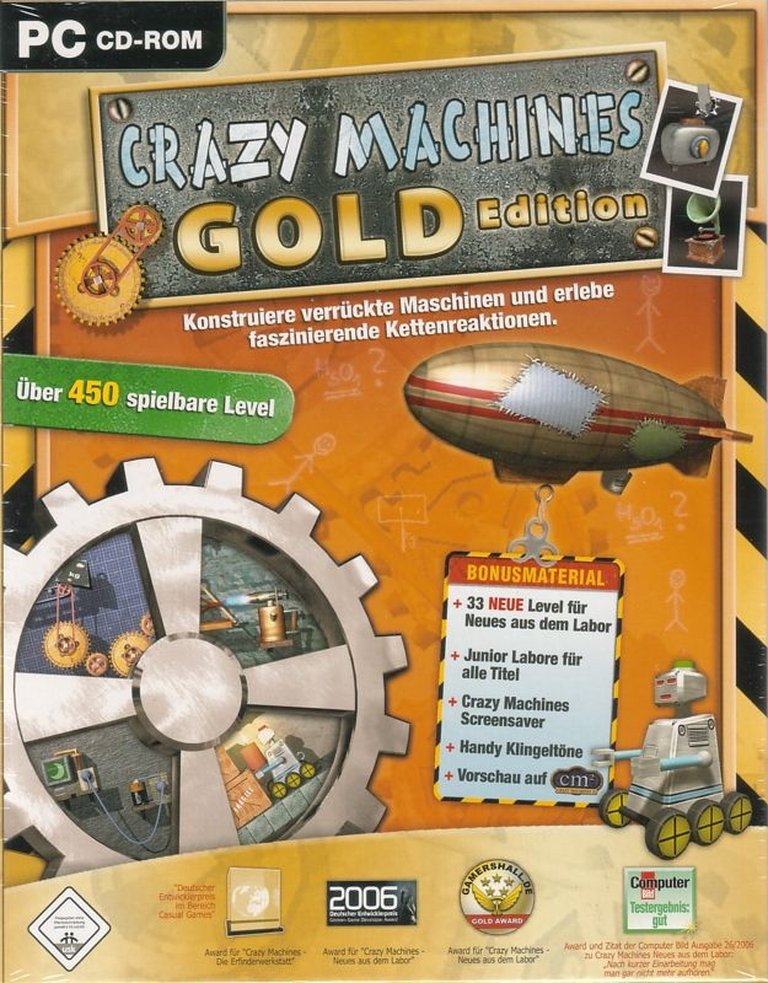
Crazy Machines: Gold Edition is a comprehensive puzzle compilation bundling three titles from the series—The Wacky Contraptions Game, Neue Herausforderungen, and New from the Lab—alongside bonus content including 33 new levels, Junior Laboratory challenges, and a ringtone. Players solve over 450 physics-based puzzles by constructing elaborate Rube Goldberg-style contraptions using a vast array of mechanical components, explosives, and everyday items, aiming to achieve goals through chain reactions in a whimsical virtual laboratory setting.
Crazy Machines: Gold Edition Free Download
Crazy Machines: Gold Edition Guides & Walkthroughs
Crazy Machines: Gold Edition Reviews & Reception
retro-replay.com : Crazy Machines: Gold Edition delivers a sprawling collection of Rube Goldberg–style puzzles that blend inventive engineering with playful experimentation.
Crazy Machines: Gold Edition: Review
To the curious mind, the thrill lies not in the destination, but in the glorious, convoluted path to get there. Crazy Machines: Gold Edition (2007), a meticulous compilation by German studio FAKT Software, embodies this principle with gleeful abandon. More than a mere bundle of puzzles, it’s a digital workshop inviting players to become digital inventors, constructing Rube Goldberg contraptions to achieve the simplest of tasks—igniting a rocket, popping a balloon, or toppling a domino. This exhaustive review delves into the nuts, bolts, and whimsical explosions that define this enduring puzzle classic.
1. Introduction: The Joy of Impractical Engineering
Picture a workshop where logic meets lunacy. Crazy Machines: Gold Edition dumps you into precisely such a space. It’s a compilation collecting Crazy Machines: The Wacky Contraptions Game, Crazy Machines: Neue Herausforderungen (New Challenges), and Crazy Machines: New from the Lab, alongside 33 new levels, the “Junior Laboratory,” a ringtone, and a glimpse at Crazy Machines 2. Its legacy rests on reviving and refining the spirit of The Incredible Machine series for a new generation. This review argues that while Gold Edition excels as a value-packed, physics-based puzzle playground offering near-unparalleled creative freedom and replayability, its steep difficulty curve and occasional interface quirks temper its accessibility. Nevertheless, it stands as a testament to timeless puzzle design and the enduring appeal of making things work, however absurdly.
2. Development History & Context: German Ingenuity Meets Digital Physics
Crafted by FAKT Software, a German developer known for its physics-based puzzles, Crazy Machines: Gold Edition represents the culmination of early 2000s efforts to modernize the Incredible Machine template. Released in 2007 via publisher ak tronic Software & Services GmbH, it arrived amidst a burgeoning indie scene and growing fascination with physics simulation in games. Technologically, it leveraged a capable physics engine for its era, handling variables like gravity, air pressure, electricity, and particle effects with reasonable fidelity. While not pushing graphical boundaries, its core mechanics were robust. The compilation nature reflected a common strategy at the time—to bundle successful titles and add-ons into a definitive package, maximizing value for players and ensuring wider reach for a niche genre. The German roots are evident in the precise, sometimes playful physics simulation and the emphasis on logical experimentation.
3. Narrative & Thematic Deep Dive: The Silence of the Inventor
Gold Edition eschews traditional narrative in favor of pure gameplay. The “story” is one of experimentation itself. Framed as a series of experiments in a virtual laboratory, each level presents a problem: “Get the ball into the basket,” “Light the candle,” “Pop the balloon.” The only “character” is a token Einstein-esque figure who offers minimal guidance, serving as a silent mentor. Dialogue is virtually nonexistent; the true narrative unfolds through player action and the cause-and-effect symphony of each contraption. Underlying themes are potent: the triumph of ingenuity over brute force, the joy of discovery through trial and error, and the celebration of impracticality. There’s a deep-seated satisfaction in watching a complex, domino-like cascade succeed, embodying the whimsical spirit of Heath Robinson and Rube Goldberg. The absence of characters forces the player into the role of the lone inventor, their creations the sole expression of their problem-solving genius.
4. Gameplay Mechanics & Systems: Physics, Parts, and Perseverance
The core loop is deceptively simple: Analyze -> Place -> Test -> Refine.
* Objective Analysis: Each level presents a clear, often whimsical goal (e.g., “Feed the mouse,” “Launch the rocket”). Parts are provided; success hinges on their placement and interaction.
* The Toolbox: A staggering array of parts forms the heart of the experience. Beyond basics (balls, boxes, gears, ropes), players wield toasters, blow torches, C4, conveyor belts, magnets, light bulbs, solar panels, robots, zeppelins, and even bottle rockets. Each interacts realistically within the physics engine.
* The Physics Engine: This is the game’s engine and its greatest strength. It simulates gravity (variable mass affects bounce), momentum, collisions, electricity (circuits, switches, bulbs), air pressure (fans, vacuums), and chain reactions with impressive consistency for its time. Magnets work only within specific ranges; light bulbs need power; explosions have blast radius. This realism creates genuine “eureka!” moments and frustrating dead ends.
* Open-Ended Solutions: Levels rarely dictate how a goal is met. Multiple viable solutions exist, encouraging experimentation and rewarding efficiency (often rated with stars). A player might use a single, perfectly placed gear, or a sprawling, multi-step contraption. This fuels immense replayability.
* The “Ready” Button & Time: Players have unlimited time to design. Pressing “Ready” unfreezes time, initiating the chain reaction. Failure means redesigning.
* Progression & Difficulty: Over 400+ puzzles (including bonus content) scale gradually. Early tutorials teach basic part functions. Later levels demand intricate multi-step logic and precise timing. As noted in reviews (PC Games Germany, 41%), this can lead to “Trial & Error,” frustrating some players.
* Free Style Editor & Sandbox: A significant addition is the “Free Style” editor, allowing players to build their own contraptions without constraints, limited only by their imagination and the available parts. This transforms the game from a puzzle collection into a creative sandbox.
* Interface (Strengths & Quirks): Clean, functional 2.5D graphics clearly distinguish parts. Drag-and-drop mechanics are intuitive. However, the UI can feel slightly dated, and some players reported frustrations with precise placement or understanding niche interactions (e.g., magnet polarity/ range) without explicit hints, as seen in JayIsGames comment threads.
5. World-Building, Art & Sound: The Whimsical Laboratory
- Setting & Atmosphere: The world is a boundless, slightly steampunk-inspired inventor’s laboratory. Backgrounds depict cluttered workbenches, bubbling beakers, and chalkboards covered in schematics. The atmosphere is one of focused, playful experimentation. There’s no grand narrative location, but the laboratory itself is a character – a place of boundless potential and delightful chaos.
- Art Direction & Visuals: Graphics prioritize clarity over spectacle. Parts are rendered with bold colors and distinct shapes for easy identification. The 2.5D perspective allows for rotation and zooming, crucial for inspecting complex contraptions. Animation is functional but effective – gears turn, balls roll, explosions burst with particle effects. The visual style is charmingly utilitarian, fitting the theme perfectly.
- Sound Design: Sound is functional and thematic. The clatter of parts, the whir of gears, the sizzle of a blow torch, the boom of C4, and the gentle plop of a ball landing provide satisfying feedback. Background music is light, upbeat, and unobtrusive, creating a pleasant, focused ambiance without distracting from the puzzle-solving. The overall soundscape reinforces the workshop environment.
6. Reception & Legacy: A Cult Classic of Contraptions
- Critical Reception at Launch: Reception was notably mixed, particularly in its native Germany. PC Action awarded a solid 78%, praising the “gizmo-twisting levels” and inventive nature. However, PC Games gave a harsher 41%, criticizing the “Trial & Error” frustration and difficulty spike. MobyGames lists an average critic score of 59% based on these two reviews, reflecting its niche appeal. Player reviews on sites like JayIsGames were more positive, with users praising the creativity, physics, and sheer volume of content, though many shared frustrations with specific, fiendishly designed levels and sought walkthroughs.
- Legacy & Evolution: Crazy Machines: Gold Edition cemented FAKT Software’s position as a leader in the physics puzzle niche. Its success directly spawned sequels (Crazy Machines 2 in 2007, Crazy Machines 3 in 2016) and numerous ports (DS, Wii, iOS, VR). It significantly influenced the genre, demonstrating the commercial viability and creative potential of physics-based puzzle games beyond the Incredible Machine legacy. Titles like Fantastic Contraption and The Incredible Machine-inspired games owe a debt to its polished mechanics. Its compilation nature ensured the original trilogy and expansions remained accessible, preserving the core experience for new audiences.
- Enduring Appeal: Decades later, Gold Edition retains a dedicated following. Its combination of accessible entry, deep mechanics, and near-infinite creative freedom via the editor ensures its place as a beloved cult classic. It’s frequently cited as a prime example of “tinkering” gameplay and remains relevant in educational settings, teaching basic physics principles through engaging, hands-on experimentation. The Steam release (2008) and continued presence on platforms like GOG further attest to its lasting legacy.
7. Conclusion: The Timeless Workshop
Crazy Machines: Gold Edition is less a game to be “completed” and more a playground to be inhabited. Its genius lies in distilling pure, unadulterated problem-solving joy into accessible-yet-deep puzzles. The compilation offers staggering value, bundling hundreds of hours of inventive challenges with tools that empower boundless creativity. While the physics, while robust for its time, can occasionally feel finicky, and the difficulty can spike into frustrating territory, these are minor quibbles in the face of its core achievement: making the act of building absurdly complex machines to achieve simple goals endlessly compelling. It stands as a vital piece of puzzle gaming history, successfully modernizing a classic formula and proving that the simple pleasure of watching a perfectly executed chain reaction is as potent today as it was in the era of physical Mouse Trap machines. For anyone who ever wondered, “What if I could just… connect that to this?” Crazy Machines: Gold Edition remains an essential, enduring workshop of digital invention. Verdict: A Cult Classic of Whimsical Engineering.