
- Release Year: 1998
- Platforms: Windows
- Publisher: Focus Multimedia Ltd., K.E. Media
- Developer: Attica Interactive Ltd.
- Genre: Simulation
- Perspective: Third-person
- Game Mode: Single-player
- Gameplay: Business simulation, Managerial
- Setting: Music
Description
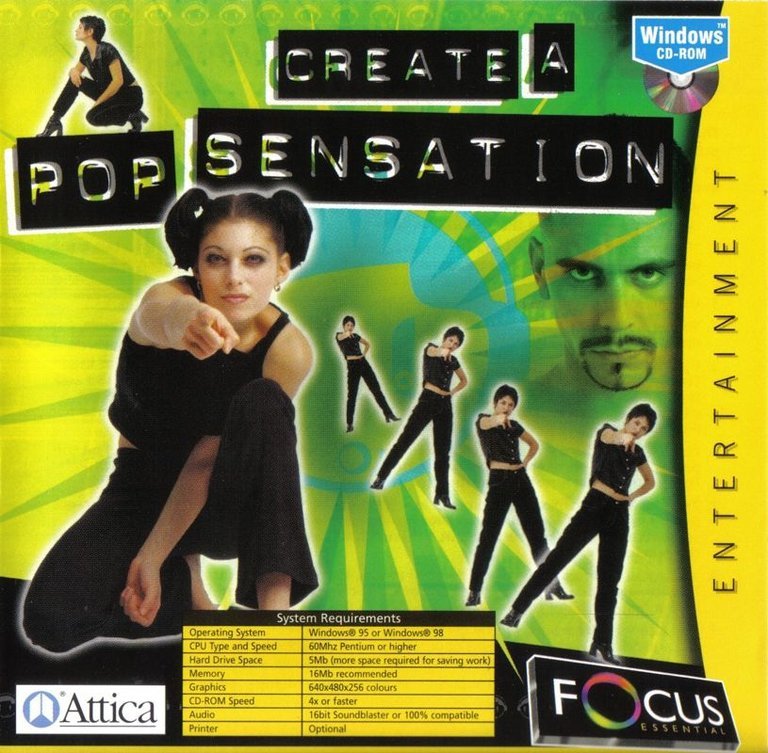
Create a Pop Sensation is a 1998 music simulation game where players assemble a five-member band, compose songs by mixing sections from five pre-existing tracks, record their creations in a studio with adjustable mixing controls, and perform in concerts to chart success. Players can customize their band’s singer and continually refine their musical creations through the rehearsal, recording, and performance cycle, with the goal of creating a chart-topping pop hit.
Create a Pop Sensation Free Download
Create a Pop Sensation Cheats & Codes
PC
Keyboard shortcuts for specific in-game screens.
| Code | Effect |
|---|---|
| BACKSPACE or DELETE | Remove a band member (Formation screen) |
| BACKSPACE or DELETE | Remove an old album (Project Selection screen) |
| CTRL + L | Unlock all labels (Editing screen) |
| CTRL + C | Reset contracts (Editing screen) |
| Hold A | Force an awards ceremony (during news) |
| Hold C | Force a record deal (during news) |
| CTRL + M | Erase missions (Calendar screen) |
| ALT + F | Change fog colour |
| ALT + L | Change light colour |
| ALT + B | Change lighting location |
Create a Pop Sensation: Review
Introduction
In the vibrant, pre-social-media era of 1998, when CD-ROMs hummed with promise and Windows 95/98 dominated desktops, Create a Pop Sensation emerged as a curious artifact of pop culture ambition. Released exclusively in Europe under publishers K.E. Media and Focus Multimedia, this simulation game from Attica Interactive Ltd. tasked players with sculpting pop stardom from the ground up. Yet, despite its niche origins, Create a Pop Sensation transcended obscurity decades later when a cryptic 17-second audio snippet—dubbed “Everyone Knows That” by lost media hunters—was traced back to its modular song engine. This review dissects the game’s legacy, not merely as a relic of 90s music software, but as a foundational experiment in interactive creativity. Through its band auditions, song-crafting mechanics, and chart-obsessed gameplay, Create a Pop Sensation offered a prescient glimpse into democratized artistry, embodying themes of aspiration, experimentation, and the alchemy behind manufactured pop.
Development History & Context
Create a Pop Sensation was forged in the crucible of late-90s European gaming, an era defined by CD-ROM proliferation and burgeoning edutainment markets. Attica Interactive Ltd., a UK-based developer with a portfolio spanning educational software and atlases, partnered with publishers K.E. Media and Focus Multimedia to target the region’s burgeoning casual gaming audience. The game’s vision, spearheaded by Producer Shelley Clark and Senior Software Engineer Bertie Bassett, was ambitious: replicate the music industry’s creative pipeline—from band formation to chart success—within accessible, mouse-driven mechanics. Technologically constrained by Windows 95/98’s multimedia capabilities, the team leveraged MIDI-based audio and pre-rendered animations to deliver a polished yet lightweight experience.
The game’s development roster reflects its hybrid identity: 59 contributors spanned coding (Sarah Hadley, John McDonnell), graphics (Jill Frisby), and even professional music production. Composer Christopher Norton (of Boosey & Hawkes) crafted original lyrics and melodies at CN Studios in Leeds, while animation studio A for Animation Ltd. brought the game’s concert sequences to life. This synergy aimed to bridge educational software and entertainment, positioning Create a Pop Sensation as both a tool for musical exploration and a playful business simulation. Released in select European markets (Denmark, Finland, Norway, Sweden, UK) in 1998, the game arrived alongside titles like The Sims (2000) and Music (1998), yet its Eurocentric release and niche focus limited its mainstream impact. Yet, as the Reddit chronicle of “Everyone Knows That” reveals, its modular design would later prove unexpectedly influential as a blueprint for user-generated content.
Narrative & Thematic Deep Dive
Create a Pop Sensation is not a narrative-driven game in the traditional sense—there is no overarching plot, protagonists, or dialogue. Instead, its “story” emerges from the player’s iterative journey through the music industry’s ecosystem. Thematically, the game operates as a satire and celebration of pop culture’s mechanics. The player, cast as a svengali-like producer, navigates three core phases: band formation, song creation, and chart performance. Each stage symbolizes a facet of stardom’s mythos:
- Band Formation: Assembling a quintet (singer, drummer, keyboardist, lead guitarist, bassist) mirrors the industry’s fetishization of image. The singer alone is customizable, allowing players to tweak appearance and vocal style—ironically reducing human identity to marketable tropes.
- Song Creation: The grid-based rehearsal system—with its 8-song sections (intro, verses, choruses, bridge) sourced from 5 pre-existing tracks—metaphorizes pop music’s reliance on formulaic hooks. Players splice disparate elements, creating a ” Franken-song” that embodies both creativity and pastiche.
- Chart Performance: The concert’s passive, animated-audience spectacle underscores the manufactured nature of pop success. Chart rankings become the ultimate narrative climax, redefining “story” as a climb from obscurity to #1.
Beneath its playful surface, the game critiques commercialism: players “fire” band members or overhaul songs to chase trends, reflecting the industry’s disposable nature. Meanwhile, its European exclusivity subtly nods to regional pop differentiation (e.g., Britpop vs. hip-hop), though the game itself avoids explicit cultural commentary. Ultimately, Create a Pop Sensation’s “narrative” is a loop of trial-and-error, with victory measured not by storytelling coherence, but by algorithmic chart placement—a theme resonating with today’s algorithm-driven fame.
Gameplay Mechanics & Systems
The game’s brilliance lies in its streamlined yet robust mechanics, which distill music production into accessible systems:
Band Assembly & Customization
Players select band members via clickable icons for each instrument. The singer stands out as the sole customization option, with visual and vocal presets (e.g., “Britpop crooner” or “rap diva”). This asymmetry emphasizes the pop star’s centrality while reducing other musicians to interchangeable tools.
Song Construction: The Rehearsal Phase
The core loop unfolds in a grid-based editor, where players arrange 8 sections of 5 predefined songs into a cohesive track. This modular system—akin to musical Lego—allows radical experimentation: the keyboardist’s intro from Song A might sync with the drummer’s chorus from Song B, creating novel hybrids. Each band member’s contribution is independently assignable, enabling layered complexity despite limited options.
Recording Studio & Mixing
Post-rehearsal, players enter a studio with mixer controls: individual volume sliders, left/right panning, and optional additions (backing vocals, brass highlights). This phase introduces rudimentary audio engineering, rewarding players who balance elements to avoid muddy mixes.
Concert & Chart Performance
Songs are submitted to a passive concert sequence, featuring a static stage and animated crowd. The game’s AI evaluates tracks based on structural cohesion, balance, and “catchiness,” assigning a chart position (1–20). Success incentivizes iteration: players tweak arrangements, replace singers, or overhaul mixes to climb the rankings.
UI & Innovation
The interface—point-and-click with voice-overs—prioritizes simplicity. Notably, the game supports printing band snapshots and sheet music, bridging digital and physical creativity. Its “interactive manual” (a separate app) stands out for depth, offering tutorials on song structure and mixing. These systems, while primitive by modern standards, were revolutionary for 1998, offering a sandbox for musical expression without requiring technical proficiency.
Flaws
The lack of player control during concerts and reliance on predefined song snippets limit creative freedom, while the repetitive loop risks monotony. The 2.0/5 player rating (MobyGames) hints at these frustrations, though it likely stems from unmet expectations of “active” gameplay.
World-Building, Art & Sound
Create a Pop Sensation’s world is one of aspirational abstraction—a glittering, simplified microcosm of the music industry. Its 3rd-person perspective and cartoonish aesthetic (rendered by Jill Frisby and A for Animation Ltd.) prioritize clarity over realism. Band members are stylized icons, while the rehearsal and studio environments feature static, interface-heavy backdrops. The concert sequences inject dynamism, with crowd animations and stage lighting evoking 90s pop concerts, albeit with limited interactivity.
Sound design bridges the game’s educational and entertainment goals. Christopher Norton’s original compositions—covering genres like pop, rock, and hip-hop—are professionally recorded at CN Studios, lending the game an authenticity rare for its era. The mixer system allows players to dissect these tracks, hearing how vocals, drums, and guitars coalesce. Voice-overs for guidance and the manual add a human touch, though they lack the polish of AAA titles.
Artistically, the game’s visual language reflects its Eurocentrism: bright colors and clean lines evoke British pop magazines of the era, while the absence of cultural nuance in character designs underscores its broad-strokes approach. Despite this, the synergy between art, sound, and mechanics creates a cohesive “pop universe,” where every menu click and slider adjustment reinforces the fantasy of stardom.
Reception & Legacy
Upon release, Create a Pop Sensation garnered minimal critical attention, its Euro-exclusive release and niche genre limiting mainstream visibility. The MobyGames archive lists no professional reviews, and its 2.0/5 player average (based on a single rating) suggests lukewarm reception. Yet, its legacy has evolved in fascinating ways:
- Lost Media Resurrection: The 2021 Reddit search for “Everyone Knows That” repositioned the game as a digital artifact. Players’ shared creations within its modular engine likely birthed the snippet, highlighting the game’s role as an unsung pioneer of user-generated music.
- Influence on Music Games: While titles like Music (1998) and Dreamer Series: Pop Star (2009) refined pop-simulation mechanics, Create a Pop Sensation’s emphasis on chart success and creative iteration presaged modern platforms like SoundCloud or BandLab. Its grid-based song assembly foreshadowed rhythm games like DJ Hero (2009).
- Cult Status: Abandonware communities (e.g., MyAbandonware) preserve the game, celebrating its quirky charm and historical value. Its availability on the Internet Archive underscores its place in digital preservation efforts.
Critically, the game is now recognized as a product of its time—an ambitious attempt to fuse education and entertainment amid 90s CD-ROM experimentation. Its flaws (repetition, passive gameplay) are contextualized by the era’s technological limits, while its strengths (modularity, accessibility) resonate with contemporary debates about creativity in digital spaces.
Conclusion
Create a Pop Sensation occupies a unique space in video game history: as a flawed yet visionary product of 90s edutainment, and as an unwitting progenitor of user-generated content. Its band-assembly, song-crafting, and chart-chasing loops offer a distilled, playful simulation of pop stardom, where creativity is both celebrated and commodified. While its technical constraints and Eurocentric release limited its initial impact, the game’s legacy endures in its modular design—a system that empowered players to become musical alchemists and inadvertently preserved fragments of ephemeral pop culture in the form of mysterious audio snippets.
For modern players, Create a Pop Sensation is less a game to be “won” and more a historical document—a window into an era when music creation was democratized before algorithms and social media. Its 2.0/5 rating is a testament to its unfulfilled potential, but its rediscovery through lost media reveals a deeper truth: in Create a Pop Sensation, the true pop sensation was the act of creation itself. As a relic of interactive artistry and a prescient critique of manufactured fame, it earns a resounding—if niche—place in the annals of gaming history.
Verdict: A flawed, fascinating time capsule that captures the magic and mechanics of pop’s golden age. Essential for historians and cult-game enthusiasts, but best approached with nostalgia and an appreciation for its 90s context.