
- Release Year: 2004
- Platforms: Windows
- Publisher: East Entertainment Media GmbH, Fusion Software, Gameware Europe Ltd, Kalypso Media GmbH, Merge Games Ltd., Russobit-M
- Developer: Creature Labs Ltd.
- Genre: Compilation, Educational, Simulation
- Perspective: Side view
- Game Mode: Single-player
- Gameplay: Artificial life simulation, Ecology, Evolution
- Setting: Ecology, Educational, Health, Nature, nutrition
- Average Score: 80/100
Description
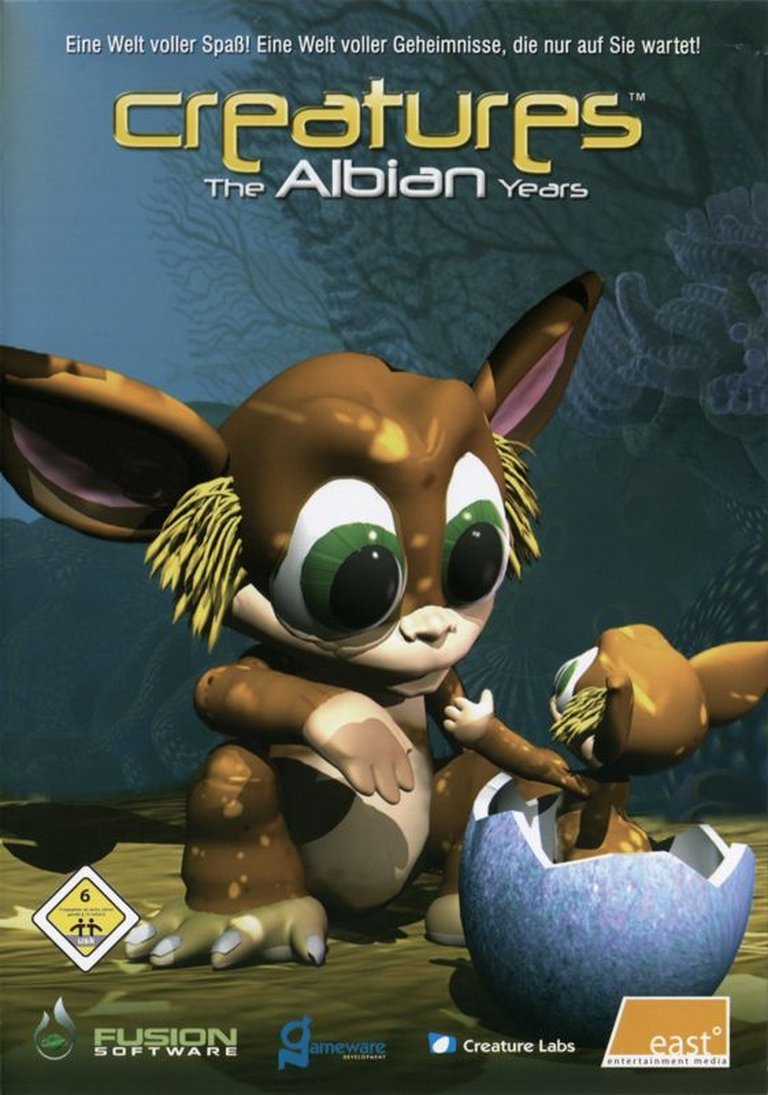
Creatures: The Albian Years is a compilation that bundles the original Creatures and Creatures 2 games, along with their respective Life Kits and official Object Packs. Set in the whimsical world of Albia, players nurture and guide intelligent, evolving creatures called Norns through a rich simulation of life, ecology, and artificial intelligence. The game emphasizes exploration, genetics, and environmental interaction, offering a unique blend of educational and entertainment value as players shape the destiny of their digital pets.
Gameplay Videos
Where to Buy Creatures: The Albian Years
Creatures: The Albian Years Cracks & Fixes
Creatures: The Albian Years Patches & Updates
Creatures: The Albian Years Mods
Creatures: The Albian Years Guides & Walkthroughs
Creatures: The Albian Years Reviews & Reception
store.steampowered.com (75/100): Lots of depth to explore – Unique game experience – Lore
steambase.io (94/100): Creatures: The Albian Years has earned a Player Score of 94 / 100.
mobygames.com (72/100): Average score: 72% (based on 2 ratings)
Creatures: The Albian Years – A Definitive Retrospective on a Landmark in Artificial Life Simulation
Introduction: The Legacy of a Virtual Ecosystem
Few games in history have dared to blur the line between simulation and sentience as boldly as Creatures: The Albian Years. Released in 2004, this compilation is not merely a repackaging of two classic titles—Creatures (1996) and Creatures 2 (1998)—but a testament to one of the most ambitious experiments in artificial life (A-life) ever attempted in gaming. At its core, The Albian Years invites players to nurture, observe, and interact with the Norns, Grendels, and Ettins of Albia, a world where digital organisms exhibit behaviors so complex they often feel alive.
This review will dissect The Albian Years in exhaustive detail, exploring its development, narrative depth, gameplay mechanics, and enduring influence. More than just a game, Creatures was a pioneering fusion of biology, psychology, and emergent storytelling—a digital terrarium where players could witness evolution, emotion, and tragedy unfold in real time.
Development History & Context: The Birth of a Digital Ecosystem
The Vision of Steve Grand and Cyberlife Technology
The Creatures series was the brainchild of Steve Grand, a British artificial intelligence researcher whose fascination with emergent behavior led to the founding of Cyberlife Technology Ltd. in 1995. Grand’s vision was radical: to create a game where creatures weren’t scripted but learned, where their personalities, fears, and desires emerged from a complex interplay of genetics, neural networks, and environmental interaction.
The original Creatures (1996) was a technical marvel for its time, running on a custom engine that simulated:
– Biochemistry: Norns had virtual organs, hormones, and neurotransmitters governing hunger, fear, and curiosity.
– Genetics: Traits were inherited, mutated, and passed down through generations.
– Neural Networks: Creatures learned through reinforcement, forming associations between actions and outcomes.
By the time Creatures 2 arrived in 1998, the system had evolved further, introducing:
– A larger, more dynamic world (Albia expanded with new biomes).
– More species (Grendels became more aggressive, Ettins more mischievous).
– Enhanced AI (Norns could now solve simple puzzles and exhibit deeper social behaviors).
The Albian Years (2004) was not a new game but a preservation effort—a way to ensure these groundbreaking titles remained accessible as operating systems evolved. Published by Fusion Software and later distributed digitally via GOG.com and Steam, it bundled:
– Creatures (1996) + Life Kit #1 (1997)
– Creatures 2 (1998) + Life Kits #1 & #2 (1998–1999)
– Official Object Packs (holiday-themed expansions and additional injectable content)
Technological Constraints and Workarounds
Developing Creatures in the mid-90s was a Herculean task. The team faced:
– Hardware Limitations: The original game ran on Windows 3.1/95 with just 8MB of RAM and a 256-color palette. The engine had to simulate an entire ecosystem without crashing.
– AI Complexity: The creatures’ brains were modeled after real neural networks, meaning they could develop unpredictable behaviors—sometimes leading to bugs where Norns would become “stuck” in loops of fear or hunger.
– Modding Challenges: The game’s CAOS (Creatures Agent Object System) scripting language allowed players to create custom creatures and objects, but early modding tools were rudimentary.
Despite these hurdles, Creatures became a cult phenomenon, spawning a dedicated modding community that continues to thrive today.
Narrative & Thematic Deep Dive: A World Without a Script
The Mythology of Albia
Unlike traditional games with linear narratives, Creatures presents Albia as a living world with its own lore, delivered through:
– The Chronicles of Nornia (a manual included in the original boxed release, detailing the history of the Norns).
– Environmental Storytelling: Ruins, ancient devices, and the behavior of creatures hint at a lost civilization.
– Player-Driven Emergent Stories: Since Norns age, reproduce, and die, every playthrough generates unique dramas—families rising and falling, rivalries forming, and entire bloodlines succumbing to genetic flaws.
Themes: Life, Death, and Digital Parenthood
The Albian Years explores profound themes rarely seen in games:
1. Artificial Life as a Mirror of Reality
– Norns exhibit real emotions: They can be happy, scared, lonely, or depressed.
– They suffer from diseases, genetic disorders, and old age—forcing players to confront mortality.
– Players often develop genuine attachments, mourning when a beloved Norn dies.
-
Ethics of Godhood
- The game grants players omnipotent tools (the “Hand” to interact, the “Injector” to add objects).
- But with power comes responsibility: Should you intervene when a Norn is dying? Or let nature take its course?
- Some players became “Norn torturers”, deliberately harming creatures—a dark but fascinating emergent behavior.
-
Evolution and Survival
- Unlike The Sims, where characters are static, Creatures simulates real genetic inheritance.
- Poor breeding choices could lead to inbred, weak Norns—a harsh lesson in natural selection.
Characters: The Inhabitants of Albia
| Species | Behavior | Role in Ecosystem |
|---|---|---|
| Norns | Curious, social, capable of learning language | The “protagonists”—players raise and nurture them. |
| Grendels | Aggressive, territorial, disease carriers | Predators that hunt Norns, adding tension. |
| Ettins | Playful, mischievous, non-lethal | Comic relief; they steal food but don’t kill. |
| Gremlins (C2) | Mechanical, repair-oriented | Maintain the world’s infrastructure. |
Each species has distinct AI routines, making Albia feel like a real, unpredictable ecosystem.
Gameplay Mechanics & Systems: A Masterclass in Emergent Design
Core Gameplay Loop: Nurture, Observe, Intervene
The Albian Years defies traditional gaming conventions. There is:
– No “win” condition—only survival and evolution.
– No direct control—players influence rather than command.
– No pause button—life in Albia continues even when you’re not playing.
Key Mechanics Breakdown
-
The Hand of God (Player Interaction)
- Pick Up/Drop: Move creatures or objects.
- Slap/Praise: Reinforce behavior (Norns learn through positive/negative feedback).
- Inject Agents: Add food, toys, or even new creatures via the COB (Creatures Object) system.
-
Biochemistry & Needs System
- Norns have eight primary drives:
- Hunger
- Tiredness
- Loneliness
- Fear
- Pain
- Cold/Heat
- Boredom
- Sexual Urge
- Each drive is tied to chemical levels (e.g., low glucose = hunger, high adrenaline = fear).
- Norns have eight primary drives:
-
Genetics & Breeding
- Norns inherit 256 genes from their parents.
- Mutations can occur, leading to new traits (or crippling defects).
- The Genome Editor (included in Life Kits) allows players to tweak DNA.
-
Language & Learning
- Norns start with baby talk but can learn real words if taught.
- They associate words with objects/actions (e.g., saying “Apple” while holding food).
- Advanced players could teach Norns complex phrases.
-
Ecosystem Management
- Players must balance:
- Food supply (too little = starvation, too much = obesity).
- Population control (overcrowding leads to disease).
- Predator-prey dynamics (Grendels keep Norn numbers in check).
- Players must balance:
Flaws & Frustrations
While revolutionary, The Albian Years is not without issues:
– Steep Learning Curve: New players often struggle with the lack of clear objectives.
– Technical Instability: The original engine was buggy—Norns could get stuck in walls, and genetics sometimes broke unexpectedly.
– Outdated UI: The interface, while functional, feels clunky by modern standards.
– Split Installations: A notorious bug where files install across multiple directories, causing COB injection failures.
Despite these flaws, the game’s depth and emergent storytelling make it a uniquely rewarding experience.
World-Building, Art & Sound: Crafting a Believable Digital Eden
The Aesthetic of Albia
The Albian Years employs a hand-drawn, cartoonish art style that belies its complexity:
– Creatures: Norns are expressive, with animations conveying emotion (e.g., shivering when cold, rubbing their bellies when hungry).
– Environment: Albia is a lush, vertical world with multiple floors, filled with:
– Interactive objects (beehives, mushrooms, toys).
– Hidden areas (caves, underwater zones in Creatures 2).
– Seasonal changes (via Christmas Packs).
Sound Design: The Language of Norns
The game’s audio is minimal but highly effective:
– Norn Speech: A mix of gibberish and learned words, creating a unique “language” that feels alien yet understandable.
– Ambient Sounds: Gentle wind, water, and creature chirps reinforce the world’s tranquility.
– Music: The original Creatures had a hauntingly beautiful theme (composed by Andrew Barnabas), later expanded in sequels.
Atmosphere: A World That Feels Alive
What makes Albia special is its sense of discovery:
– Every playthrough is different—new creatures hatch, explore, and die in unpredictable ways.
– The world reacts dynamically—if Norns overpopulate, disease spreads; if Grendels dominate, Norns go extinct.
– Players become emotionally invested, forming bonds with their digital pets.
Reception & Legacy: From Cult Classic to Enduring Phenomenon
Critical Reception at Launch
The Albian Years itself was a compilation, so it didn’t receive major reviews. However, the original Creatures games were critically acclaimed for their innovation:
– PC Gamer (1996): Praised its “unprecedented AI depth” but noted the steep learning curve.
– Games Finder (2014): Gave The Albian Years a 7.5/10, calling it “a unique experience with lots of depth.”
– Steam Reviews (Modern): 94% Positive (as of 2026), with players highlighting its “unmatched emotional engagement.”
Commercial Performance & Community
- Niche Success: Creatures never achieved SimCity-level sales but cultivated a passionate fanbase.
- Modding Scene: The CAOS scripting language allowed players to create:
- New creature breeds (e.g., “ChiChi Norns,” “Banshee Grendels”).
- Custom worlds (e.g., underwater biomes, sci-fi settings).
- Quality-of-life fixes (bug patches, UI improvements).
- Modern Revival: Thanks to GOG.com and Steam, new players continue to discover The Albian Years, with Discord communities and wikis keeping the game alive.
Influence on Gaming & AI Research
The Albian Years left an indelible mark on:
1. Artificial Life Games
– Inspired titles like Spore (2008), Black & White (2001), and Niche (2016).
– Proved that emergent storytelling could be as compelling as scripted narratives.
-
AI & Machine Learning
- Steve Grand’s work influenced neural network research.
- The game’s genetic algorithms were studied in academic papers.
-
Digital Pet & Simulation Genres
- Paved the way for Tamagotchi evolutions and Stardew Valley’s relationship mechanics.
- Showed that player attachment to AI characters was possible.
Conclusion: A Timeless Experiment in Digital Life
The Albian Years is more than a game—it’s a living laboratory, a philosophical exploration of creation and mortality, and a testament to the power of emergent gameplay. While its dated mechanics and technical quirks may deter some, those who embrace its complexity will find an experience unlike any other.
Final Verdict: 9/10 – A Masterpiece of Artificial Life
Pros:
✅ Unparalleled AI depth – Norns feel alive in ways few game characters do.
✅ Endless emergent stories – Every playthrough is unique.
✅ Rich modding community – Extends the game’s lifespan indefinitely.
✅ Emotionally powerful – Forms real attachments to digital creatures.
Cons:
❌ Steep learning curve – Overwhelming for newcomers.
❌ Outdated UI/UX – Clunky by modern standards.
❌ Technical instability – Bugs and crashes still plague the original engine.
Who Should Play It?
- Fans of deep simulations (Dwarf Fortress, RimWorld).
- AI & biology enthusiasts – A fascinating study in emergent behavior.
- Patients willing to learn – The game rewards long-term investment.
Legacy & Where to Play
The Albian Years remains available on:
– Steam ($5.99)
– GOG.com (DRM-free)
For those seeking a modernized experience, the Creatures Remastered Patch and community mods (like Creatures Exodus) provide stability improvements.
Final Thoughts
In an era where games increasingly rely on scripted spectacle, Creatures: The Albian Years stands as a bold, uncompromising vision of what interactive media can achieve. It is not just a simulation—it is a digital ecosystem, a mirror of life itself, and a testament to the enduring power of emergent design.
If you’ve ever wondered what it’s like to play God, Albia awaits.