
- Release Year: 1998
- Platforms: PlayStation, Windows
- Publisher: Interplay Entertainment Corp.
- Developer: Pixelogic Limited
- Genre: Driving, Racing
- Perspective: First-person, Third-person
- Game Mode: Co-op, Single-player
- Gameplay: Armed vehicles, Driving, Vehicle combat
- Setting: Futuristic, Sci-fi
- Average Score: 96/100
Description
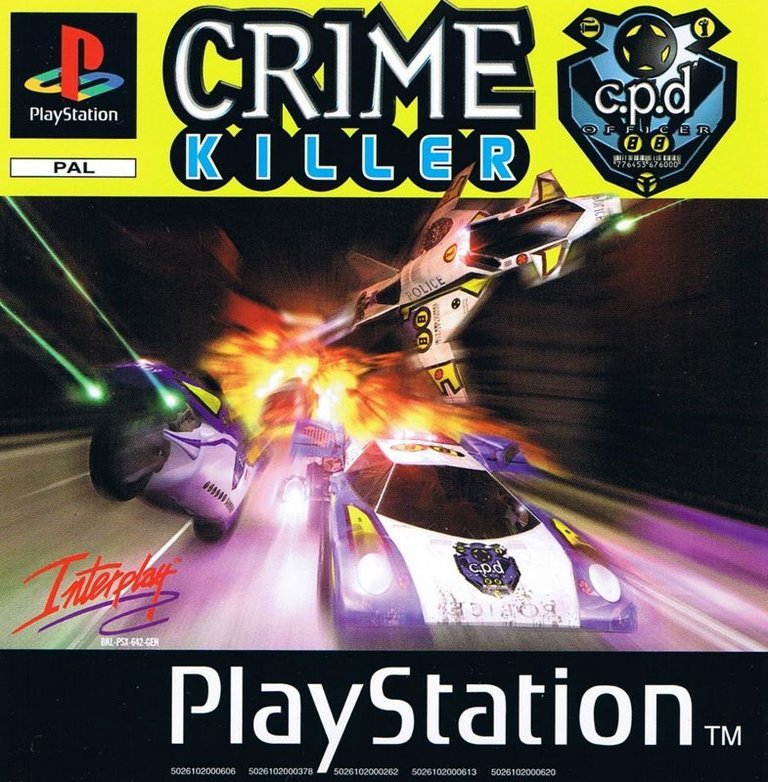
Crime Killer is a 1998 sci-fi driving and combat game where players take on the role of a futuristic cop, using armed vehicles such as bikes, cars, and flying wings to chase and apprehend criminals in high-speed missions. Set in a futuristic world, the game offers arcade-style action inspired by titles like Carmageddon, with options for first or third-person perspectives and two-player split-screen multiplayer.
Gameplay Videos
Crime Killer Free Download
Crime Killer Guides & Walkthroughs
Crime Killer Reviews & Reception
myabandonware.com (96/100): a very fun underdog that, despite my grumbles, definitely merits our Top Dog tag.
Crime Killer Cheats & Codes
PlayStation 1 (NTSC-U)
For hex codes, use with CodeBreaker, Action Replay, or GameShark device. For level passwords, enter at the password screen in the game.
| Code | Effect |
|---|---|
| Circle,Square,X,Triangle,Square,Triangle,Square | Unlocks Level 2 |
| Circle,Circle,Square,X,Triangle,Circle,Circle,Circle,Circle,Circle | Unlocks Level 3 |
| Circle,Circle,Square,Triangle,Circle,Circle,Square,Triangle,Square,X | Unlocks Level 4 |
| Triangle,Circle,Circle,Circle,Circle,Circle,Circle,Circle,Square,Triangle | Unlocks Level 5 |
| Square,Triangle,Square,Triangle,Circle,Square,X,X,X,Triangle | Unlocks Level 6 |
| Circle,Circle,Circle,Circle,Square,X,Triangle,Circle,Circle,Circle | Unlocks Level 7 |
| Square,Triangle,Square,X,Triangle,Square,X,Triangle,Square,X | Unlocks Level 8 |
| X,X,Triangle,Circle,Square,X,Triangle,Square,Triangle,Circle | Unlocks Level 9 |
| Circle,Triangle,Circle,Circle,Square,X,Triangle,Circle,Circle,Circle | Unlocks Level 10 |
| Square,Triangle,Square,Triangle,Circle,Circle,Square,Triangle,Square,Triangle | Unlocks Level 11 |
| Square,Triangle,Square,Triangle,Square,Triangle,Circle,Square,Triangle,Square | Unlocks Level 12 |
| X,X,X,Triangle,Circle,Circle,Circle,Square,X,X | Unlocks Level 13 |
| X,X,X,X,Triangle,Circle,Square,X,X,X | Unlocks Level 14 |
| X,Triangle,Square,X,X,Triangle,Circle,Square,Triangle,Square | Unlocks Level 15 |
| X,Triangle,Circle,Square,Triangle,Square,X,Triangle,Square,Triangle | Unlocks Ending |
| 80120630 0000 | Level Modifier for Hitting the Streets |
| 80120630 0001 | Level Modifier for Suburbia |
| 80120630 0002 | Level Modifier for The Break In |
| 80120630 0003 | Level Modifier for Rapid Response |
| 80120630 0004 | Level Modifier for Cult Moves |
| 80120630 0005 | Level Modifier for The Kidnap |
| 80120630 0006 | Level Modifier for Family |
| 80120630 0007 | Level Modifier for Police Hijack |
| 80120630 0008 | Level Modifier for The Rescue |
| 80120630 0009 | Level Modifier for Static |
| 80120630 000A | Level Modifier for Use of Force |
| 80120630 000B | Level Modifier for The Deadline |
| 80120630 000C | Level Modifier for M.E. |
| 80120630 000D | Level Modifier for Freeway Racers |
| 80120630 000E | Level Modifier for Revelation |
| 80120630 000F | Level Modifier for Epilogue |
| 80159D62 0000 | More Time for Hitting The Streets |
| 80159D64 0000 | More Time for Hitting The Streets |
| 8015AB0C 00FF | Infinite Ammo for Hitting The Streets |
| 8015AB10 00FF | Infinite Shields for Hitting The Streets |
| 8017B4D2 0000 | More Time for Suburbia |
| 8017B4D4 0000 | More Time for Suburbia |
| 8017C284 00FF | Infinite Ammo for Suburbia |
| 8017C288 00FF | Infinite Shields for Suburbia |
| 801A991A 0000 | More Time for The Break In |
| 801A991C 0000 | More Time for The Break In |
| 801AA784 00FF | Infinite Ammo for The Break In |
| 801AA788 00FF | Infinite Shields for The Break In |
| 8019C06A 0000 | More Time for Rapid Responce |
| 8019C06C 0000 | More Time for Rapid Responce |
| 8019CE4C 00FF | Infinite Ammo for Rapid Responce |
| 8019CE50 00FF | Infinite Shields for Rapid Responce |
| 8019F702 0000 | More Time for Cult Moves |
| 8019F704 0000 | More Time for Cult Moves |
| 801A053C 00FF | Infinite Ammo for Cult Moves |
| 801A0540 00FF | Infinite Shields for Cult Moves |
| 801AB0AA 0000 | More Time for The Kidnap |
| 801AB0AC 0000 | More Time for The Kidnap |
| 801ABED4 00FF | Infinite Ammo for The Kidnap |
| 801ABED8 00FF | Infinite Shields for The Kidnap |
| 801A80DC 0000 | More Time for Family |
| 801A80E0 0000 | More Time for Family |
| 801A8EFC 00FF | Infinite Ammo for Family |
| 801A8F00 00FF | Infinite Shields for Family |
| 8019CCFE 0000 | More Time for Police Hijack |
| 8019CD00 0000 | More Time for Police Hijack |
| 8019DAEC 00FF | Infinite Ammo for Police Hijack |
| 8019DAF0 00FF | Infinite Shields for Police Hijack |
| 801994EE 0000 | More Time for The Rescue |
| 801994F0 0000 | More Time for The Rescue |
| 8019A33C 00FF | Infinite Ammo for The Rescue |
| 8019A340 00FF | Infinite Shields for The Rescue |
| 801A6B8A 0000 | More Time for Static |
| 801A6B8C 0000 | More Time for Static |
| 801A7A3C 00FF | Infinite Ammo for Static |
| 801A7A40 00FF | Infinite Shields for Static |
| 801aa78800ff | Infinite Shields for the Car |
| 8019ce5000ff | Infinite Shields for the Motorcycle |
| 801a054000ff | Infinite Shields for the Plane |
Crime Killer: Review – The Flawed Futurism of a Vehicular Vigilante
Introduction: A Flash in the Pan or a Forgotten Gem?
In the crowded landscape of late-’90s PC and PlayStation gaming, few titles have faded into obscurity as completely yet as contentiously as Crime Killer. Released in 1998 by British studio Pixelogic and published by the then-mighty Interplay Entertainment, this vehicular combat game arrived with a clear and provocative thesis: what if Carmageddon’s anarchic, pedestrian-smashing mayhem was given the heroic, law-enforcement veneer of a gritty sci-fi cop drama? The result was a game that polarized critics and players alike, earning scores that ranged from the rapturous 88% of Absolute PlayStation to the scathing 17% of Germany’s GameStar. This review argues that Crime Killer is not merely a failed Carmageddon clone, but a fascinating and deeply flawed artifact of its time—a game whose technical ambition and thematic potential were consistently undermined by problematic design choices and a failure to escape the shadow of its inspirations. It stands as a cautionary tale about the perils of genre hybridization and the critical importance of core gameplay polish.
1. Development History & Context: Pixelogic’s Pivot and Interplay’s Pipeline
Crime Killer was developed by Pixelogic Limited, a UK-based studio with a curious portfolio. Their credits, as seen on MobyGames, include work on titles like Heart of Darkness and VR Sports Powerboat Racing, suggesting a team comfortable with both atmospheric platformers and arcade-style racing. This diversity hints at a studio experimenting with genres, and Crime Killer represents their major foray into the burgeoning “vehicular combat” subgenre, directly competing with the controversial but undeniably influential Carmageddon (1997).
The publisher, Interplay Entertainment, was a powerhouse in 1998, known for Fallout, Baldur’s Gate, and Descent. Their involvement provided necessary funding and distribution, but also likely came with pressure to tap into a hot market trend. The technological context was the PlayStation 1 and the early 3D accelerator PC market. The game’s consistent 60 frames per second performance, repeatedly praised in reviews, was a significant technical achievement for the era, especially on the PlayStation, where smooth 3D was a constant challenge. However, this pursuit of speed came at a cost. As the German PC reviews (PC Games, GameStar) noted, the Windows port was a notorious “shoddy conversion” that ignored 3D hardware acceleration, resulting in visuals that looked dated and performance that was often worse than the console original. The development cycle was likely constrained, rushing to meet the competitive 1998 release window and leading to the “Schnellschuß” (flash in the pan) feel many critics detected.
2. Narrative & Thematic Deep Dive: A Promising Premise, Poorly Executed
Crime Killer’s narrative, lifted straight from its IMDb and box art synopsis, sets up a compelling sci-fi cop drama. In a near-future metropolis, the corrupt URIEL consortium has corporatized the police department. The player character is the son of a slain cop, driven by vengeance and duty. This establishes a clear, personal stake—a rare element in the genre—and a classic cyberpunk them of corporate overreach versus individual justice.
However, the game’s execution of this narrative is almost nonexistent. The “story” is delivered via low-resolution FMV sequences (noted by Mega Fun and PC Player), which critics universally panned as “bescheiden” (mediocre) and “angestaubte” (dated). There is no meaningful character development for the protagonist or the criminal kingpins you pursue. The thematic potential of examining a privatized police force, or the moral ambiguity of a “license to kill,” is completely squandered. The game presents a black-and-white moral universe: you are the absolute good, pursuing cartoonish “criminals” with no justification or background. The narrative is not integrated into the gameplay; it’s a thin, forgettable veneer slapped onto an otherwise pure action loop. This represents a fundamental missed opportunity to elevate Crime Killer beyond its competitors, which at least offered satirical or chaotic frameworks (Carmageddon) or engaging campaign structures (Twisted Metal).
3. Gameplay Mechanics & Systems: The Agony and the Ecstasy of 60 FPS
The core gameplay loop is simple: select a mission, choose a vehicle (Patrol Car, Bike, or Flying Wing), and pursue a designated criminal target through a cityscape, destroying them with your arsenal. The 60 FPS is the game’s undeniable crown jewel. Reviews from Mega Fun (“bei 60 fps”) to GameSpot (“the speed is certainly cool”) and GoldenAgeofGames (“breakneck speed of 60 frames per second”) consistently celebrate this fluid, reaction-based experience. The handling is described as “pretty solid” (GameSpot) and the sense of speed is intoxicating.
Yet, this speed is the source of the game’s most infamous flaw: cripplingly poor visibility. Multiple sources (MyAbandonware, PC Joker, PC Player) explicitly state the visibility radius is a mere ~40 feet. This transforms the pursuit missions from dynamic chases into frantic, radar-dependent exercises. As MyAbandonware’s reviewer bluntly states, “I can’t remember how many times I crash and burn while looking at the radar.” The game actively punishes you for looking at what you’re supposed to be chasing. This is compounded by:
* Awkward Controls: Especially on PC, the keyboard/tank-style controls are described as “hakelig” (jerky) and “schlecht” (bad) by German critics.
* Predictable AI: Criminals follow “vordefinierten Routen im Kreis” (predefined circular routes) (PC Player), removing any sense of a dynamic pursuit.
* Repetitive Mission Structure: The “seek and destroy” objective, while genre-standard, becomes grating with little variation. As GameSpot noted, you eventually hope “the dispatcher gives it a rest.”
* Weapon & Vehicle Parity: The three vehicles (car, bike, wing) handle only “unwesentlich” (insignificantly) differently (Das Offizielle PlayStation Magazin), and the weapon pickups, while numerous, are often placed in repetitive locations.
The two-player split-screen mode is a consistent bright spot. Reviews from Absolute Playstation to Mega Fun highlight “holotag” and deathmatch modes as the game’s most enduring fun, testing reflexes in chaotic, direct competition. This suggests the core combat mechanics (shooting, dodging) are sound, but the single-player mission design fails to leverage them effectively over time.
4. World-Building, Art & Sound: A Technically Adept, Aesthetically Bland Future
The game’s sci-fi setting is represented through a series of city environments. The technical art direction shows ambition. Mega Fun praised realistic lighting effects and lens flares, and the vehicle damage modeling (vehicles reflect damage) was noted as a detail “missing in many other games.” However, the execution is mixed. Environments are criticized as “etwas dunkel und auch pixelig” (somewhat dark and pixelated) (Mega Fun), with the PC port looking particularly poor (“kaum besser als bei der älteren PlayStation-Version” – hardly better than the older PS version – PC Action). The “flying wing” vehicle offers a unique perspective but doesn’t fundamentally alter the visual monotony of the urban sprawl.
The sound design is the most praised element after the framerate. Game Express called the soundtrack “rockig” (rocking) and providing “Abwechslung pur” (pure variety). MyAbandonware concurred, noting “catchy soundtrack” and “very good and appropriate” sound effects for weapons and sirens. The German localization even received commendation for its “Bildschirmtexte und… deutsche Sprachausgabe” (on-screen text and German voice acting) (Mega Fun), indicating a localization effort that stood out for the European market.
Ultimately, the world feels hollow. There’s little environmental storytelling, no sense of a lived-in city beyond traffic and targets. The atmosphere is one of generic, neon-drenched futurism, lacking the distinct cyberpunk grit of Blade Runner or the clean futurism of Wipeout. It’s a functional arena for combat, not a place.
5. Reception & Legacy: A Portrait of Polarization
Crime Killer‘s launch reception was a study in division, primarily along regional and platform lines.
- PlayStation (Moby Score: 7.0): Reviews were generally positive to middling. Scores of 82% (Game Express, Mega Fun), 78% (NowGamer), and 76% (Super Play, MAN!AC, Power Unlimited) indicate a solid, fun arcade experience with reservations. The praise centered on speed, multiplayer, and the novelty of the “flying wing.” The lower scores (68% GameSpot, 58% OPM) cited repetitiveness and graphical dullness.
- Windows (Moby Score: 4.9): The PC port was disastrous. Scores plummeted into the 30s and 20s (32% PC Action, 18% PC Games, 17% GameStar). The criticisms were universal: terrible port job, unoptimized graphics, awful controls on keyboard, and a complete lack of respect for PC hardware of the time. Game Over Online‘s verdict—”This game is not fun… terrible”—encapsulates the PC experience.
This schism reveals the game’s core identity crisis: a console-focused arcade racer poorly adapted to PC. Its legacy is one of “what could have been.” It is frequently mentioned alongside Auto Destruct (1998) and Twisted Metal as part of a brief vein of police-themed vehicular combat that never coalesced into a major franchise. Its most lasting influence may be as a data point in discussions about the importance of visibility and radar design in pursuit games. Its attempt to merge the “freedom” of Carmageddon with the “objective-based” structure of a cop game was not replicated successfully. Instead, it highlighted that the core chaotic fun of vehicular combat often conflicts with structured mission design.
6. Conclusion: A Speedy Missile with a Blunted Tip
Crime Killer is a classic case of a game whose sum is less than its parts. Its technical achievement—a buttery-smooth 60 FPS on the PlayStation—is genuinely impressive and provides a foundation of exhilarating, reflex-based action. Its three-vehicle approach and robust two-player modes are conceptually strong. However, these positives are systematically torpedoed by crippling design decisions: the abysmal single-player visibility that forces radar dependency, the repetitive and simplistic mission structure, the negligible difference between vehicles, and the utterly incompetent PC port.
Historically, it occupies a fascinating niche. It represents Interplay’s attempt to cash in on a trend with a unique thematic twist, executed by a capable but seemingly rushed studio. It is not a lost masterpiece, nor is it the irredeemable trash some PC reviews claimed. Instead, it is a profoundly mediocre game with flashes of brilliance, buried under a mound of flawed execution. Its legacy is that of a cautionary example: technical prowess (60 FPS) is meaningless without sound gameplay fundamentals (visibility, AI, mission variety), and a compelling narrative hook cannot compensate for repetitive mechanics. For historians, it’s a valuable study in late-’90s genre experimentation and platform-specific development pitfalls. For players, it remains a curiosity—a game best enjoyed in short, multiplayer bursts on the original PlayStation, its promise forever outrunning its potential, much like the criminals it so futilely pursues.
Final Verdict: 5.9/10 – A Flawed Artifact of Ambition.