
- Release Year: 1999
- Platforms: Macintosh, Windows
- Publisher: Vision Park AB
- Developer: Deadline Multimedia ApS
- Genre: Adventure
- Perspective: 3rd-person
- Game Mode: Single-player
- Gameplay: Graphic adventure, Puzzle elements
- Setting: Fantasy
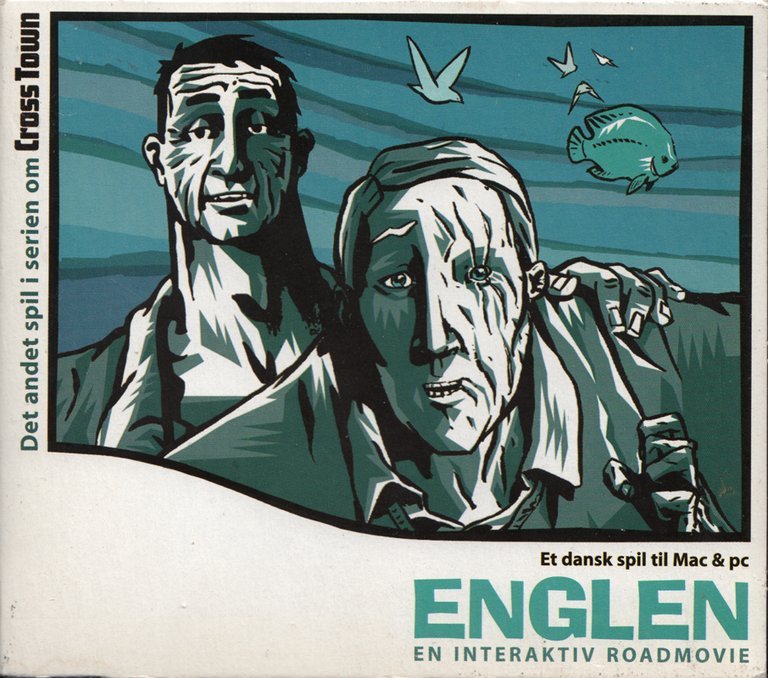
Description
CrossTown: Englen is a 1999 fantasy graphic adventure game and the second entry in the CrossTown series. Players control an angel who can travel between three distinct planes: the heavenly world of angels, the physical Earth, and the delusional realm of a mentally ill patient. The narrative centers on this angel’s mission to help a male nurse and his patient achieve mutual understanding and resolve their personal conflicts through point-and-click exploration and puzzle-solving.
CrossTown: Englen: A Forgotten Angel’s Journey Through Mental Illness and the Fragility of Connection
Introduction: The Whisper of a Fallen Series
In the vast, digitized archives of gaming history, certain titles exist not as celebrated landmarks but as delicate whispers—games that flickered briefly before being swallowed by the relentless tide of commercial and critical discourse. CrossTown: Englen (Swedish: CrossTown: Ängeln, 1999) is one such whisper. As the second and final entry in the CrossTown series from Swedish publisher Vision Park AB and Danish developer Deadline Multimedia ApS, it represents a profound and deeply personal narrative experiment that dared to merge metaphysicalfantasy with the gritty, sensitive reality of mental healthcare. Its premise—an angel mediating between a male nurse and a mentally ill patient across three planes of existence—is not merely a gameplay mechanic but a poetic framework for exploring empathy, communication, and the architectures of the mind. This review posits that Englen is a significant, if commercially and critically neglected, artifact of the late-1990s graphic adventure renaissance. It is a game that prioritized thematic depth and a unique tripartite world structure over conventional puzzle design, creating an experience that is less about “solving” and more about witnessing and bridging. Its legacy is one of ambitious, humane storytelling that was, perhaps, too subtle and introspective for its time, leaving behind a touching monument to a vision unfulfilled.
Development History & Context: Nordic Ambition in a CD-ROM Era
CrossTown: Englen emerged from a specific European development context often overshadowed by the dominant narratives of North American and Japanese game creation. Deadline Multimedia ApS, based in Denmark, was part of a vibrant Scandinavian scene that produced idiosyncratic, often narrative-driven titles for the burgeoning CD-ROM market. The year 1999 was a pivot point: 3D acceleration was becoming standard (with games like Half-Life and Unreal Tournament defining the FPS genre), but the graphic adventure, a direct descendant of the interactive movie and point-and-click eras, was寻找ing its place. It was a time of experimentation—Grim Fandango had redefined noir, The Longest Journey had blended fantasy and sci-fi with unprecedented scope, and smaller studios were using the increased storage of CD-ROMs to explore more mature, personal stories.
The CrossTown series itself began with CrossTown: Giften (“The Poison”) in 1998. The continuity is clear: both games center on a protagonist navigating between realities to resolve a profound human crisis. Giften dealt with a poisoning, while Englen (The Angel) tackles mental illness. This progression shows a studio iterating on a core narrative mechanic—the “cross-town” travel—to address increasingly complex psychological themes. Vision Park AB, the publisher, specialized in bringing Nordic and European titles to market, often with a focus on narrative and educational ambitions.
Technologically, the game was built for Windows and Macintosh, utilizing the standard “point-and-select” interface of the era. Its “3rd-person (Other)” perspective suggests a pre-rendered or fixed-camera view of environments, a common cost-saving and stylistic choice for adventure games not embracing full 3D. The constraint of the CD-ROM medium (noted in specs) meant FMV sequences, high-resolution static backgrounds, and possibly voice acting in Swedish or with subtitles—a barrier to wider international reception. The development likely faced the classic indie challenges of the time: limited marketing budgets, the struggle for shelf space against blockbuster titles, and the difficulty of localizing a culturally specific story about mental health for a global audience. Its status as the “last” game in the series implies it did not achieve the commercial success necessary to justify a sequel, a common fate for ambitious, niche adventures.
Narrative & Thematic Deep Dive: The Angel in the Mind
The narrative of CrossTown: Englen is its most profoundly original element. We must dissect its core triad of worlds:
1. The Heavenly World of Angels: This is the protagonist’s origin—a realm of order, peace, and presumably, detached observation. The angel is not a warrior but a celestial social worker, a guide.
2. The Physical World: This is the tangible, external reality where the male nurse (a sjukvårdare) performs his duties in a clinical or institutional setting. It is the world of medicine, routines, and social protocols.
3. The World of Delusions: This is the patient’s internal landscape—a surreal, symbolic, and frightening manifestation of their psychosis. It is not a “dream world” but a lived reality for the patient, populated by their fears, obsessions, and fragmented memories.
The plot’s engine is the angel’s mission: to “help the nurse and patient to understand each other and move on from their problems.” This is a radical departure from typical adventure game MacGuffins (find the treasure, stop the villain). Here, the “problem” is a fundamental breakdown in human connection caused by mental illness. The patient’s delusions create an impenetrable wall; the nurse, bound by professional distance and perhaps fear or frustration, cannot reach them. The angel operates as a literal and metaphorical bridge.
Characters as Archetypes of Care:
* The Angel: The player’s avatar is an interesting inversion of power fantasy. They possess the ability to traverse realities, but their power is purely communicative and empathetic. Their “combat” is not with monsters but with metaphors, with the logic of delusion. Their goal is understanding, not conquest.
* The Male Nurse: He represents the institutional, rational approach to mental health—well-meaning but potentially limited by his training and the structures around him. His arc is about learning to see the person, not just the symptoms, through the lens of the patient’s own world.
* The Mentally Ill Patient: They are the silent core of the narrative. Their delusional world is their truth. The game, through the angel’s eyes, invites the player to experience the logic, beauty, and terror of that world without judgment. The patient’s “problems” are the fractured narratives we must help synthesize.
Themes in Extreme Detail:
* Empathy as a Superpower: The central thesis is that true empathy requires entering another’s subjective reality. The angel’s tri-world travel is the ultimate metaphor for the psychotherapeutic act of “walking a mile in someone’s shoes,” even if those shoes exist on a plane of fantasy.
* The Architecture of the Mind: The “world of delusions” is likely depicted as a fragmented, non-Euclidean space where symbols replace objects. Solving “puzzles” here might involve reconciling contradictory symbols or finding the emotional core of a nightmare scenario. It’s a literalization of Jungian or Freudian imagery.
* Institutional vs. Personal Care: The tension between the nurse’s clinical world (rules, charts, medication) and the patient’s inner world (chaos, meaning, symbolism) critiques a purely biomedical model of mental health. The solution lies in the narrative integration of the two.
* Spiritual vs. Scientific: The angel introduces a spiritual, metaphysical dimension to a situation typically framed in scientific/psychological terms. The game may be exploring whether some wounds require a “soul-level” healing that medicine alone cannot provide.
The dialogue and writing (not available in sources but inferable from the premise) would be the game’s lifeblood. Conversations in the physical world would be stilted, professional. Interactions in the delusional world would be poetic, oblique, heavy with subtext. The angel’s role is to translate between these two dialects of human experience.
Gameplay Mechanics & Systems: The Bridge Builder’s Toolkit
Given the described “Graphic adventure” and “Puzzle elements” with a “Point and select” interface, the core gameplay loop is investigative and connective.
- The Tri-World Navigation System: This is the game’s flagship