
- Release Year: 1995
- Platforms: Arcade, PlayStation, SEGA Saturn, Windows
- Publisher: Konami Co., Ltd., Konami of America, Inc.
- Developer: Konami Co., Ltd., Konami Computer Entertainment Tokyo Co., Ltd.
- Genre: Action, Light gun shooter
- Perspective: First-person
- Game Mode: Co-op, Single-player
- Gameplay: Boss fights, Branching paths, Direct control, Rail shooter, Smartbombs
- Setting: Contemporary
- Average Score: 80/100
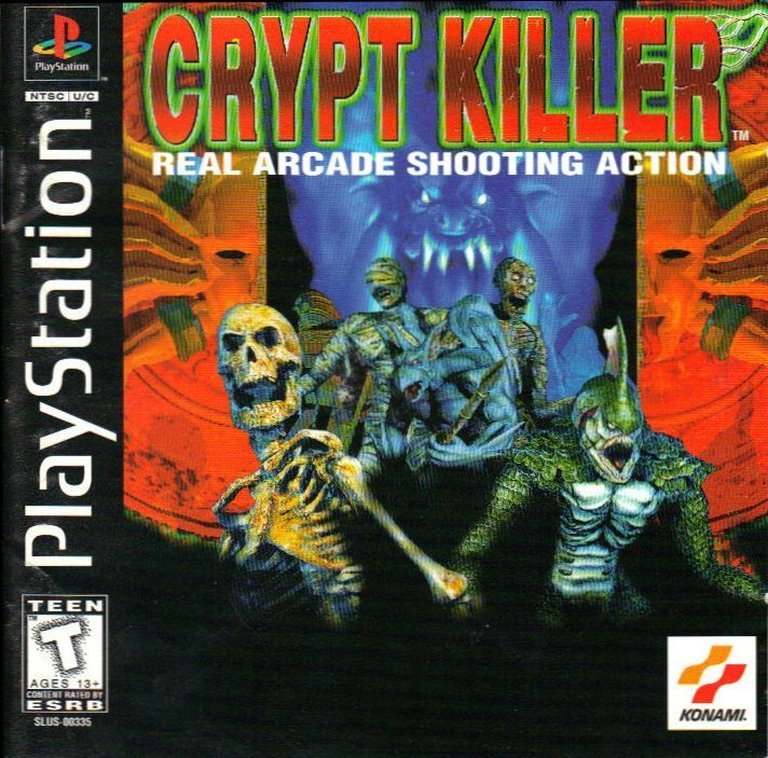
Description
Crypt Killer is a horror-themed lightgun shooter where players take on the role of an adventurer searching for the legendary ‘Eyes of Guidance’ ancient crystals, battling through six non-linear stages filled with monsters like skeletons, zombies, and demons across diverse environments including dark forests, crypts, and underwater labyrinths, using weapons such as shotguns and grenade throwers while navigating predetermined paths, avoiding enemy projectiles, and confronting boss enemies at the end of each stage.
Gameplay Videos
Crypt Killer Free Download
Crypt Killer Patches & Updates
Crypt Killer Reviews & Reception
imdb.com (70/100): I think this game was unfairly treated at the time. The game is fun, but very tough and a total coin guzzler.
imdb.com (90/100): It’s a monster shooting, treasure hunting good time worth your time.
retroarcadememories.wordpress.com : Crypt Killer is not a refined or essential arcade classic, but it is a loud, messy, often daft reminder of when developers took more risks with their cabinet shooters.
Crypt Killer: Review
Introduction
In the saturated mid-1990s arcade landscape, where Virtua Cop redefined polygonal precision and Time Crisis loomed on the horizon, Konami’s Crypt Killer emerged as a defiantly chaotic outlier. Released in 1995 as a horror-themed light gun shooter, it promised a descent into gothic nightmares, armed with shotguns and haunted by skeletal hordes. Yet, its legacy is one of bewildering contradictions: a game lauded for its imaginative monster designs and branching paths, yet reviled for its pixelated visuals and punishing difficulty. As a product of Konami’s experimental phase—sandwiched between Lethal Enforcers and the polished polish of the Silent Hill era—Crypt Killer remains a fascinating, if flawed, artifact. This review deconstructs its origins, dissect its ambitions, and evaluates its enduring place in the pantheon of rail shooters, arguing that beneath its jarring surface lies a uniquely earnest attempt to fuse horror and adventure in an age of escalating technical competition.
Development History & Context
Conceived by Konami Computer Entertainment Tokyo under director Kuniaki Kakuwa, Crypt Killer (titled Henry Explorers in Japan) emerged from the studio’s legacy in light gun shooters, following the success of Lethal Enforcers. Its vision was ambitious: a three-player cooperative arcade experience where players, as “crypt raiders,” would navigate 3D polygonal environments teeming with mythological beasts. The game ran on Konami’s proprietary GQ System hardware—a 32-bit arcade platform derived from PlayStation technology—enabling dynamic enemy AI and seamless co-op play. However, the team faced significant constraints. To optimize performance, they combined 3D backgrounds with 2D sprites for enemies, a compromise that would later haunt its console ports.
The 1995 arcade market was dominated by Sega’s Virtua Cop (1994), which had set new standards for graphical fidelity and immersion. Konami’s bid to compete was unorthodox: where Virtua Cop offered sleek, militarized action, Crypt Killer leaned into grotesque, Ray Harryhausen-inspired monsters and a campy adventurer motif. This choice reflected a broader industry trend—developers scrambling to differentiate their shooters through thematic quirks. Yet, as Next Generation noted in its 1995 review, the game’s “free-moving, hand-held sawed-off shotgun” was its sole standout feature, otherwise “blend[ing] in quite well with the pile of new laser-gun shooters with little distinction.” The arcade version’s three-player support was a technical feat, but its core design—focused on chaotic monster waves over strategic depth—positioned it as a “quintessential rapid-fire, skill-less, anxiety-packed shooting game,” per Next Generation.
Narrative & Thematic Deep Dive
The plot of Crypt Killer is a tapestry of B-movie tropes wrapped in occult mysticism. Players assume the role of unnamed adventurers guided by Galazon, a floating disembodied head serving as an exposition fairy. Their quest: to recover the “Eyes of Guidance,” ancient crystals that unlock the “Door of Fate” and promise untold treasure. This framework is deliberately skeletal, serving as a vehicle for set pieces rather than deep storytelling.
The narrative unfolds across six stages—from haunted forests and underwater labyrinths to volcanic infernos—each populated by archetypal horror foes: mummies that attack with Cloth Fu-style bandage slaps, skeletons that hurl swords, and fish-men brandishing tridents. These enemies are less characters than obstacles, their designs cribbed from Ray Harryhausen’s stop-motion oeuvre (e.g., the multi-armed Hindu god statue, the Hydra). The dialogue is minimal, with Galazon’s gravel-voiced pronouncements (“Choose your path wisely!”) punctuating the action.
The game’s most intriguing narrative feature is its system of multiple endings, determined by the colors of the Eyes collected (red or blue, chosen via path splits). This creates a meta-narrative layer:
– Normal Ending: Blue eye + red eye—treasure is found, but a skeleton’s taunt hints at deception.
– Legendary Sword Ending: Red eye + blue eye—the player gains a mythic weapon, implying cyclical adventure.
– Bad Ending: Two red eyes—fake treasure leads to an ambush by all defeated bosses.
– Behind-the-Scenes Ending: Two blue eyes—the “horror” is revealed as a film set, with monsters as stuntmen.
This self-awareness underscores the game’s tonal schizophrenia: it embraces horror tropes while winking at their absurdity, culminating in a Hollywood parody that questions the nature of the player’s quest. Yet, this thematic depth is undercut by repetitive gameplay, reducing the narrative to a series of disconnected boss encounters rather than a cohesive journey.
Gameplay Mechanics & Systems
At its core, Crypt Killer is a rail shooter with deceptively simple mechanics. Players progress through on-rails paths, aiming with a light gun to dispatch waves of enemies. The arcade version’s pump-action shotgun—requiring off-screen reloads—added tactile satisfaction, but console ports replaced this with standard auto-fire, diminishing the experience.
The gameplay loop emphasizes chaos over precision:
– Combat: A relentless barrage of skeletons, zombies, and gargoyles attack in swarms, often throwing projectiles (knives, bones). Success hinges on pattern recognition, but poor hit detection and cheap hits (e.g., off-screen attacks) frustrate.
– Weapon Upgrades: Temporary power-ups like the Gatling gun or grenade launcher offer fleeting moments of catharsis, but their limited use and obscure placement encourage trial-and-error gameplay.
– Smart Bombs: Three per life in console versions, these screen-clearing tools are essential for survival during overwhelming waves but feel like a band-aid for systemic imbalance.
– Branching Paths: After certain acts, players choose between two routes, altering stage sequences and influencing ending outcomes. This grants replayability but little meaningful variation in enemy design.
Bosses—such as Medusa, the Hydra, and a Pharaoh head—anchor each stage but suffer from clumsy hitboxes and drawn-out fights. The Saturn and PlayStation ports exacerbated these issues, with sluggish controls (when using a standard pad) and nauseating camera shifts during player character acrobatics, as noted by Sega Saturn Magazine, which quipped that more fun could be derived from “pistol whipping yourself with the Virtua Gun.” Ultimately, the gameplay prioritizes spectacle over skill, making it a coin-guzzler in arcades but a frustrating experience at home.
World-Building, Art & Sound
Crypt Killer’s world-building is a pastiche of horror clichés, unified by a pervasive sense of decay. The six stages—from a gargoyle-infested forest to a pyramid bristling with hieroglyphs—are rendered in murky, low-resolution polygons, their textures smudged and repetitive. Environments feel less like cohesive spaces than shooting galleries, with sparse details failing to immerse.
The art direction prioritizes grotesquery over elegance. Enemies are 2D sprites with stiff animations, their death effects reduced to pixelated explosions. Mummies unravel into ribbons, fish-men gurgle before dissolving—effects that are laughably basic by 1995 standards. This visual clash between 3D backgrounds and 2D sprites creates a disorienting “cardboard cutout” effect, as Retro Arcade Memories noted, where monsters “pasted in” like attractions at a ghost train.
Sound design fares better. Yuji Takenouchi and Mutsuhiko Izumi’s soundtrack blends eerie synth melodies with tribal rhythms, evoking a sense of dread amid the chaos. Sound effects—shotgun blasts, monster roars—are crisp, though the Hydra’s Godzilla-like roar feels jarringly out of place. Galazon’s voice acting, however, is tonally inconsistent, his gravelly pronouncements undercut by campy inflections that undercut the horror. Overall, the art and sound fail to sustain atmosphere, reducing the game’s gothic aspirations to a cacophony of pixelated sprites and silly screams.
Reception & Legacy
Upon its 1995 arcade debut, Crypt Killer received lukewarm praise. Next Generation highlighted its “ambitious” monster cavalcade but dismissed it as generic. The 1997 console ports, however, were a critical disaster. Aggregating reviews from MobyGames and GameRankings reveals an average score of 49% for the arcade version, plummeting to 46% for PlayStation and 52% for Saturn. Critics eviscerated the ports:
– Graphics: “Heavily pixelated and blocky” (Electronic Gaming Monthly), with enemies resembling “a mush of tiles” (Edge).
– Controls: “Imprecise” and “sluggish” without light guns, compounded by “nauseating” camera movements (Sega Saturn Magazine).
– Difficulty: Cheap hits and sparse continues made it “punishing” and “unforgivable” for a Konami title (GameSpot).
Commercially, the game floored. Its arcade run was moderate, but home ports—released amid Time Crisis and Virtua Cop 2—were commercial failures. Today, it commands cult status among retro gamers, prized for its rarity and chaotic energy. Its legacy is one of curiosity: celebrated for branching paths and Harryhausen-esque bosses but remembered as a technical laggard. Notably, it received a runner-up in Electronic Gaming Monthly’s 1998 “Light Gun Game of the Year” (Readers’ Choice), a nod to its niche appeal.
Conclusion
Crypt Killer is a product of its time: a chaotic, unpolished experiment that embodies the mid-’90s arcade industry’s scramble for innovation. Its strengths—imaginative monster designs, co-op thrills, and multiple endings—offer fleeting moments of joy, overshadowed by technical flaws and inconsistent tone. As a horror game, it fails to unsettle, trading genuine dread for camp; as a shooter, it lacks the precision of Virtua Cop or the polish of The House of the Dead. Yet, its flaws are inseparable from its charm. It is a game that “raided the dressing up box, downed a pint, and decided to throw every mythological monster onto the screen,” as Retro Arcade Memories aptly put it.
Ultimately, Crypt Killer is not an essential classic but a vital historical document. It represents Konami’s willingness to take risks, blending genres and themes in a way that feels both earnest and absurd. For collectors and arcade historians, it remains a crypt worth cracking open—for others, it’s a reminder of an era when shooters prioritized spectacle over sophistication. Verdict: A flawed, fascinating footnote in light gun history, best approached with low expectations and a sense of humor.