
- Release Year: 2012
- Platforms: PlayStation 3, Windows
- Publisher: Electronic Arts, Inc.
- Genre: Compilation
- Average Score: 81/100
Description
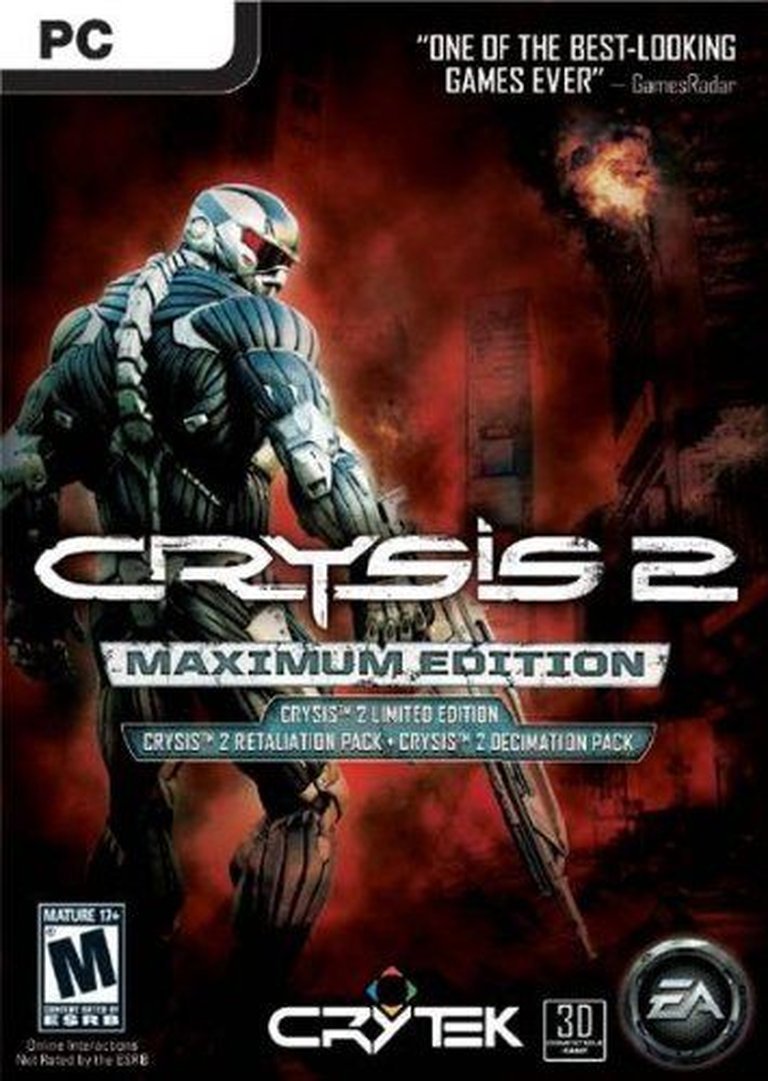
Crysis 2: Maximum Edition is a first-person shooter set in a chaotic 2023 New York City devastated by an alien invasion and a deadly viral outbreak. Players assume the role of Alcatraz, a Marine equipped with the advanced Nanosuit 2.0, battling both the extraterrestrial Ceph forces and hostile CELL operatives. This edition includes the base game, Crysis 2 (Limited Edition), along with additional downloadable content like the Decimation Pack and Retaliation Pack, expanding the game’s weapons, customization, and multiplayer options.
Gameplay Videos
Where to Buy Crysis 2: Maximum Edition
PC
Crysis 2: Maximum Edition Free Download
Crysis 2: Maximum Edition Cracks & Fixes
Crysis 2: Maximum Edition Patches & Updates
Crysis 2: Maximum Edition Mods
Crysis 2: Maximum Edition Guides & Walkthroughs
Crysis 2: Maximum Edition Reviews & Reception
steambase.io (93/100): Very Positive rating based on player feedback on Steam.
metacritic.com (69/100): It’s a good shooter, sometimes a pretty fun one.
gamefaqs.gamespot.com (80/100): Crysis 2 offers more freedom than the whole Call of Duty series combined.
raijin.gg (85/100): A nearly unanimous player consensus.
Crysis 2: Maximum Edition Cheats & Codes
PC
Open the cheat console window by pressing ~ (or the key above Tab), then enter con_restricted 0 and hit Enter. Now you can enter the following cheats:
| Code | Effect |
|---|---|
| g_godMode = 1 | God mode |
| g_infiniteAmmo = 1 | Unlimited ammo |
| i_unlimitedammo = 1 | Unlimited ammo |
| g_infinitesuitenergy=1 | Unlimited Suit Energy |
Crysis 2: Maximum Edition: A Technological Marvel and Divergent Sequel
Introduction
When Crysis 2 stormed onto the scene in 2011, it bore the weight of a legacy defined by its predecessor’s infamous tagline: “Can it run Crysis?” Developed by Crytek, the sequel traded the open-ended jungles of the original for the claustrophobic ruins of a war-torn New York City, signaling a bold evolution in both scope and technical ambition. The Maximum Edition, released in 2012, bundled the base game with the Decimation and Retaliation multiplayer DLC packs, cementing its status as a definitive package. This review argues that while Crysis 2 leverages groundbreaking technology and refined mechanics to deliver a visually stunning FPS experience, its narrative and structural compromises reveal a franchise caught between innovation and mainstream appeal—a tension that reshaped its legacy in gaming history.
Development History & Context
Studio Vision and Technological Ambition
Crytek’s development of Crysis 2 marked a strategic pivot. After the original Crysis (2007) became synonymous with PC hardware “benchmark” culture, the studio sought broader accessibility by optimizing their new CryEngine 3 for consoles (PlayStation 3, Xbox 360) without sacrificing visual fidelity. Director Cevat Yerli’s team aimed to create “a living, breathing city that reacts to alien occupation” (Crysis Wiki)—a technical challenge requiring dynamic destruction, advanced AI, and realistic lighting. The shift from rural to urban environments reflected a desire to balance Crysis’ sandbox DNA with the cinematic pacing of contemporaries like Call of Duty.
The Leaked Beta and Piracy Controversy
A January 2011 developer build leaked weeks before launch, exposing unfinished textures and bugs, which Crytek called “a traumatic experience” (Wikipedia). While the incident highlighted piracy’s threat to PC gaming, it paradoxically fueled anticipation for the polished final product. The Maximum Edition later addressed this legacy by integrating post-launch fixes, including high-resolution textures and DirectX 11 support via Patch 1.9 (Steam Reviews).
A Changing FPS Landscape
Crysis 2 arrived amid a crowded market dominated by military shooters. Its focus on verticality (“skyscraper-to-skyscraper combat”) and the Nanosuit 2.0’s abilities sought to differentiate it, but Crytek’s concessions—like streamlining the suit’s four modes into two core functions (Cloak, Armor)—sparked debates about “dumbing down” for consoles (Alchetron).
Narrative & Thematic Deep Dive
Plot and Characters: A Fractured Identity
Set in 2023, Crysis 2 follows Force Recon Marine Alcatraz, who inherits the Nanosuit 2.0 from Prophet (returning from the first game) to combat a Ceph alien invasion and the bioweapon-fueled “Manhattan Virus.” The narrative, penned by sci-fi author Richard Morgan (Altered Carbon), grapples with transhumanism and corporate militarism. Crynet’s shadowy CEO Jacob Hargreave and scientist Nathan Gould embody themes of technological hubris, while the Nanosuit itself becomes a character—slowly overwriting Alcatraz’s consciousness with Prophet’s memories.
Themes: Assimilation and Control
The game interrogates identity erosion through the Nanosuit’s symbiosis with Alcatraz, culminating in the protagonist’s iconic line: “They call me Prophet”—a poignant metaphor for losing oneself to technology (Crysis Wiki). Meanwhile, the private military CELL represents unchecked privatization of warfare, echoing real-world PMC controversies. However, critics noted underdeveloped characters and a convoluted plot, with GameZone calling the story “weaker compared to the original” (Metacritic).
Dialogue and Pacing
While the script delivers punchy one-liners (“Adapt or perish!”), supporting roles like Tara Strickland (daughter of Crysis’ Major Strickland) lack depth. Pacing falters in later acts, as linear set-pieces overshadow earlier environmental storytelling.
Gameplay Mechanics & Systems
The Nanosuit 2.0: Iterative Mastery
The Nanosuit remains Crysis 2’s defining feature. Crytek condensed its predecessor’s strength/speed/jump functions into context-sensitive actions (e.g., sprinting auto-triggers Speed Mode). Players customize loadouts via modules like “Air Stomp” (aerial melee) and “Tactical Mode” (enemy tagging), creating hybrid stealth/tank playstyles. Energy management adds tension, rewarding hit-and-run tactics against bullet-sponge Ceph (Niklas Notes).
Combat Sandbox: Freedom Within Limits
Levels like “Central Park” encourage creative problem-solving: snipe enemies from rooftops, cloak past patrols, or trigger environmental hazards. Yet compared to Crysis’ open islands, NYC’s segmented zones (e.g., flooded subway tunnels) feel restrictive. Enemy AI is inconsistent—CELl troops flank players intelligently, while Ceph drones exhibit predictable patterns (GameFAQs).
Multiplayer and DLC: Lost Potential
The Maximum Edition includes nine DLC maps, like the claustrophobic “Chasm,” and modes such as “Crash Site” (pod defense). While progression systems and customizable classes drew praise, multiplayer’s 2014 shutdown (via GameSpy’s closure) left a fragmented legacy. The mode’s absence in the 2021 Remastered edition underscores its missed longevity.
UI and Progression
A minimalist HUD adapts to suit modes (e.g., blue tinge for Armor), enhancing immersion. The radial weapon-customization menu allows real-time attachment swaps (silencers, scopes), rewarding experimentation.
World-Building, Art & Sound
Visual Design: NYC as a Character
CryEngine 3’s prowess shines in dystopian vistas: crumbling skyscrapers draped in algae, ash-choked skies, and dynamic lighting that paints firefights in chiaroscuro. The “urban jungle” juxtaposes nature’s reclamation (vines engulfing Times Square) with alien biomechanical horror—a stark contrast to Crysis’ tropical palette (Raijin.gg). Water effects remain unparalleled, from tsunami waves to irradiated puddles reflecting warped skylines.
Sound Design and Score
Hans Zimmer and Lorne Balfe’s orchestral score blends haunting choirs with pulsating electronic beats, elevating key moments like the “Nanosuit Theme.” Diegetic sounds—alien screeches, distant gunfire—create oppressive ambience. However, weapon audio lacks punch compared to contemporaries like Battlefield 3 (Steam Reviews).
Atmosphere and Environmental Storytelling
Abandoned subway stations littered with corpses and CELL propaganda (“Report Nanosuit Sightings”) sell the pandemic’s toll. Yet linear paths undercut immersion; players rarely linger to absorb details.
Reception & Legacy
Critical and Commercial Performance
Crysis 2 earned acclaim for visuals and gameplay (Metacritic: 86/100 PC, 84/100 Xbox 360), though critiques targeted its linearity and AI. It sold over 3 million copies but underperformed against EA’s expectations (Wikipedia). The Maximum Edition’s 2012 re-release bolstered sales but couldn’t revive defunct multiplayer.
Industry Influence
The game’s rendering techniques—tessellation, parallax occlusion mapping—became industry benchmarks, inspiring titles like Battlefield 4 and Cyberpunk 2077. Its approach to urban sandbox design influenced Dying Light’s verticality and The Division’s ruined NYC.
Modern Reappraisal
While lauded as a technical milestone, retrospectives frame Crysis 2 as a “transitional” entry (VaporLens). 2021’s Remastered edition amplified its strengths but couldn’t mask dated design quirks. The franchise’s identity crisis—open-world pioneer vs. cinematic blockbuster—peaked here.
Conclusion
Crysis 2: Maximum Edition stands as a paradox: a technical tour de force that sacrificed part of its soul for broader appeal. Its Nanosuit mechanics and CryEngine 3 innovations remain influential, and its dystopian NYC is unforgettable. Yet conservative level design and narrative stumbles prevent it from eclipsing its predecessor. For better or worse, Crysis 2 redefined what a AAA FPS could achieve graphically while foreshadowing the homogenization of big-budget gaming. It is not Crytek’s magnum opus—but as a snapshot of early 2010s ambition, it remains indispensable.