
- Release Year: 2009
- Platforms: Windows
- Publisher: Electronic Arts, Inc.
- Developer: Crytek
- Genre: Compilation
- Perspective: First-person
- Game Mode: LAN, Online PVP, Single-player
- Average Score: 87/100
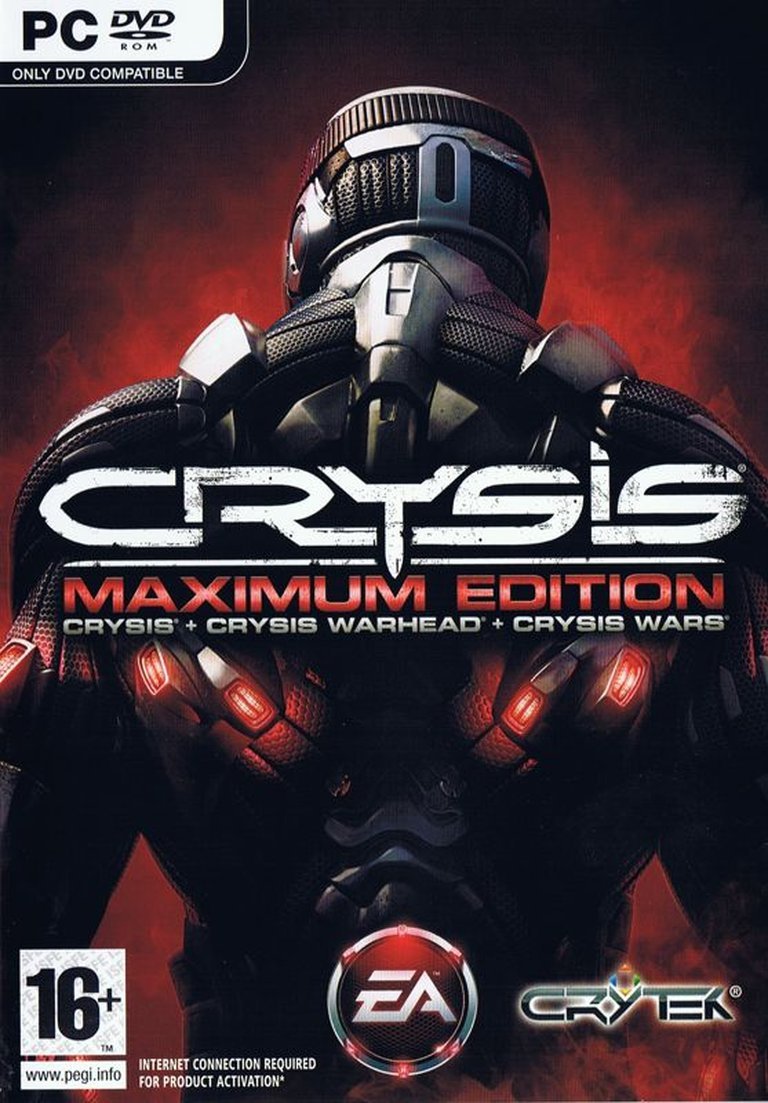
Description
Crysis: Maximum Edition is a compilation that includes the base game Crysis and its standalone expansion Crysis: Warhead, set in a future where a U.S. Army Delta Force soldier, Nomad, discovers an ancient alien structure on the Lingshan Islands. Players engage in intense first-person shooter action against both North Korean and extraterrestrial foes, utilizing advanced weapons and a futuristic Nanosuit. The game is renowned for its groundbreaking graphics and challenging gameplay, making it a benchmark for high-performance gaming PCs.
Where to Buy Crysis: Maximum Edition
PC
Crysis: Maximum Edition Free Download
Crysis: Maximum Edition Cracks & Fixes
Crysis: Maximum Edition Mods
Crysis: Maximum Edition Reviews & Reception
mobygames.com (93/100): Average score: 93% (based on 1 ratings)
vgchartz.com (81/100): Avg Community Rating: 8.1
Crysis: Maximum Edition Cheats & Codes
PC
Add these codes to the bottom of the game’s .cfg files (e.g., diff_easy.cfg, diff_normal.cfg) or enter them in the console after unlocking it with ‘con_restricted = 0’.
| Code | Effect |
|---|---|
| g_godMode = 1 | God Mode |
| i_unlimitedammo = 1 | Unlimited Ammunition |
| ai_IgnorePlayer = 1 | Enemies Ignore You |
| i_noweaponlimit = 1 | Carry Unlimited Weapons |
| v_goliathmode = [0 or 1] | Toggle vehicle invincibility |
| g_suitSpeedEnergyConsumption = [number] | Set Energy Consumed While Sprinting |
| g_meleeWhileSprinting = [0 or 1] | Toggle melee attacks while sprinting |
| g_playerSuitEnergyRechargeDelay = 0 | Immediate Energy Regen |
| g_playerHealthValue = 900.0 | Extra Health |
| pl_fallDamage_SpeedFatal = [number] | Set Fall Speed at Which You Die |
| time_scale = [number] | Set Speed of Time In-Game |
| pl_swimBaseSpeed = [number] | Set How Fast You Can Swim |
| g_suitarmorhealthvalue = [number] | Set How Much Damage Armor Mode Energy Shields Take |
| pl_swimJumpSpeedBaseMul = [number] | Set How Quickly You can Jump Out of the Water |
| g_playerSuitEnergyRechargeTimeArmor = 0 | Instant Energy |
| g_playerSuitEnergyRechargeTimeArmorMoving = 0 | Instant Energy While Moving |
| g_playerSuitArmorModeHealthRegenTime = 0 | Instant Health Regen |
| g_playerSuitArmorModeHealthRegenTimeMoving = 0 | Instant Health Regen While Moving |
| pl_fallDamage_SpeedSafe = [number] | Maximum Speed at Which You Take No Damage |
| g_suitSpeedMult = [number] | Multiply Movement Speed in Speed Mode |
| g_suitCloakEnergyDrainAdjuster = [number] | Multiply Energy Consumption of Cloaking |
| g_suitRecoilEnergyCost = [number] | Multiply Energy Consumption of Each Shot Fired in Strength Mode |
| cl_strengthscale = [number] | Multiply Punch Strength |
| g_walkmultiplier = [number] | Multiply Player Movement Speed |
| g_playerSuitHealthRegenDelay = 0 | No Waiting Until Regen Starts |
| g_difficultyLevel = [number] | Set Difficulty (1-4, 4 is hardest) |
| g_playerSuitEnergyRechargeTime = 0 | Set Energy Regen Time to Zero |
| g_playerSuitHealthRegenTime = 0 | Set Health Regen Time to Zero |
| g_playerSuitHealthRegenTimeMoving = 0 | Set Regen Time While Walking to Zero |
| r_displayinfo = [0 or 1] | Toggle frame rate display |
| ai_UseAlternativeReadability = 0 | Koreans Speak Korean |
| i_giveitem |
Spawn indicated item |
Crysis: Maximum Edition: Review
Introduction
In 2007, Crytek unleashed Crysis, a game so technically ambitious that it spawned the infamous meme: “But can it run Crysis?” By 2009, the Crysis: Maximum Edition compilation bundled this landmark title with its standalone expansion Crysis: Warhead and the multiplayer-focused Crysis Wars, cementing its legacy as a defining moment in PC gaming history. This collection isn’t just a time capsule of Crytek’s audacious vision—it’s a testament to how far the boundaries of interactive storytelling, systemic gameplay, and visual fidelity could be pushed. This review dissects Maximum Edition’s triumphs, flaws, and enduring influence, arguing that while its technological prowess remains legendary, its true brilliance lies in its marriage of open-ended combat and atmospheric world-building.
Development History & Context
Studio and Vision: Founded in 1999, Crytek sought to revolutionize gaming with its proprietary CryEngine, building on the success of Far Cry (2004). With Crysis, the studio aimed to create a “next-generation shooter” that emphasized player freedom, photorealistic environments, and emergent gameplay. Director Cevat Yerli envisioned a title that would “set a new standard for quality in downloadable gaming,” though its ambition came at a cost: Crysis notoriously demanded cutting-edge hardware, with even high-end PCs struggling to run it at max settings upon release.
Technological Constraints and Innovations: Built on CryEngine 2, Crysis leveraged DirectX 10 for advanced effects like volumetric lighting, destructible environments, and dynamic physics. The engine’s complexity—boasting over 1 million lines of code and 85,000 shaders—made it a benchmark for PC performance for years. Warhead (2008) refined the tech, optimizing performance while introducing new AI behaviors and vehicular combat.
Gaming Landscape: Released amidst the rise of console-centric franchises like Halo 3 and Call of Duty 4, Crysis doubled down on PC exclusivity, appealing to enthusiasts hungry for technical showcases. Its 2009 re-release as Maximum Edition arrived as the industry began shifting toward multiplatform development, marking the end of an era for PC-first AAA experiments.
Narrative & Thematic Deep Dive
Plot and Characters: Set in 2020, Crysis follows Nomad, a Delta Force operative clad in a nanosuit, as he battles North Korean forces and an ancient alien threat on the Lingshan Islands. The story blends military sci-fi tropes with existential dread—the Ceph aliens, dormant for millions of years, represent an unknowable, biomechanical menace. Warhead shifts focus to Sergeant Psycho, offering a parallel narrative that deepens the lore while emphasizing dark humor and frenetic action.
Themes: At its core, Crysis explores humanity’s hubris. The nanosuit—a metaphor for transhumanism—grants godlike power but isolates its wearers, as seen in Prophet’s descent into obsession. The Ceph, meanwhile, symbolize nature’s retaliation against militaristic exploitation, their icy bioweapon literally freezing human progress. The dialogue is utilitarian, prioritizing military jargon over character development, but this sterility reinforces the game’s bleak tone.
Criticisms: The plot falters in its third act, devolving into a linear alien shootout that abandons the sandbox ethos of earlier levels. Yet, Warhead’s tighter pacing and Psycho’s charismatic voice acting compensate, making the anthology structure of Maximum Edition a strength.
Gameplay Mechanics & Systems
Nanosuit Dynamics: The nanosuit’s four modes—Armor, Strength, Speed, and Cloak—enable staggering flexibility. Players can punch jeeps into enemies, sprint-flank squads, or snipe from invisible vantage points, all while managing a finite energy pool. This system rewards creativity: a 2008 GameSpot review praised how it “lets us tackle challenges in whatever way we wished.”
Combat and AI: Enemy soldiers react dynamically, calling reinforcements via flare guns and flanking players who overcommit. The Ceph escalate the threat with zero-gravity skirmishes and towering exosuits, though their AI is less nuanced. Warhead sharpens these systems, introducing drivable tanks and MOAC guns that freeze foes.
Multiplayer: Crysis Wars offers 32-player battles across 21 maps, blending infantry combat with vehicular mayhem. While overshadowed by contemporaries like Battlefield, its “Power Struggle” mode—where teams vie for resource points to build nuclear weapons—remains a cult favorite.
Flaws: The UI feels dated, with clunky weapon customization menus, and later levels prioritize spectacle over player agency. Yet, these missteps are minor in light of the overall innovation.
World-Building, Art & Sound
Visual Design: From sun-dappled jungles to the crystalline alien hive, Crysis’ environments are breathtaking. Destructible shacks, swaying foliage, and dynamic weather create a living world—a PC Gamer review (2007) hailed it as “the most advanced graphics engine ever created.” Warhead expands this palette with frozen tundras and volcanic tunnels, though the art direction leans on photorealism over stylistic flair.
Sound Design: Inon Zur’s score oscillates between haunting ambience and militaristic drums, while weapon sounds—from the FY71’s metallic ping to the MOAC’s icy crack—ground the action. The Ceph’s insectoid clicks and rumbling footfalls amplify their otherworldliness.
Atmosphere: The game’s quiet moments—stalking KPA patrols at dusk or diving into coral reefs—are as memorable as its firefights. This juxtaposition of serenity and chaos epitomizes Crysis’ immersive power.
Reception & Legacy
Critical Reception: The original Crysis holds a 91/100 on Metacritic, praised for its graphics and emergent gameplay. Warhead (84/100) earned nods for improved pacing, while Crysis Wars was dubbed a “solid multiplayer companion” by IGN. The Maximum Edition compilation itself scored 93% from Germany’s GameStar, though broader critical coverage was sparse.
Commercial Impact: Despite piracy concerns, the franchise sold over 4.5 million copies by 2010. Its influence echoes in titles like Destiny (nanosuit-like abilities) and Far Cry’s open-ended design.
Cultural Legacy: The “Can it run Crysis?” meme endures, symbolizing PC gaming’s obsession with performance. The 2020 Remastered trilogy reintroduced the series to new audiences, but Maximum Edition remains the purist’s choice for its unaltered vision.
Conclusion
Crysis: Maximum Edition is more than a relic of hardware-busting bravado—it’s a masterclass in player-driven design. While its storytelling falters and later levels buckle under technical ambition, the compilation captures a watershed moment in gaming history. Crytek’s opus redefined what shooters could aspire to, blending systemic freedom with unmatched audiovisual splendor. For historians and enthusiasts alike, Maximum Edition isn’t just a game; it’s a benchmark of what’s possible when artistry and technology collide. 9/10 — a flawed masterpiece that remains essential.