
- Release Year: 2023
- Platforms: Windows
- Publisher: Witz Games
- Developer: Witz Games
- Genre: RPG, Strategy, Tactics
- Perspective: Diagonal-down
- Game Mode: Single-player
- Gameplay: Turn-based tactics
- Setting: Fantasy
Description
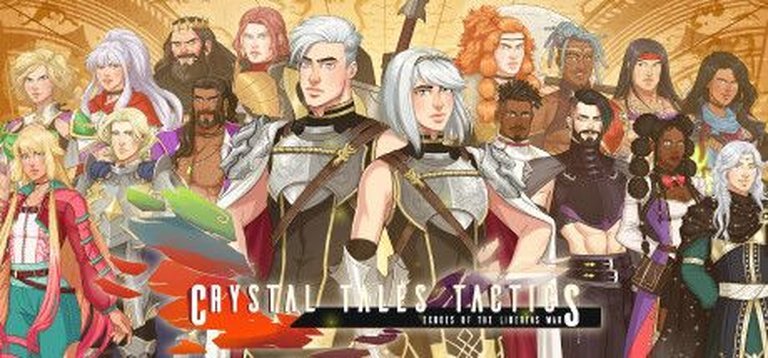
Crystal Tales Tactics: Echoes of the Libertas War is a turn-based tactics RPG set in a fantasy realm where the Libertasians Alliance fights against the expansionist Empire of Aeterna, led by Emperor Eligius Emeritus IV who seeks six magic crystals to control the serpent Obitus and conquer the world. Players engage in strategic combat, build relationships with a diverse cast of over 90 characters through a dating system without gender restrictions, and shape the narrative toward more than 20 unique endings in a story-rich experience.
Where to Buy Crystal Tales Tactics: Echoes of the Libertas War
PC
Crystal Tales Tactics: Echoes of the Libertas War Reviews & Reception
witzgames.itch.io : I’m really dissapointed with this game, I’ve payed for it and I’ve had nothing but bugs.
Crystal Tales Tactics: Echoes of the Libertas War: A Flawed Beacon of Queer Tactical Innovation
1. Introduction: Forging a New Path in the Tactical Genre
In the lush, pixel-art fields of the continent of Libertas, a quiet revolution is underway—not just against the imperial forces of Aeterna, but against the very foundations of relationship mechanics in the tactical role-playing game (TRPG). Crystal Tales Tactics: Echoes of the Libertas War arrives not as a AAA behemoth, but as a fiercely independent statement from Brazilian developer Witz Games. Launching in August 2023 for Windows, the game wears its inspirations—Fire Emblem and Final Fantasy Tactics—proudly on its sleeve, yet its most profound innovation lies in a single, revolutionary promise: “NO GENDER RELATIONSHIP RULES.” This review argues that Crystal Tales Tactics is a landmark title of immense narrative ambition and progressive design, whose historical significance is, however, tragically compromised by the technical constraints of its engine and a tumultuous launch. It stands as a testament to what queer indie developers can achieve with passion and RPG Maker, and a cautionary tale about the perils of ambition outpacing technical execution.
2. Development History & Context: A Strategic Separation and an Engine’s Burden
The Witz Games & Male Doll Schism: Understanding Crystal Tales Tactics requires understanding its origin story. The game was initially developed under the Male Doll banner, a studio known for its adult-oriented visual novels (Crimson Song, Magic Exposure). In a pivotal July 2023 devlog, the project was “migrated” to the new, explicitly SFW (Safe For Work) brand Witz Games. This was not just a re-branding but a philosophical declaration. As developer Witz Games (likely the same core team) stated on itch.io: “Witz Games is a 100% SFW brand, so no patch/DLC/games with NSFW content. All NSFW games will be publish under Male Doll main line.” This split allowed Crystal Tales Tactics to target a broader audience on Steam and itch.io, separating its queer, harem-focused narrative romance from the more explicit content of its sister studio. The developer’s comments reveal a core mission: “We hope we can tell more queer stories in the complexity and diversity they are, especially the Brazilian ones.” This positions the game as a culturally specific, yet universally aimed, narrative project.
The RPG Maker MV Crucible: Technologically, the game is a product of the accessible yet notoriously finicky RPG Maker MV engine. The developers are startlingly upfront about its greatest flaw: “This game was entirely made on RPG Maker MV and it suffers from a native engine problem: the frame rate drop. We optimized the game as much as we could and we’re still working on new improvements.” This transparency is rare but necessary. The frame rate issue isn’t a minor glitch; it directly disables Steam Achievements (as noted on the store page) and fundamentally impacts playability, as user reviews confirm. The post-launch patch history (from v1.0.1 to v1.0.5) is a chronicle of fighting this engine limitation and fixing game-breaking bugs, from “invisible party members in menu” to “wrong death triggers” and a notorious bug where a new game could start players in Chapter 5 with an invisible, level 1 protagonist. The community even devised a workaround: starting a demo save and manually transferring files. This context is essential: Crystal Tales Tactics is a game being actively rescued from its own foundation.
Gaming Landscape & Niche: Released in mid-2023, the game entered a tactical RPG space saturated by giants like Fire Emblem: Engage and Triangle Strategy. Its niche was clear: a pixel-art, narrative-heavy, deeply queer tactical experience with dating sim elements—a combination almost entirely absent from the mainstream. Its Steam tags (LGBTQ+, Harem, Otome, Boys Love, Yaoi, Bara, Gay, Lesbian, Transgender) explicitly signal its intended audience, carving out a vital space in the indie ecosystem.
3. Narrative & Thematic Deep Dive: Crystals, Empires, and Queer Liberation
Plot & Structure: The narrative follows a classic, yet effective, fantasy war drama. The militaristic Empire of Aeterna, led by the tyrannical Emperor Eligius Emeritus IV, is systematically conquering the nations of the continent of Libertas. The conquered kingdoms’ cultures are being erased. In response, the holdout nations form the Libertasians Alliance. The Emperor’s goal is to locate the six magic crystals created by the goddess Vitalia to control the world-ending serpent Obitus and achieve global domination. The protagonist, a customizable hero, joins this alliance. The plot is framed as a classic struggle for freedom against fascistic expansion, but its genius lies in the integration of its secondary system.
Character & Romance as Narrative Engine: Where the game transcends its plot is in its 14 unique, romanceable characters (referred to as “ROs” or Romantic Options in dev comments). These are not mere side quests; the dating system is deeply woven into the narrative fabric. The developer explicitly confirmed that the harem tag is accurate: “you can date more than one person at same time and there is a slight differences in the endings when the persons you dated/loved are alive.” This mechanics-driven polyamory is radical for the genre. Relationships aren’t a distraction from the war; they are a strategic component that alters the story’s conclusion. With over 20 unique endings, the narrative branches are predicated on who lives, who dies, and who the protagonist loves—a powerful statement that personal happiness and political victory are intertwined.
Thematic Underpinnings: Thematically, the game is a rich tapestry.
* Resistance & Found Family: The Libertasians Alliance is literally a coalition of displaced cultures, mirroring the chosen family formed among the squad of 90+ potential recruits.
* Queer Love as Radical Act: In a world threatened by a monolithic, oppressive empire (whose name, Aeterna, implies rigid, eternal order), the fluid, player-driven romantic relationships—encompassing B+B, G+G, B+G, and including a transgender RO (Yohan, a trans man)—become an act of defiance. The game argues that the very flexibility the empire seeks to crush is the source of the Alliance’s strength.
* The Burden of Power (Crystals): The quest for the six elemental crystals (classic FF/Tactics fare) is reframed not just as a power grab, but as a desperate race to prevent their misuse for absolute control.
The narrative’s weakness, hinted at in user complaints about font readability and “trapped” menus, may lie in its delivery via RPG Maker’s visual novel engine, which can feel static. However, its ambition to make romance a core, consequential mechanic in a war story is its most profound and historically significant achievement.
4. Gameplay Mechanics & Systems: Ambitious Systems in a Strained Engine
Core Loop & Combat: The gameplay is a direct descendant of Final Fantasy Tactics: isometric, turn-based tactical battles on grids. The key innovation is the “Element Wheel”—a real-time, interactive system where the six elemental affinities (Fire, Water, Earth, Wind, Light, Dark) interact in a rock-paper-scissors style. Hitting an enemy with an element they are weak to (e.g., Water on Fire) causes amplified damage and status effects. The wheel’s image was enlarged in a patch, indicating its importance but also UI clunkiness.
Character Progression & Customization: The game offers immense depth:
1. Class & Element Customization: At creation, players choose a base class and a primary element.
2. Subclasses: Characters can unlock secondary classes, though user reviews lament the lack of in-game descriptions for these ("Subclasses don't have descriptions so you're just guessing"), a major flaw in an otherwise deep system.
3. Relationship-Based Skill Growth: This is the flagship mechanic. “Skill improvements based on the level of relationship with the characters.” Bonding with ROs via camp scenes and dates directly boosts specific skills or unlocks class abilities, making romance a tangible gameplay upgrade, not just flavor.
4. Massive Roster: The promise of “More than 90 characters to join your team” suggests a staggering amount of recruitment and management, reminiscent of Suikoden but within a tactical framework.
Dual Modes: To cater to different players, Story Mode reduces enemy difficulty for narrative-focused players, while Classic Mode offers a standard challenge. A Permanent Death Mode was added in a patch, satisfying hardcore TRPG fans. This shows a developer aware of audience segmentation.
Flawed Implementation: The systems are undermined by execution.
* UI/UX Nightmares: Reviews cite inoperative cursors in battle ("it never goes where you actually click"), non-functional back buttons in menus causing soft-locks, and the aforementioned subclass opacity. These aren’t polish issues; they are fundamental barriers to play.
* Engine Limitations: The persistent frame rate drop is the specter haunting every battle and map traversal, crippling performance on what should be lightweight pixel art. The devs’ suggestion to “save and restart” is a band-aid on a structural flaw.
* Save Game Issues: The bizarre demo/full game save incompatibility points to a fractured launch and poor user onboarding.
The gameplay is a fascinating dichotomy: a deeply thoughtful, modernized tactical system (relationship-powered progression, polyamorous narrative) shackled to an engine struggling to render it smoothly and a UI that often works against the player.
5. World-Building, Art & Sound: Vibrant Vision, Limited Palette
Setting & Atmosphere: Libertas is a continent of fallen kingdoms, each with a distinct aesthetic implied by the “unique maps” boast. The presence of six elemental shrines and the goddess Vitalia’s mythology provides a solid high-fantasy scaffold. The tone blends the grave stakes of a liberation war with the intimate, personal tone of a dating sim. This tonal whiplash—from tactical battlefield commands to campfire romances—is the game’s unique signature, though its success depends on the player’s buy-in.
Visual Direction: Built in RPG Maker MV, the art is 2D scrolling, diagonal-down pixel art. The Steam tags highlight “Colorful” and “Anime,” which aligns with the character art seen in promotional material. The character designs for the 14 ROs are likely the visual highlight, needing to convey distinct personalities for romance to land. However, the engine’s limitations mean battle animations and environmental detail are functional at best. The “unique maps” claim suggests creative tilework, but the ability to zoom out properly (a user complaint: "How do I zoom out? Its clearly possible...") is broken, frustrating tactical awareness.
Sound Design: The source material is silent on this front. As an RPG Maker title, it likely relies heavily on the engine’s default sound library or affordable commissioned assets. The lack of mention in patches or features suggests it is not a standout element, functioning as competent but unremarkable background support for the tactics and dialogue. The full audio support (English) is noted, but no composer or sound design credits are visible in the provided sources, implying a low-budget, utilitarian approach.
The art and sound serve their purpose to establish setting and character, but they are not the selling point. The game’s soul is in its systems and writing, not its audiovisual spectacle.
6. Reception & Legacy: A Cult Classic in the Making, or a Cautionary Tale?
Commercial & Critical Reception: Data from Raijin.gg indicates minimal commercial success: ~166 units sold at the time of data capture, with a modest 3,300 wishlists. Critically, it is virtually invisible—MobyGames has no critic reviews, and its user review score on Steam is “Mixed” (50% positive from 4 reviews at time of writing). The reviews are a perfect microcosm of the game’s divide.
* The Positive: Praises the queer representation (“For Queer stories told by Queer people!”), the interesting characters, and the ambitious relationship systems. Etoile Rouge‘s support comment is telling: they bought multiple Male Doll titles to support the devs’ “endeavour.”
* The Negative (and Scathing): Reviews like yukia101‘s are devastating: “I’ve had numerous problems, mainly with controls and cutscenes and battles not working… The download didn’t even have the full game in, I checked and it was just the demo… this is unplayable.” This points to a catastrophic initial release state.
The devs’ responsive patch notes (fixing black scenes, death triggers, menu bugs) show a committed, small team trying to right the ship, but the damage to first impressions is severe for a $12.99 commercial product.
Legacy & Influence: Crystal Tales Tactics will not influence major studios. Its technical flaws are too fundamental. Its legacy will be niche, cultural, and inspirational.
1. A Blueprint for Queer Mechanics: Its most significant contribution is proving that polyamory and LGBTQ+ relationship systems can be integrated as core, consequential gameplay mechanics in a non-visual-novel genre. The “relationship levels boost skills” model is a design paradigm other indie devs can adopt.
2. The Indie RPG Maker Paradox: It serves as a modern case study in the limits and potential of RPG Maker. It shows the engine can facilitate complex, modern game design ideas but also the absolute necessity of rigorous optimization and QA.
3. The Power of Branding: The Witz Games/Male Doll split is a masterclass in marketing to disparate audiences while maintaining creative integrity. It allows the queer SFW project its own space without alienating either audience.
4. A Touchstone for Representation: For queer players, especially those in Brazil (as the devs note), this game is a rare and deeply meaningful title where their identities are not an aside but the engine of the narrative. This cultural impact far outweighs its sales figures.
Its legacy will be that of a flawed gem—a game more important for what it attempted and symbolized than for what it fully achieved in execution. It is a beacon for a specific kind of inclusive design, albeit one flickering under the strain of its own灯泡.
7. Conclusion: An Imperfect but Pivotal Victory
Crystal Tales Tactics: Echoes of the Libertas War is a game of profound contradictions. It is a tactical RPG with a revolutionary approach to relationships, built on an engine that struggles to render its own battles. It is a passionate, culturally specific narrative of queer liberation, marred by a launch that trapped players in menus and sent them back to Chapter 5. It is a testament to independent developers carving out vital space for representation, and a stark lesson in the technical challenges of doing so with accessible tools.
Its place in video game history is not as a classic, but as a culturally significant milestone. It pushes the boundary of what narrative relationships can mean in mechanics-heavy genres, prioritizing player agency in love as much as in war. For scholars of LGBTQ+ representation in games, it is a essential case study. For players seeking a tactical challenge with deep, polyamorous romance, it is a frustrating but potentially rewarding experience if one can navigate its technical minefields.
The final, definitive verdict must be dualistic. As a piece of technical software: it is a compromised, buggy product that fails to meet basic standards of polish. As an act of creative and cultural significance: it is a brave, necessary, and influential work that expands the vocabulary of the tactical RPG and the landscape of queer gaming. One hopes Witz Games, having fought so many battles against their own engine, will have the resources to build a more stable foundation for their future titles. Until then, Crystal Tales Tactics remains a brave, broken, and beautiful first volley in a war for more inclusive game worlds.