
- Release Year: 2001
- Platforms: Windows
- Publisher: Bohemia Interactive s.r.o.
- Developer: Centauri Production s.r.o.
- Genre: Adventure, Educational
- Perspective: Side view
- Game Mode: Single-player
- Gameplay: Graphic adventure, Mini-games, Puzzle elements
- Setting: Fantasy
Description
Čtyřlístek CD-Romek 15: Na turnaji (also known as Čtyřlístek: Bobík hubne or Čtyřlístek: To všechno jsou svaly) is the 15th installment in the Čtyřlístek series, distributed as an interactive CD-ROM with the CD-Romek magazine. Set in a fantasy world, the game combines a base adventure with various logic, action, and puzzle mini-games designed to help children practice perception, memory, orientation, and ecological thinking, while also incorporating activities for learning the basics of the English language.
Čtyřlístek CD-Romek 15: Na turnaji Reviews & Reception
myabandonware.com : nejlepší. hra na světě
centauri.cz : Základem je vždy adventurní hra se členy Čtyřlistku, jejím plnohodnotným doplňkem pak jsou různé logické a akční hrádky…
Čtyřlístek CD-Romek 15: Na turnaji: Review
A Forgotten Pillar of Czech Edutainment
Introduction
In the annals of video game history, certain titles transcend mere entertainment to become cultural touchstones—especially within their national contexts. Čtyřlístek CD-Romek 15: Na turnaji (2001), known alternatively as Čtyřlístek: To všechno jsou svaly (All That Are Muscles) or Čtyřlístek: Bobík hubne (Bobík Loses Weight), is precisely such a gem. As the 15th installment in the beloved Czech Čtyřlístek series, distributed with the CD-Romek magazine, this Windows-exclusive adventure from developer Centauri Production s.r.o. represents a remarkable fusion of pedagogy and playful storytelling. Its core mission: to teach children perception, memory, spatial orientation, ecological awareness, and English fundamentals—all while guiding the iconic quartet of Fifinka, Bobík, Myšpulín, and Pinďa through lighthearted misadventures. This review deconstructs the game’s multifaceted legacy, from its development in the early 2000s Czech gaming landscape to its enduring impact on educational design and cultural memory.
Development History & Context
The Architects of a Czech Classic
Čtyřlístek CD-Romek 15 emerged from the creative laboratories of Centauri Production s.r.o., a studio renowned for narrative-driven adventures like Pohádka o Mrazíkovi, Ivanovi a Nastěnce and the cult-favorite Memento Mori series. The CD-Romek project itself was a multimedia phenomenon, a collaboration between Centauri, publisher Bohemia Interactive s.r.o. (later Cenega), and the Čtyřlístek comic franchise. Initially launched in 2000 as localized Polish editions (“Rodinný CD-Romek”), the series pivoted to original Czech content with issue #14 in 2001, birthing the Čtyřlístek CD-Romek line. Each issue paired a comic story (written by Stanislav Havelka, illustrated by Jaroslav Němeček) with an interactive CD-ROM featuring a primary adventure and supplementary mini-games.
Technologically, Na turnaji was powered by Centauri’s proprietary CPAL2 engine, a Windows-centric tool enabling 3D character models and point-and-click interfaces despite the era’s hardware constraints. The game’s development was marked by pragmatic ingenuity: assets were repurposed across installments (e.g., cave animations recycled from the earlier Vzhůru na myši multimedia title), ensuring consistency while optimizing resources. Released on CD-ROM in 2001, it was later bundled in the 2002 collection 3x Čtyřlístek, compiling issues 14–16.
The gaming landscape of 2001 was dominated by console 3D revolutions, but PC edutainment thrived in niches like Central Europe. Na turnaji competed indirectly with titles such as Scooby-Doo!: Case File N°2, yet its true context was the Czech educational sphere. Its English lessons—pioneering for Czech children—aligned with growing bilingualism initiatives, while its ecological themes mirrored rising environmental awareness. The game stood as a testament to Centauri’s vision: “mixlevpixle” (as developer Ruda Šetula quipped), where learning and laughter were inseparable.
Narrative & Thematic Deep Dive
A Tale of Strength, Friendship, and Self-Improvement
The primary adventure, “To všechno jsou svaly,” centers on Bobík’s journey to shed weight and build strength, framed as a tournament-themed quest. The narrative unfolds across diverse locales—Čtyřlístek’s home, training grounds, and exotic locales—driven by character dynamics rather than epic stakes. Bobík’s earnest efforts to transform himself into a “musclebound champion” (a playful nod to his nickname “Stinko” in international versions) provide the backbone, while Fifinka’s pragmatism, Myšpulín’s inventiveness, and Pinďa’s neuroticism add comedic layers.
The dialogue, delivered by iconic Czech voice actors Ota Jirák (Myšpulín, Pinďa, Bobík, and a coach) and Helena Brabcová (Fifinka), is the game’s emotional core. Jirák’s vocal dexterity—differentiating Myšpulín’s eccentric inventor tone from Pinďa’s anxious whimpers—transforms simple lines into character-defining moments. Brabcová’s Fifinka anchors the chaos as the voice of reason, her warmth contrasting with the boys’ slapstick antics.
Thematic depth emerges organically:
– Perseverance: Bobík’s incremental progress teaches that effort yields results.
– Friendship: The Čtyřlístek’s collaborative problem-solving highlights teamwork.
– Ecological Awareness: Puzzles involving animals and habitats subtly promote environmental stewardship.
– Language Learning: English mini-games (e.g., “Colors,” “In the Zoo”) integrate vocabulary into gameplay, avoiding didacticism.
The narrative’s strength lies in its simplicity. Unlike complex epics, it mirrors childhood experiences—small victories, playful rivalries, and the comfort of friendship—making it universally relatable.
Gameplay Mechanics & Systems
Point-and-Click Pedagogy
The core gameplay is a graphic adventure structured around inventory puzzles and environmental interaction. Players guide the Čtyřlístek through side-view scenes, clicking hotspots to examine items, collect objects, or engage with characters. Puzzles are designed for young audiences, prioritizing logic and observation over complexity:
– Inventory Challenges: Fetching ingredients for Myšpulín’s inventions or assembling exercise equipment.
– Environmental Puzzles: Navigating caves or training obstacles using spatial reasoning.
– Dialogue Trees: Simple conversations that yield hints or advance the plot.
The mini-games are the game’s pedagogical heart:
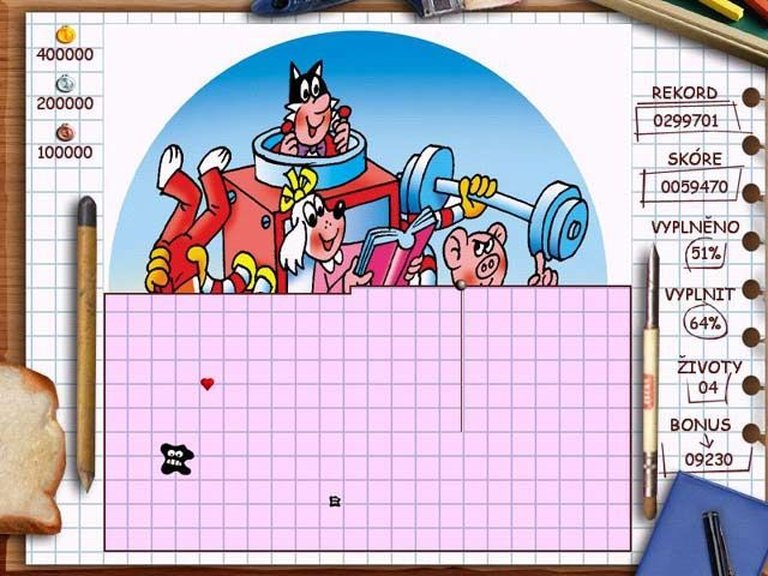
– Pexeso: Memory-matching using images from the Festival vynálezů storybook.
– Puzzle Jigsaws: Assembling scenes of Čtyřlístek in flying cars or submarines.
– Flappy: A simplified obstacle-dodging game honing reflexes.
– English Lessons: Vocabulary mini-games (e.g., matching animals to names) with voice repetition.
– Medal System: Players earn bronze/silver/gold medals for completing challenges, with scores submittable to the now-defunct cdromek.cz server.
Innovations & Flaws: The CPAL2 engine enabled dynamic camera angles and fluid character animations, making 3D environments feel lively. However, the lack of a hint system could frustrate younger players, and linear progression limited replayability. Nevertheless, the seamless blend of education and gameplay—where learning felt like play—was revolutionary.
World-Building, Art & Sound
A Whimsical Canvas for Czech Childhood
The game’s setting, the fictional Czech town of Třeskoprsk, is rendered in a vibrant, cartoonish style faithful to Jaroslav Němeček’s Čtyřlístek comics. Environments—from cozy home interiors to tournament grounds—are bursting with color and detail, using the CPAL2 engine to create inviting 3D spaces. Character designs are iconic: Bobík’s muscular frame, Fifinka’s polka-dot dress, Myšpulín’s goggles, and Pinďa perpetually worried expression. These models, while simple, are expressive, with animations that convey personality (e.g., Myšpulín’s excited gestures).
Art Direction prioritizes accessibility: large, clickable objects, clear UI elements, and child-friendly aesthetics. Mini-games feature recycled assets (e.g., Kaňky uses Festival vynálezů illustrations), fostering visual continuity. The sound design is equally commendable:
– Soundtrack: Cheerful, looping melodies set an upbeat tone.
– Sound Effects: Crisp contextual cues (e.g., Bobík’s weights clanking).
– Voice Acting: Jirák and Brabcová’s performances elevate dialogue, adding warmth and humor.
The overall atmosphere is one of nostalgic comfort—a digital storybook where learning feels like an adventure.
Reception & Legacy
A Cult Classic with Preservationist Roots
Upon release, Čtyřlístek CD-Romek 15 received positive reviews in Czech outlets like PC World, praised for its educational value and engaging design. Commercial success was modest, confined by regional distribution and niche appeal. Yet, its legacy grew through word-of-mouth and cultural resonance. The CD-Romek series influenced later Czech edutainment titles, including Ferda CD-Romek and Polda, demonstrating the viability of blending storytelling with pedagogy.
The game’s reputation evolved into a cult phenomenon, fueled by retro gaming communities. Preservation efforts, notably the Knihovnička Čtyřlístek project, documented the series and recovered lost assets. A landmark achievement came in 2024, when enthusiasts successfully integrated the lost Czech dubbing of the unreleased Čtyřlístek na horách (issue #42) with its Romanian version, breathing new life into a “lost” title. This underscored the series’ enduring affection and the importance of digital heritage.
Conclusion
Timeless Lessons in Pixels
Čtyřlístek CD-Romek 15: Na turnaji is more than a game—it is a cultural artifact capturing the essence of 2000s Czech childhood. Its strength lies in its authenticity: a heartfelt fusion of adventure, education, and humor, crafted with passion for its young audience. While its graphics and mechanics are dated by modern standards, its design philosophy—where learning is joyful and collaborative—remains revolutionary.
Final Verdict: 8/10
A hidden gem of Czech gaming, Na turnaji exemplifies how edutainment can transcend borders. Its legacy endures in the hearts of nostalgic players and the preservation efforts that safeguard such titles. For historians, it offers a window into Czech creativity; for parents, a blueprint for meaningful digital play. In an era of gamified education, Čtyřlístek reminds us that the best lessons are those wrapped in laughter and friendship.