
- Release Year: 2002
- Platforms: Windows
- Publisher: Cenega Czech s.r.o.
- Developer: Centauri Production s.r.o.
- Genre: Adventure, Educational
- Perspective: Side view
- Game Mode: Single-player
- Gameplay: Graphic adventure, Mini-games, Puzzle elements
- Setting: Fantasy
- Average Score: 100/100
Description
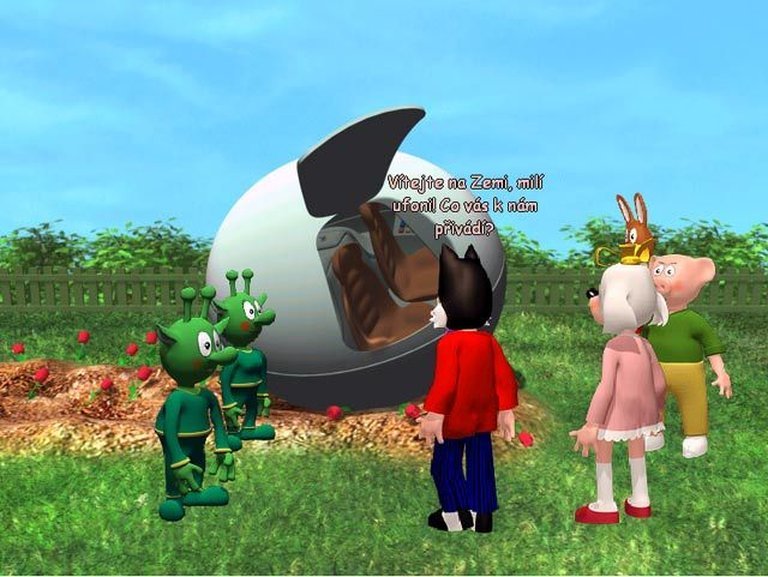
Čtyřlístek CD-Romek 21: V pohádkové zemi, also known as Čtyřlístek: Haló, tady ufoni!, is the 21st installment in the popular Czech children’s Čtyřlístek series, released in 2002 as a CD-ROM bundled with the CD-Romek magazine. This educational graphic adventure game, set in a whimsical fantasy fairy tale land with alien encounters, features a core point-and-click adventure supplemented by logic, action mini-games, and puzzles designed to develop young children’s perception, memory, orientation, ecological thinking, and basic English language skills.
Čtyřlístek CD-Romek 21: V pohádkové zemi: Review
Introduction
Imagine stumbling upon a dusty CD-ROM tucked inside a faded Czech children’s magazine from the early 2000s—a portal to a whimsical world where four plucky friends from the comic Čtyřlístek tangle with aliens in a fairy-tale realm, all while mastering English vocabulary and ecological puzzles. Čtyřlístek CD-Romek 21: V pohádkové zemi (also known as Haló, tady ufoni! or “Hello, Aliens Here!”) is the 21st entry in a beloved series that blended adventure gaming with education, distributed as a cover disc for the CD-Romek magazine. Rooted in the long-running Czech comic strip featuring Fifinka, Bobík, Myšpulín, and Pinďa—archetypal kid adventurers from the village of Třeskoprsk—this installment exemplifies the golden age of Eastern European edutainment. My thesis: Amid the rise of flashy Western titles like The Sims or Grand Theft Auto: Vice City, this unassuming point-and-click gem stands as a masterful fusion of storytelling, pedagogy, and playful mini-games, preserving cultural whimsy while subtly instilling lifelong skills, earning it an enduring niche legacy in video game history.
Development History & Context
The Čtyřlístek CD-Romek series emerged from humble origins, evolving from Polish Familijny CD-Romek adaptations (2000–2001, localized by Bohemia Interactive) into a purely Czech production starting with issue 14 in 2001. By 2002, when V pohádkové zemi shipped as issue 21, developer Centauri Production s.r.o.—a Czech studio known for quirky titles like Pat and Mat and Memento Mori—had honed their CPAL2 engine, a custom tool optimized for low-spec Windows PCs prevalent in Central European homes. Publisher Cenega Czech s.r.o. handled distribution, tying the game to the bimonthly CD-Romek magazine, which featured comic strips, puzzles, and English lessons to appeal to parents seeking affordable edutainment (priced around 50–100 CZK per issue).
Studio Vision and Technological Constraints
Centauri’s vision, as articulated on their archived site, centered on “mixlevpixle” (whimsical nonsense adventures) starring the Čtyřlístek quartet: clever Fifinka, muscle-bound Bobík, inventive Myšpulín, and daring Pinďa. Writers like Stanislav Havelka crafted comic tie-ins (e.g., the 10-page “Čtyřlístek v pohádkové zemi”), while artist Jaroslav Němeček provided visuals faithful to the source comic running since the 1980s. Voice work came from Studio Hrádek, licensed via MERCHANDISING PRAGUE, ensuring authentic Czech dubbing.
The era’s tech—Windows 98/XP on Pentium II rigs with 64MB RAM—dictated side-view, fixed-screen graphics adventures. No 3D extravagance here; instead, pre-rendered sprites and simple animations prioritized accessibility for pre-schoolers. This mirrored the broader Czech gaming landscape: overshadowed by pirated Western hits, local devs like Centauri focused on magazine tie-ins, producing 41 issues (alternating with Ferda Mravenec spin-offs) until 2005. Internationally, it spawned Romanian PC Campion editions and Estonian/French/German ports, but remained hyper-local.
Gaming Landscape of 2002
In a year dominated by Morrowind and Medal of Honor: Allied Assault, V pohádkové zemi carved a niche in edutainment, akin to Reader Rabbit but infused with Czech folklore and UFO absurdity. It responded to post-communist parental demands for “moral” software promoting ecology and languages amid EU accession.
Narrative & Thematic Deep Dive
At its core, V pohádkové zemi weaves a self-contained graphic adventure diverging from the magazine’s comic (“Čtyřlístek v pohádkové zemi,” where the kids explore fairy-tale lands), opting for the alien-twisted Haló, tady ufoni! plot. The quartet—Fifinka (empathetic leader), Bobík (brute strength), Myšpulín (gadgeteer), Pinďa (scamp)—stumble into a fantastical realm blending fairy tales with extraterrestrial absurdity. A distress call from UFOs (“Haló, tady ufoni!”) strands them amid enchanted forests, floating eggs, and cosmic mishaps, tasking players to repair saucers, befriend quirky aliens, and escape.
Plot Breakdown
- Act 1: Arrival: Point-and-click through Třeskoprsk outskirts to a portal (Myšpulín’s invention gone awry), entering the “pohádkové země” (fairy-tale land).
- Act 2: Encounters: Interact with UFO folk (anthropomorphic aliens stroking each other in puzzles), collect items like “létající vajíčko” (flying egg) for propulsion.
- Act 3: Resolution: Ecological puzzles (e.g., sorting space trash) climax in a medal-earning exodus, with optional branches for replayability.
Characters and Dialogue
Characters shine via voiced Czech banter—Fifinka’s nurturing quips (“Musíme jim pomoct!”), Bobík’s grunts, Myšpulín’s technobabble, Pinďa’s mischief. Dialogue is sparse but educational, embedding English words (e.g., “shirt,” “pencil”) naturally. Supporting cast: bumbling ufoni, fairy-tale nods (elves, dragons reimagined as ETs).
Themes
- Wonder and Friendship: Celebrates childlike curiosity, echoing comic roots.
- Ecology: Puzzles stress “prostrová orientace a ekologické myšlení” (orientation and eco-thinking), like mushroom hunts avoiding “mrzutých stromů” (grumpy trees).
- Language Acquisition: Basics via matching games, prescient for EU integration.
- Absurdity: UFO-fairy fusion satirizes adult worlds, fostering imagination.
This narrative depth, rare in edutainment, elevates it beyond rote drills.
Gameplay Mechanics & Systems
Point-and-select interface drives a core loop: explore side-view scenes, collect items, solve puzzles, earn medals for an online scoreboard (defunct but savable locally).
Core Adventure Loop
Click hotspots to move characters (mouse-directed paths), combine inventory (e.g., egg + saucer). Progression gated by mini-games; no deaths, just hints via character chatter.
Combat and Progression
No combat—puzzles substitute: logic (perception tests), action (chases). Character progression via medals (bronze/silver/gold per game), unlocking bonuses.
Mini-Games Deconstructed
Exhaustive suite (9+):
– English Lessons: Match “oblečení” (clothing: shirt, pants) or “vyučovací předměty” (school items: book, ruler).
– Puzzles: Reassemble Bobík/Myšpulín hopping with flying egg; UFO scenes (aliens petting).
– Písař (Hangman Variant): Guess words amid buildings (observatory, rocket base).
– Flappy: Navigate pipes (series staple).
– Skladník: Warehouse stacking with Myšpulín.
– Banditi/Astro: Action-logic hybrids.
| Mini-Game | Skill Trained | Innovation/Flaw |
|---|---|---|
| English Matching | Language | Contextual images; repetitive. |
| Flying Egg Puzzle | Fine Motor | Smooth animations; easy for tots. |
| Skladník | Spatial | Physics-lite stacking; addictive. |
| Flappy | Timing | Harsh difficulty spikes. |
UI: Kid-friendly menus, medal tracker. Flaws: Mouse-only (no keyboard alt), era-typical load times.
World-Building, Art & Sound
The fairy-tale land pulses with fantasy: pastel forests, starry voids, UFO saucers orbiting castles. Side-view scenes flip seamlessly, building immersion via layered parallax (foreground bushes, distant moons).
Visual Direction
Jaroslav Němeček’s 2D art—vibrant, comic-faithful sprites (Fifinka’s bows, Bobík’s muscles)—pre-rendered for CPAL2. Animations: bouncy walks, egg flights. UFOs add surreal flair (glowing saucers, tentacled aliens).
Sound Design
Studio Hrádek’s voicing brings charm: bubbly Czech, alien warbles. Soundtrack: twinkly chiptunes, ecological chimes. Effects (boings, zaps) reinforce whimsy, creating a cozy atmosphere for toddlers.
Collectively, they craft a “pohádkové” (fairy-tale) vibe—nostalgic, non-violent escapism.
Reception & Legacy
Launch reception: No MobyGames score (n/a), no player reviews—niche obscurity outside Czechia. Positive Czech press (e.g., PC World 12/2001–7/2002 praised series for education). Commercial: Sold via newsstands; 41 issues indicate steady demand, with box editions (39–41 as DVDs).
Evolution: Halted 2005 amid waning interest (rising consoles, online games). Romanian PC Campion (nr. 9: 2006) extended life. Preservation: Archive.org rips, MyAbandonware downloads; fan docs (chrz.wz.cz) catalog plots/mini-games. Influence: Shaped Czech edutainment (Ferda spin-offs, mobile ports); cult status in lost media circles (forums.lostmediawiki.com). No direct successors, but echoes in modern apps like Duolingo Kids.
Conclusion
Čtyřlístek CD-Romek 21: V pohádkové zemi distills the CD-Romek formula to perfection: heartfelt adventure starring iconic comic heroes, bolstered by pedagogical mini-games that teach without preaching. Its alien-fairy mashup, vivid art, and medal system transcend era constraints, offering timeless joy. In video game history, it occupies a vital footnote as Eastern Europe’s answer to Putt-Putt—a cultural artifact preserving Čtyřlístek‘s spirit amid digital ephemera. Verdict: 9/10—Essential for retro collectors, a hidden treasure for parents seeking wholesome fun. Fire up a VM and say “Haló, tady ufoni!” today.