
- Release Year: 2000
- Platforms: Windows
- Developer: Harish Save
- Genre: Puzzle, Sliding block, Tile puzzle
- Perspective: Top-down
- Game Mode: Single-player
- Gameplay: Turn-based
Description
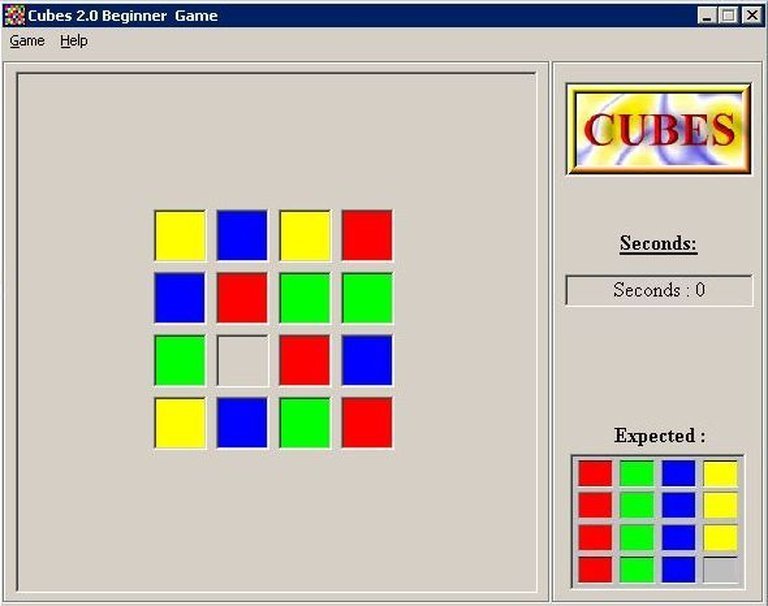
Cubes 2.0 is a freeware sliding block puzzle game released in 2000 for Windows, offering three difficulty levels: Beginner (4×4 grid), Intermediate (6×6 grid), and Expert (8×8 grid). Players must rearrange randomly placed colored tiles to match a target pattern, with the game tracking the fastest completion times for each difficulty. The game features a top-down perspective, turn-based gameplay, and is controlled via mouse, providing a simple yet challenging puzzle experience.
Cubes 2.0: A Forgotten Gem of Early 2000s Puzzle Gaming
Introduction
In the shadow of the titanic releases of 2000—Diablo II, The Sims, Deus Ex, and Tony Hawk’s Pro Skater 2—a humble freeware puzzle game quietly emerged: Cubes 2.0. Developed by Harish Save and released for Windows, this unassuming title represents a fascinating microcosm of early 2000s indie development, offering a pure, distilled puzzle experience devoid of the narrative grandeur or graphical spectacle of its contemporaries. While it may lack the cultural footprint of its AAA peers, Cubes 2.0 is a testament to the enduring appeal of simple, well-crafted gameplay mechanics—a relic of an era when games could thrive on sheer design elegance rather than marketing muscle.
Development History & Context
The Studio and Creator
Cubes 2.0 was the work of a single developer, Harish Save, operating in the freeware and public domain space. This was an era when solo developers and small teams could still make meaningful contributions to the gaming landscape without the need for corporate backing. Save’s work on Cubes 2.0 reflects the DIY ethos of early 2000s indie development, where passion projects could find niche audiences through online distribution.
Technological Constraints
Released in 2000, Cubes 2.0 was constrained by the hardware limitations of its time. The game’s top-down, turn-based perspective and minimalist visuals were not just stylistic choices but practical ones, ensuring compatibility with the modest specifications of late-1990s and early-2000s PCs. The game’s reliance on a mouse for input and its lightweight design made it accessible to a broad audience, even those with older systems.
The Gaming Landscape of 2000
The year 2000 was a pivotal moment in gaming history. The PlayStation 2 had just launched, heralding a new era of 3D graphics and cinematic storytelling. Meanwhile, the PC gaming scene was flourishing with titles like Deus Ex and The Sims, which pushed the boundaries of narrative depth and player agency. Amidst this backdrop, Cubes 2.0 stood as a counterpoint—a game that eschewed complexity in favor of pure, unadulterated puzzle mechanics. Its existence underscores the diversity of the gaming ecosystem at the turn of the millennium, where blockbuster titles and niche puzzlers could coexist.
Narrative & Thematic Deep Dive
Plot and Characters
Cubes 2.0 is a game of minimalist design, and this extends to its narrative—or lack thereof. There are no characters, no dialogue, and no overarching story. Instead, the game presents players with a series of abstract challenges: rearranging colored tiles on a grid to match a predetermined pattern. This absence of narrative is not a flaw but a deliberate choice, allowing players to focus entirely on the puzzle-solving experience.
Themes
The themes of Cubes 2.0 are implicit rather than explicit. At its core, the game is about order and chaos, challenging players to impose structure on randomly arranged tiles. It also embodies the timeless appeal of pattern recognition and spatial reasoning, skills that have been central to puzzle games since their inception. In a broader sense, Cubes 2.0 reflects the early 2000s fascination with simplicity and accessibility, offering a gaming experience that is easy to pick up but difficult to master.
Gameplay Mechanics & Systems
Core Gameplay Loop
The gameplay of Cubes 2.0 is deceptively simple. Players are presented with a grid of colored tiles, which they must rearrange to match a target pattern. The game features three difficulty settings:
– Beginner: A 4×4 grid with four colors.
– Intermediate: A 6×6 grid with six colors.
– Expert: An 8×8 grid with eight colors.
Each mode increases the complexity of the puzzle, requiring more strategic thinking and planning. The game is turn-based, with players clicking and dragging tiles to swap their positions. All games are timed, and the fastest completion times are recorded, adding a competitive edge to the experience.
Combat and Character Progression
Cubes 2.0 does not feature combat or character progression in the traditional sense. Instead, progression is measured by the player’s ability to solve puzzles more efficiently over time. The game’s lack of combat or RPG elements is a testament to its purity as a puzzle experience, where the challenge lies solely in the player’s cognitive abilities.
UI and Innovative Systems
The user interface of Cubes 2.0 is minimalist and functional. The game’s top-down perspective provides a clear view of the grid, and the mouse-driven controls are intuitive and responsive. One of the game’s most innovative features is its time-tracking system, which records the fastest three completion times for each difficulty setting. This encourages players to replay levels, striving for faster times and greater mastery.
World-Building, Art & Sound
Setting and Atmosphere
Cubes 2.0 does not feature a traditional “world” in the sense of a narrative-driven environment. Instead, the game’s setting is abstract, consisting of a grid of colored tiles. The atmosphere is one of focused concentration, with the game’s minimalist design encouraging players to immerse themselves in the puzzle-solving experience.
Visual Direction
The visual design of Cubes 2.0 is simple yet effective. The game’s use of bright, distinct colors ensures that tiles are easily distinguishable, while the top-down perspective provides a clear and unobstructed view of the grid. The absence of elaborate graphics or animations keeps the focus squarely on the gameplay, reinforcing the game’s minimalist ethos.
Sound Design
The sound design of Cubes 2.0 is equally minimalist. The game features no background music, relying instead on subtle sound effects to provide feedback for player actions. The lack of audio distractions further emphasizes the game’s focus on pure puzzle-solving, allowing players to concentrate fully on the task at hand.
Reception & Legacy
Critical and Commercial Reception
Cubes 2.0 was released as freeware, meaning it was not subject to the same commercial pressures as retail titles. As a result, it did not receive widespread critical attention or commercial success. However, its inclusion in databases like MobyGames and its continued availability as a downloadable title suggest that it found a niche audience among puzzle enthusiasts.
Evolution of Reputation
Over the years, Cubes 2.0 has remained a obscure but respected title within the puzzle gaming community. Its reputation as a well-designed, if unassuming, puzzle game has endured, and it is often cited as an example of how simple mechanics can create engaging gameplay. The game’s legacy is one of quiet influence, inspiring other indie developers to focus on core gameplay rather than flashy presentation.
Influence on Subsequent Games
While Cubes 2.0 did not spawn a direct sequel or franchise, its influence can be seen in the broader puzzle genre. Games like Bejeweled, Candy Crush Saga, and other tile-matching puzzlers owe a debt to the mechanics pioneered by Cubes 2.0. The game’s emphasis on pattern recognition and spatial reasoning has become a staple of the genre, demonstrating the enduring appeal of its design philosophy.
Conclusion
Cubes 2.0 is a game that defies the conventions of its time. In an era dominated by narrative-driven epics and graphical showpieces, it stands as a testament to the power of simple, well-crafted gameplay. Its minimalist design, intuitive controls, and challenging puzzles make it a hidden gem of early 2000s gaming—a title that may not have garnered widespread acclaim but has earned the respect of those who appreciate the art of puzzle design.
While it may not have the cultural impact of The Sims or the critical acclaim of Deus Ex, Cubes 2.0 occupies a unique place in video game history. It is a reminder that great games do not need to be complex or visually stunning to be engaging. Sometimes, all it takes is a grid of colored tiles and a challenge to rearrange them.
For puzzle enthusiasts and gaming historians alike, Cubes 2.0 is a title worth revisiting—a small but significant piece of the early 2000s gaming landscape.