
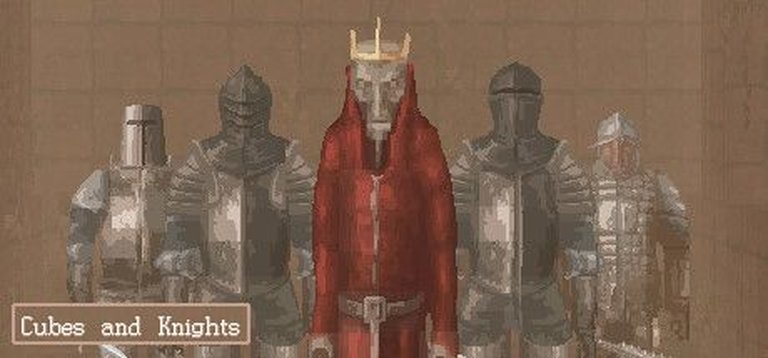
Description
Cubes and Knights is a first-person action game set in medieval fantasy dungeons, where players control a knight sent by the king to hunt down an ancient immortal necromancer lurking in labyrinthine depths filled with secret passages, artifacts, and merchants. Emphasizing melee sword combat with pushes and parries, permanent death mechanics that summon a new knight upon failure, and power-ups like magic staves, elixirs, and rings, the game draws inspiration from 90s early 3D titles using a custom CPU software renderer.
Where to Buy Cubes and Knights
PC
Cubes and Knights Reviews & Reception
store.steampowered.com (93/100): Very Positive (93% of the 77 user reviews for this game are positive).
steambase.io (93/100): Player Score of 93 / 100. Very Positive.
Cubes and Knights: Review
Introduction
In an era dominated by sprawling open-world epics and hyper-realistic blockbusters, Cubes and Knights emerges as a defiant pixelated relic—a solo developer’s love letter to the raw, unforgiving dungeon crawlers of the 1990s. Released in 2022 by Sergey Bobrov, this first-person action-roguelike hurls players into blocky labyrinths teeming with skeletal foes and necrotic horrors, tasking you with slaying an immortal necromancer on behalf of a king who views his knights as utterly expendable. With its software-rendered visuals evoking the jittery charm of early 3D PC games like Wolfenstein 3D or Heretic, the title hooks through brutal melee combat and hidden secrets that reward pixel-peeping persistence. My thesis: Cubes and Knights is a masterful microcosm of retro design philosophy, blending permadeath roguelike tension with souls-like precision in a compact package that punches far above its indie weight, cementing its place as a hidden gem for genre purists despite its brevity.
Development History & Context
Cubes and Knights is the brainchild of Sergey Bobrov, a one-man army who handled every aspect from code to sound design. Self-published on Steam on May 4, 2022, for a modest $7.99, the game arrived amid a roguelike renaissance fueled by titles like Hades and Dead Cells, yet it carves a niche by emulating the technological primitivism of the 90s PC scene. Bobrov coded the engine in C++ using a software renderer—eschewing GPUs entirely, relying on CPU pixel-pushing for that authentic low-res flicker. Tools were equally bootstrapped: Code::Blocks and GCC for compilation, Visual Studio for debugging, Sleepy for profiling, Blender for low-poly models, GIMP for textures, and Audacity for audio. This DIY ethos mirrors the bedroom coding revolution of the DOS era, when developers like id Software squeezed miracles from 486 processors.
The 2022 indie landscape was saturated with procedural roguelites, but Cubes and Knights stands apart by fixing its five-level structure—eschewing endless generation for handcrafted dungeons inspired by 90s shareware like Catacomb 3-D or Rise of the Triad. Constraints bred creativity: minimal system requirements (1GB RAM, 2-core CPU for 800×600) ensure it runs on toasters, evoking an era before bloatware. Bobrov’s vision, explicitly stated in the Steam description, was nostalgic revival—”the era of early 3D on the PC”—amid modern gaming’s GPU arms race. No major studio backing meant no marketing blitz; it flew under radars like Metacritic (no critic scores) and MobyGames (no approved description until community nudges). Yet, its Steam Deck unverified status and family sharing support hint at humble ambitions for broad accessibility.
Narrative & Thematic Deep Dive
At its core, Cubes and Knights delivers a sparse yet thematically potent tale of inexorable duty and disposable heroism. You embody the King’s elite warrior—a hulking brute wielding a massive sword—dispatched to purge an “ancient evil, an immortal necromancer” lurking in primordial dungeons. Dialogue is minimal, confined to terse prompts and merchant barters, but the permadeath mechanic weaves a profound narrative thread: upon defeat, “the King will send the next knight,” underscoring mortality’s futility. This roguelike loop transforms failure into lore, implying an endless parade of fallen heroes, their ghosts haunting procedurally identical runs.
Themes of fatalism and augmentation dominate. The necromancer represents undying corruption, countered not by plot twists but player ingenuity—scavenging “lost artifacts” like magic staves (ranged superiority), elixirs (stat boosts), and rings (exotic powers). No named characters beyond “the King” or “old man” merchants emphasize archetypal medieval fantasy: knight vs. undead horde, labyrinths as metaphors for existential descent. Community posts reveal hidden lore via collectibles—three books and scrolls per level unlock secret shops and new enemies, culminating in a “cool new enemy type” rather than a secret boss, subverting expectations for deeper payoff.
Critically, the narrative’s brevity amplifies replayability; each death reframes the quest as Sisyphean, echoing Dark Souls‘ “you died” philosophy but stripped to cubes. No cinematic cutscenes—just ambient dread—mirrors 90s immersion, where story emerged from survival. Subtle touches, like poison floors or chain-activated secrets, imply ancient builders’ malice, theming dungeons as living traps. Ultimately, victory feels pyrrhic: the necromancer falls, but the King’s mill grinds on.
Gameplay Mechanics & Systems
Cubes and Knights distills action-roguelike essence into taut loops: descend five dungeon levels, melee skeletons and elites, collect power-ups, confront the necromancer. Core combat shines—first-person swordplay emphasizes timing over twitch reflexes. Normal swings cleave foes, pushes create space against packs, and parries enable counters, evoking souls-like risk-reward without stamina bars. Magic staves shatter this melee focus, firing projectiles that “exceed any melee weapon,” while rings grant “unusual abilities” like speed or invincibility bursts.
Progression resets per run (permadeath), but secrets provide meta-advancement. Players unearth books/scrolls (needing multiple runs per level), triangle keys for poison-floor vaults, and chain-pulled grids revealing loot. Merchants vend artifacts using scavenged gold, gating power behind exploration. UI is spartan: a mini-map dots ladders and secrets (e.g., “orange dot” on poison floors), health/stamina bars, and inventory hotkeys—intuitive yet unforgiving, with no tutorials demanding self-discovery.
Flaws emerge in repetition: fixed layouts spawn similar foes (wizards, pike-men, flamberge elites, fat bosses), prompting complaints of “exact same dudes in exact same halls.” Balance wobbles—early levels spike difficulty, janky hitboxes frustrate wizards, and no “story mode” persists upgrades. “No damage” runs trigger minor post-credits events, but no secret final boss disappoints completionists. Playtime (~4 hours per Niklas Notes) suits bite-sized roguelike bursts, with destruction physics (wall-crushing) adding chaos. Innovative yet flawed, it rewards mastery: parry chains, staff swaps, secret-rush strats yield 30-minute clears.
| Mechanic | Strengths | Weaknesses |
|---|---|---|
| Melee Combat | Precise parry/push depth | Janky vs. mages |
| Items/Secrets | High replay incentive | RNG-dependent drops |
| Permadeath | Tense progression | Repetitive restarts |
| UI/Controls | Retro-direct | No remapping |
World-Building, Art & Sound
The dungeons pulse with medieval fantasy decay: blocky corridors of 2.5D pixel graphics—low-poly cubes textured in GIMP’s gritty palettes—evoke King of the Hill-era renders, with flickering torchlight and poison mists crafting claustrophobic dread. Atmosphere thrives on restraint: no skyboxes, just infinite gray walls hiding “secret corridors and halls.” Destruction lets swords pulverize barriers, revealing vaults; poison floors corrode health, ladders propel descents. Levels vary subtly—Level 1’s chain secrets, Level 3’s elite-keyed treasuries, Level 4’s overt shop—building a labyrinthine mythos of forgotten builders.
Art direction nails retro homage: software rendering yields aliasing charm at 800×600, scaling to 1080p on beefier rigs. Models (Blender-sourced) are simplistic—knights as hulking silhouettes, skeletons jittering menacingly—yet animations convey weighty clashes. Sound design, via Audacity, is muffled clangs and guttural grunts; sparse ambiance (drips, winds) heightens isolation, though players critique “lacking” effects. Collectively, these forge immersion: a dark fantasy tomb where every cube hides peril, amplifying tension without bombast.
Reception & Legacy
Launch reception skewed niche but fervent: Steam’s Very Positive (93% of 77 reviews, 81 total per Steambase) praises “satisfying combat” (16%), “challenging gameplay” (10%), and “unique art style” (9%), with exploration (9%) and atmosphere (5%) lauded. Negatives hit repetition (6%), balance (5%), and jank (2%). No Metacritic/MobyGames scores reflect obscurity—added to MobyGames post-release by JarlFrank, zero critic/player reviews. Community forums buzz with secrets (e.g., Level 1 book farm via magic staff), roguelike pleas for meta-upgrades, and “no secret boss?” queries, signaling engaged diehards.
Commercially modest (collected by 1 MobyGames user), its legacy echoes 90s indies like Mordeth—cult appeal for retro fetishists. Influences Barony or Delver in blocky roguelikes; tags like “Souls-like” and “Action Roguelike” position it amid Darkest Dungeon heirs. Potential lingers: expansion calls abound, but as a complete solo vision, it endures as a testament to constraint-driven brilliance, inspiring bedroom devs in GPU-saturated 2025.
Conclusion
Cubes and Knights masterfully resurrects 90s dungeon-delving grit through Sergey Bobrov’s artisanal engine, delivering parry-perfect combat, secret-laden depths, and permadeath philosophy in a pixel-cubed shell. Strengths—visceral melee, atmospheric nostalgia—outweigh repetition and brevity, yielding ~4-hour bursts of triumph. As a historian, I verdict it essential for retro action fans: not a landmark like Doom, but a preserved artifact of indie purity, warranting a 9/10 and spot in “overlooked gems” canon. Descend the cubes, knight—history awaits your blade.