
- Release Year: 2009
- Platforms: Macintosh, Windows
- Publisher: astragon Software GmbH, Big Fish Games, Inc
- Developer: Ph03nix New Media
- Genre: Adventure, Puzzle, Spot the difference
- Perspective: 1st-person
- Game Mode: Single-player
- Gameplay: Hidden object
- Setting: Egypt (Ancient), Egypt (Medieval, Modern)
- Average Score: 80/100
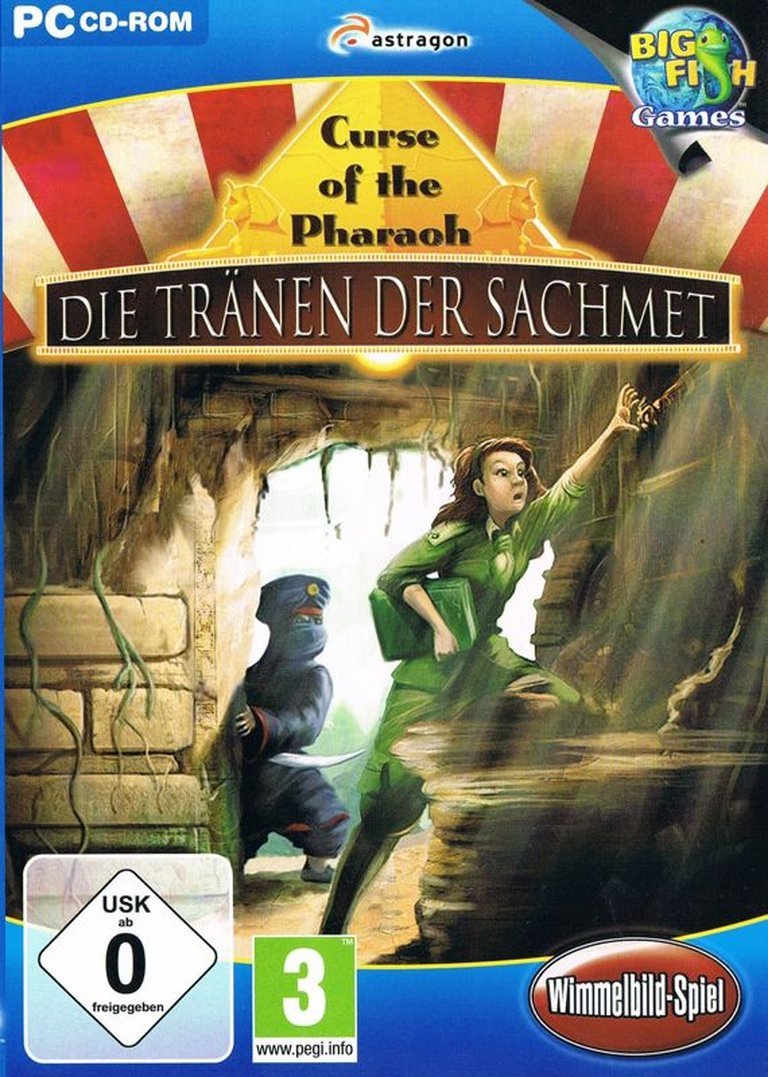
Description
In Curse of the Pharaoh: Tears of Sekhmet, archaeologist Anna discovers the destructive Curse of Nefertiti in Egyptian ruins but is betrayed by her evil step-brother Will, who steals the artifact and buries her alive. Players guide Anna through hidden object scenes, puzzles, and spot-the-differences challenges as she escapes the tomb and searches for the seven Tears of Sekhmet jewels to thwart Will’s world-ending plans in this Ancient Egyptian adventure.
Gameplay Videos
Curse of the Pharaoh: Tears of Sekhmet Free Download
Curse of the Pharaoh: Tears of Sekhmet Guides & Walkthroughs
Curse of the Pharaoh: Tears of Sekhmet Reviews & Reception
gamezebo.com (80/100): It’s a bit easier than you might like, but it’s so beautifully done that you won’t really mind.
Curse of the Pharaoh: Tears of Sekhmet: Review
Introduction
In the pantheon of hidden object adventures, few settings evoke as much mystique as Ancient Egypt. Curse of the Pharaoh: Tears of Sekhmet plunges players into this world, continuing the saga established in The Quest for Nefertiti and Napoleon’s Secret. As archaeologist Anna races against her villainous step-brother Will to recover the seven legendary Tears of Sekhmet jewels, the game delivers a global odyssey blending puzzle-solving, artifact-hunting, and atmospheric storytelling. This review posits that while Tears of Sekhmet excels in visual polish and mechanical variety, its accessibility and reliance on convenience mechanics dilute the challenge, positioning it as a quintessential—if slightly flawed—casual game for its era.
Development History & Context
Developed by Ph03nix New Media and published by Big Fish Games (with astragon Software GmbH handling distribution), Tears of Sekhmet emerged in October 2009—a pivotal year for casual gaming. The studio, led by producers Jon Lam and Tiffany Lee, assembled a 15-person team including writer/designer Tim Perreault, lead programmer Lorne Sturtevant, and art director Michael Grills. Their vision was to create a polished, narrative-driven hidden object game that expanded beyond Egypt’s borders, offering a worldwide adventure while retaining the series’ core appeal.
Technologically, the game targeted modest systems: Windows XP/Vista with a 1.0 GHz CPU, 128 MB RAM, and DirectX 9.0. This constrained its visual scope but allowed for smoother performance on mid-2000s hardware. Released as shareware via CD-ROM and download, it capitalized on Big Fish Games’ dominance in the casual market—where hidden object games thrived as accessible, bite-sized adventures. The genre was saturated, yet Tears of Sekhmet distinguished itself through its international locales and integrated puzzle systems, reflecting the era’s trend toward hybridizing gameplay.
Narrative & Thematic Deep Dive
The plot unfurls with classic pulp adventure tropes: Anna and Professor Cullen unearth the “Curse of Nefertiti,” an apocalyptic artifact, only to be betrayed by Will, who steals it and buries them alive. Anna’s escape initiates a globe-trotting quest to collect the Tears of Sekhmet—jewels capable neutralizing the curse before Will harnesses its power. While the narrative efficiently establishes stakes (family rivalry, world-ending peril), it prioritizes gameplay over character depth. Anna is a determined but archetypal heroine, while Will’s “psychotic” ambition (per the Big Fish Games description) lacks nuance, serving as a straightforward antagonist.
Themes of preservation vs. exploitation permeate the story. Anna’s quest to safeguard the Tears contrasts with Will’s desire to control ancient power for destructive ends, mirroring real-world debates about cultural heritage. The global settings—from the Antarctic Temple to a Japanese Palace—also subtly frame archaeology as a unifying human endeavor, transcending borders. However, dialogue is minimal, with lore delivered via journal entries rather than immersive cutscenes. The narrative’s strength lies in its structure, guiding players through distinct cultures and historical puzzles, albeit with a predictable emotional arc.
Gameplay Mechanics & Systems
Tears of Sekhmet centers on hidden object (HO) scenes—the genre’s signature mechanic. Players scan cluttered environments for 10 listed items per scene, marked in blue (inventory) or red (puzzle items). These are straightforward but occasionally clever, requiring contextual reasoning (e.g., finding a “handle” to pair with a “partition”). The game spices this up with:
– Find-the-Difference Puzzles: Split-screen comparisons where subtle discrepancies (e.g., a shadow’s length) demand meticulous observation.
– Inventory Integration: Red items must be dragged-and-dropped onto interactive elements (e.g., placing a scarab on a sarcophagus to unlock new paths).
– Global Mini-Games: A Hanoi Tower-style statue puzzle, tile-swapping challenges, and a grid-lighting circuit test varied skills.
Progression hinges on three collectibles per scene: coins (for the in-game shop), mask pieces (awarding hints/coins), and Tear fragments (advancing the plot). The shop system, however, undermines challenge. Tools like the double cursor (for easier difference spotting), oxygen tank (for underwater time limits), or hammer (to skip puzzles) are purchasable with coins. Since coins are abundant and mandatory for progression, players rarely face true difficulty. Critic Vanessa Carter (GameZebo) notes, “Knowing you’re a single click away from an answer saps some joy,” highlighting this tension between accessibility and engagement.
UI is intuitive, with bottom tabs for object lists, tools, puzzle items, and shop access. A map screen tracks location progress, and hints—either a button revealing an item’s location or a “Wipi” creature capture—ensure players rarely stall. While the system is “polished it practically gleams” (GameZebo), its hand-holding may frustrate veterans.
World-Building, Art & Sound
The game’s world-building is its crown jewel. Nine distinct locales—from Egypt’s hidden temples to a sunken African shipwreck—are rendered with detailed, hand-drawn art. Each environment bursts with cultural specificity: hieroglyphs in the British Museum’s Tomb Chapel of Nabanum, neon-lit Parisian streets, and an Antarctic Temple’s frost-encrusted architecture. This diversity prevents monotony, even as HO scenes repeat.
Atmosphere is masterfully crafted. Dark tombs flicker with torchlight, watery depths murmur with ambient sounds, and mirrored inverted scenes disorient players. SomaTone Interactive Audio’s score elevates tension during chases and mystery during explorations, using leitmotifs for Egypt and global locales. Sound effects—clinking coins, grinding mechanisms, water drips—add tactile immersion. The result is a “gorgeous” and “wonderful” (GameZebo) experience that transports players, even if HO lists occasionally feel perfunctory.
Reception & Legacy
Upon release, Tears of Sekhmet earned critical acclaim for its presentation. GameZebo scored it 80%, praising its “polished” visuals and “loads to do,” while noting its “bit easier than you might like.” Players appreciated its standalone narrative—no prior series knowledge required—and global scope. Commercially, it capitalized on Big Fish Games’ distribution, becoming a staple for casual gamers.
Its legacy is twofold. Within the genre, it exemplified the mid-2000s trend of blending HO gameplay with adventure and puzzle elements, influencing titles like Mystery Case Files. However, it’s rarely cited as a revolutionary entry; its ease and familiar formula place it among solid, if derivative, works. The Curse of the Pharaoh series continued with iterative sequels, but Tears of Sekhmet remains a benchmark for atmospheric polish. Modern players might find its mechanics simplistic, but it retains nostalgic value for fans of the golden age of casual gaming.
Conclusion
Curse of the Pharaoh: Tears of Sekhmet is a triumph of execution over innovation. Its art, sound, and global scope create an immersive adventure that casual gamers will adore, while its varied puzzles prevent monotony. Yet, the game’s reliance on convenience tools and forgiving difficulty robs it of the tension that could elevate it to greatness. For historians, it represents a snapshot of 2009’s casual gaming boom—where accessibility trumped complexity, and visual polish was paramount.
Verdict: A beautifully crafted, if undemanding, hidden object gem. It’s essential for series fans and genre newcomers seeking a polished, atmospheric jaunt, but hardcore players may yearn for greater challenge. In the annals of gaming history, Tears of Sekhmet stands as a testament to the power of art and accessibility—even when its ambition is more geographical than revolutionary.