
- Release Year: 2021
- Platforms: Windows
- Publisher: smatrade GmbH
- Developer: LGT SIA
- Genre: Action
- Perspective: 1st-person
- Game Mode: Single-player
- Gameplay: Cards, Hidden object, Mini-games, Puzzle elements, Tile matching puzzle, Tiles
- Setting: Detective, Mystery
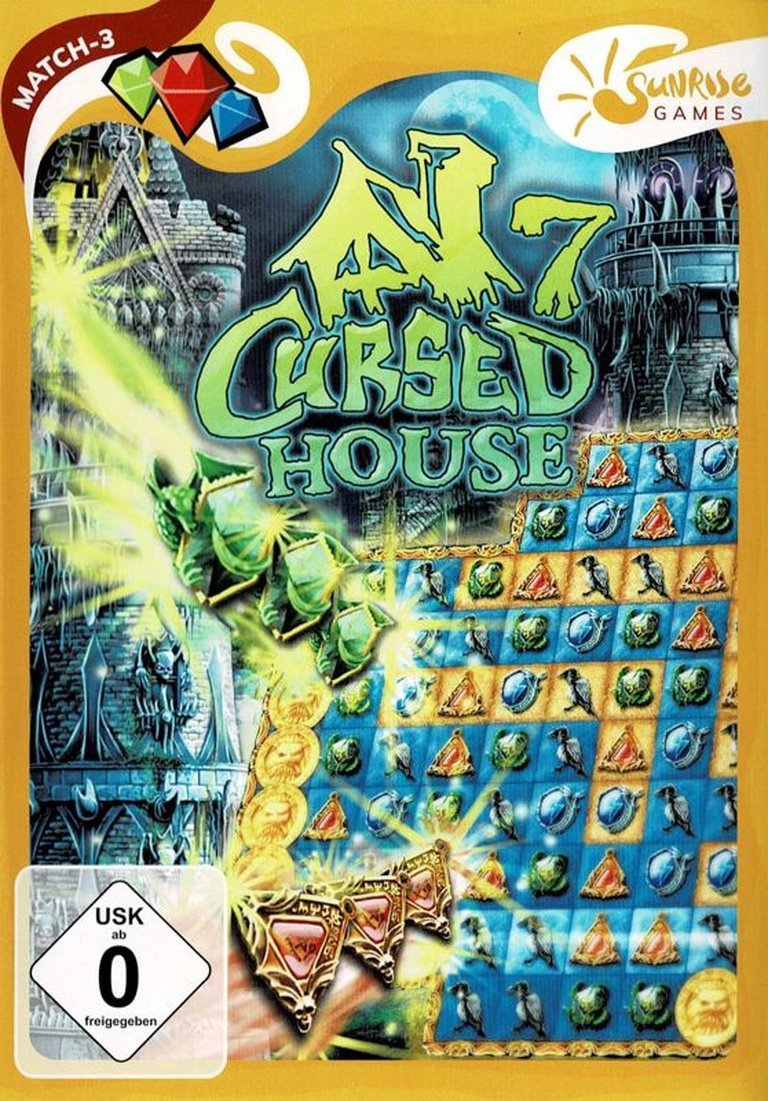
Description
Cursed House 7 is a hybrid match-3 puzzle game set in a small seaside town that has been overrun by evil spirits released from the depths of the sea. Players harness the power of a mysterious Amulet—the same tool that summoned the evil—to banish the ghosts through over 105 puzzles, including tile matching, hidden objects, and mini-games, all within a detective-themed mystery narrative.
Where to Buy Cursed House 7
PC
Cursed House 7: A Haunting Mastery of the Hybrid Match-3 Formula
Introduction: The Ghost in the Machine of Casual Gaming
In the sprawling, ever-expanding universe of casual puzzle games, few series have demonstrated the quiet, relentless perseverance of Cursed House. Emerging from the European development scene, this long-running franchise has, for over a decade, meticulously refined a specific and potent subgenre: the narrative-driven, hybrid match-3 adventure. Cursed House 7, released in 2021 by the Latvian studio LGT SIA and published by smatrade GmbH, is not a game that seeks to reinvent the wheel. Instead, it represents a summit of iterative design—a title that perfects the established mechanics of its lineage while encapsulating the entire evolutionary path of the modern “haunted house” puzzle game. This review will argue that Cursed House 7 is a critical text for understanding the aesthetics of efficiency and thematic cohesion within the constraints of the commercial casual market. It is a game built not on revolutionary spectacle, but on the unwavering reliability of its core loop, a digital séance where every matched tile is a whispered incantation against chaos.
Development History & Context: Latin Efficiency in a Global Market
The Studio and the Vision:
LGT SIA, a development studio based in Riga, Latvia, operates within a distinct niche of the games industry: the “value-priced” or “mid-core” casual market. Unlike the high-budget, high-risk ventures of AAA or theuteur-driven indie experiments, studios like LGT SIA thrive on expertise in a specific formula. Their body of work, heavily concentrated in the Cursed House series and related titles like Cursed and Cursed Roots, reveals a clear design philosophy: maximize engaging, low-friction gameplay within a consistent spooky-occult aesthetic. The “vision” for Cursed House 7 was almost certainly one of consolidation and polish—taking the proven hybrid model of its immediate predecessor, Cursed House 6 Bundle, and expanding its scope with a new thematic backdrop (a seaside town) and 105 fresh puzzles.
Technological Constraints & The “CD-ROM” Era Mindset:
The game’s specification lists “Media Type: CD-ROM,” a fascinating anachronism for a 2021 PC release. This is not a technical requirement but a cultural marker. It signals that the game is designed for the distribution and consumption model of the casual download portal (Big Fish Games, GameHouse, GameFools). These platforms often bundle games into collections, sell them as one-time purchases, or offer them via subscription. The technology—likely a lightweight, DirectX 9-era engine—is chosen not for graphical fidelity but for maximum compatibility with low-spec PCs, the primary hardware of its target audience (older players, casual gamers). The “Fixed / flip-screen” visual perspective and “Direct control” interface are hallmarks of this design school: clarity over cinematic flair, immediate feedback over complex inputs.
The 2021 Gaming Landscape:
Released in 2021, Cursed House 7 entered a world where “match-3” was a genre dominated by monolithic franchises like King’s Candy Crush Saga (mobile) and PopCap’s Bejeweled (console/PC). The niche it occupies—the hybrid narrative-adventure match-3—was and is fiercely competed for by other series like Mystery Case Files, Hidden Expedition, and Jewel Quest. Its competition was not Hades or Resident Evil Village, but Mystery Manor and Brøste. In this context, Cursed House 7’s success was measured in steady, quiet sales through digital storefronts and bundle deals, not in Metacritic scores (which are nonexistent) or viral Twitter moments. It is a product of a robust, stable, and often critically overlooked economic segment of gaming.
Narrative & Thematic Deep Dive: The Amulet as a Mechanic and a Metaphor
The narrative of Cursed House 7 is delivered with the minimalistic efficiency of its puzzles. As per the official description: “Hordes of evil spirits have been released from the depths of the sea and have taken hold of a small town at the shore and the surrounding areas. Once again, the Amulet will be the key to banishing the spirits as it was the tool that summoned the evil in the first place!”
Plot as Framework:
The plot is a causal loop. A mysterious amulet (a MacGuffin of pure utility) caused a problem (summoning sea spirits), and now the player must use the same amulet to solve it. This isn’t a story of discovery or moral choice; it’s a story of tool usage. The “seaside town” setting provides a fresh environmental skin—think fog-drenched piers, boarded-up lighthouses, and haunted seafood shacks—but the core narrative beat remains identical to every prior Cursed House entry: a possessed location, a mystical artifact, a cycle of banishment. The lack of character development or dialogue (none is mentioned in the sources) is not a flaw but a feature. The player is not a protagonist with a name or backstory; they are an operator. They are the hands that move the tiles, the mind that solves the patterns, the will that wields the amulet. The narrative exists purely to justify the spatial progression (“cleansing” one area to move to the next) and to layer a consistent thematic veneer of “supernatural detective work” over the abstract puzzle-solving.
Themes: Order vs. Chaos, Ritual and Repetition:
The deepest theme is the imposition of order upon chaos, a perfect metaphor for the match-3 mechanic itself. The board is a jumbled, spirit-corrupted mess. The player’s task is to create sets of three, to impose color and shape-based order, which in the game’s logic releases “catalysts of energy” that exorcise “even the toughest ghosts.” Each match is a small ritual of purification. The “Amulet” is the sanctioned tool of this ritual—a focus for the player’s actions. The repetition of this cycle across 105 levels becomes a digital meditation. The “Hardcore or Casual modes” speak directly to this theme: in Hardcore, the chaos (spirits, frozen tiles, blockers) is more persistent and aggressive, demanding more strategic, ordered planning. In Casual, the ritual is gentler, the chaos more forgiving. The game mechanically encodes its own theme of controlled versus overwhelming supernatural force.
Gameplay Mechanics & Systems: The Anatomy of a Hybrid
Cursed House 7 is classified as a “hybrid Match 3” game. This means the core tile-matching is interwoven with other puzzle types and adventure-game tropes.
Core Loop – The Match-3 Engine:
The heart of the game is a classic swap-based match-3 grid. The goal on most levels is a specific objective: banish a certain number of spirits (by matching tiles adjacent to them), clear “ice” or “frost” tiles (by matching adjacent tiles), collect keys to open chests, or break stone barriers. The “Amulet” is not a separate inventory item but an integrated game-state modifier. Sources state you use it to “produce catalysts of energy,” which in practice likely means that matching certain special tiles (perhaps gold/yellow “amulet” tiles, hinted at in the Steam guide discussion for Level 23) triggers board-wide effects like explosions, which are crucial for solving the more complex puzzles. The Steam guide for Level 23 reveals a sophisticated puzzle design: players must sequence specific tile activations (“activate the left side, then the bottom, and then the right side”) to channel “fire” (a special effect) to a frozen coin. This indicates a puzzle design that goes beyond simple match clearance into spatial logic and chain reaction planning.
Hybrid Elements – The “Adventure” Glue:
The game promises “Solitaire, Find the difference and Hidden Objects” as bonus mini-games. In the hybrid model, these serve two purposes:
1. Pacing: They break the intensity of the match-3 focus, providing a different cognitive challenge.
2. Progression & Rewards: Completing these mini-games likely awards bonus resources (like “Amulet charges” or extra moves) or progresses the “exploration” of the seaside town map. The “Detective / mystery” narrative genre suggests players click between locations on a overworld map, with each match-3 level or hidden object scene representing an “investigation” of a specific haunted locale (the pier, the fisherman’s cottage, the seaside inn).
Difficulty & Accessibility – Hardcore vs. Casual:
This is a significant systemic choice. “Casual” mode would presumably offer more moves, a more forgiving timer (if a timer exists), and perhaps more frequent appearances of helpful power-ups. “Hardcore” mode would tighten move counts, introduce more aggressive blockers, and remove hints. This bifurcation allows the game to cater to both the player seeking a relaxing, ambient experience and the player seeking a punishing, logic-puzzle challenge—all within the same 105-level structure. It maximizes the product’s appeal without requiring separate development paths.
UI & Interface:
The “Direct control” and “Menu structures” specification points to a standard, no-frills interface: a prominent game board, a clear objective tracker, and easily accessible pause/quit menus. There is no implication of complex inventory management or stat screens. The player’s skill is their puzzle-solving acumen, not character build. This is a pure “game” interface, stripped of RPG or simulation layers.
World-Building, Art & Sound: Atmospheric Consistency Over Graphic Novelty
Given the lack of high-resolution screenshots in the provided data, analysis must infer from genre conventions and the described “eerie atmosphere.”
Visual Direction & Atmosphere:
The “Fixed / flip-screen” perspective in a first-person game is a specific choice. It likely means the view is static on a location (e.g., a static image of a haunted hallway), and the match-3 board is overlaid on it, possibly as a “magical projection” from the amulet. “Flip-screen” might indicate that completing a level “flips” the view to the next static scene, advancing the exploration. The art style would be realistic-moody or stylized-dark, with a cool, damp color palette (blues, greys, murky greens) fitting the “depths of the sea” and “seaside town” theme. Visual storytelling would be environmental: a shattered fishing net, a ghostly figure in a broken window, seaweed hanging from a ceiling. The world is not a 3D space to traverse but a series of evocative tableaus to “cleanse.”
Sound Design:
No specific credits or descriptions are provided. However, the genre dictates a soundscape of:
* Ambience: Distant waves, wind howling through broken windows, creaking wood, dripping water.
* UI Feedback: Crisp, satisfying clicks for tile matches, a deep chime for special tile activations, a rising, ethereal hum when the Amulet’s power is used.
* Musical Themes: Looping, melodic but slightly haunting MIDI-style tracks that change subtly as one progresses through different areas of the town. The music would likely be non-intrusive, designed to fade into the background during intense puzzle-solving but provide a haunting underscore during exploration.
The contribution of these elements is to maintain a consistent, low-grade suspense. The game is not terrifying; it is uneasy. This tone perfectly matches its audience: safe scares for an evening of casual play.
Reception & Legacy: The Silent Success of a Workhorse
Critical & Commercial Reception:
There are no critic reviews on Metacritic or MobyGames for Cursed House 7. This is the single most telling data point. It did not appear on the radars of mainstream or even enthusiast gaming press. Its commercial life was almost entirely conducted through the “funnel” of digital storefronts (Big Fish Games, GameHouse, Steam), bundle collections (the “Cursed House Collection” with 14 games for $49.99), and subscription services like GameFools On Demand. User reviews are also absent, indicating a player base that is large but disengaged from review culture. Its “reception” is therefore a silent, statistical one: it sold steadily, likely for years, as part of a catalog. The Steam discussion thread has only one post—a strategy guide for Level 23—which, paradoxically, is a mark of engaged players who found the challenge compelling enough to seek help.
Evolution of Reputation & Influence:
Its reputation has not evolved because it never had a public reputation to evolve. Within its niche community of hybrid match-3 aficionados, it is likely viewed as a solid, if not standout, entry in a beloved series. Its influence on the industry is indirect but significant. Games like Cursed House 7 represent the bedrock of the casual games market, a multi-billion-dollar segment that funds the operations of publishers like Big Fish Games and provides a sustainable lifestyle for dozens of developers like LGT SIA. It has not influenced Blizzard or Nintendo, but it has defined the expectations for thousands of players who buy a “haunted match-3 game” once a month. It perfected a template that newer series (Amanda’s Magic Book, Gaslamp Cases) now iterate upon with their own thematic skins.
Conclusion: The Definitive Verdict on a Quiet Classic
Cursed House 7 is not a game that aims for the pantheon. It does not feature philosophical narratives, genre-blending mechanics, or graphical breakthroughs. To judge it by those standards is to fundamentally misunderstand its purpose. It is a consummate professional in its field—a precision instrument for delivering a specific experience: 10-20 hours of satisfying, spooky-tinged puzzle-solving with zero friction and maximum reliability.
Its place in video game history is not in the canon of “important” or “transformative” games. Instead, its significance is anthropological. It is a perfect artifact of the late-2010s/early-2020s casual gaming ecosystem: a low-spec, widely accessible, hybrid-puzzle game built on a decade of iterative refinement, sold through a specific digital pipeline to a loyal, quiet audience. It demonstrates that a game can be utterly successful on its own terms while remaining virtually invisible to the broader cultural conversation. For the historian, Cursed House 7 is a vital data point, proving the enduring power of a well-executed formula. For the player within its target demographic, it is simply a very good, very competent haunted match-3 game—and that is its own, hard-earned kind of excellence. It does not need to be seen to be effective. It simply works.
Final Score (Relative to Genre & Intent): 4 out of 5 Amulets. A masterclass in focused, hybrid casual design, penalized one point solely for its utter lack of ambition beyond its own excellent, self-imposed constraints.