
- Release Year: 2009
- Platforms: Wii, Windows
- Publisher: Koch Media GmbH (Austria), Noviy Disk
- Developer: Deep Silver GmbH, Sproing Interactive Media GmbH
- Genre: Action, Survival horror
- Perspective: Third-person
- Game Mode: Single-player
- Gameplay: Combat with pick axe, Mountain climbing, Puzzle elements, Third eye mechanic
- Setting: Asia, Himalayas, Mountain, Village
- Average Score: 77/100
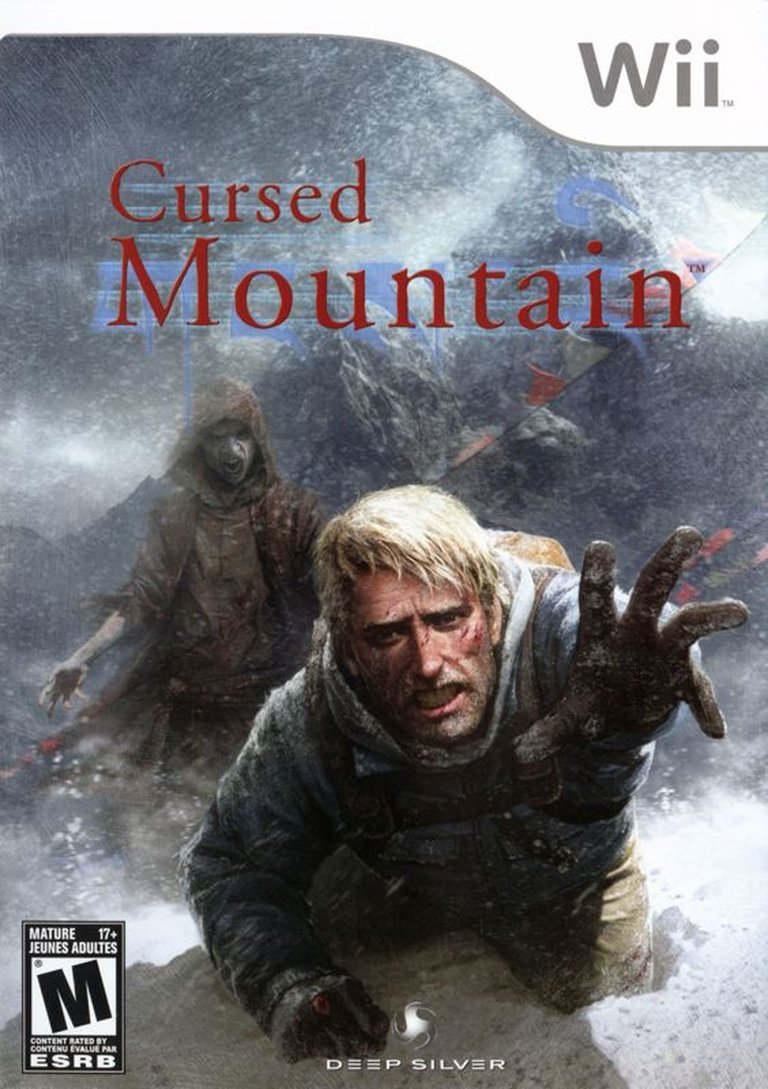
Description
Cursed Mountain is a survival horror game set in the Himalayas, where protagonist Eric Simmons searches for his missing brother, Frank, in the deserted village of Lhando. Armed with a pickaxe and a mystical ‘third eye’ ability, Eric battles supernatural forces, solves puzzles, and climbs treacherous mountains to uncover the dark secrets behind the village’s abandonment. The game blends exploration, combat, and puzzle-solving, with motion controls for climbing and fighting ghosts.
Gameplay Videos
Cursed Mountain Free Download
Cursed Mountain Guides & Walkthroughs
Cursed Mountain Reviews & Reception
metacritic.com (67/100): A great setting and lots of top shocks – Cursed Mountain is chilling in every sense.
fanboydestroy.com (95/100): Cursed Mountain is designed to scare you in a more than few ways, but if you fit squarely into the first two categories above, you’ll need to thoroughly surrender yourself to its finer points if you expect to fully enjoy what’s here.
bullz-eye.com (70/100): Deep Silver should be proud of this one. It truly adds something to a tired genre, and while it feels low-budget at times, the deeply involving story will keep you entertained from start to finish.
Cursed Mountain Cheats & Codes
Nintendo Wii (US)
These codes work only when used with a softmodded Wii running the Gecko OS (or compatible homebrew application).
| Code | Effect |
|---|---|
| 040CBA40 60000000 | Infinite Health |
| 0481E3B0 000003E7 | Infinite Incense Sticks |
| 040E7C98 909F0030 040EC4F0 909F0030 040EAD58 907C0030 |
Infinite Ammo |
| 040E7C94 60000000 040EC4EC 60000000 040EAD44 60000000 |
Rapid Fire |
| 0775C000 00000010 3D604000 916400B4 C02400B4 4A97330C 040CF314 4968CCEC |
Speed x2 |
| 0775C010 00000020 3D608069 896BD7CB 2C0B0008 4082000C C1C30040 EC0E002A D0030034 4A91B77C 040777A4 496E486C 0498B230 3E99999A |
Jump (Press Up on WiiMote) |
Cursed Mountain: A Haunting Ascent into the Unknown
Introduction
In the annals of survival horror, few games dare to tread the path less traveled. Cursed Mountain, released in 2009 for the Wii and later ported to Windows, is one such title—a game that defies convention, embraces cultural depth, and attempts to carve its own niche in a genre dominated by zombies, jump scares, and gothic mansions. Developed by Sproing Interactive Media and Deep Silver Vienna, Cursed Mountain is a game that polarizes critics and players alike, yet remains a fascinating case study in atmospheric storytelling, innovative gameplay mechanics, and the challenges of pushing a console’s limitations.
This review will dissect Cursed Mountain in exhaustive detail, exploring its development history, narrative depth, gameplay mechanics, artistic vision, and lasting legacy. By the end, we will determine whether this game is a forgotten gem, a flawed experiment, or a cautionary tale of ambition outpacing execution.
Development History & Context
The Birth of a Unique Vision
Cursed Mountain was conceived as a departure from the typical survival horror fare. The development team, led by industry veterans including writer Bob Bates and former Rockstar Vienna staff, sought to create a game that was deeply rooted in real-world folklore and spirituality. The initial concept revolved around a game set in Asia, with a strong emphasis on religion and scenery. This evolved into a survival horror experience set in the Tibetan Himalayas, a region steeped in mysticism and untouched by the clichés of Western horror.
The choice of the Wii as the primary platform was strategic. The Wii’s motion controls offered a unique opportunity to immerse players in the game’s spiritual combat mechanics, particularly the use of gestures to exorcise ghosts. This was a bold move, given the Wii’s reputation as a family-friendly console dominated by casual games. Cursed Mountain aimed to prove that the Wii could handle mature, atmospheric experiences just as well as its competitors.
A Collaborative Effort
The development of Cursed Mountain was a massive collaborative effort, involving 16 external companies across 14 countries. This level of outsourcing was unprecedented for Deep Silver, and while it allowed for a diverse range of talents, it also introduced challenges in communication and consistency. The team relied on a simple, unified game design document and frequent web calls to maintain cohesion, but delays and the closure of some partner studios during development added to the complexity.
The game’s engine, dubbed “Athena,” was a proprietary creation by Sproing Interactive, designed to push the Wii’s graphical capabilities. The team aimed for realism in both the environment and the supernatural elements, striving to create a seamless, immersive experience. However, hardware limitations forced them to scale down some of their ambitions, particularly in level size and scope.
The 1980s Setting and Cultural Research
The decision to set Cursed Mountain in the late 1980s was deliberate. This era was chosen to enhance the sense of isolation and helplessness, as modern technology like cell phones and GPS were not yet ubiquitous. The setting also played into the superstitions of the time, where Western climbers were often viewed with suspicion by locals who believed they were violating sacred customs.
The narrative and environmental design were heavily influenced by Tibetan Buddhist folklore, particularly the concept of the Bardo—a transitional realm between life and death. The team conducted extensive research, drawing from documentaries on Buddhism, the Dalai Lama, and survival stories like Touching the Void. The tragic tale of Reinhold Messner, who lost his brother on an expedition, served as inspiration for the game’s central plot of one brother searching for another.
The Role of Motion Controls
Motion controls were integral to Cursed Mountain from its inception. The combat system was built around the idea of using gestures to perform exorcisms, a mechanic inspired by real-world mantras. However, early playtesting revealed that players craved more direct combat interactions, leading to the introduction of the pickaxe as a weapon. This hybrid approach—blending motion-based spiritual attacks with traditional melee combat—was intended to create a unique, immersive experience.
The climbing mechanics also utilized the Wii Remote and Nunchuk, requiring players to mimic climbing motions to scale icy walls. This was another attempt to deepen immersion, though it would later become a point of contention among critics.
Release and Reception
Cursed Mountain was announced in 2008 and released in August 2009 for the Wii, with a Windows port following in early 2010. The game received minimal marketing support from Deep Silver, which may have contributed to its mixed reception. Critics praised its narrative depth, atmospheric tension, and cultural authenticity, but many were frustrated by its motion controls, linear level design, and occasional technical shortcomings.
The game’s development studio, Deep Silver Vienna, closed shortly after its release, making Cursed Mountain its sole title. This closure, attributed to economic challenges, left the game as a standalone experiment—a testament to both its ambition and its struggles.
Narrative & Thematic Deep Dive
Plot Summary
Cursed Mountain follows Eric Simmons, a mountaineer searching for his brother Frank, who has vanished during an expedition to retrieve a sacred artifact known as the Terma from the mountain Chomolonzo. The Terma is believed to grant eternal life, and its retrieval has unleashed a curse upon the region, summoning hostile ghosts and monsters.
Eric’s journey begins in the abandoned village of Lhando, where he is attacked by a ghost and rescued by the monk Thod-pa. Thod-pa teaches Eric to awaken his “third eye,” a spiritual ability that allows him to see and combat the supernatural entities plaguing the mountain. As Eric ascends Chomolonzo, he uncovers the dark truth behind Frank’s disappearance and the true nature of the Terma.
The narrative unfolds through a series of journal entries, environmental storytelling, and encounters with surviving villagers and monks. Eric learns that Frank, in his haste to retrieve the Terma, skipped crucial rituals, angering the mountain’s deity, Palden Lhamo. This sacrilege has trapped Frank’s spirit in the Bardo, a liminal space between life and death. Eric’s quest culminates in a confrontation with his own inner demons and a final, bittersweet reunion with Frank, who chooses to embrace reincarnation rather than return to the living world.
Themes and Symbolism
Cursed Mountain is rich with themes of brotherhood, sacrifice, and the consequences of greed. The relationship between Eric and Frank is central to the story, with Eric’s journey serving as both a physical and spiritual ascent. The mountain itself is a symbol of both challenge and enlightenment, reflecting the Buddhist concept of suffering as a path to wisdom.
The game’s exploration of the Bardo is particularly compelling. The Bardo represents a state of limbo, where souls are trapped between existence and non-existence. This theme is mirrored in Eric’s own psychological struggle, as he confronts his fears and doubts while climbing the mountain. The ghosts he encounters are not merely enemies but manifestations of unresolved trauma, both his own and those of the villagers who perished on Chomolonzo.
The Terma, the artifact at the heart of the story, symbolizes the dangers of seeking immortality. Frank’s desire to possess it leads to his downfall, while Eric’s selfless quest to save his brother ultimately redeems him. The game’s ending, where Frank chooses reincarnation over resurrection, reinforces the Buddhist belief in the cyclical nature of life and the importance of letting go.
Characters and Dialogue
Eric Simmons is a well-realized protagonist, voiced with a Scottish accent to reflect the historical prevalence of Scottish mountaineers in the Himalayas. His character is defined by determination and resilience, though his dialogue can occasionally feel stiff. The supporting cast, including Thod-pa, Jomo Menmo, and Edward Bennett, are similarly well-developed, each contributing to the game’s themes of faith, betrayal, and redemption.
The dialogue is generally strong, though some critics have noted inconsistencies in tone, particularly in the game’s latter half. The voice acting is commendable, with a cast of English and Scottish actors lending authenticity to the characters. However, the game’s reliance on journal entries and environmental storytelling means that much of the narrative is conveyed through text, which may not resonate with all players.
Cultural Authenticity
One of Cursed Mountain’s greatest strengths is its respectful and detailed portrayal of Tibetan Buddhist culture. The game incorporates real-world rituals, such as the kora (circling a sacred site before entering), and uses authentic Tibetan chanting in its soundtrack. The developers’ commitment to cultural accuracy is evident in the game’s environmental design, from the architecture of the monasteries to the depiction of religious artifacts.
However, the game’s blending of Buddhist mythology with Western horror tropes occasionally feels uneven. While the Bardo and the concept of Palden Lhamo are faithfully represented, the game’s more overtly supernatural elements—such as the demonic transformation of Edward Bennett—can clash with the otherwise grounded tone. This tension between authenticity and genre conventions is a recurring theme in Cursed Mountain, and one that contributes to its polarizing reception.
Gameplay Mechanics & Systems
Core Gameplay Loop
Cursed Mountain is a survival horror game with strong action-adventure elements. The core gameplay loop revolves around exploration, puzzle-solving, and combat. Players guide Eric Simmons through a series of linear environments, from abandoned villages to icy cliffs, as he ascends Chomolonzo. The game is divided into thirteen levels, each with its own set of challenges and objectives.
Exploration is a key component of the experience. Eric must search for items, such as health-restoring incense sticks and journal entries, which provide lore and context. The game’s environments are meticulously designed, with hidden pathways and interactive objects that encourage thorough exploration. However, the linear level design can feel restrictive, with many areas blocked off until specific puzzles are solved.
Combat and the Third Eye
Combat in Cursed Mountain is a blend of traditional melee attacks and motion-based spiritual gestures. Eric’s primary weapon is a pickaxe, which can be upgraded with ritual objects to enhance its power. The pickaxe is used both for melee strikes and ranged attacks, with the latter requiring players to aim and fire projectiles at ghosts.
The game’s most innovative mechanic is the “third eye,” a spiritual ability that allows Eric to see hidden symbols and weaknesses in his enemies. Activating the third eye is done by pointing the Wii Remote at the screen, which shifts the game into a first-person perspective. This mechanic is used for both combat and puzzle-solving, as some doors and seals can only be unlocked by revealing hidden symbols.
Once a ghost is weakened, a glowing symbol appears on its body. Players must then perform a quick-time event (QTE) by matching motion gestures with the Wii Remote and Nunchuk to banish the ghost permanently. These gestures are based on real-world mantras and are intended to immerse players in the spiritual combat. However, the motion controls can be unresponsive, leading to frustration during intense encounters.
Climbing and Environmental Interaction
In addition to combat, Cursed Mountain features climbing sections that utilize the Wii’s motion controls. Players must mimic climbing motions with the Wii Remote and Nunchuk to scale sheer walls, adding a layer of physicality to the gameplay. These sections are generally well-implemented, though they can feel repetitive over time.
The game also incorporates environmental hazards, such as rock slides and oxygen deprivation, which add tension to the climbing sequences. At higher altitudes, Eric’s oxygen levels deplete, forcing players to manage their resources carefully. These mechanics reinforce the game’s themes of survival and endurance, though they can also contribute to the game’s occasionally sluggish pacing.
Puzzle Design
Puzzles in Cursed Mountain are primarily environmental, requiring players to manipulate objects, activate switches, or decipher symbols using the third eye. While these puzzles are generally well-integrated into the narrative, they can be overly simplistic, with many solutions involving straightforward object manipulation.
One of the game’s more innovative puzzle mechanics is the use of the third eye to reveal hidden pathways and symbols. This mechanic ties into the game’s spiritual themes and encourages players to engage with the environment in a more immersive way. However, the lack of variety in puzzle design can make these sections feel repetitive, particularly in the game’s latter half.
User Interface and Inventory Management
The game’s user interface (UI) is minimalist, with a focus on immersion. Health and oxygen levels are displayed as circular meters that appear only when relevant, avoiding the clutter of a traditional HUD. This design choice enhances the game’s atmospheric tension, though it can also make it difficult to track resources during combat.
Inventory management is handled through a backpack system, where players can store items and weapons. The backpack is accessed through a menu, which can feel cumbersome during intense moments. The lack of a quick-select system for weapons or items is a notable omission, particularly given the game’s emphasis on combat and resource management.
Technical Performance and Controls
Cursed Mountain’s technical performance is a mixed bag. The game’s proprietary engine, Athena, pushes the Wii’s graphical capabilities, delivering detailed environments and atmospheric lighting. However, the game suffers from occasional slowdown, particularly during combat sequences, and the draw distance can be inconsistent.
The motion controls are the most divisive aspect of the gameplay. While they are innovative and immersive when they work, their lack of responsiveness can lead to frustration. The climbing mechanics, in particular, can feel imprecise, and the combat gestures often fail to register correctly. The Windows port attempts to address these issues by replacing motion controls with mouse-based gestures, but this solution is not without its own flaws.
World-Building, Art & Sound
Setting and Atmosphere
Cursed Mountain’s setting is one of its greatest strengths. The game’s environments, from the abandoned village of Lhando to the icy peaks of Chomolonzo, are richly detailed and steeped in atmosphere. The developers’ commitment to cultural authenticity is evident in the architecture, religious artifacts, and environmental storytelling.
The game’s use of lighting and fog is particularly effective in creating a sense of isolation and dread. The environments are often shrouded in mist, obscuring distant objects and adding to the game’s eerie tension. The lack of a traditional HUD further enhances this immersion, as players are forced to rely on environmental cues to navigate the world.
Visual Design and Art Direction
The visual design of Cursed Mountain is a blend of realism and stylization. The character models are detailed, with a focus on realistic proportions and facial expressions. The ghosts and supernatural entities are similarly well-rendered, with a design that draws from Tibetan Buddhist iconography.
The game’s art direction is consistent with its cultural themes, incorporating authentic Tibetan symbols and motifs. The monasteries and villages are meticulously designed, with a focus on architectural accuracy. However, the game’s graphical fidelity is limited by the Wii’s hardware, and some textures and animations can appear dated.
Sound Design and Music
The sound design in Cursed Mountain is exceptional, contributing significantly to the game’s atmospheric tension. The environments are filled with ambient noise, from the howling wind on the mountain to the distant chanting of monks. The game’s use of Tibetan chanting and traditional instruments adds to its cultural authenticity, creating a soundscape that is both immersive and unsettling.
The soundtrack, composed by Darren Lambourne, is a standout feature. Lambourne’s score blends traditional Tibetan music with darker, more ominous themes, reflecting the game’s spiritual and horror elements. The music is dynamically integrated into the gameplay, with certain tracks triggering during combat or exploration sequences.
The voice acting is generally strong, with a cast of English and Scottish actors lending authenticity to the characters. However, some critics have noted inconsistencies in tone, particularly in the game’s latter half. The dialogue is well-written, though it can occasionally feel stiff or overly expository.
Reception & Legacy
Critical Reception
Cursed Mountain received a mixed but generally positive reception from critics. The game’s narrative depth, cultural authenticity, and atmospheric tension were widely praised, with many reviewers highlighting its unique setting and mature themes. However, the game’s motion controls, linear level design, and occasional technical shortcomings were frequent points of criticism.
On Metacritic, the Wii version holds a score of 67/100, indicating “mixed or average” reviews. Critics such as Official Nintendo Magazine and Nintendo Life praised the game’s innovative approach to survival horror, with the former calling it “chilling in every sense.” GameSpot and IGN similarly lauded the game’s narrative and setting, though both noted frustrations with the motion controls.
The Windows port, released in 2010, received a slightly lower score of 60/100 on Metacritic. While it addressed some of the motion control issues by replacing them with mouse-based gestures, the port was criticized for its lack of significant improvements and its failure to fully capitalize on the PC’s capabilities.
Commercial Performance and Legacy
Cursed Mountain did not achieve significant commercial success, partly due to its limited marketing support and the Wii’s reputation as a family-friendly console. However, the game has developed a cult following among fans of survival horror and atmospheric storytelling.
The game’s legacy is one of ambition and innovation. Cursed Mountain attempted to push the boundaries of what was possible on the Wii, both in terms of gameplay mechanics and narrative depth. While it did not achieve the same level of acclaim as titles like Silent Hill or Resident Evil, it remains a unique and memorable entry in the survival horror genre.
The closure of Deep Silver Vienna shortly after the game’s release meant that Cursed Mountain would remain the studio’s sole title. This has added to the game’s mystique, as it stands as a testament to the studio’s creative vision and the challenges of developing for the Wii.
Influence on Subsequent Games
Cursed Mountain’s influence on subsequent games is difficult to quantify. While it did not spawn a franchise or directly inspire a wave of imitators, its emphasis on cultural authenticity and atmospheric storytelling has resonated with developers in the survival horror genre. Games like The Evil Within and Amnesia: The Dark Descent have similarly explored the psychological and spiritual dimensions of horror, though they have not replicated Cursed Mountain’s unique blend of Tibetan Buddhist mythology and Western horror tropes.
The game’s use of motion controls, while divisive, also represents an early attempt to integrate physical gestures into survival horror gameplay. While later games have moved away from motion controls in favor of more traditional input methods, Cursed Mountain’s experimentation in this area remains a notable aspect of its legacy.
Conclusion
Cursed Mountain is a game of contradictions—a title that is both ambitious and flawed, innovative and frustrating, deeply atmospheric and occasionally tedious. It is a game that defies easy categorization, blending survival horror with action-adventure elements and grounding its supernatural narrative in real-world cultural and spiritual traditions.
At its best, Cursed Mountain is a haunting, immersive experience that transports players to a world of isolation, dread, and spiritual awakening. Its narrative depth, cultural authenticity, and atmospheric tension are commendable, and its attempt to push the boundaries of the Wii’s capabilities is admirable. However, its motion controls, linear level design, and occasional technical shortcomings prevent it from achieving true greatness.
In the pantheon of survival horror, Cursed Mountain occupies a unique and somewhat overlooked niche. It is not a game that will appeal to everyone, particularly those seeking fast-paced action or traditional jump scares. But for players willing to embrace its slow, methodical pacing and immerse themselves in its richly detailed world, Cursed Mountain offers a rewarding and unforgettable experience.
Ultimately, Cursed Mountain is a testament to the power of ambition and the challenges of innovation. It is a game that dared to be different, and while it may not have achieved the same level of acclaim as its genre peers, it remains a fascinating and worthy entry in the survival horror canon. For those seeking a game that is as thought-provoking as it is chilling, Cursed Mountain is well worth the climb.