
- Release Year: 2018
- Platforms: Nintendo Switch, PlayStation 4, PS Vita, Windows, Xbox One
- Publisher: Grab the Games, LLC Shinyuden, Ratalaika Games S.L.
- Developer: Ritual Games
- Genre: Action, Platform
- Perspective: Side view
- Game Mode: Single-player
- Gameplay: Platform
- Setting: Fantasy, Sci-fi
- Average Score: 70/100
Description
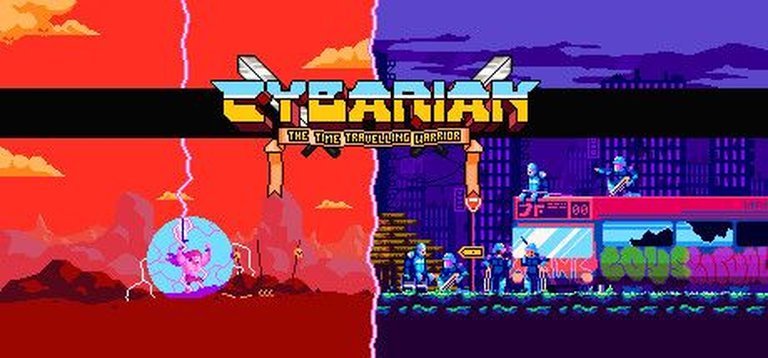
Cybarian: The Time Travelling Warrior is a challenging 2D action-platformer that blends fantasy and sci-fi elements in a side-view, fixed-screen setting. Players take on the role of a Conan-like warrior navigating through time, battling enemies with tough combat mechanics, all while enjoying retro-inspired graphics and a dynamic soundtrack. The game offers a nostalgic yet fresh experience for fans of classic platformers, with a focus on skill-based gameplay and a relatively short but engaging adventure.
Gameplay Videos
Where to Buy Cybarian: The Time Travelling Warrior
PC
Cybarian: The Time Travelling Warrior Reviews & Reception
metacritic.com (80/100): Engaging, tough combat combined with superb retro graphics and a killer soundtrack make for an experience that fans of old school action titles will relish.
gamingtrend.com : Despite its colorful graphics, catchy music, and satisfying challenge, Cybarian: The Time Travelling Warrior too often prizes its retro feel over enjoyable gameplay.
indiegamereviewer.com : Cybarian: The Time Traveling Warrior is a good game inspired by older 2D platformers, and at times it might fool you into thinking it is one.
familygamerreview.com : If you are a fan of 16bit style action/platformers, the Cybarian: The Time Traveling Warrior is a must have game for your digital library.
steambase.io (60/100): Cybarian: The Time Travelling Warrior has earned a Player Score of 60 / 100.
Cybarian: The Time Travelling Warrior Cheats & Codes
PC
Enter codes at the main menu.
| Code | Effect |
|---|---|
| Up, Up, Down, Down, Left, Right, Left, Right | Unlocks rolling (dash) and throwing sword |
Cybarian: The Time Travelling Warrior – A Retro Revival with Mixed Results
Introduction: A Barbarian Out of Time
Cybarian: The Time Travelling Warrior (2018) is a love letter to the golden age of 16-bit action-platformers, blending the brute-force combat of Conan the Barbarian with the neon-drenched aesthetics of cyberpunk dystopias. Developed by Ritual Games and published by Ratalaika Games, this indie title wears its retro influences proudly—perhaps too proudly—on its pixelated sleeve. At its core, Cybarian is a side-scrolling hack-and-slash adventure where a prehistoric warrior, armed with the legendary Sword of Ages, is hurled into a futuristic metropolis teeming with cybernetic enforcers, rogue AI, and towering boss battles.
The game’s premise is as absurd as it is alluring: a muscle-bound savage wielding a magical blade against laser-toting thugs and mechanized horrors. It’s a concept ripe with potential, evoking the pulp fantasy of He-Man meets Blade Runner. Yet, for all its stylistic ambition, Cybarian struggles to transcend its inspirations, often feeling more like a museum exhibit than a living, breathing game. This review dissects Cybarian’s strengths and shortcomings, examining its development, narrative, gameplay, and legacy in the crowded retro-revival landscape.
Development History & Context: A Kickstarter-Fueled Throwback
The Studio and Vision
Ritual Games, a small UK-based indie studio, set out to craft Cybarian as a deliberate homage to the side-scrolling action-platformers of the 1990s. The team’s vision was clear: recreate the punishing difficulty, tight combat, and pixel-art charm of classics like Castlevania, Strider, and Mega Man, while infusing it with a cyberpunk twist. The game was successfully crowdfunded via Kickstarter, with backers drawn to its promise of “no hand-holding” gameplay and a nostalgic aesthetic.
Technological Constraints and Design Choices
Built using GameMaker Studio, Cybarian embraces the limitations of its engine to mimic the technical quirks of 16-bit hardware. The fixed flip-screen perspective, limited animation frames, and chiptune soundtrack are all deliberate choices to evoke the era. However, this adherence to retro design philosophies extends beyond aesthetics into gameplay mechanics—some of which feel archaic rather than intentional.
One of the most polarizing decisions was the absence of a save system. In an era where even the most hardcore retro-inspired games (e.g., Shovel Knight, Blasphemous) offer modern conveniences like checkpoints or save slots, Cybarian forces players to complete its four levels in a single sitting. The game’s cheeky “Winners Don’t Use Saves” splash screen is a nod to the anti-drug PSAs of old arcade games, but it’s a design choice that alienates casual players and even frustrates hardcore fans who can’t dedicate an uninterrupted hour to a playthrough.
The Gaming Landscape at Launch
Released in November 2018, Cybarian entered a market saturated with retro-inspired platformers. Games like Celeste, Dead Cells, and The Messenger had already proven that blending old-school aesthetics with modern design sensibilities could yield critical and commercial success. Cybarian, by contrast, leaned heavily into purism, forgoing contemporary quality-of-life features in favor of an uncompromising “arcade experience.” This approach garnered praise from niche audiences but left many critics and players cold.
Narrative & Thematic Deep Dive: A Sword, a Warrior, and a Cyberpunk Wasteland
Plot: Minimalist to a Fault
Cybarian’s story is delivered in a single, brief cutscene at the start: a barbarian warrior pulls the Sword of Ages from a stone, only to be teleported to a dystopian future where he must fight his way through hordes of cybernetic enemies. There are no further cutscenes, no dialogue, and no lore drops—just raw, unfiltered action. While this minimalism aligns with the game’s arcade roots, it also means the narrative is barely existent.
The lack of context for the warrior’s journey or the world he’s fighting in makes Cybarian feel more like a tech demo than a cohesive experience. The cyberpunk setting is visually striking but thematically underdeveloped. Why is the warrior fighting? What is the significance of the Sword of Ages? Who are the faceless enemies he’s slaughtering? The game offers no answers, leaving players to fill in the blanks with their own headcanon.
Themes: Man vs. Machine, Strength vs. Technology
Despite its thin narrative, Cybarian touches on a few intriguing themes:
– Primordial Strength vs. Futuristic Technology: The warrior’s brute-force combat style contrasts sharply with the high-tech weaponry of his enemies, creating a satisfying David-vs-Goliath dynamic.
– Survival in a Hostile World: The game’s punishing difficulty reinforces the idea that the warrior is out of his element, fighting against overwhelming odds.
– Nostalgia and Purism: The game itself is a meta-commentary on retro gaming, celebrating the uncompromising challenge of older titles while also highlighting their flaws.
However, these themes are implied rather than explored, leaving them as subtext rather than a driving force in the experience.
Gameplay Mechanics & Systems: A Double-Edged Sword
Core Gameplay Loop: Combat and Platforming
Cybarian’s gameplay is a hybrid of side-scrolling platforming and beat ‘em up combat, with a heavy emphasis on the latter. The warrior’s basic moveset includes:
– A three-hit sword combo (precisely timed, with no room for error).
– A dodge roll (unlocked after the first boss).
– A ranged sword throw (unlocked later).
Combat is timing-based and punishing. Enemies deal significant damage, and the warrior’s health bar is minuscule. Mistiming an attack or failing to dodge can quickly lead to a death spiral, where the player is stunned repeatedly until their health is depleted. This design choice is intentional—Cybarian wants players to master its rhythms—but it often crosses the line from challenging to frustrating.
Platforming: Precision and Punishment
Platforming sections are tight and unforgiving, featuring:
– Moving platforms (including treadmill-style conveyor belts).
– Disappearing blocks.
– Fire traps and laser grids.
The controls are responsive but stiff, with a slight delay between inputs and actions. This deliberate sluggishness is meant to evoke the feel of 16-bit platformers, but it can make precision jumps and combat maneuvers feel clunkier than necessary.
Boss Battles: The Game’s Saving Grace
The boss fights are the undisputed highlight of Cybarian. Each boss is a pattern-based challenge requiring memorization and quick reflexes. Standout encounters include:
– A dual-form robot that splits into two smaller enemies.
– A giant mech with devastating area-of-effect attacks.
– A final boss that tests everything the player has learned.
Unlike the regular levels, boss fights allow retries upon death, making them the most fair and rewarding part of the game. Defeating a boss provides a genuine sense of accomplishment, something the rest of the game struggles to deliver.
Progression and Abilities
Cybarian features a linear progression system:
– New abilities (dodge roll, sword throw) are unlocked after boss fights.
– Health upgrades can be purchased from vending machines (using in-game currency dropped by enemies).
However, the game’s short length (roughly 1.5–2 hours for skilled players) means these upgrades don’t have time to meaningfully impact gameplay. By the time players unlock the sword throw, the game is nearly over.
UI and Accessibility
The UI is minimalist, with no map, no health indicators beyond a small bar, and no tutorial. This aligns with the game’s retro aesthetic but makes it less accessible to modern players. The lack of controller remapping or graphical options (beyond toggling scanlines) further limits its appeal.
World-Building, Art & Sound: A Feast for the Senses
Visual Design: Pixel Perfection
Cybarian’s pixel art is a standout feature, with:
– Detailed character sprites that animate smoothly.
– Vibrant, varied environments, from neon-lit cityscapes to industrial wastelands.
– Expressive enemy designs, including cybernetic soldiers, robotic drones, and hulking bosses.
The art style is authentically retro, with a color palette that evokes the Sega Genesis era. The backgrounds are parallax-scrolled, adding depth to the 2D environments.
Sound Design: Chiptune Glory
The soundtrack, composed by Matt Kenyon with additional tracks by Steven Melin, is a pulsing, energetic chiptune score that perfectly complements the action. The music is catchy but not overly memorable, serving its purpose without distracting from the gameplay.
Sound effects are crisp and satisfying, from the clang of steel on steel to the explosions of defeated enemies. The lack of voice acting or ambient dialogue reinforces the game’s arcade roots.
Atmosphere: Cyberpunk Meets Conan
The game’s cyberpunk-meets-fantasy aesthetic is its strongest selling point. The juxtaposition of a barbarian warrior in a futuristic dystopia creates a unique visual identity, even if the world itself is underdeveloped. The neon lights, towering skyscrapers, and robotic adversaries make for a striking backdrop, even if the levels themselves are repetitive and uninspired.
Reception & Legacy: A Niche Classic or a Forgotten Relic?
Critical Reception: Mixed but Respectful
Cybarian received mixed reviews upon release, with critics praising its retro charm and challenging gameplay while criticizing its short length, lack of saves, and clunky controls. Aggregate scores reflect this divide:
– MobyGames: 6.3/10 (based on 14 critic reviews).
– Metacritic: No official Metascore (due to insufficient reviews), but user scores are similarly mixed.
– Steam: “Mixed” (58% positive from 404 reviews).
Positive Reviews Highlighted:
– Nintendo Life (80%): “Engaging, tough combat combined with superb retro graphics and a killer soundtrack.”
– SquareXO (80%): “A refreshing addition… delightfully difficult gameplay.”
– Pure Nintendo (70%): “A neat little game that will present you with a pretty good challenge.”
Negative Reviews Focused On:
– Gaming Age (25%): “A lousy game… reminds people that a lot of the games from 30 years ago were lousy-to-mediocre.”
– Xbox Tavern (45%): “Frustrating design choices… overly frustrating, somewhat boring trek.”
– Gold-Plated Games: “A tiny game with few features… going to beat the shit out of you just to see what little it offers.”
Commercial Performance and Legacy
Cybarian was not a commercial blockbuster, but it found a cult following among retro enthusiasts. Its Kickstarter success and subsequent multi-platform release (PC, PS4, Xbox One, Switch, Vita) ensured it reached a wide audience, even if it didn’t leave a lasting impact.
The game’s legacy is twofold:
1. A Cautionary Tale for Retro Purism: Cybarian demonstrates the risks of prioritizing nostalgia over modern design sensibilities. While its adherence to old-school mechanics is admirable, it also highlights why many of those mechanics were abandoned or refined in later games.
2. A Testament to Indie Passion: Despite its flaws, Cybarian is a labor of love, showcasing what a small team can achieve with a clear vision and limited resources.
Influence on Subsequent Games
Cybarian hasn’t spawned direct imitators, but it contributes to the broader retro-revival movement in indie gaming. Titles like Blasphemous, The Messenger, and Griftlands have similarly blended old-school aesthetics with modern design, though with greater success in balancing challenge and accessibility.
Conclusion: A Flawed but Fascinating Relic
Cybarian: The Time Travelling Warrior is a flawed gem—a game that succeeds in its retro ambitions but fails to evolve beyond them. Its punishing difficulty, lack of saves, and short length make it a hard sell for all but the most devoted retro enthusiasts. Yet, its striking visuals, satisfying boss battles, and unapologetic old-school design give it a unique charm that’s hard to dismiss.
Final Verdict: 6.5/10 – “A Niche Delight for Retro Masochists”
Pros:
✅ Gorgeous pixel art that authentically recreates the 16-bit era.
✅ Challenging, rewarding boss battles that test player skill.
✅ A killer chiptune soundtrack that enhances the cyberpunk atmosphere.
✅ A unique premise (barbarian vs. cyberpunk) that stands out in the crowded platformer genre.
Cons:
❌ No save system, forcing players to complete the game in one sitting.
❌ Clunky, stiff controls that feel deliberately archaic rather than refined.
❌ Extremely short (1.5–2 hours), with little replay value.
❌ Repetitive level design that lacks creativity or variety.
Who Should Play It?
- Retro purists who crave uncompromising, arcade-style challenge.
- Pixel art enthusiasts who appreciate meticulously crafted 16-bit aesthetics.
- Speedrunners and achievement hunters looking for a quick, brutal challenge.
Who Should Avoid It?
- Casual players who prefer modern conveniences like saves and checkpoints.
- Those seeking deep narrative or world-building.
- Players who dislike repetitive, punishing gameplay loops.
Final Thoughts: A Time Capsule, Not a Masterpiece
Cybarian: The Time Travelling Warrior is not a lost classic, but it’s not a complete misfire either. It’s a time capsule—a game that captures the spirit of its inspirations while also exposing their limitations. For those who grew up with the games it emulates, it’s a nostalgic trip worth taking. For everyone else, it’s a curio, a reminder of how far game design has come—and how some relics are best left in the past.
If you’re willing to embrace its flaws, Cybarian offers a brief but intense blast of retro adrenaline. Just don’t expect it to stand the test of time.