
- Release Year: 2003
- Platforms: Macintosh, Windows
- Publisher: Brighter Minds Media, Inc., Learning Company, Inc., The
- Developer: Basis Applied Technology, Inc.
- Genre: Educational, logic, Math
- Perspective: Side view
- Game Mode: Single-player
- Gameplay: logic, Math, Puzzle, Spatial Reasoning
- Setting: Fantasy, Horror
- Average Score: 40/100
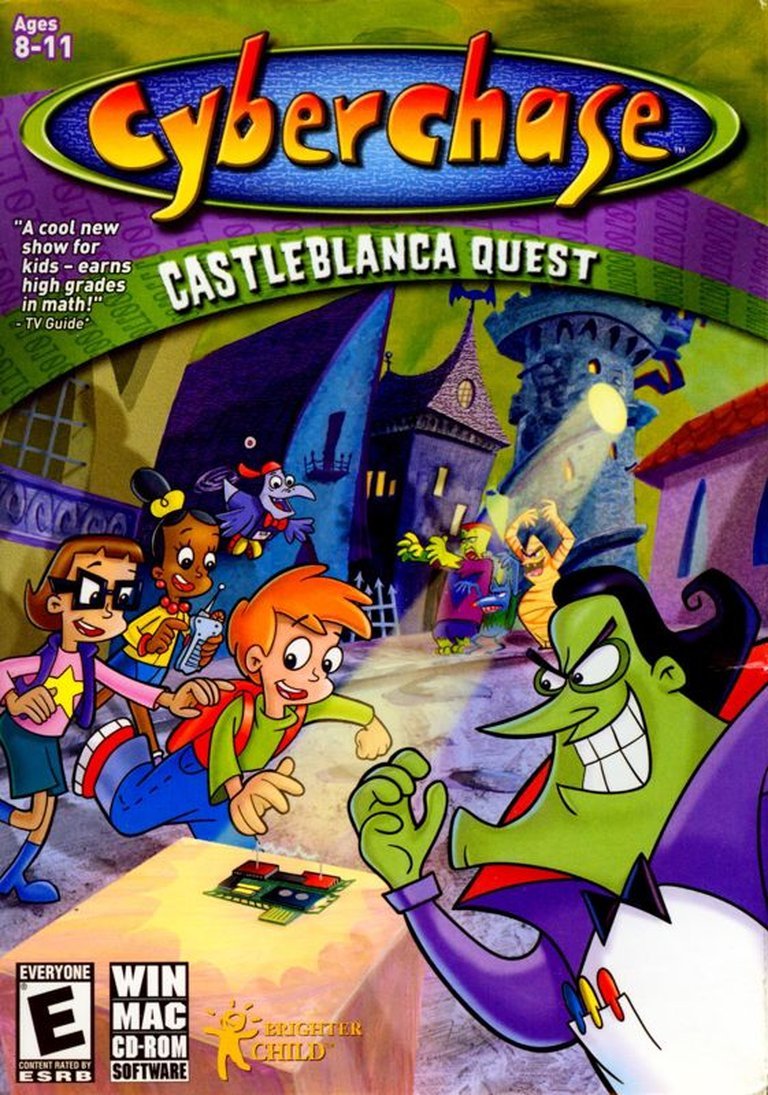
Description
Cyberchase: Castleblanca Quest is an educational game based on the PBS show Cyberchase, designed to teach basic math principles and spatial reasoning. Set in the town of Castleblanca, players help the show’s young stars and their bird companion solve various math-related puzzles and activities to build a solar protection device. The game features a variety of challenges, including balancing scales, packaging goop, and managing water levels, all while interacting with the town’s monstrous inhabitants.
Gameplay Videos
Cyberchase: Castleblanca Quest Free Download
Cyberchase: Castleblanca Quest Reviews & Reception
en.wikipedia.org (40/100): Parents need to know that a hard-to-follow storyline and inadequate directions make this software difficult to play
Cyberchase: Castleblanca Quest: Review
Introduction
In 2003, Cyberchase: Castleblanca Quest landed as an edutainment title aiming to translate PBS’s math-focused TV series Cyberchase into interactive lessons. Developed by Basis Applied Technology and published by The Learning Company, the game sought to teach spatial reasoning and arithmetic through a whimsical, monster-themed adventure. Yet, beneath its colorful exterior lay a product criticized for clunky execution and lackluster guidance—a cautionary tale of educational intent versus technical limitations. This review dissects its legacy as a well-meaning but flawed entry in the era’s edutainment landscape.
Development History & Context
Studio Vision & The Learning Company’s Legacy
Basis Applied Technology, a Canadian studio, partnered with The Learning Company—a titan of 1990s–2000s educational software—to adapt Cyberchase into a game. The series’ focus on problem-solving through math made it ripe for interactivity, but the transition to a CD-ROM adventure was riddled with challenges. The Learning Company’s catalog (Reader Rabbit, Carmen Sandiego) set high expectations, but Castleblanca Quest struggled to balance pedagogy and engagement.
Technological Constraints & Educational Trends
The early 2000s saw edutainment leaning heavily on licensed IPs to attract young audiences. Castleblanca Quest’s CD-ROM format limited its audiovisual fidelity, evident in its grainy cutscenes and rudimentary animations. Developers faced pressure to integrate “tracking features” for parental oversight—a selling point at the time—but this innovation couldn’t compensate for poor onboarding.
Competitive Landscape
The game debuted alongside contemporaries like JumpStart and Math Blaster, but its horror-lite theme (vampires, mummies) aimed to differentiate it. Unfortunately, its release was overshadowed by its sibling title, Cyberchase: Carnival Chaos, which reviewers deemed superior in clarity and execution.
Narrative & Thematic Deep Dive
Plot Synopsis
The game follows Cyberchase’s protagonists—Jackie, Matt, Inez, and their robotic bird Digit—as they visit Castleblanca, a town besieged by relentless sunlight. To save its monstrous inhabitants, players gather components for a “solar protection device” by solving math puzzles. The narrative frames arithmetic as heroic, but its delivery falters: cutscenes are brief and visually murky, diluting the stakes.
Characters & Tone
Voice acting from the show’s cast (e.g., Thom Christopher as Hacker) lends authenticity, but the writing lacks depth. The townsfolk—mummies, goblins, and a coffin-bound Dracula—serve as quest-givers, yet their dialogue is functional rather than engaging. The horror-comedy tone feels disjointed, often prioritizing theme over educational coherence.
Thematic Underpinnings
Castleblanca Quest subtly champions resourcefulness and teamwork, echoing the show’s ethos. However, its thematic potential is undermined by disjointed pacing; players rush from puzzle to puzzle without narrative payoff, reducing the story to a thinly veiled excuse for math drills.
Gameplay Mechanics & Systems
Core Activities
The game features eight minigames, each targeting specific skills:
– Scary Scales: Balance mummies of varying weights to unlock a restaurant.
– Goop Zapper: Resize gelatinous blocks to fit shipping crates using proportions.
– Monster Dive: Apply water displacement principles to float diving monsters.
– Lights Out: Calculate angles and distances to close window blinds via grappling hook.
While conceptually sound, these activities suffer from opaque instructions. Common Sense Media noted players frequently paused to consult online manuals—a fatal flaw in a child-targeted game.
Progression & Difficulty
Three difficulty levels and “adventure/practice” modes offer flexibility, but uneven scaling frustrates. For instance, Haunting Hang Gliders—a timing-based obstacle course—becomes unfairly precise on higher settings, alienating younger players.
UI & Feedback
The interface is cluttered, with minimal visual cues to guide players. Successes trigger lackluster feedback (e.g., static victory screens), while failures lack constructive prompts. The absence of saves mid-puzzle exacerbates frustration.
World-Building, Art & Sound
Visual Direction
Castleblanca Quest’s side-view perspective and gothic backdrops (spooky castles, foggy labs) lean into its monster motif. However, low-resolution textures and choppy animations betray its CD-ROM roots. Cutscenes, though stylized, are pixelated and fleeting, diminishing narrative immersion.
Sound Design
The game reuses sound effects and music from the TV series, providing nostalgic continuity. Voice acting is a highlight, with energetic performances from the cast, but repetitive lines (e.g., Digit’s quips) grate over time. Ambient sounds—creaking doors, bubbling cauldrons—add atmosphere but can’t salvage the shallow world-building.
Reception & Legacy
Launch Reception
Critics panned Castleblanca Quest for its “grainy video” and “inadequate directions” (Common Sense Media). USA Today bluntly advised fans to “skip this one” in favor of Carnival Chaos. Commercial performance was tepid, with the game fading quickly from shelves.
Long-Term Impact
The game’s legacy is one of caution. It exemplifies the pitfalls of licensing-driven edutainment, where rushed development cycles sacrificed clarity for marketability. While its puzzles demonstrated creative math applications, poor execution relegated it to a footnote in The Learning Company’s storied history.
Cultural Footprint
Beyond die-hard Cyberchase fans, Castleblanca Quest left minimal imprint. Its lack of innovation contrasts with enduring titles like Math Blaster, which balanced pedagogy and play more deftly.
Conclusion
Cyberchase: Castleblanca Quest is a well-intentioned misfire. Its monster-themed math puzzles brim with potential, but hamstrung by technical limitations, baffling design choices, and a half-baked narrative. For historians, it offers a case study in edutainment’s early-2000s growing pains; for players, it’s a relic best left to completists. While earnest in its educational goals, the game ultimately underscores a universal truth: even the noblest intentions require execution to match. 2/5.