
- Release Year: 2001
- Platforms: Windows
- Publisher: Beijing Kinghope Software Technology Co., Ltd., Softstar Entertainment Inc.
- Developer: Softstar Entertainment Inc.
- Genre: Gambling, Strategy, Tactics
- Perspective: Diagonal-down
- Game Mode: Co-op, Online Co-op, Single-player
- Gameplay: Board game, Real-time
- Setting: Comedy
Description
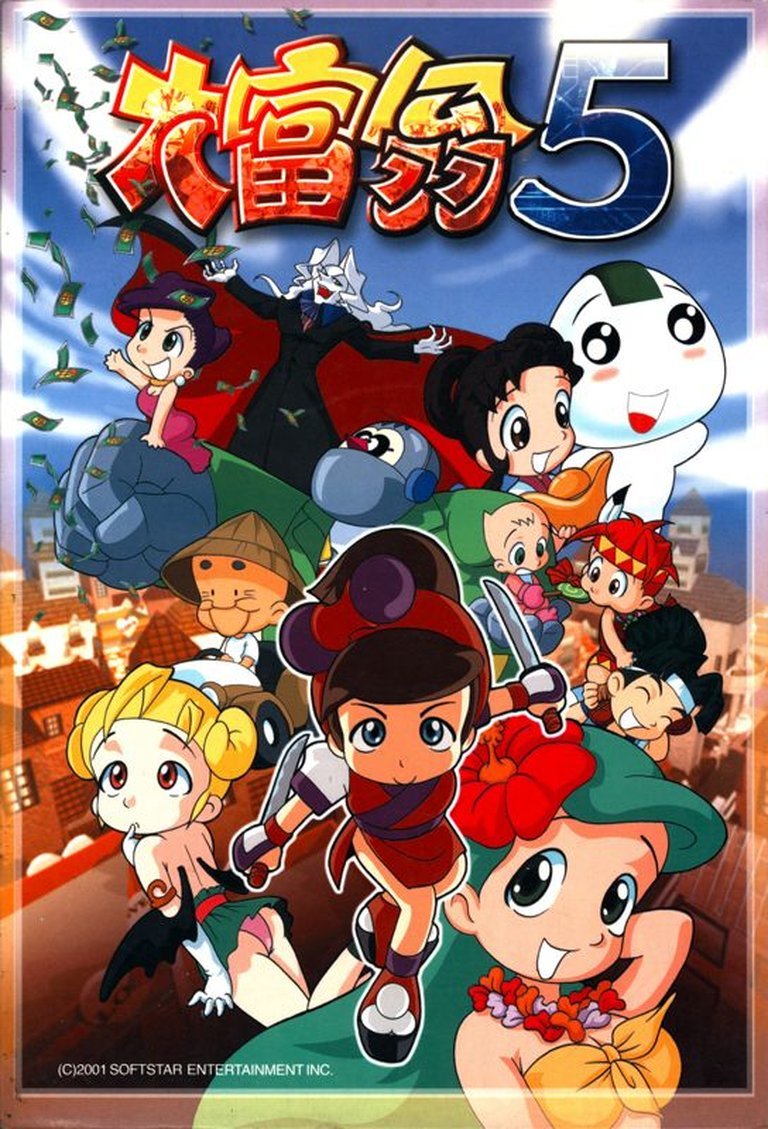
Da Fuweng 5 is a Monopoly-inspired board game from the Richman series, transitioning to real-time gameplay instead of traditional turn-based mechanics. Developed by Softstar Entertainment, it features strategic property trading, gambling elements, and a comedic narrative with anime/manga-style artwork. As the first installment in the series to support online multiplayer, it allows players to compete via LAN or internet, blending fast-paced strategy with accessible, competitive fun.
Da Fuweng 5: Review
Introduction
In the pantheon of digital board games, few franchises carry the cultural weight of Softstar Entertainment’s Richman series, known in Chinese as Da Fuweng. A Taiwanese answer to Monopoly, the series thrived on chaotic capitalism, anime-inspired charm, and a blend of strategy and slapstick. Da Fuweng 5 (2001) represents one of the series’ boldest experiments: a seismic shift from turn-based tradition to real-time mechanics and online multiplayer—a first for the franchise. Yet, this pivot polarized fans and critics alike. This review excavates Da Fuweng 5’s legacy, examining how its high-risk reinvention cemented its status as a fascinating, if flawed, footnote in gaming history.
Development History & Context
Studio Ambitions & Technological Constraints
Developed by Softstar Entertainment, Da Fuweng 5 emerged during a transformative era for PC gaming. By 2001, the rise of broadband internet and LAN parties spurred demand for networked multiplayer experiences. Softstar, riding high on the success of Richman 4: Chao Shi Kong Zhi Lu (2000), sought to modernize the series. However, technical constraints loomed: real-time synchronization in a board game framework was uncharted territory, and Taiwan’s gaming hardware ecosystem lagged behind global standards.
The Gaming Landscape
The early 2000s saw board game adaptations flourish (Catan Online, Monopoly Tycoon), but few dared to abandon turn-based foundations. Da Fuweng 5’s real-time gamble mirrored broader industry trends toward faster-paced, accessible gameplay, yet it risked alienating a fanbase accustomed to methodical strategy. Its June 2001 release positioned it against titans like Diablo II and The Sims, forcing it to carve a niche through innovation—or perish trying.
Narrative & Thematic Deep Dive
Plot & Characters: Cartoon Capitalism
Da Fuweng 5 dispenses with narrative pretension, embracing the series’ trademark comedic tone. Players choose from a roster of absurd archetypes: the rural schemer Ah Tu Bo (阿土伯), the glamorous Qian Furen (钱夫人), and newcomers like the vampiric Count or the cyborg Science Monster. Dialogue is laced with puns and fourth-wall breaks, echoing the satirical excess of Japan’s Momotaro Dentetsu series.
Themes: Luck vs. Strategy
Beneath its cartoon veneer, Da Fuweng 5 critiques capitalist absurdity. The game’s real-time system amplifies tension between random chance (dice rolls, card draws) and tactical skill (property monopolies, stock manipulation). Characters’ unique abilities—Ah Tu Bo’s land discounts, Qian Furen’s rent hikes—reflect socioeconomic stereotypes, parodying wealth inequality through playful mechanics.
Gameplay Mechanics & Systems
Real-Time Revolution
Gone are the patient turns of earlier entries. Da Fuweng 5 adopts a continuous real-time system: players race to deploy Movement Cards (0-9 steps, backward jumps) within a shared timer, creating frenetic scrambles for prime real estate. Vehicles like motorcycles (2 cards/action) and cars (3 cards/action) add momentum, while Special Skills—unlocked via XP—introduce RPG-lite depth (e.g., instant building upgrades or enemy teleports).
Innovations & Flaws
- Online Multiplayer: A landmark addition, supporting LAN and internet play for up to 12 players—a technical feat in 2001.
- Skill System: Character progression incentivizes replayability but risks imbalance (e.g., Science Monster’s area-of-effect attacks).
- UI Clunk: The transition to real-time exposed interface weaknesses. Menus lacked clarity during rapid play, and the abolition of local multiplayer (Richman 4’s signature) alienated couch-competition fans.
Economy & Cards
The stock market—a series staple—operates independently, inflating property values unpredictably. Card play (e.g., “Robot Dancer” to block rivals) remains visceral, but the real-time framework reduces strategic deliberation, favoring reflexive over reflective play.
World-Building, Art & Sound
Visual Identity: Anime-Chic
Da Fuweng 5 leans into manga-inspired aesthetics, with chibi-style characters and vibrantly colored, isometric boards. Maps range from neon-lit Taipei to feudal Japan, each dripping with whimsical detail—think erupting volcanoes beside convenience stores. While primitive by 3D standards (compare RollerCoaster Tycoon), the art direction oozes personality.
Sound Design: MIDI Mayhem
Composer Zhou Hua Jian’s upbeat MIDI tracks—reminiscent of Pocket Monster covers—contrast with slapstick sound effects (explosions, exaggerated groans). Voice clips (“发财啦!”/“I’m rich!”) punctuate actions, though limited variety grows repetitive.
Reception & Legacy
Launch Backlash & Cult Rehabilitation
Upon release, Da Fuweng 5 faced lukewarm reception. Critics praised its ambition but lambasted its learning curve and netcode instability. Taiwanese magazine GAME STAR awarded it “Best Domestic Puzzle Game” (2002), yet sales underperformed Richman 4. Players rejected the real-time pivot, lamenting the loss of turn-based camaraderie.
Long-Term Influence
Despite its flaws, Da Fuweng 5’s DNA permeates later entries:
– Legacy Mechanics: Richman 6 (2002) hybridized real-time/turn-based systems.
– Online Infrastructure: Pioneered LAN/online modes now standard in Richman 10 (2019).
– Cultural Footprint: Bootleg handheld ports (e.g., Feng Kuang Da Fu Weng for GBC) cemented its cult status in East Asia.
Conclusion
Da Fuweng 5 is a bold misfire—an experimental leap that stumbled yet irrevocably shaped its franchise. Its real-time chaos and online ambitions clashed with player expectations, but its mechanical risks paved the way for modern Richman titles. Today, it stands as a testament to Softstar’s willingness to gamble, even when the dice roll against them. For historians, it’s essential; for purists, a curiosity; for innovators, a cautionary triumph.
Final Verdict: ★★★☆☆ (3/5)
A flawed but fascinating relic, Da Fuweng 5 earns its place in the annals of board-game digitization—not as king of the hill, but as the court jester who dared to rewrite the rules.