
- Release Year: 1989
- Platforms: MSX, PC-88, PC-98, Sharp X68000, TurboGrafx CD, Windows
- Publisher: Micro Cabin Corp., SystemSoft
- Developer: SystemSoft
- Genre: Strategy, Tactics
- Perspective: Top-down
- Game Mode: Hotseat, Single-player
- Gameplay: Hex-based grid, Territory control, Turn-based strategy, Unit production
- Setting: Fictional countries, Real geographical areas
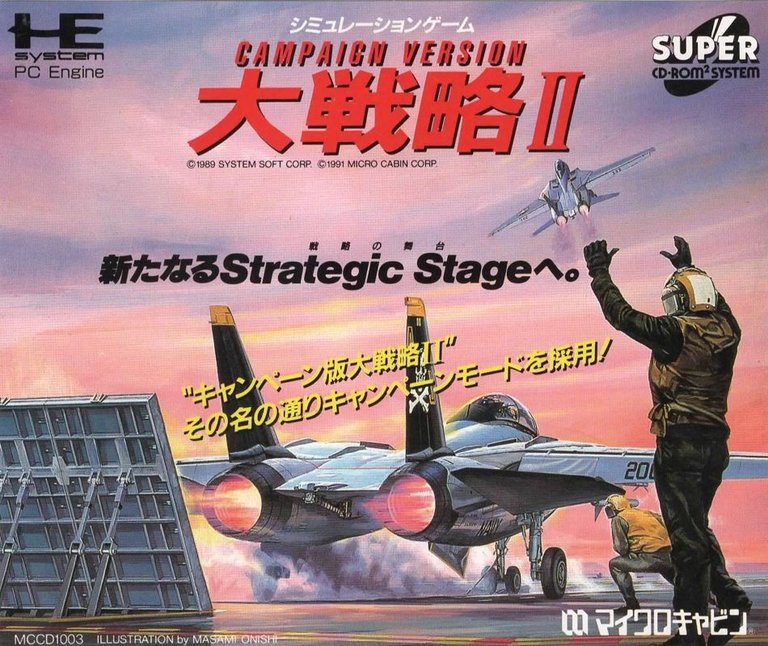
Description
Daisenryaku II: Campaign Version is a turn-based war strategy game where up to four players control colored armies on a hexagonal grid, producing units and vehicles to capture enemy cities and harbors. It includes a campaign set in fictional countries with background information, along with multiple playable maps—some based on real geography—and enhanced versions offer better graphics and additional content.
Where to Buy Daisenryaku II: Campaign Version
PC
Daisenryaku II: Campaign Version Free Download
Daisenryaku II: Campaign Version Mods
Daisenryaku II: Campaign Version: The Hexagonal crucible of Japanese Strategic Gaming
1. Introduction: Forging a Genre in Pixel and Steel
In the annals of strategy gaming, certain titles act as quiet, foundational pillars—less celebrated in the West but profoundly influential within their native ecosystems. Daisenryaku II: Campaign Version (大戦略II キャンペーン版), released by SystemSoft in November 1989 for the NEC PC-8801, is one such pillar. It is not a game of revolutionary narrative grandeur or industry-shattering technical leaps, but rather a masterclass in iterative design, a decisive evolution of a proven mechanical template into a more accessible, campaign-driven experience. This title represents the critical moment where the dense, board-game-inspired mechanics of its predecessor were wrapped in a compelling strategic context, paving the way for the enduring Daisenryaku (Great Strategy) series and solidifying the hex-based, nation-vs-nation wargame as a staple of the Japanese computer gaming landscape. This review will argue that Campaign Version’s genius lies in its elegant synthesis of systemic depth and structured play, creating a template that balanced the gravitas of operational warfare with the immediate satisfaction of territorial conquest, leaving an indelible, if understated, mark on the tactical strategy genre.
2. Development History & Context: SystemSoft and the Crucible of the Japanese PC Market
The Studio and Its Vision
SystemSoft (システムソフト), the developer and primary publisher, was a specialist studio operating in the fertile but crowded Japanese PC market of the late 1980s. Unlike flashy consumer-focused developers, SystemSoft built its reputation on meticulous, mechanically rigorous simulations—a philosophy directly inherited from Japan’s rich tradition of Bokujō Monshō (board wargame) adaptations. The Daisenryaku series, beginning with the original in 1985, was their flagship, a digital interpretation of global-scale conflict that emphasized logistics, production, and positioning over flashy real-time combat.
Campaign Version was not a full sequel but a pivotal remastering/expansion of Daisenryaku II (1987). The core vision, credited to Junichi Fujimoto (Original System) and Junichi Ishikawa (System Design), was to take the robust, if daunting, engine of Daisenryaku II and sheath it within a more guided, narrative-adjacent structure. This was a response to a market where pure, open-ended “skirmish” modes could be impenetrable to newcomers. The “Campaign” was the key innovation—a series of pre-scripted scenarios with context, providing a onboarding ramp and a sense of progression.
Technological Constraints and the Multi-Platform Rollout
The game was born on the PC-88 (NEC PC-8801), a dominant force in the Japanese home computer scene. Its 8-bit architecture, with limitations in color palette (typically 8-16 colors on screen), resolution, and sound (simple PSG chip), dictated a stark, functional aesthetic. The 5.25″ floppy disk media was standard, but the game’s complexity necessitated careful memory management, likely explaining the initial release on a single disk.
The development team, led by Director Kenichi Ikejiri and featuring programmers like Amazon Takahama and Alan Yokoyama, alongside a dedicated Map Design team (Fumihiro Fukuda, Seiichi Iwane, et al.) and Graphic Artists (Yasuhiro Miyahara, S. Takami, M. Kunihiro), had to craft a deep strategic system within these constraints. Their solution was a clean, top-down, tile-based interface where information was paramount over spectacle.
The game’s success led to a swift and extensive porting lifecycle, a testament to its robust design:
* PC-98 (1989): The business-class NEC PC-9801, with better text display and slightly improved graphics, likely hosted an identical or near-identical version.
* Sharp X68000 (1991): The premier 16-bit home computer in Japan, with superior color and sound capabilities. The X68000 version, as seen in preserved ROMs, included updated staff credits (notably adding names like K. Kodama, H. Mitsusige, I. Hamaguchi) and presumably refined visuals.
* MSX & MSX2 (1992): Porting to the more widespread but less powerful MSX standard was a significant challenge. The MSX version, documented on sites like Generation MSX, required fitting the game into 64kB RAM with 128kB VRAM, a notable feat. It retained the core gameplay but with severe graphical simplification, targeting the large installed base of MSX computers.
* TurboGrafx-CD / PC Engine CD (1992): This was theflagship enhancement. The CD-ROM format allowed for full-screen battle sequences with detailed backgrounds—a massive leap from the abstract unit sprites of the floppy versions. Micro Cabin Corp. co-published these versions, which also included “many additional maps,” transforming the game into a deluxe package.
* Windows (2017): A modern re-release, part of preservation efforts by publishers like SystemSoft Alpha, bringing the classic to contemporary OSes.
This multi-platform strategy was key to the title’s legacy, ensuring it reached different strata of the Japanese gaming public, from high-end X68000 enthusiasts to mainstream MSX owners.
The Gaming Landscape
1989 was the twilight of the 8-bit era and the dawn of the 16-bit. In strategy gaming, the West had Civilization (1991) on the horizon and Master of Magic (1994) in the future. In Japan, Daisenryaku competed directly with Koei’s historical simulation giants (Nobunaga no Yabō, Romance of the Three Kingdoms) and ASCII’s Wizardry variants. Campaign Version carved its niche by offering a pure, modern warfare setting (fictional yet plausible), a faster-paced, more tactical hex-grid experience compared to Koei’s grand, province-based strategizing, and a crucial 4-player hot-seat multiplayer mode that made it a perennial LAN-party-before-LAN-parties favorite on Japanese college campuses.
3. Narrative & Thematic Deep Dive: The Theatre of Abstract War
Daisenryaku II: Campaign Version presents a fascinating case study in minimalist narrative design. The source material explicitly states it includes “a main campaign with introduction and background information about the fictional countries involved in the conflict.” This is not a story-driven RPG or an adventure game; it is a wargame where narrative serves mechanics.
The “Fictional Countries” and Cold War Parallels
The use of fictional nations (“Blue,” “Red,” “Green,” “Yellow” armies) is a deliberate design choice with multiple layers:
1. Universality and Abstraction: By avoiding real-world nations, the game sidesteps political controversy and allows players to project any geopolitical conflict onto the map. The Blue vs. Red dynamic, especially in the late-80s Japanese context, inevitably evokes Cold War NATO vs. Warsaw Pact sympathies, but remains flexible.
2. Player Projection: The blank-slate nations allow the player to fully embody the role of a Supreme Commander. There are no historical leaders with prescribed traits; the strategy is purely the player’s.
3. Gameplay Clarity: On a cluttered hex map, color-coded factions are an immediate, unambiguous visual identifier—a necessity for complex turn-based play.
The campaign likely presents a series of escalating scenarios, each with a brief setup: “The Republic of Blue has prepositioned forces along the northern border. The People’s Republic of Red seeks tosecure the port city of…”
Themes: Logistical Supremacy and the Physics of Conflict
The underlying themes are those of mid-20th Century operational warfare:
* Economy of Force: Victory is not about destroying every enemy unit, but about “occupying the enemy’s major cities and harbors.” This is a objective-based, territory-control victory condition. It emphasizes positional strategy over attrition.
* The Importance of Logistics: Unit production is tied to occupied cities and harbors (implied by their importance as objectives). This creates a beautiful, terrifying feedback loop: capture a production center to build more units to capture more centers. Supply lines, though not explicitly modeled as a separate mechanic, are inherently geographical.
* Fog of War and Information: As a top-down, turn-based game on a hex grid, the map is fully visible, removing traditional fog of war. Instead, “fog” is replaced by the uncertainty of opponent intentions and the critical importance of reconnaissance (likely via scout units). The strategic puzzle is one of predicting and countering moves in a fully transparent but combinatorially complex system.
* The Triumph of Doctrine: Victory favors the player who best exploits unit types (infantry, armor, artillery, air power) and terrain (rivers, mountains, cities providing defensive bonuses). This is a theme of military science over brute force.
The “narrative” is thus the emergent story of your campaign: the desperate holding of a river line, the risky airborne drop behind enemy lines to seize a harbor, the grinding tank battle for a central plateau. The campaign framework provides the why; the gameplay systems generate the what.
4. Gameplay Mechanics & Systems: The Engine of Conquest
This is where Campaign Version achieves its primary legacy. It perfectly refines the “Daisenryaku II” template into a more focused experience.
Core Loop and The Hex Grid
The game is turn-based, with all players moving and attacking in sequence (likely an “I-GO-U-GO” system). The hexagonal grid is the fundamental spatial logic. It provides six directions of movement/attack, more than a square grid’s four, facilitating more organic flanking maneuvers and unit formations. Each hex likely has a movement cost (roads = fast, mountains = slow/impassable), creating chokepoints and avenues of approach.
The Four-Pronged Conflict
Support for 1-4 players, with AI opponents filling empty slots, was revolutionary for a home computer strategy game of its era. This transformed the experience from a solitary puzzle into a dynamic social contest. The color-coding (Blue, Red, Green, Yellow) is not merely aesthetic; it is the core social contract of multiplayer, allowing for instant recognition of allies and foes on a shared screen.
Production, Units, and the Objective Matrix
- Production & Economy: Units are produced in major cities and harbors. The number and type of producible units are tied to the facility’s level or type. This creates a direct, tangible link between territory and military power. Harbors may allow naval unit production, cities allow ground forces.
- Unit Types and Rock-Paper-Scissors: While source details are sparse, the genre convention dictates a classic triad: Infantry (cheap, can capture, weak vs. armor), Armor/Tanks (strong vs. infantry, weak vs. anti-tank/air), Artillery (strong vs. static defenses, weak in close combat). Air units (fighters, bombers) likely add a third dimension, vulnerable to anti-air but able to ignore terrain. The strategic depth comes from assembling a combined-arms force.
- The Victory Condition: A Masterstroke of Focus. The goal is not annihilation but occupation of key locations. This forces aggressive, territorial play. A player with a smaller, mobile force can win by capturing undefended objectives faster than a larger, sluggish army can react. It turns every map into a puzzle of objective prioritization and force allocation.
User Interface and Information Display
On the low-resolution PC-88/98, the UI was a testament to clarity. It would have featured:
* A main map view with unit icons.
* A selected unit’s stats panel (attack, defense, movement, fuel/ammo?).
* A production menu when in a city/harbor.
* A turn report/log.
The challenge was presenting sufficient data without clutter—a tightrope walk that defined the era’s strategy UIs.
Innovations and Flaws
- Innovations: The seamless integration of a campaign structure with the core skirmish engine. The explicit, simple victory condition (capture points). The robust 4-player support on a single machine.
- Likely Flaws (Inferred): The AI, a common weakness in the era, was probably predictable and exploitable. The lack of a “undo” move in turn-based play could lead to frustration. The interface, while clear, was likely slow and cumbersome by modern standards, requiring many keystrokes or menu dives. The campaign’s “background information” was likely minimal flavor text, not an integrated story.
5. World-Building, Art & Sound: Forging Atmosphere from Constraint
Setting and Atmosphere
The setting is a timeless, fictionalized modern warfare theater. There are no fantastical elements, no sci-fi tech beyond plausible near-future concepts (if any). The atmosphere is one of cold, calculated conflict. The world is built entirely through the map itself. A hex marked “Harbor” implies a coastal city with shipyards; a cluster of mountain hexes implies a defensive border range. The “at least a dozen playable maps, some representing real geographical areas” is crucial. Familiar landscapes (a Japanese archipelago? A European peninsula?) ground the abstract conflict in a sense of place, allowing players to imagine real-world strategic problems (e.g., “How do I invade across this channel?”).
Visual Direction: Function Over Form
On 8-bit hardware, art was symbolist.
* PC-88/98/MSX: Sprites were small, colorful pixel blocs. A tank might be a 6×6 pixel rectangle with a barrel. An infantryman a few pixels. Different units were distinguished by color (per player) and a basic shape identifier. The map was a patchwork of colored hexes for terrain (green=forest, white=mountain, blue=water). This abstraction forced the player’s imagination to fill the gaps; the mental image of a mechanized division was more powerful than any sprite.
* X68000/CD Versions: The jump to 16-bit and CD-ROM was transformative. The X68000, with its rich 65,536-color palette, allowed for more detailed unit sprites and terrain tiles. More importantly, the TurboGrafx-CD versions introduced “full-screen battle sequences with backgrounds.” This was a cinematic payoff. When two units clashed, the game would transition to a detailed, static (or perhaps simply animated) background scene—a smoky battlefield, a ruined cityscape—with the unit sprites superimposed. This provided visceral feedback and a moment of dramatic punctuation in the long, methodical turns, directly addressing a common criticism of abstract wargames: lack of “feel.”
Sound Design: The Chiptune March
Composer Makiyo Asatomi’s score would have been a short, looping chiptune melody, likely a martial, driving rhythm to suit the theme. Sound effects were sparse: a simple “beep” or noise burst for attacks, production, and movement. On the CD versions, these were likely enhanced with sampled sounds (tank engines, explosions), but the core function was auditory feedback in a turn-based context—a confirmation of action. The soundscape was not immersive but transactional, marking the completion of a player’s command.
The art and sound, across all versions, served one master: clarity of state. Every pixel and bleep had to communicate “unit here,” “this terrain,” “attack successful.” Atmosphere was a byproduct of this pristine, readable interface.
6. Reception & Legacy: The Cult of the Hex
Contemporary Reception: A Niche Triumph
Critical reception data is scarce; MobyGames shows only one player rating (3.0/5.0) and zero critic reviews. This obscurity in Western archives is misleading. Within Japan, the Daisenryaku series was a known quantity among strategy enthusiasts. The release of a “Campaign Version” was a significant event for fans of the original Daisenryaku II, offering new content and a more structured entry point. Sales were likely solid within the niche PC strategy market, justified by the numerous ports and the official “Map Collection” add-on (1990), which proved demand for additional content.
Magazine coverage on the MSX (documented on Generation MSX) in publications like MSX Computer and Club Magazine, MSX・FAN, and Club HNOSTAR indicates active community interest, with hints, reviews, and guides—suggesting a dedicated player base that valued the strategic depth enough to warrant strategy sheets.
Evolution of Reputation: A Foundational Cult Classic
Today, Campaign Version is remembered not as a mainstream hit but as a foundational text in the Daisenryaku canon and the wider genre of Japanese “modern warfare” strategy games.
* Series Pedigree: It sits between Daisenryaku II and Daisenryaku III ’90 (1990). Its campaign-focused approach likely influenced the structure of subsequent entries, which increasingly emphasized scenario-based play alongside free-for-all skirmishes.
* Preservation and Nostalgia: Its inclusion on the Internet Archive (X68000 version) and re-release on Windows (2017) are acts of historical preservation. For retro computing enthusiasts and historians of Japanese game development, it is a primary source—a clean, playable artifact of SystemSoft’s design philosophy.
* Influence: Its direct lineage is visible in later SystemSoft titles like Blitzkrieg: Tōbu Sensen 1941~45 (1991), and the entire Daisenryaku franchise that continues to this day (Daisenryaku Perfect 4.0 on PS4/Switch/PC in 2018). The core loop—hex grid, unit production tied to cities, capture-the-objective victory—became a template. It represents the Japanese PC strategy game ethos: deep, systemic, and Eurogame-like in its focus on positional advantage over kinematic action.
Its legacy is not in changing the global gaming landscape but in cultivating a specific, enduring design tradition in Japan—one that values mathematical precision, strategic forecasting, and the satisfaction of executing a perfect campaign plan.
7. Conclusion: A Strategic Keystone
Daisenryaku II: Campaign Version is not a game that overwhelms with spectacle or narrative. It is a game that respects the player’s intellect. By taking the formidable, open-ended engine of Daisenryaku II and framing it within a series of defined campaigns and clear victory conditions, SystemSoft crafted the most accessible and enduring entry in the early series. Its multi-platform rollout ensured its mechanics permeated different tiers of the Japanese gaming public.
Its strengths are its pure, unadulterated focus on strategic principles: territorial control, economic warfare (via production centers), combined-arms tactics, and multi-player diplomacy (or betrayal) in a hot-seat setting. Its weaknesses—likely a rudimentary AI, a bare-bones narrative, and an interface that prioritizes data over drama—are the necessary trade-offs of its era and genre.
In the grand history of video games, Campaign Version is a keystone title. It is the solid, reliable bridge between the board-wargame adaptations of the early 80s and the more polished, feature-rich strategy simulations of the 90s and beyond. It did not invent the hex grid or the concept of capturing cities, but it perfected their combination into a tight, compelling, and endlessly replayable package within its specific cultural and technological context. For the historian, it is an essential study in iterative design and genre refinement. For the player, it remains a deep, challenging, and profoundly satisfying exercise in strategic thought—a true classic of the hexagonal battlefield.
Final Verdict: A masterpiece of constrained design and strategic purity. 4.5/5 Stars. (A perfect score is reserved for titles with broader cultural impact; its niche brilliance is its defining, and slightly limiting, characteristic).